The U.S. Securities and Exchange Commission (SEC) estimates that 5,976 companies would be affected by a proposal to replace three quarterly reports with one interim report. The first- and third-quarter reports may become optional.
Executive Summary
258,655
Public comments on the SEC’s portal on October 6, 2026.Of the 1,000 comments in our random sample, 979 opposed the option
23 of 26
Companies, company associations and exchanges in our random sample supported less frequent reporting. Three took no side and none opposed
33 of 40
Investors, investor associations and advocates in our random sample opposed the option. Three took no side and four supported less frequent reporting.
236 of 250
Web commenters for finance, accounting, audit and tax roles in our random sample opposed the option. Five supported it and nine took no sides
Our analysis follows the quarterly report through its life: how it got here, what the SEC proposed, what the SEC has now heard, and what a finance leader should do before the answer arrives.
First, how did the quarter get here, and what did it deliver?
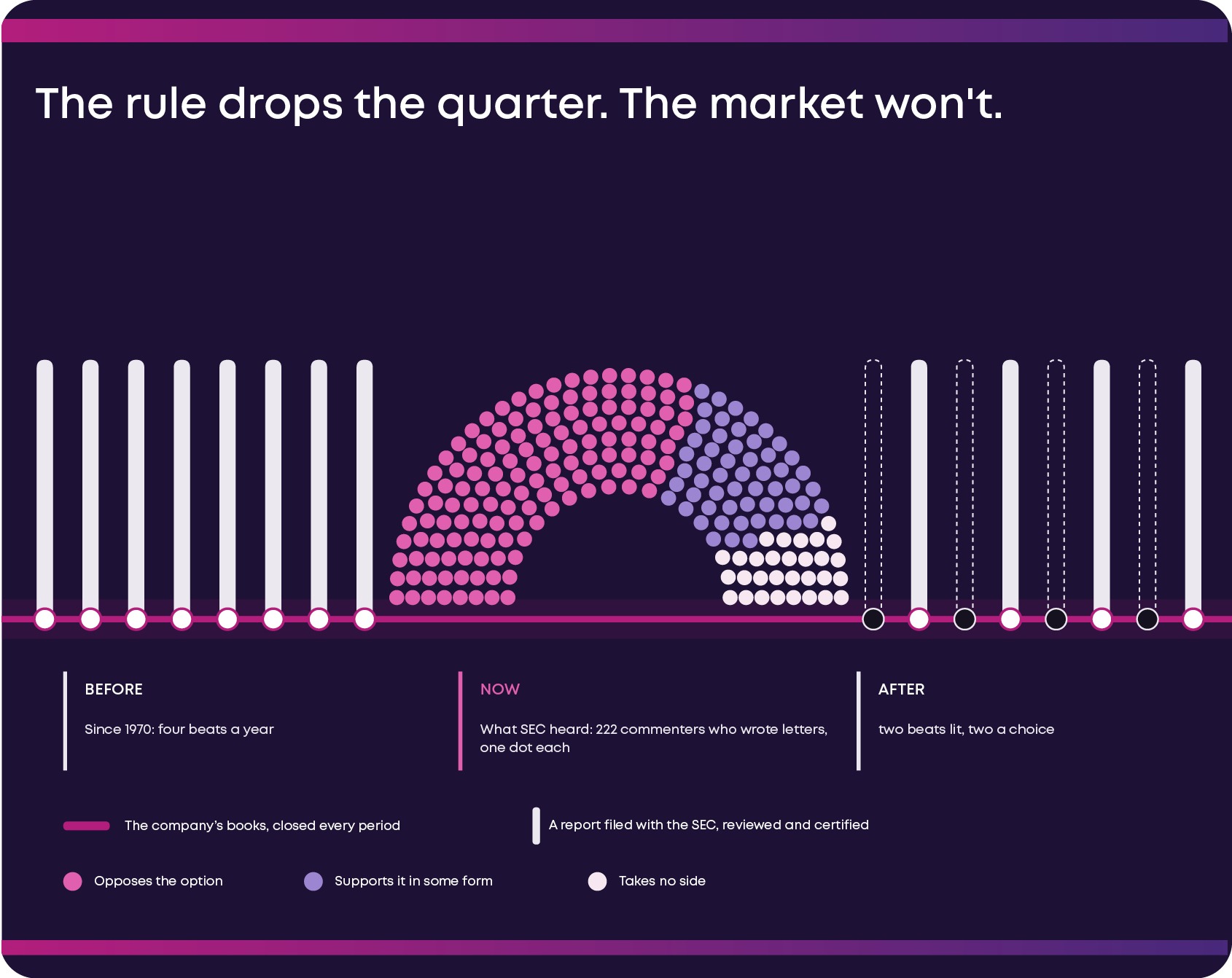
The market asked for it before the SEC did: 90% of active domestic New York Stock Exchange companies published quarterly results by the mid-1950s, and the SEC required the Form 10-Q in 1970. The frame around it came later, with the auditor’s review in 2000 and the CEO and CFO certifications in 2002. The SEC says the effects of reporting frequency on real corporate decisions are “mixed”.
(Refer Section 1: How the Quarter Got Here)
Q2
Second, what did the SEC propose?
In May 2026 the SEC proposed, any company that files Form 10-Q choose a single half-year report, new Form 10-S, in its place. The choice would be made each year by checking a box on the cover of Form 10-K. By our count of the SEC’s comment portal, 258,655 public comments on the proposal had been posted by October 6, 2026.
(Refer Sections 2: What the SEC Proposed)
Q3
Third, what did the SEC hear?
From the 1000 comments we sampled at random from ‘those submitted through the SEC’s online form’, 979 comments opposed the option.
From the 222 commenters who filed letters to SEC, a split by seat: 23 of 26 companies, company associations and exchanges supported less frequent reporting, 33 of 40 investors, investor associations and advocates opposed the option, and 9 of 10 audit firms took no side.
A large majority of commenters asked the SEC to slim or re-examine the Form 10-Q instead on top of making it optional.
(Refer Sections 3: What the SEC Heard)
Q4
Fourth, would companies elect it?
The SEC assumes that 20% would. Per our analysis, the answer depends on who is asked: 58% of those answering a preliminary survey conducted by committee on corporate reporting would most likely elect, against 8% of investor relations officers. Of 100 governance professionals surveyed, by society for corporate governance, none would move disclosure controls to a half-yearly cycle and 2% would likely stop quarterly updates.
(Refer Section 4: What an Election Does Not Change)
Q5
Fifth, what other markets do?
The EU, the UK and Japan already require only a half-year report however certain exceptions exist for quarterly reporting. India, Middle East and South Korea still require reviewed quarterly results.
(Refer Sections 5: What Other Markets Do)
Q6
Sixth, what should a leader do before the final rule?
Read the debt documents, map the offering calendar, and ask the auditor what a year with one interim review costs. Then decide what will stand behind first and third quarter numbers if no Form 10-Q is filed. Section 6 sets out eight decisions for the investors, analysts and board.
(Refer Section 6: What To Do Before the Final Rule)
Uniqus Point of View: when the quarter is reported but not reviewed
The publication considers whether investors should lose two reports a year. A finance leader faces a different question, because for most companies the quarter will not go away: lenders, underwriters, analysts, and the board will still ask for it.
What an election removes is the requirement for the frame around the first and third quarters: the auditor’s review, the CEO and CFO certifications, the interim financial statements with their notes and the tagged data. We expect most electing companies to publish the quarterly number anyway, in an earnings release furnished under Item 2.02 of Form 8-K; the proposal neither requires that release nor bars a voluntary review. In Japan the review of first and third quarter results became optional in 2024, and 324 of the 1,481 large companies that reported a first quarter to June 30 of that year underwent voluntary reviews.
We would treat the election as a decision for the board.
1
How the Quarter Got Here

The market asked for it first. The SEC mandated the Form 10-Q in 1970. The assurance around it arrived between 2000 and 2002.
Quarterly reporting in the United States began as an exchange practice. By the mid-1950s, 90% of its active domestic companies published quarterly earnings.
The SEC came later, and in steps. It required a quarterly sales report from 1946 to 1953 and a half-year report on Form 9-K for 1955. It replaced that with the quarterly Form 10-Q in 1970, and has not changed the cadence since.
Exhibit 1 — The quarter in U.S. reporting, 1946 to 2026
Requirement added
1946
The SEC requires a quarterly report of sales. It ends the requirement in 1953.
Requirement added
1955
The SEC requires a half-year report of sales and income, Form 9-K.
Requirement added
1970
The SEC requires Form 10-Q in place of Form 9-K: summarized figures, three times a year.
Requirement added
2000
The auditor must review interim statements before they are filed.
Requirement added
2002
The CEO and CFO certify every quarterly report.
Requirement added
2003
Earnings releases must be furnished to the SEC on Form 8-K.
Requirement questioned
2018
The SEC asks whether quarterly reports should change. A roundtable follows; no rule does.
Requirement questioned
2026
Proposal: one Form 10-S may replace three Forms 10-Q.
Time line not to scale
Req Source: SEC Release 33-11414 (May 5, 2026), 64 FR 73389 (1999), 67 FR 57276 (2002) and 68 FR 4820 (2003); SEC Release 33-10588 (2018)
The first Form 10-Q carried summarized figures and required no auditor’s review. What separates a quarter-end number in a Form 10-Q from the same number in a press release was added a generation later: the auditor’s review before filing, from 2000, and the CEO and CFO certifications, from 2002. The SEC last tested the question in 2018 and 2019, when it sought comment on quarterly reports, held a roundtable, and took no action.
1.1 What the quarter delivered
The SEC release 33-11414 states that “There is some evidence that decreasing reporting frequency could reduce short-termism. Overall, however, the effects of reporting frequency on real corporate decisions are mixed.”
- More frequent reports narrowed the information gap. A study of US companies from 1951 to 1973 found that higher reporting frequency reduced information asymmetry and the cost of equity*.
- Increased reporting frequency followed a decline in investment. A study from 1950 to 1970 found that a move toward more frequent reporting was followed by a large decline in investment, which its authors attributed to short-term pressure*.
- In Britain’s first year, few stopped. The United Kingdom stopped requiring interim management statements in November 2014, and the SEC’s 2018 release put the number of companies still reporting quarterly in 2015 at 471 out of 516 companies studied. The study found no significant change in investment among the 45 that stopped and a larger fall in their analyst coverage; it does not show the longer-term effect. (FCA Policy Statement PS14/15; SEC Release 33-10588).
*When considering the evidence from these studies, we consider that there are limitations to inferences that can be drawn from such historical U.S. studies due to dramatic changes in institutional investor participation, technology, market structure, and market competition that have occurred since then—together, composing a potentially different information environment for reporting companies today.
The release 33-11414 notes that where an earnings release comes first, quarterly filings “may not provide markets with novel information”.
Investors see the earnings release and quarterly filings as complements: in the CFA Institute’s January 2026 survey, which drew “more than 2,500 responses”, 74% did not want to give up the Form 10-Q filing requirement even if quarterly reporting became voluntary.
2
What the SEC Proposed
What the SEC Proposed 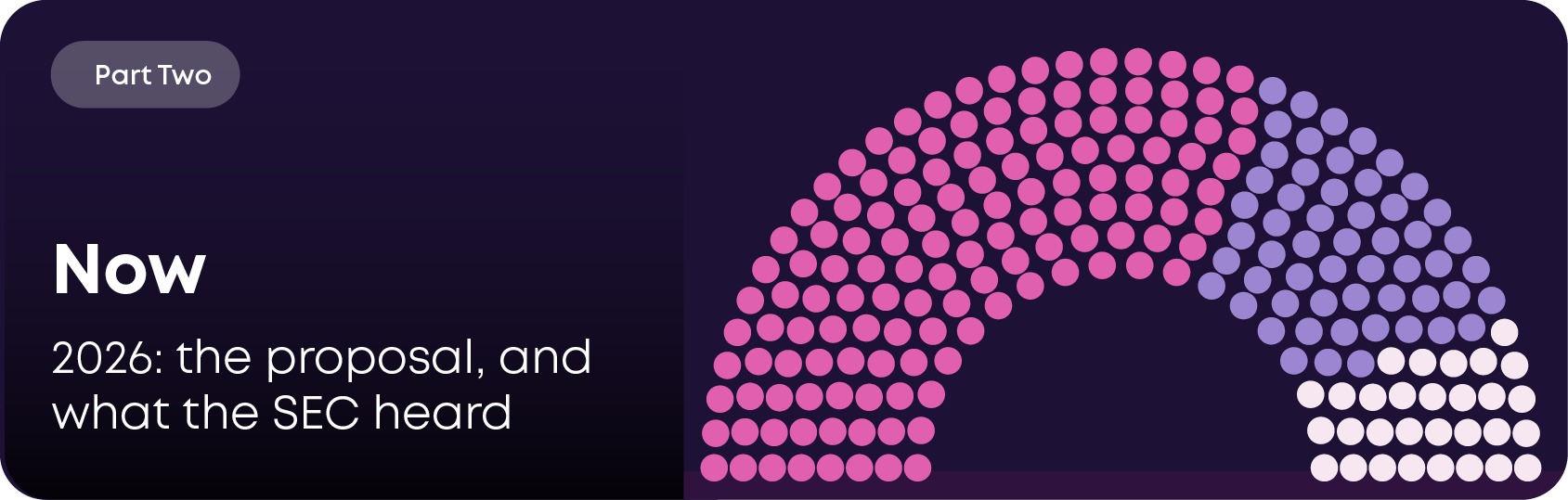
An annual choice on the cover of Form 10-K: one interim report in place of three.
Release 33-11414 would let every company that files Form 10-Q elect semiannual reporting. The SEC estimates there are 5,976 such companies, of which 2,933 are smaller reporting companies would be eligible for semiannual reporting. Foreign private issuers that report on Form 20-F or 40-F, asset-backed issuers and most registered investment companies are outside it.
Exhibit 2 — One reporting year, two calendars
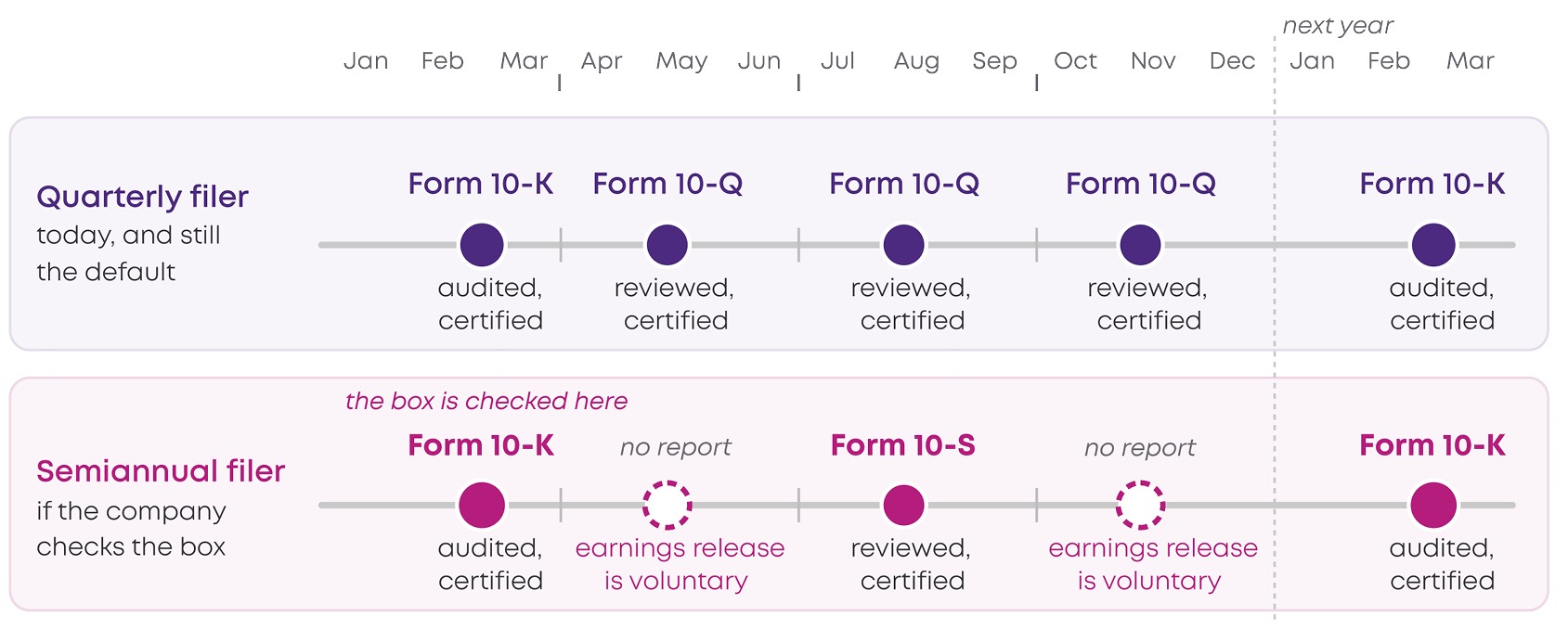
Calendar-year large accelerated filer. Form 10-Q and Form 10-S are due 40 days after the period ends; Form 10-K, 60 days.
Source: SEC Release 33-11414; Form 10-K, General Instruction A.
| Element | Today | Proposed, for a company that elects |
|---|---|---|
| The election | None. Quarterly reporting is mandatory. | A check box on the Form 10-K cover, made each year and binding for that fiscal year. No advance notice |
| Interim reports | Three Forms 10-Q, each due 40 or 45 days after the quarter | One Form 10-S for the first six months, with the same content and the same deadline |
| First and third quarters | A Form 10-Q for each | No report. No quarterly figures required anywhere, including in Form 10-K |
| Review, certifications, tagged data | Auditor’s review three times a year; certifications and tagged data four times | Review once; certifications and tagged data twice. |
| Earnings releases, Form 8-K, Regulation FD | Releases are voluntary and furnished on Form 8-K | Unchanged |
Source: SEC Release 33-11414.
3
What the SEC Heard
Nearly all form comments opposed the option. The formal letters split by seat: companies in favor, investors against, and auditors taking no side.
On October 6, 2026, the SEC released 206,090 public comments and listed a further 52,565 form letters under 15 comment templates. From the 1000 comments we sampled at random from ‘those submitted through the SEC’s online form’, 979 comments opposed the option.
Exhibit 3 — A file of 258,655 public comments, and when they arrived
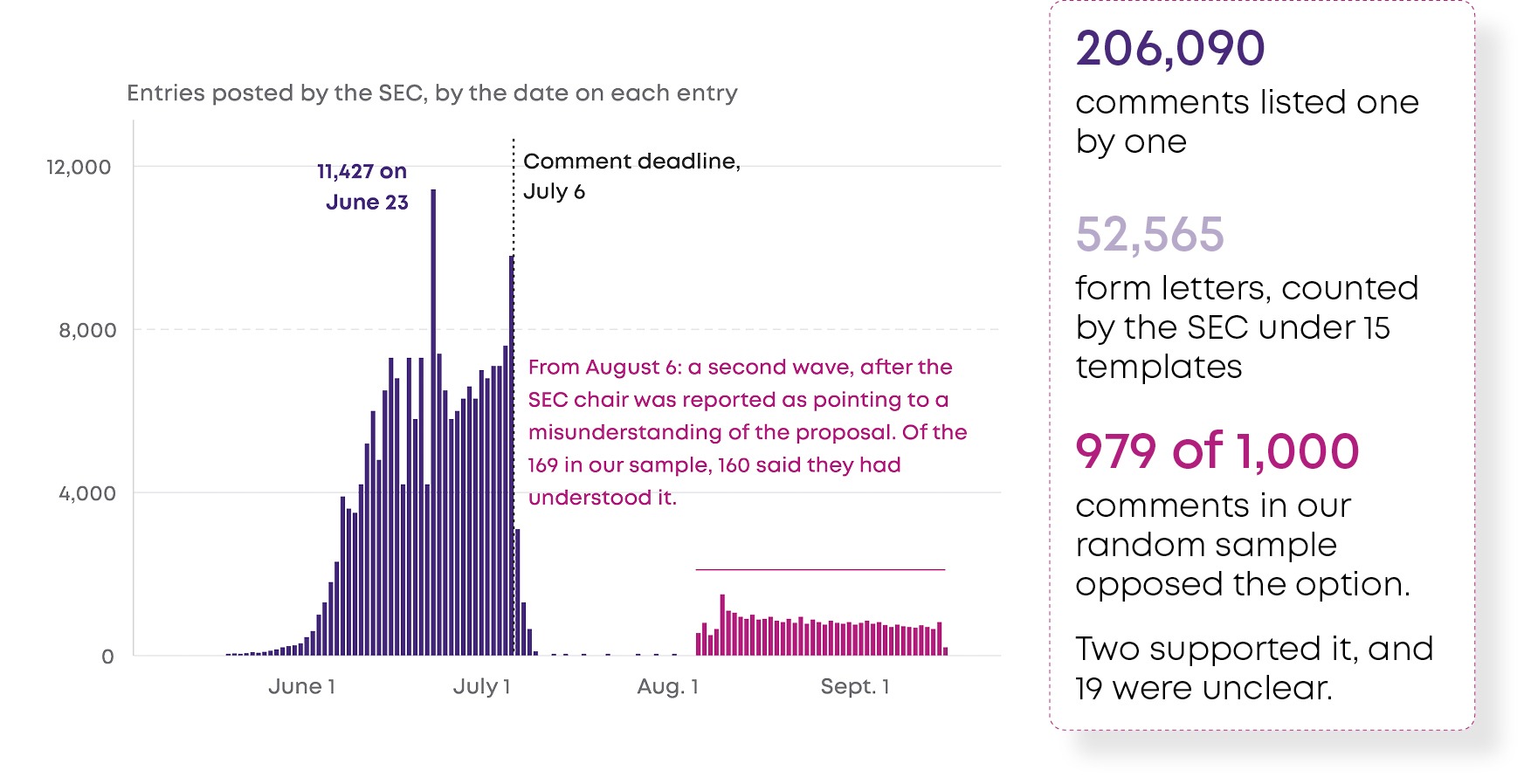
Source: SEC comment file S7-2026-15 as posted on October 6, 2026; SEC form-letter counts for Letter Types A to O as posted the same day
3.1 The letters, by seat
The Exhibit below represents the 222 sample commenters who filed letters to the SEC. These letters are where the argument is. Out of the 222 commenters, 60 supported the option in some form, 134 opposed it, and 28 took no side.
Exhibit 4 — Where commenters stood on the option to report semiannually
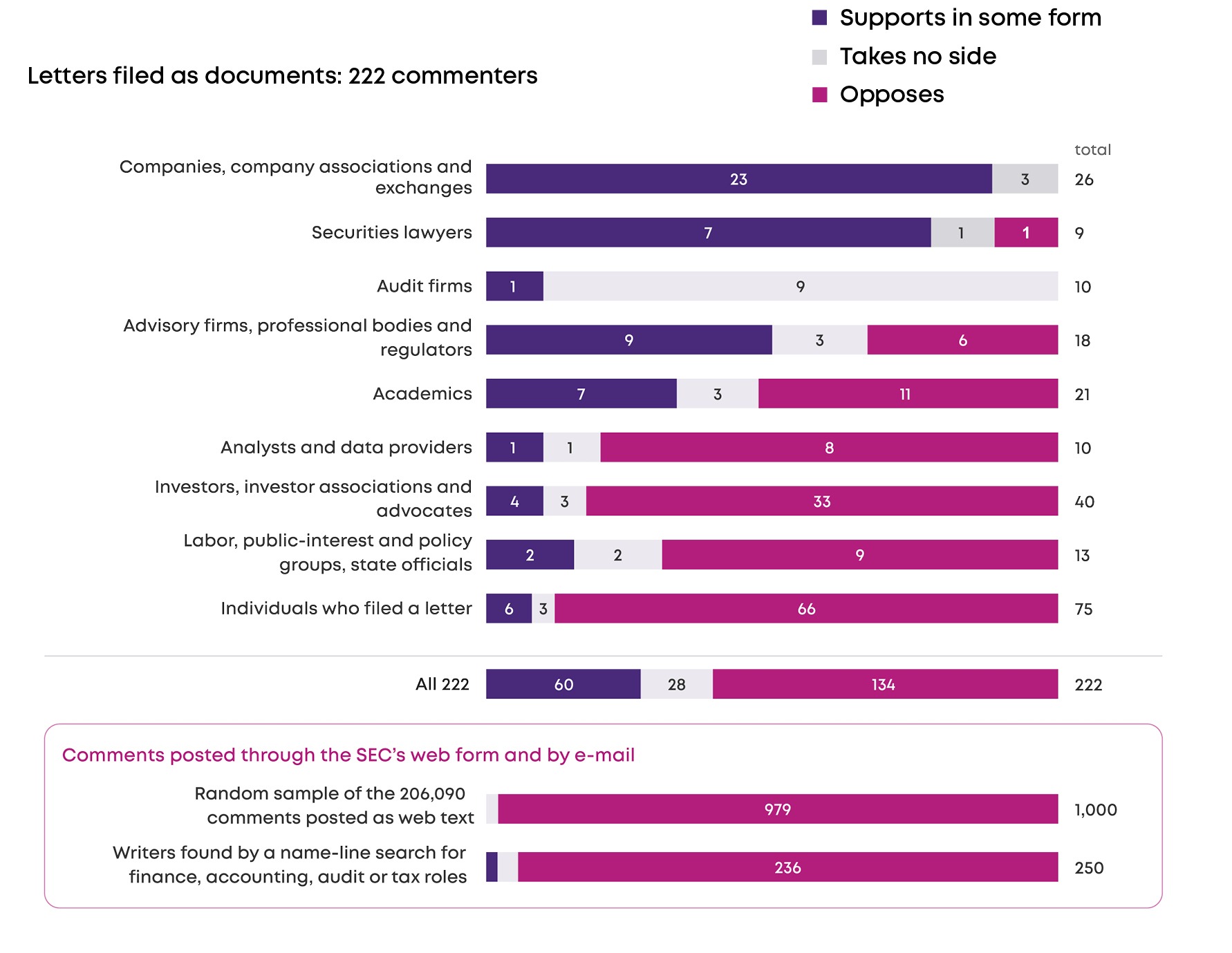
Source: SEC comment file S7-2026-15 as posted on October 6, 2026. The counts describe the analysis and are not a forecast of how the Commission will weigh each letter.
| What they told the SEC | How many | What they asked for, and what it means for you |
|---|---|---|
| Let us report less often: Companies and their associations | 23 of 26 | 14 of the 26 asked for a change to the comfort letter limit or said it must be addressed. Read this as support for the choice, not as a plan to use it. |
| We take no side: Audit firms | 9 of 10 | All 9 said, that they take no view on frequency and that investors & companies should determine the frequency. All 10 agreed that as independent accountants, they are prepared and stand ready to adjust review procedures for either frequency. Do not assume an earnings release alone can be reviewed; agree the scope with the auditor. |
| Do not adopt it: Investors, investor associations and advocates | 33 of 40 | 12 of the 40 asked the SEC to slim the Form 10-Q. Several warned that a semi-annual election could raise the risk of fraud or misstatement being detected later or deter investment. Expect investors to price and question an election. |
| Adopt it, with care: Securities lawyers | 7 of 9 | Work through offerings, trading windows and debt documents first. 3 firms noted that directors’ and officers’ trading-plan cooling-off periods would often run to the 120-day maximum, since reports would be filed less frequently. |
Three points bear directly on a company’s planning.
- The auditor’s work would not fall in step with the filings. 4 firms said the savings would be less than proportional, and none said otherwise. 6 firms said the same procedures apply for 6 months, and 4 firms said the procedures could be incorporated into or added to the annual audit.
- Deficiencies could surface later. 9 of the 10 firms said fewer period-end cycles could mean control deficiencies or misstatements come to light later, with less time to remediate before year-end.
- The most common request beyond adopt or reject was a different reform. 70 commenters asked the SEC to slim or re-examine the Form 10-Q: 20 of the 60 supporters, 35 of the 134 opponents, and 15 that took no side effect.
3.2 What finance professionals wrote
Analysis was further conducted on a sample of 250 professionals in finance, accounting, audit, or tax roles. Of those commenters, 236 opposed the option, citing reduced transparency, timely information, or lower management accountability as the primary reasons; 5 supported it; and 9 took no side.
Of the 27 self-described current or former chief financial officers, 22 opposed it.
Several drew on their own reporting experience. One signing as a retired Nasdaq-company CFO took the other side: “10-Qs are mostly boilerplate for most filers.”
4
What an Election Does Not Change
Lenders, underwriters, exchanges, and investors each keep a claim on the quarter. For most companies, we expect the savings to be in the 10-Q filing, not the management reporting.
The SEC release 33-11414 assumes that 20% of companies, or 1,195, would switch. Analysis of samples of comments submitted to the SEC suggests that the answer to the election depends on who within the company is asked.
Exhibit 5 — Who expects to elect semiannual reporting
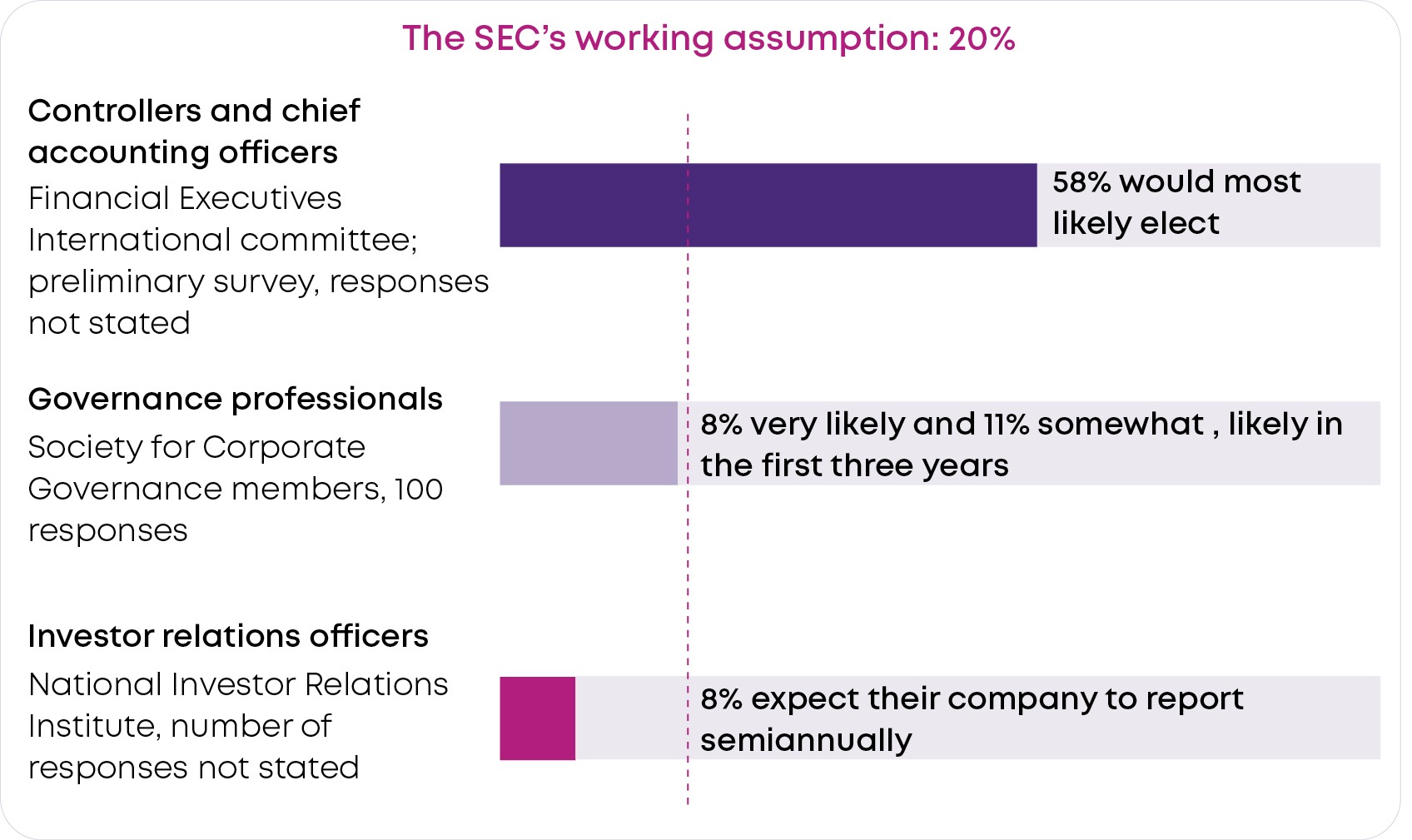
The three surveys asked different questions of different groups and are not directly comparable.
Source: comment letters of the Financial Executives International Committee on Corporate Reporting, the Society for Corporate Governance and the National Investor Relations Institute;
The same surveys show what electing companies would keep. Every controller who preferred semiannual reporting would continue quarterly earnings releases. Of the 100 governance professionals, none would move quarterly disclosure controls to a half-yearly cycle, and 37% expect minimal or no reduction in burden.
Lenders
The release 33-11414 says debt agreements “frequently require the provision of quarterly or even monthly financial information to the lender”. The Financial Executives International (FEI) committee said that where a covenant requires only financial statements accompanied by a management certificate, the main savings would not be materially eroded.
Underwriters
An auditor may give negative assurance on changes since the last financial statements only to a date less than 135 days after the last period it audited or reviewed. Sullivan & Cromwell warned of “a de facto quarterly reporting requirement” for companies that frequently access the capital markets.
Investors
The New York State Common Retirement Fund wrote that “Some investors may seek a higher risk premium or avoid companies that opt to step down to semiannual reporting”. In the Society for Corporate Governance’s survey, 56% were very concerned about investor or analyst reaction.
4.1 The savings, on the file’s evidence
The SEC release 33-11414 estimates the direct cost of three Forms 10-Q at $330,000 a year and of one Form 10-S at $132,000, a saving of $198,000 per company.
Japan offers the nearest precedent for what happens to the review. The review of first- and third-quarter results became optional there in 2024, and 324 of the 1,481 large companies that reported a first quarter through June 30 of that year underwent voluntary reviews. (CPAAOB, 2025 Monitoring Report). Where no voluntary review was conducted, the regulator reported that “procedures were often performed as part of the annual audit”.
Eli Lilly, the one reporting company that said in a letter of its own that it expects to elect, also said it “would continue our current accounting close processes (including internal controls) each quarter”.
That is the pattern to plan on. Professor Shivaram Rajgopal of Columbia concludes that if firms keep reporting quarterly to satisfy investors, the savings evaporate; if they stop, the market-quality costs such as lower liquidity, higher cost of capital for investors, and slower detection of problems tend to increase.
5
What Other Markets Do
| Market | Interim report required | Auditor’s review. |
|---|---|---|
| European Union (EU) and United Kingdom (UK) | Half-yearly, in three months. In the EU, national law and exchange rules can add to this, as Frankfurt’s Prime Standard does with quarterly statements. | Not required by the directive or UK rules; the report must state whether it was not reviewed. France requires a limited review. |
| Japan | Half-yearly by statute; quarterly earnings report by exchange rule | Half-year reviewed. Q1 and Q3 reviews have been optional since 2024 unless the exchange requires them. |
| Canada | Quarterly. A half-yearly pilot for small venture issuers since March 2026; Fasken, a law firm, found “some 310” adopters by September 17 | Not required. A notice if not reviewed. Regulators are consulting on all issuers. |
| India, main board | Quarterly results, standalone and consolidated | Limited review of the results by the statutory auditor, or audit |
| Saudi Arabia and United Arab Emirates | Quarterly | Reviewed |
| South Korea | Quarterly | Reviewed |
Source: Directive 2004/109/EC, Article 5; French Code monétaire et financier, Article L4511-2; Frankfurt Stock Exchange Rules, section 53; FCA DTR 4.2; Tokyo Stock Exchange (2023); Canadian Securities Administrators, Blanket Order 51-933 and Consultation Paper 51-406; Fasken, September 22, 2026; SEBI Listing Regulations, Regulations 33 and 52, and SEBI consultation paper of November 19, 2024; Saudi Capital Market Authority, Rules on the Offer of Securities and Continuing Obligations, Articles 66, 71 and 94; UAE Capital Market Authority (formerly the Securities and Commodities Authority), Board Decision No. 3 of 2000, Article 36; DFM Listing Rules 2.6 and 2.15; DFSA and ADGM market rules.
Cross-border implications
- A US group’s subsidiary in an issuer category in India, South Korea, Canada and the Middle East keeps its quarter while it gets aligned with the semi-annual requirement in EU, UK and Japan. A US election changes none of those local obligations. Indian and Gulf issuers that qualify as foreign private issuers and report on Form 20-F are outside the proposal.
- India has moved toward more frequent reporting. Debt-listed entities moved to quarterly results in 2021, and in November 2024 SEBI consulted on the same for the SME platforms, which still report half-yearly under Regulation 33(5). Its limited review already covers less than a full set of statements: results in SEBI’s format, on Ind AS 34 recognition and measurement principles.
- The half-year exists in these markets too. India’s SME platforms and Saudi Arabia’s Parallel Market report half-yearly, and the DIFC and ADGM have half-yearly regimes of their own. Frequency turns on the regulator, the issuer category and the listing venue: a free-zone company listed on DFM reports quarterly.
- The half-year exists in these markets. EU, UK and Japan report half-yearly. Few exceptions exist. For instance, France requires a limited review. Similarly in Japan, quarterly reporting is required if any of the conditions outlined by Tokyo Stock Exchange is applicable.
6
What To Do Before the Final Rule
For the CEO, CFO, and the audit committee chair: eight decisions, in order.
Start by testing whether the option is usable at all. Three questions settle it for most companies, and each company should ask all three.
Exhibit 6 — Would your company elect the option?
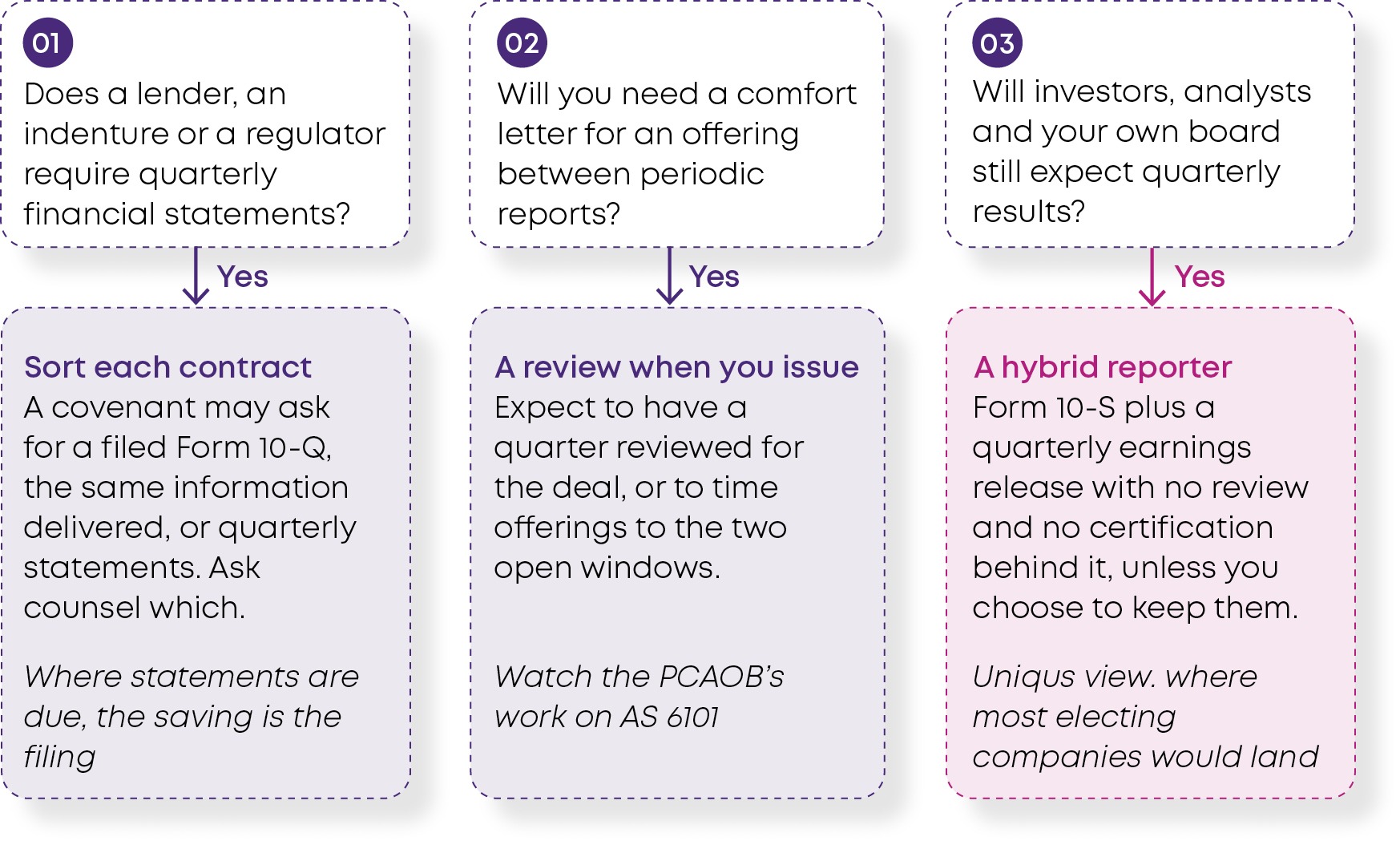
No to all three: a semiannual filer in full.
One Form 10-S and no quarterly release: the likely course for 2% of 100 governance professionals surveyed.
Uniqus view: it fits pre-revenue and development-stage companies that have no quarterly covenants.
Source: SEC Release 33-11414; PCAOB AS 6101; Society for Corporate Governance comment letter.
Eight decisions for the company management
1
Read every debt document for its reporting covenant
A covenant may require a filed Form 10-Q, delivery of what one would contain, whatever the SEC requires, or quarterly financial statements in any case. Whether an election changes the obligation, and whether an amendment or waiver is needed, turns on the words of each contract. Have counsel sort them before the saving is counted.
2
Map the next 18 months of capital markets activity
A shelf takedown, an at-the-market program or an acquisition financing between periodic reports will normally call for a comfort letter. Without a first or third quarter review there are two long stretches, of 86 and 109 days, with no negative assurance on subsequent changes.
3
Ask the auditor for a plan and a fee on both bases
No audit firm told the SEC its work would fall in proportion, and said procedures could move into, or add to, the annual audit. Price the saving from your auditor’s proposal, not from the release.
4
Decide what you would publish for the first and third quarters
An earnings release, fuller statements on Form 8-K, or nothing. Then decide who stands behind it before it goes out: management alone, internal audit, or the auditor, whose review, most audit firms told the SEC, would need interim statements and notes.
5
Keep the quarterly close and its controls
Nine of ten audit firms warned that deficiencies could surface later. A quarterly close also preserves the comparatives a company needs if it returns to quarterly reporting, though the auditor may still have to review them.
6
Revisit trading windows and trading plans
Windows keyed to periodic reports open after each Form 10-Q and the Form 10-K, four times a year. For an electing company that falls to two, unless the policy is rewritten around earnings releases. Cooling-off periods for directors’ and officers’ trading plans would often run to the 120-day maximum.
7
Let the board make the election
The decision to report semiannually belongs to the board. Bring evidence on lenders, offerings, investors and peers, and record the final decision in the board minutes. The check box is the only notice the rule would require, which makes the board’s documented decision the main record of why the company chose it
8
Watch four desks, not one
The SEC’s final rule, the PCAOB’s comfort-letter project, the FASB’s research project and the exchanges’ rule changes will not arrive together.
6.1 When the quarter is reported but not reviewed
We expect most electing companies to be hybrid reporters, with a Form 10-S and a voluntary quarterly earnings release. For them, the question is what stands behind a first- or third-quarter number.
| Requirement | In a Form 10-Q | In an earnings release from a semiannual filer |
|---|---|---|
| Financial statements | Condensed interim statements with notes (Rule 10-01) | What the company chooses to present, with Regulation G for non-GAAP measures |
| Auditor | Review before filing | None required |
| CEO and CFO certification | With each report | None |
| Published conclusion on disclosure controls | Each quarter | None in the release; half-yearly, in Form 10-S and Form 10-K |
| Tagged data | Inline XBRL | None required |
| Liability for a misstatement | Rule 10b-5, officer certifications, and Section 11 once incorporated into a registration statement. | Rule 10b-5 still applies. No officer certification, and no Section 11 exposure unless the release is incorporated |
Source: SEC Release 33-11414; PCAOB AS 4105;
The last row is the one to hold on to. Antifraud liability for a misstated quarter stays, while the certification and the review behind the number fall away, so the discipline has to come from the company itself.
How Uniqus Can Help
This section is for readers, each with a decision to take. If your company has quarterly covenants it cannot amend and issues securities several times a year, the option changes little, and nothing here is urgent.
1
Could we use the option?
Before the final rule is adopted
Cadence readiness memo, two weeks. Every debt document, offering program, exchange rule and regulator that asks for the quarter, sorted into what an election would and would not move.
2
Should we elect?
Before the Form 10-K on which the box would be checked
Board decision paper, three weeks. Investor and analyst expectations, peer intentions, a fee comparison built from your auditor’s own proposal, and a recommendation the audit committee can minute.
3
What stands behind an unreviewed quarter?
Before the first quarter without a Form 10-Q
Quarter-end standard, six weeks. Close calendar, disclosure committee procedures, sub-certifications and a review model for first- and third-quarter releases, with the interim accounting judgments documented each quarter.
4
Listed or reporting in more than one market?
Before the next group reporting calendar is set
Cross-border reporting calendar, four weeks. One close mapped to SEC, other market requirements, showing what a US election would save a group that still reports quarterly elsewhere.