Foreword
Record Dollars, Fewer Companies
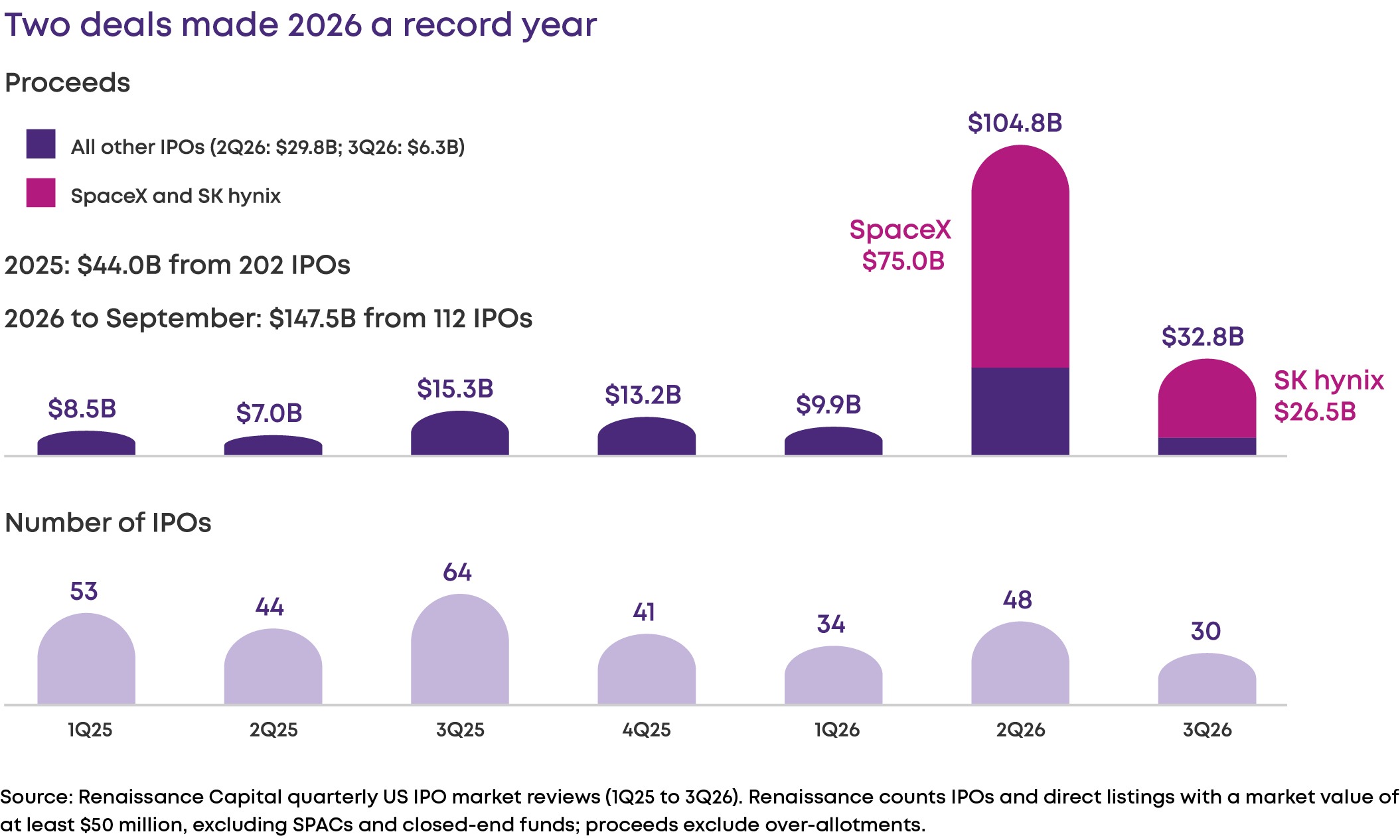
Two years ago, the question for many boards was whether the US IPO window would reopen at all. It has, and on one measure spectacularly. US IPOs raised $147.5 billion in the first nine months of 2026, more than in all of 2021. But the record belongs to two companies. SpaceX and SK hynix raised 68.8% of the money, and the number of IPOs fell from 161 to 112 against the same nine months of 2025.
That gap between dollars and companies is where this paper starts. We set out to answer the questions a CFO or a board would ask before deciding to list, using our own analysis rather than market averages. Did the buyers of the largest deals do well? Mostly not after the first day. Of the 30 large IPOs since January 2025 that rose on day one, 18 now trade below their IPO price, and 31 of the 40 largest have lagged the S&P 500 since they priced.
Where did the money go? We read the final prospectuses of 30 large deals. Outside SpaceX and SK hynix, 48.1% of the proceeds went to existing owners, lenders and employee tax bills, and not one of 28 prospectuses put a dollar figure on a growth plan. None of this is improper, but investors read that section as a signal of whether the company needs the money or its owners need the exit.
This is not a case against listing. It is a case against arriving unprepared. Private markets now do much of what an IPO used to do, and a company can be valued, traded and lent against for years before an auditor signs an opinion intended for public investors. The IPO is where that gap closes. In our sample, companies that listed below their last private mark have held up better since than those that listed above it. The sample is small, but it points one way.
This edition follows one argument in six steps. It covers the market, how the largest IPOs have traded, where the money went, why so many companies stay private or sell, the outlook by sector, and the decisions to make before filing. Both analyses are our own, and the data behind them is in the appendix.
The next window is already forming. Anthropic’s IPO, filed publicly on October 26, could make 2026 an even bigger year for dollars; whether 2027 is a bigger year for companies depends on the mid-sized issuers that have stayed away. Either way, the question for a growth company’s board is no longer whether to go public, but whether it could if the window opened next quarter.
At a Glance
The window is open, but for few companies, and the public market is repricing what private markets paid. Our analysis of the largest deals shows how, and what a company planning to list should decide now.
THE BOTTOM LINE
The IPO has become one exit among several. Dollars are at a record, but two deals raised most of them; the aftermarket has repriced most of what private books paid; and outside SpaceX and SK hynix, not one of the 28 large-IPO prospectuses we read put a dollar figure on what it would build with the money.
The paper follows one argument in six steps, each answering the question a CFO or board would ask next. Every box links to its section.
Market Overview
Is the window really open?
For dollars, not for companies. Two IPOs raised most of 2026’s proceeds while the number of listings fell.
Aftermarket Performance
Did the IPO class reward its buyers?
Mostly not after day one. Thirty-one of 40 lag the S&P 500, and the median deal trails it by 24.6 points.
Use of IPO Proceeds
What was the money for?
48.1% went to existing owners, lenders and employee tax bills; not one of 28 prospectuses put a dollar figure on growth.
Alternatives to an IPO
What are companies choosing instead?
Private rounds, secondaries and sales to AI buyers now do much of what a listing did.
Outlook
What comes next?
The pipeline sector by sector, our working assumptions for the next 12 months, and the rule changes ahead.
IPO Readiness
What should we decide now?
Six decisions, by role, starting 18 months before the filing.
Market Overview
The US IPO market set a record in 2026, but for dollars, not for companies. Two deals raised most of the money while the number of listings fell.
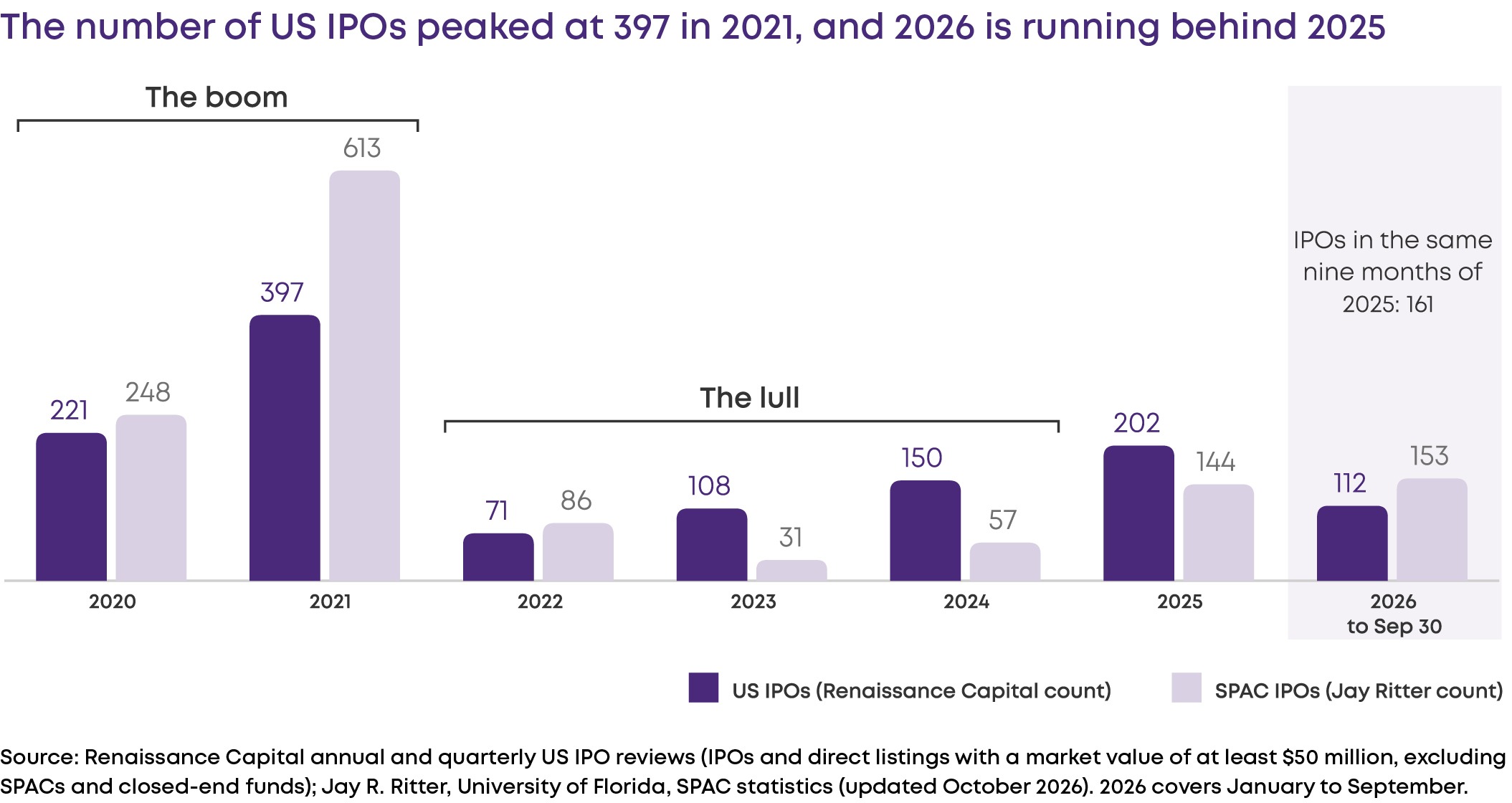
The last cycle was not a normal one. In 2021, 397 companies went public in the US, and 613 special purpose acquisition companies (SPACs) listed. A year later IPOs fell to 71. The market closed not because capital ran out but because buyers had been through the aftermarket. The window has reopened since, in stages.
1.1 IPO proceeds and deal count
US IPOs numbered 202 in 2025, raising $44.0 billion in a year interrupted by the April tariff sell-off and a 43-day government shutdown. Through September 30, 2026, 112 IPOs raised $147.5 billion, against 161 raising $30.8 billion in the same nine months of 2025. That is more money than in all of 2021, on fewer than half as many deals per quarter. These counts follow Renaissance Capital, which excludes SPACs, deals with a market value below $50 million and over-allotments. On PitchBook’s broader count of every Nasdaq and NYSE listing, 199 companies raised $146.3 billion in the first half of 2026 alone, 113 of them SPACs, and SpaceX’s $75.0 billion base deal becomes $86.25 billion with its over-allotment.
- SpaceX is the largest IPO on record. It priced on June 11, 2026 at $135 a share, raising $75.0 billion in its base deal at a valuation of $1.77 trillion, and closed its first day at $160.95.
- SK hynix is the largest US offering by a foreign company. It raised $26.5 billion in US depositary shares in July 2026, ahead of the $25.0 billion Alibaba raised in 2014 with its over-allotment.
- The window narrowed in September. The third quarter brought 30 IPOs, and the Renaissance IPO Index fell 11.5% while the S&P 500 rose 2.3%. Oura postponed, Holtec withdrew, SB Energy delayed its launch and Klook withdrew in October. The Federal Reserve raised rates by 25 basis points on September 16, 2026, its first increase since 2023.
1.2 Concentration of proceeds
2026 proceeds through September without SpaceX and SK hynix, against $44.0B in all of 2025
Renaissance Capital; Uniqus calculation
Two deals this large distort every market average, from the mean deal size to the proceeds-weighted return, so the rest of this paper looks at the largest deals one by one.
The dollars came back. The question for anyone buying, or selling, in the next IPO is what the buyers of these deals got. Section 2 tests it on the 40 largest.
Aftermarket Performance
The first-day pop is the market’s opinion of the book. The price a year later is its opinion of the company. In this cycle the two have disagreed more often than not.
2.1 Returns of the 40 largest IPOs
To look past the averages we built a dataset of the 40 largest US IPOs by base-deal proceeds from January 2025 to mid-October 2026, together $155.1 billion, and tracked each from its IPO price to its first-day close and to the close on October 16, 2026. Section 2 uses this dataset.
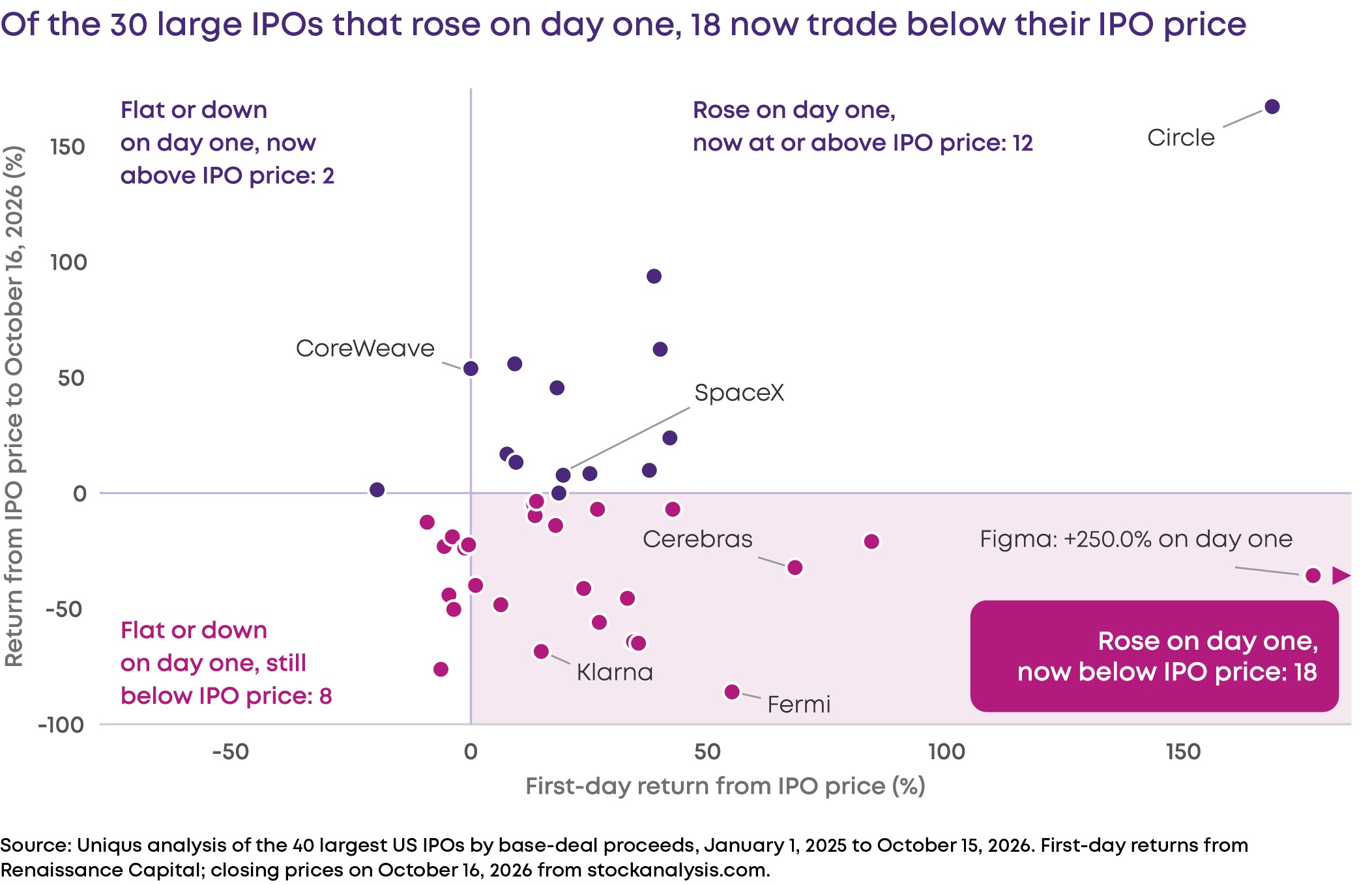
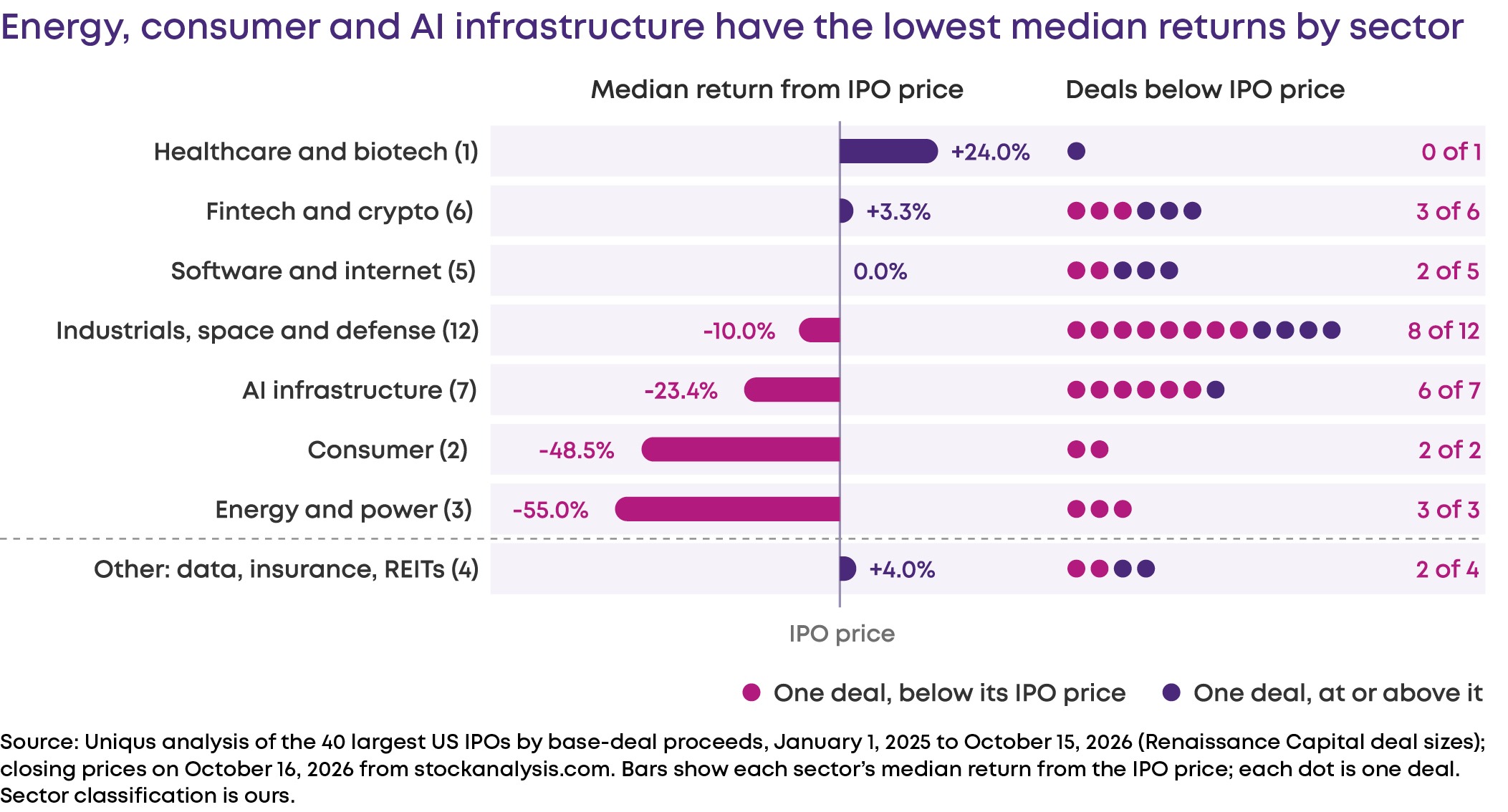
- The median investor in our set is down. A 17.8% median first-day gain has become a −12.5% median return from IPO price to the October 16, 2026 close, and 26 of the 40 trade below issue. Weighted by proceeds, the 38 deals outside SpaceX and SK hynix trade 8.5% below their IPO prices.
- A strong book did not predict a strong stock. Most of the deals in our set that priced above their initial range now trade below their IPO price.
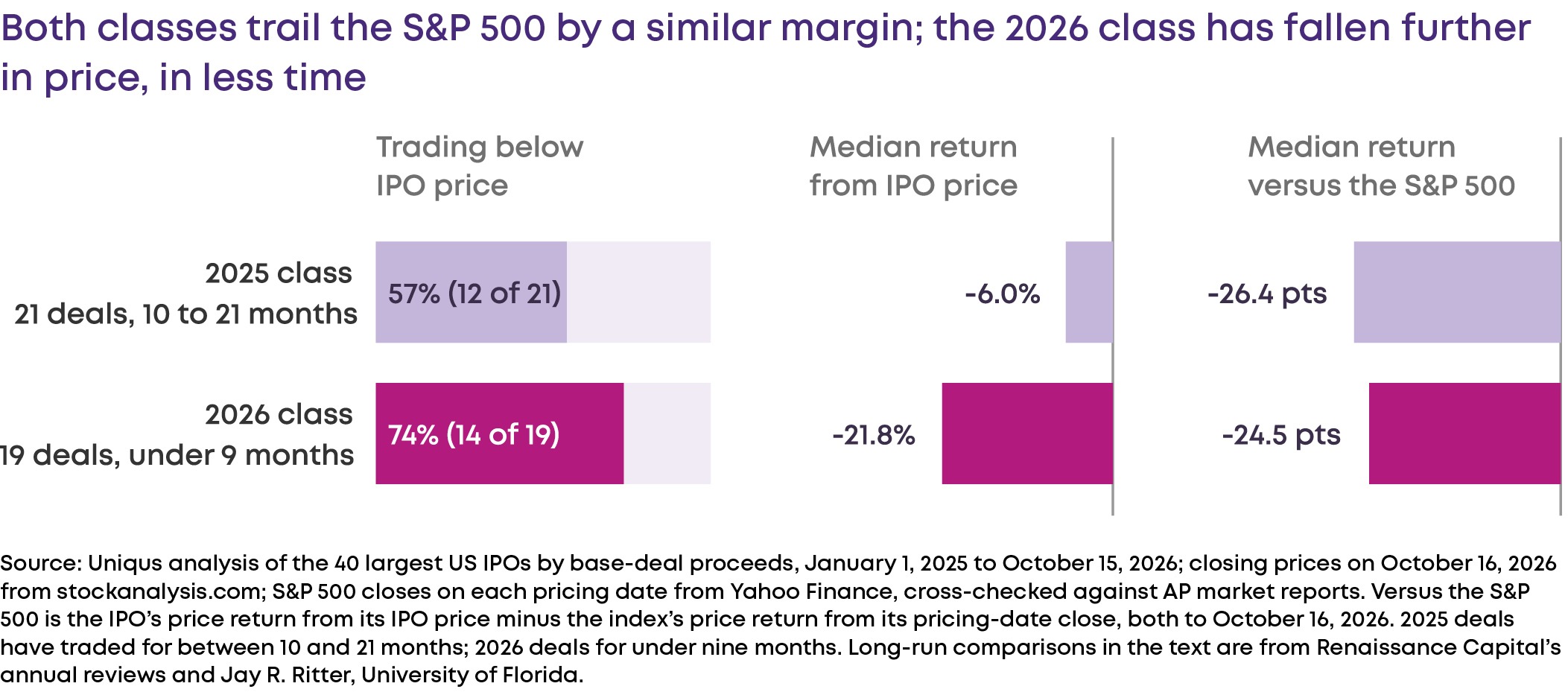
- Against the market, the record is worse. Measured against the S&P 500 from each pricing date to October 16, 2026, 31 of the 40 have lagged, and the median deal by 24.6 percentage points. Over the same holding periods the index rose a median 12.8%.
- The 2026 class fell faster in price, but both classes lag the market by a similar margin. Of the 21 deals that priced in 2025, 12 trade below issue, with a median return of −6.0%; of the 19 that priced in 2026, 14 do, with a median of −21.8%, after under nine months of trading. Against the S&P 500, the medians are −26.4 and −24.5 points.
Is this unusual? Trading below issue is common. In each year from 2021 to 2025, fewer than 40% of US IPOs ended the year above their offer price. What stands out is how far the largest deals have lagged the market. From 1980 to 2024, IPOs of companies with at least $1 billion in sales returned 32.4% on average over three years, 2.1 points below the market. The median of our 40 trails the S&P 500 by 24.6 points after at most 21 months. The measures differ, but the contrast is stark.
A note on the sample
The sample has limits. It contains the largest deals rather than the full IPO population, and the 2026 class has traded for less than a year.
It is still useful. These are the most visible offerings, from the companies with the most resources to prepare. If public investors reprice them this quickly, a smaller issuer should expect its own assumptions to get at least as hard a look.
The 2026 class started strongly, then lost ground. At September 30, 2026 the IPO index was up 15.9% for the year, ahead of the S&P 500’s 12.7%, but only because of a 42% second-quarter gain. It fell 11.5% in the third quarter, and by October 15 it trailed the S&P 500 for the year, up 12.1% against 14.2%.
- AI infrastructure is being financed in public markets, and repriced there. AI infrastructure raised $38.7 billion across 7 of the 40 deals, second only to industrials, space and defense, whose $88.1 billion across 12 deals was mostly SpaceX. Six of the 7 now trade below their IPO price; only CoreWeave is above.
Two 2026 listings show the range. SpaceX closed its first day at $160.95, 19.2% above its $135 IPO price, peaked at a close of $201.68 on June 16 and first closed below its IPO price on July 16. Its lowest close, $108.27, came on August 5, the day before 911.5 million shares became eligible for sale; it closed at $146.03 on October 16, 8.2% above its IPO price, with the last tranche of its 180-day lock-up due on December 8. Cerebras priced at $185 on May 13 and rose 68.1% on its first day, but closed at $127.21 on October 16, 31.2% below its IPO price.
After the first day, SpaceX is 8.2% above its IPO price and Cerebras 31.2% below
Source: daily closing prices from stockanalysis.com, cross-checked against Yahoo Finance and press reports; lock-up events from company prospectuses as reported. Prices indexed to each IPO price.
Are private investors pricing too aggressively, and is that why the aftermarket disappoints?
2.2 Private valuations and IPO pricing
The evidence points less to an IPO priced too high than to a chain of three prices. The private round sets the anchor, the IPO clears below it and pops, and the market then reprices on audited results and new supply.
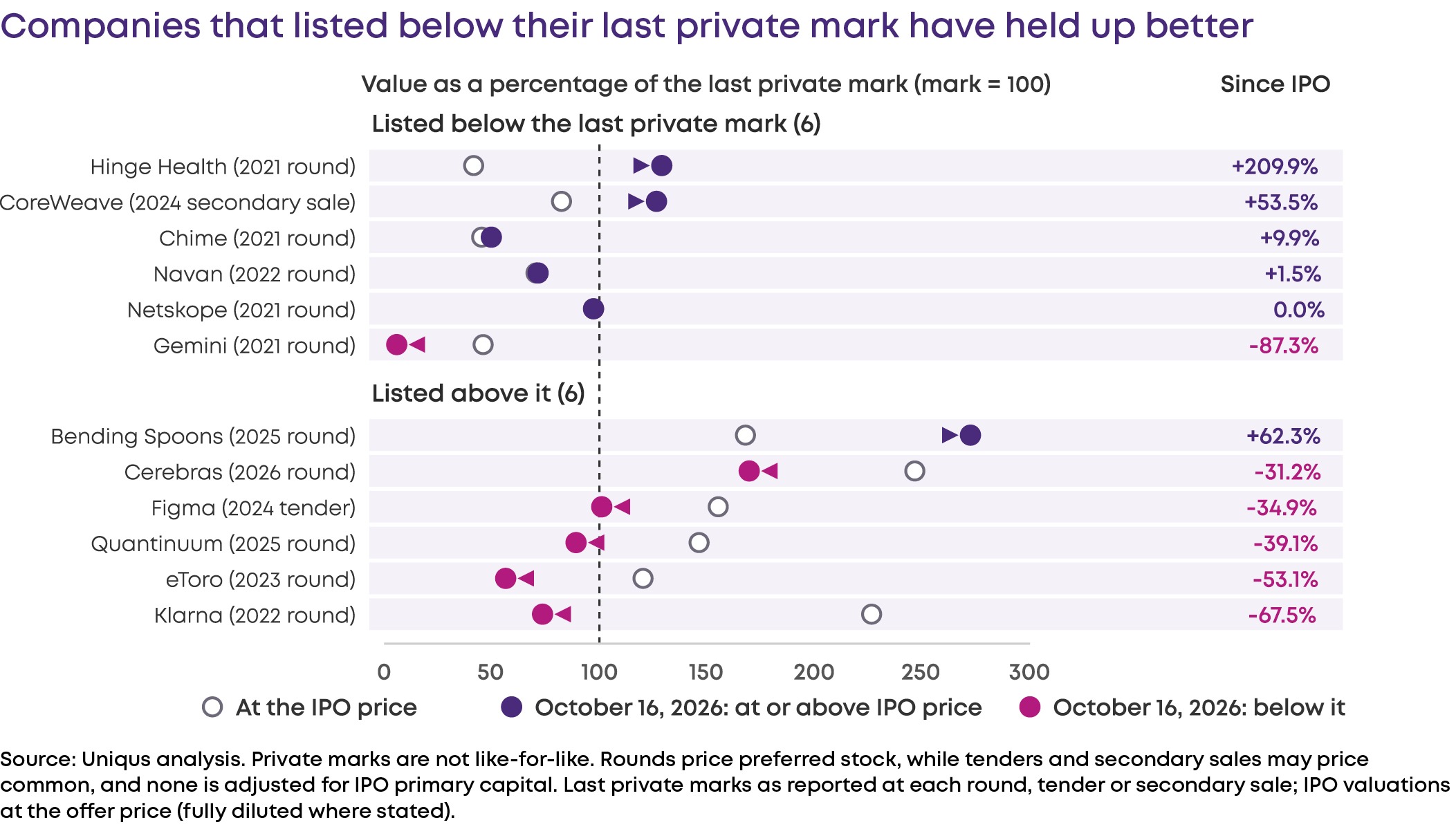
- Marks set in 2021 did not survive. All four companies in the table below whose last mark dates from 2021, Chime, Netskope, Gemini and Hinge Health, listed below it. Klarna listed at $15.1 billion, above its 2022 down round but a third of its 2021 peak.
- Recent marks listed above, then gave ground. Figma, Quantinuum, Bending Spoons and Cerebras all listed above marks set in 2024 or later, and eToro above its 2023 round. Figma, which listed 54.4% above its 2024 tender value, is now 0.5% above it; Quantinuum is 11.5% below its 2025 round.
- A down-round listing has aged better than an up-round one. Of the six that listed below their last private mark, four closed above their IPO price on October 16, 2026, Netskope at it and Gemini 87.3% below. Of the six that listed above their last mark, only Bending Spoons is above its IPO price. The sample is small, but it suggests that pricing at the reset protected the IPO buyer.
- The secondary market already discounts old marks. Forge data in PitchBook’s second-quarter 2026 review put trades in companies last priced in 2021 at a median 59.1% below that round.
THE BOTTOM LINE
Price the IPO for the second year of trading, not for the first day.
Section 3 asks what the IPO money was for, and who received it.
Use of IPO Proceeds
Investors are asked to judge an IPO partly on what the company will do with the money. Outside SpaceX and SK hynix, not one of the 28 other large-IPO prospectuses we read put a dollar figure on a growth plan.
3.1 Findings from 30 prospectuses
We read the use-of-proceeds section of the final prospectus for 30 large US IPOs since January 2025, together $140.9 billion of base-deal proceeds, and traced each dollar to where the prospectus said it would go. Twenty-four of them are among the 40 in Section 2; the other six are eToro, Hinge Health, McGraw Hill, Via, Gemini and Accelevation. The set is not exhaustive. Sixteen of the 40 is outside it, including Fermi, whose prospectus did put figures on equipment and construction. Existing owners means selling shareholders plus buyouts of pre-IPO owners.
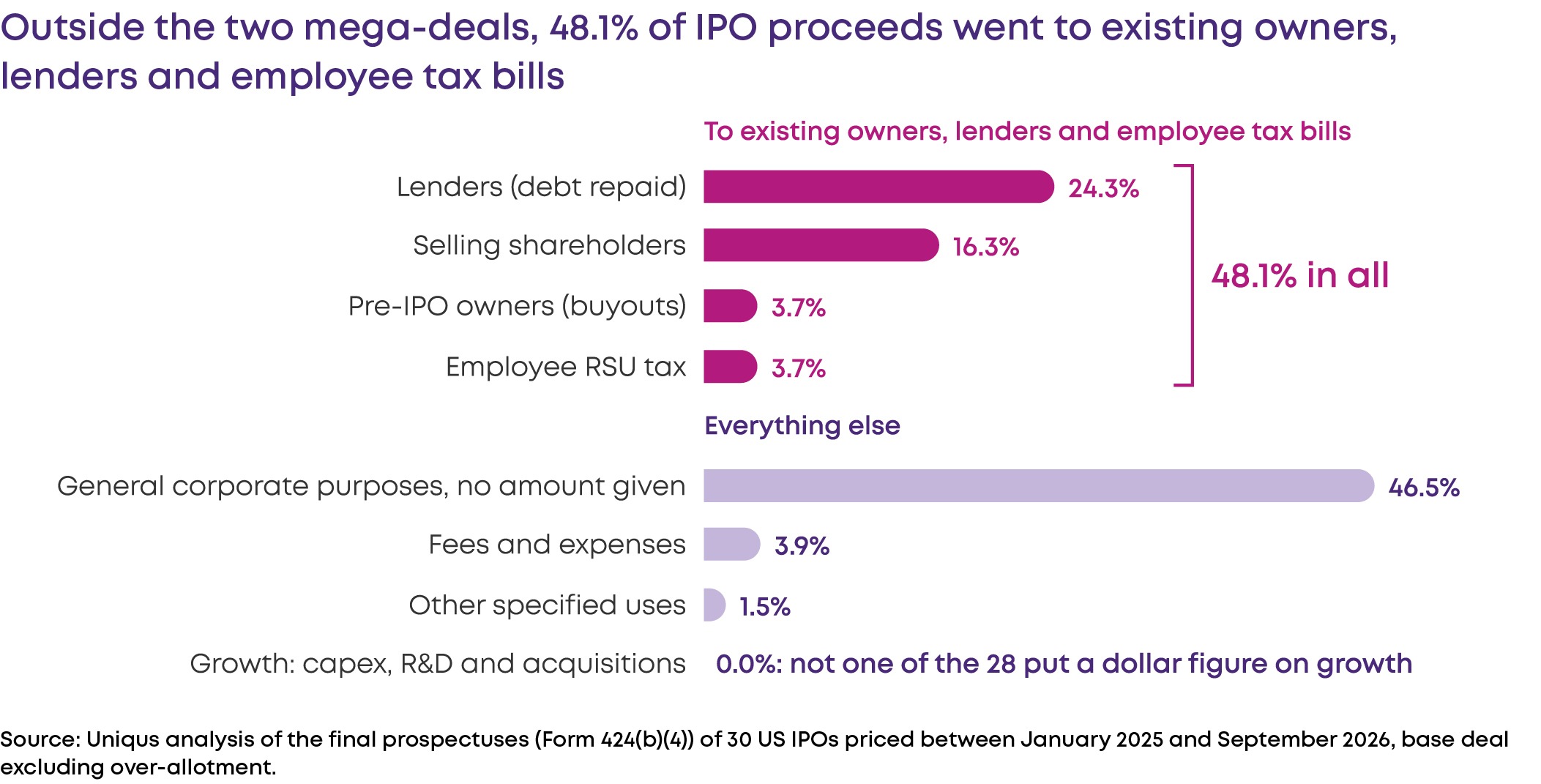
- No growth use had a dollar figure. None of the 28 prospectuses outside SpaceX and SK hynix quantified capital expenditure, research and development or acquisitions. Growth appears only inside general corporate purposes, which took 46.4% of proceeds with no amount given, and eleven of the 30 prospectuses put no dollar amount on any use.
- Sponsor-backed deals repaid debt. Twelve of the 30 used proceeds to repay debt, $9.6 billion in all. Medline directed $4.0 billion to its term loans, and Csquare put $994.6 million of its $1,010.0 million of net proceeds toward debt. Jersey Mike’s used $295 million of $301 million to retire notes that had partly funded a dividend to its sponsor.
- The two giants tell opposite stories. SK hynix tied its $26.2 billion of net proceeds to named capital programs for fab construction and EUV lithography tools. SpaceX named AI compute, launch and satellite constellations among its uses but gave no amount for any of them.
- Paying employees’ tax bills was a pattern of venture-backed tech IPOs. Nine of the 30 used proceeds to fund tax withholding when restricted stock units settled at the IPO, Figma by repaying the credit line it drew for it. Hinge Health’s withholding obligation of $285.4 million exceeded its net proceeds of $245.4 million; Chime set aside $320.0 million.
Practical Perspective on employee tax bills in the use of proceeds
Many private companies grant restricted stock units that vest only when two conditions are met, a service condition and a liquidity event such as an IPO. Under ASC 718 no compensation cost is generally recognized for these awards until the IPO occurs, because the IPO condition is not considered probable before then, so the IPO quarter carries a cumulative catch-up charge for all the service already rendered.
When the units settle, companies often withhold shares to cover employees’ taxes and pay the tax authorities in cash; withholding up to the maximum statutory rate keeps the awards equity-classified. That cash often comes from the IPO proceeds. Decide the method, net settlement or sell-to-cover, before pricing, because it changes the cash the company needs, the shares that come to market and the first reported quarter.
3.2 Disclosure requirements under Item 504
Repaying acquisition debt, letting early holders sell and settling equity awards are all normal reasons to list. But Item 504 asks for the principal purposes and an amount for each, and a section that gives neither tells investors more than the company may intend.
What Item 504 asks, and how to answer it
| What Item 504 of Regulation S-K asks | How to write it |
|---|---|
| The principal purposes, and the approximate amount for each | Name each use and put a figure on it, from the board-approved capital plan. Eleven of the 30 we read gave no amount for any use. |
| If a significant portion has no specific plan, say so and give the reasons for the offering | Say plainly why the company is raising money now, rather than leaving it inside general corporate purposes. |
| For debt repaid, the rate and maturity, and the use of any debt incurred in the past year | Trace the debt back to what it funded, including any dividend to a sponsor. |
| Amounts and sources of any other funds needed; reallocation only for stated contingencies | Show what else pays for the plan, and name what could change it. |
Source: Item 504 of Regulation S-K and its instructions (17 CFR 229.504).
The statutory safe harbor for forward-looking statements does not cover statements made in connection with an IPO, so issuers and their counsel keep growth plans general rather than attach figures they could be held to under Section 11. That explains the pattern; it does not remove the requirement. Where a company has a specific plan, Item 504 still asks for an approximate amount, and where it does not, it must say so and explain why it is raising money. Our test therefore measures how specific the disclosure is, not whether the money is spent on growth. An IPO that is mainly an exit competes with every other exit. Section 4 looks at the alternatives.
Alternatives to an IPO
Private markets now raise capital at scale, pay employees and sell companies, much as a listing used to. Each alternative has a price.
4.1 Growth of private markets
While the window was shut, private markets built everything a growth company once listed to get, including capital at scale, liquidity for employees and a valuation the press reports as a price. US-listed domestic companies fell from 8,090 in 1996 to 3,908 in 2025 (World Bank and World Federation of Exchanges data). Take-privates removed more, with 41 by private equity in 2025 worth $242.9 billion, by White & Case’s count.
Companies now list at 12 years old, not 5, and reported private valuations now reach $965 billion
| What changed | Then | Now | What it means for you |
|---|---|---|---|
| Age at IPO | Median of 5 years (1999) | Median of 12 years (2025) | Your first audited statements as a public company describe a mature business, so investors will compare them with peers, not with promise. |
| Private value | 39 US software unicorns when the term was coined (2013) | 992 US unicorns valued at $5.7 trillion (Q3 2026) | A large private valuation is now an expectation the IPO must meet, not a ceiling it can beat. |
| Largest private marks | Facebook at $50 billion before its IPO (2011) | Anthropic $965 billion; OpenAI $852 billion; Stripe $159 billion | Private rounds now set prices that the public market is asked to ratify (Section 2.2). |
| Liquidity without a listing | Occasional tender offers, company by company | 71 Carta-administered tender offers worth $3 billion in H1 2026 | Employees and early investors can be paid without an IPO (Section 4.2). |
Source: Ritter (median age); Aileen Lee, TechCrunch, November 2013 (the 39); Goldman Sachs’s January 2011 investment (Facebook); PitchBook-NVCA Venture Monitor Q3 2026 (US unicorns); Crunchbase unicorn board, October 2026 (private valuations, as last reported); Carta tender offer data, H1 2026.
4.2 Secondary trading in private shares
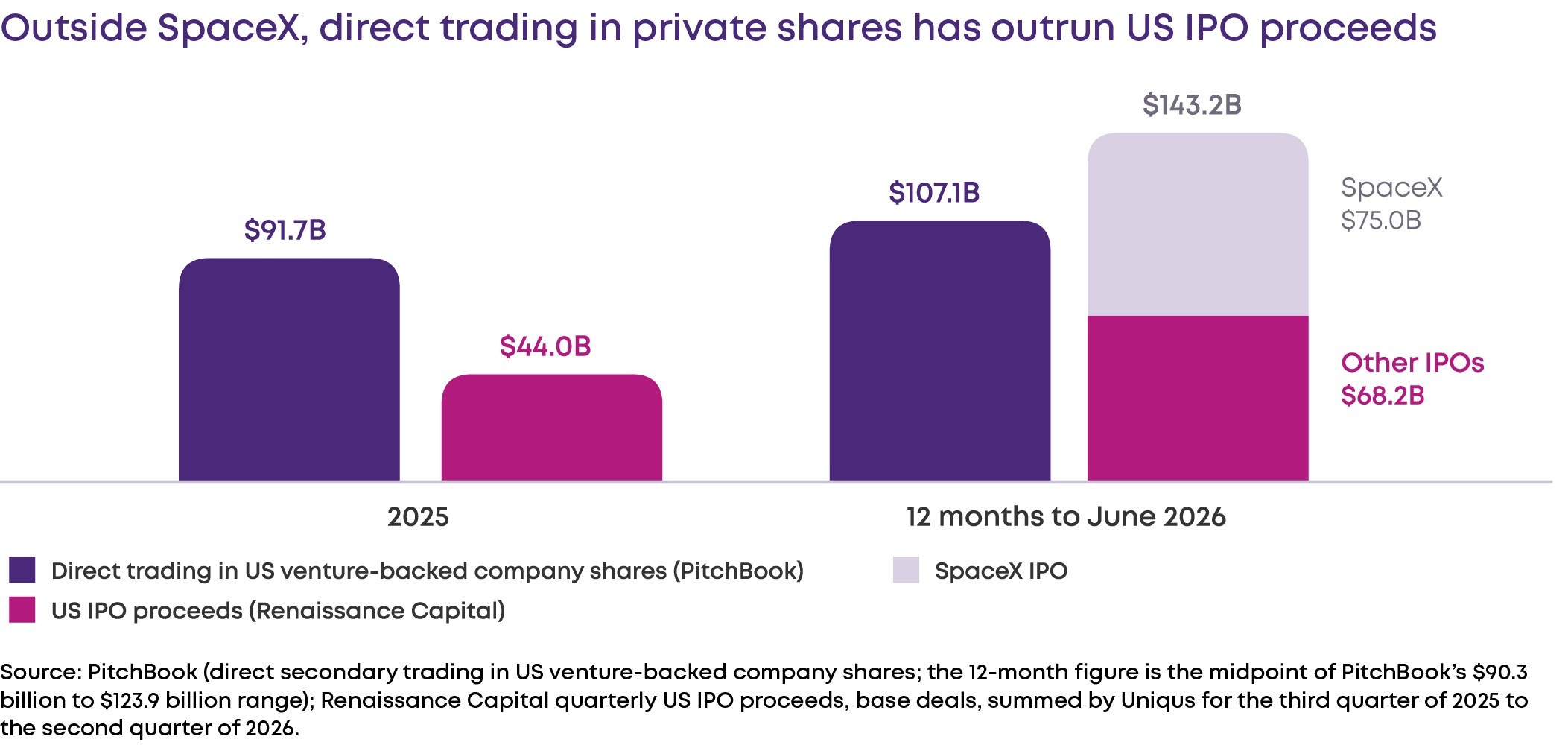
Direct trading in US venture-backed company shares
PitchBook, June 2026
We call this the shadow float. It is made up of shares of private companies that change hands through broker platforms, special purpose vehicles (SPVs), forward contracts and tokens, priced on funding headlines rather than on filed financial statements. Much of it runs through regulated brokers, though how each structure is treated depends on how it is built, and none of it carries the disclosure system that makes a public price mean something.
- It is large, growing and concentrated. Direct trading rose from $91.7 billion (midpoint) in 2025 to $107.1 billion (midpoint) in the 12 months to June 2026 by PitchBook’s estimate, and PitchBook says SpaceX, OpenAI and Anthropic dominated the volume. Charles Schwab’s purchase of Forge Global and Morgan Stanley’s of EquityZen, both completed in 2026, put retail brokerage clients one step from private shares.
4.3 Acquisitions as an exit
US venture-backed M&A exit value in 2026 through September, a decade high
PitchBook-NVCA Venture Monitor
The fastest-growing AI companies are not lining up for an IPO. Many are being absorbed by the labs, the hyperscalers and the AI-native companies that already have the currency to pay for them. The largest venture-backed deal was SpaceX’s merger with xAI in February 2026; the second was SpaceX’s $60 billion all-stock purchase of Anysphere, the maker of the Cursor coding tool, which closed in August 2026.
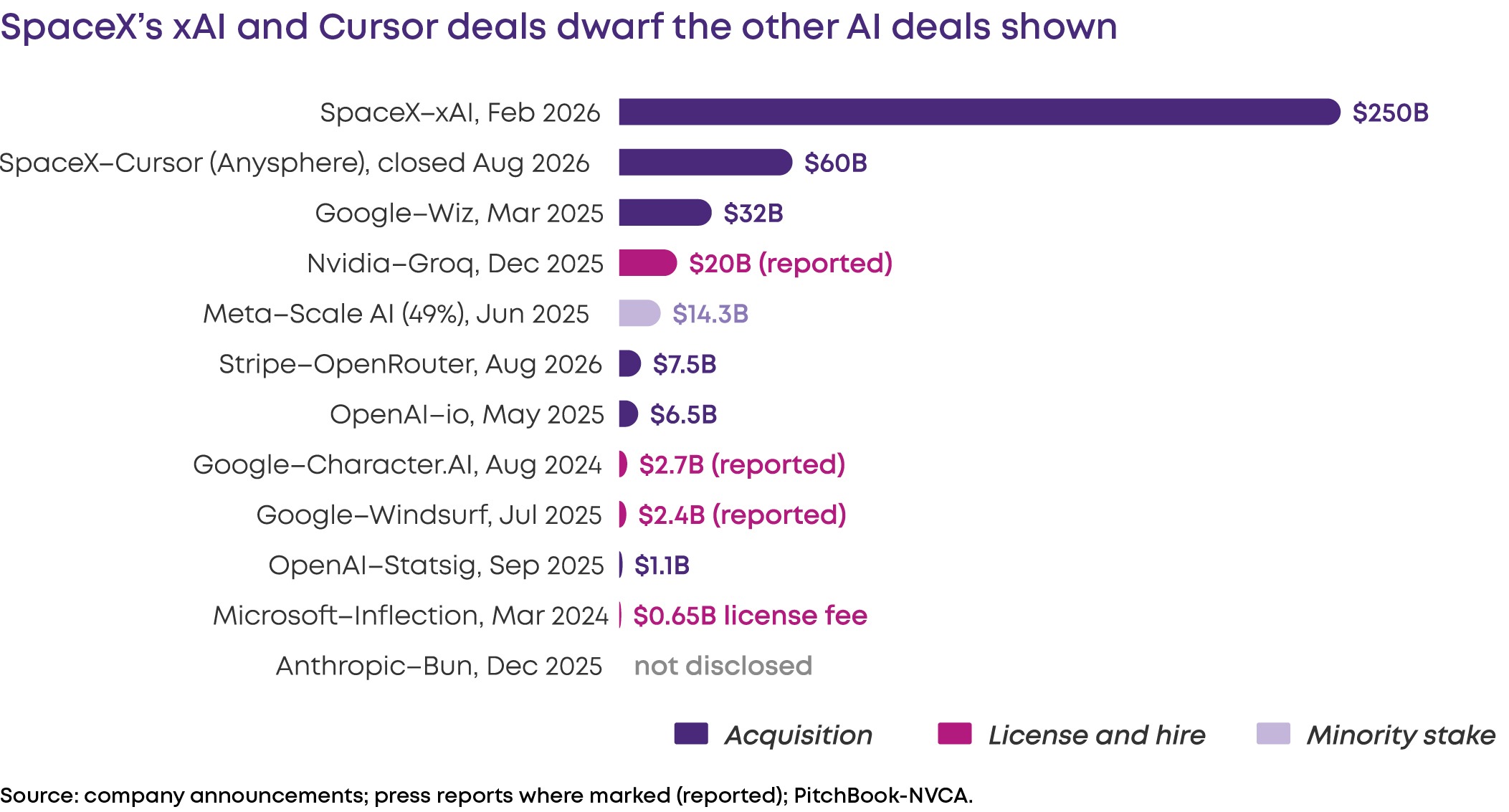
- The buyer pays in a currency the market already prices. SpaceX paid in its own shares for both xAI, while it was still private, and Cursor, a deal agreed five days after its IPO. OpenAI paid for io and Statsig largely in its private stock. A founder can swap illiquid private shares for shares with a market, without the cost and exposure of a listing. Some buyers take only the founders and a license, as Microsoft did with Inflection, which changes what the sellers receive and how the buyer accounts for it.
4.4 Staying private versus going public
Private markets have borrowed most of a listing’s benefits without its obligations. Even so, a listing still delivers four things that private capital cannot fully replace. These are a price anyone can check, a widely accepted acquisition currency, ready liquidity, and audited reporting that lowers the cost of capital.
Uniqus Point of View
- The shadow float has separated price from proof. A private company can now be valued, traded and lent against for years before an auditor signs an opinion intended for public investors.
- The IPO is where that gap closes. Our analysis of the largest 40 deals shows how often the public market has repriced what private books paid (Section 2).
- Readiness is the hedge. A company that can produce public-company financial statements, controls and disclosure on demand keeps all four exits open, whether a listing, a sale, a license-and-hire deal or a well-run private tender.
If the window opened next quarter, could you go? That is the question to answer now.
Going public costs more, but buys a price anyone can check and capital on demand
| Question | Staying private | Going public |
|---|---|---|
| Who can buy your shares? | Accredited investors, funds and, increasingly, retail through SPVs and new fund structures | Everyone, including index funds that must buy (Section 5.4) |
| How do you raise more? | A new round, if a buyer can be found at the last mark | A follow-on or convertible in days once the company is shelf-eligible. CoreWeave, listed in March 2025, sold $3.7 billion of convertible notes in September 2026 |
| What does it cost? | Lower, but rising, with 409A valuations, tender documentation and transfer controls | Underwriting (a 7% gross spread persists for mid-sized IPOs), periodic reporting, SOX, D&O insurance |
| What can go wrong? | Marks that the public market will not ratify; unauthorized transfers | Price falls in public; securities class actions after a drop |
Section 5 looks ahead at the pipeline, the outlook by sector and how the listing route itself is changing.
Outlook
The queue is long, but it is waiting on one name and on an aftermarket that has turned. Here is what is lined up, what we expect sector by sector, and the rule changes a 2027 filer has to plan around.
5.1 IPO pipeline
There are 221 companies publicly on file, seeking $21.7 billion, but forecasts for the rest of 2026 now look ambitious. The calendar is waiting on one name. No US IPO was scheduled for the week of October 19, and much of Wall Street is holding back until Anthropic prices.
- All eyes are on Anthropic. It filed its registration statement publicly on October 26, 2026, after announcing a confidential submission on June 1, and plans to list on the Nasdaq Global Select Market under the ticker ANT. The share count and price range are not yet set. IFR has reported pricing in mid-November and a raise of up to $100 billion at a $2 trillion valuation; Reuters reported on October 15 that some investors were discussing about $1.5 trillion. The S-1 shows revenue of $16.3 billion for the first half of 2026, against $4.6 billion in all of 2025, and a net loss of $80.7 billion, mostly from accounting charges. Its third-quarter revenue was $16.8 billion, against $11.6 billion in the second quarter, Reuters reported.
- The AI infrastructure queue is long, and stalling. SB Energy filed publicly for a $5 billion IPO and then delayed its launch; Nscale and DayOne filed publicly in September and October, and Switch confidentially. Outside AI, Oura postponed a $2.1 billion IPO on September 29 and Klook withdrew on October.
- Much of the next wave points to 2027. OpenAI’s CFO told staff it “will be a public company in 2027”, Kraken is not expected before the second quarter of 2027, and Databricks’ CEO told Bloomberg in June that 2026 was “a terrible year to go public”.
Practical Perspective on year-end timing
For a US company hoping to price before year-end, three dates matter as much as the market’s mood. The midterm elections fall on November 3. June 30 interim financial statements go stale in mid-November, because Rule 3-12 of Regulation S-X allows 135 days for a domestic IPO registrant, so a later pricing needs September 30 numbers reviewed and in the prospectus. And Thanksgiving week, Anthropic’s reported pricing window and the final SpaceX lock-up release on December 8 compete for the same investors.
In our view, a company not already in registration with current financial statements is now a 2027 issuer.
WHAT THE MARKET IS SAYING
– Rob Stowe, head of Americas ECM, Barclays (Bloomberg, August 31, 2026)
– Eddie Molloy, co-head of global ECM, Morgan Stanley (Bloomberg, August 31, 2026)
– Lukas Muehlbauer, IPOX (Reuters, September 29, 2026)
5.2 Sector outlook
For each sector we combine how its large IPOs have traded in our data, who is lined up and what the market is saying. The read in the last column is ours.
The window is open for the AI labs and healthcare, and narrow for AI infrastructure, energy and consumer
| Sector | Return from IPO price, our 40 largest IPOs since 2025 | What is lined up (status at October 19, 2026) | Uniqus read for the next 12 months |
|---|---|---|---|
| AI model labs | None listed yet; SpaceX, merged with xAI, is counted in industrials and is up 8.2% | Anthropic (S-1 filed publicly October 26; reported for mid-November); OpenAI (confidential; 2027) | OPEN For the two labs that can set their own window. Anthropic’s pricing, and its first quarter as a public company, will set the tone for every AI listing behind it. |
| Healthcare and biotech | 1 deal (Medline), up 24.0% | Four biotechs priced in October; vVardis, Centinel Spine, Aspen, Bambusa and Lycia filed publicly | OPEN The steadiest window of 2026, with 22 biotechs raising $6.9 billion through September against 7 raising $1.4 billion in all of 2025, by PwC’s count (biotech only; healthcare as a whole raised more). |
| Software and internet | 5 deals; 2 below issue; median 0.0% | Entrata (filed); Discord and Strava (confidential); Databricks (signaling 2027) | SELECTIVE Profitable, scaled software can list. Every prospectus will be asked what AI does to its revenue. |
| Fintech and crypto | 6 deals; 3 below issue; median +3.3% | OPay (filed); Kraken (confidential; not before the second quarter of 2027); Revolut and Plaid (considering); Brex sold to Capital One | SELECTIVE Profitable payments and lending can list. Crypto waits for prices and trading volumes. |
| Industrials, space and defense | 12 deals; 8 below issue; median −10.0% | Aggreko and CoVolt Power (filed, no price range); Anduril running an employee tender rather than an IPO | SELECTIVE Sponsor-backed industrial and power-equipment companies can list at a price. Defense-tech leaders are choosing tenders over listings. |
| AI infrastructure | 7 deals; 6 below issue; median −23.4% | Nscale and DayOne (filed); Switch (confidential); Lambda, Crusoe and SambaNova (considering) | NARROW Expect smaller deals, priced at a discount, from companies that can show contracted revenue and how their capital spending is funded. |
| Energy and power | 3 deals; all below issue; median −55.0% | SB Energy delayed; Holtec withdrew; YPF Luz and Genneia (filed, waiting); Newcleo listed via a SPAC | NARROW Development-stage power and nuclear companies need a listed comparable that has held its price, and there is none yet in our set. |
| Consumer | 2 deals; both below issue; median −48.5% | Cumberland Farms, Wella and Tailored Brands (filed); Oura postponed; Klook withdrew | NARROW Expect sponsor exits priced to clear, after both consumer listings in our set broke issue. |
Source: Uniqus analysis of the 40 largest US IPOs since January 2025; company filings on SEC EDGAR, Renaissance Capital, IFR, Bloomberg, Reuters and CoinDesk.
Our working assumptions for the next 12 months
- The year’s dollar total will again ride on one or two names. Two deals raised 68.8% of 2026’s proceeds. Anthropic’s reported raise of up to $100 billion would exceed the $46.0 billion raised by all other 2026 IPOs to September.
- The number of IPOs will recover only when the aftermarket does. Thirty-one of our 40 lag the S&P 500, and the IPO index fell behind the market in October. Barclays’ head of Americas ECM expects activity “concentrated into a few windows”.
- Old private marks will be cut before listing, not after. Marks set in 2021 did not survive the listing, secondary trades price those companies 59.1% below their last round, and the valuation talk around Anthropic fell from $2 trillion to a rumored $1.5 trillion in October.
Our view would change with Anthropic’s pricing and its first quarter as a public company; how SpaceX trades through its final lock-up release on December 8; a return of mid-sized deals; secondary prices for companies last valued in 2021; and SEC action on semiannual reporting and filer status.
5.3 SEC rulemaking
Practical Perspective on planning under today’s rules
Until adoption, an IPO company filing in 2027 should plan on today’s rules, meaning quarterly reporting and, after the second annual report, an auditor’s opinion on internal control if it becomes an accelerated filer. An emerging growth company is already exempt from that opinion for up to five years, so the proposal matters most to issuers too large to qualify.
The relief, if adopted, changes the timing of the auditor’s opinion, not management’s obligation to assess internal control. It is also contested, and the large audit firms have pushed back on how far the auditor attestation relief would reach.
Where the SEC’s IPO agenda stands
| Change | Status | What it would mean for an IPO company |
|---|---|---|
| Optional semiannual reporting (new Form 10-S) | Not adopted. Proposed May 5, 2026; comments closed July 6. A record file of more than 240,000 letters; the SEC’s Chief Accountant has said adoption in 2026 would be aggressive. | A choice, made on the S-1, between three quarterly reports and one half-year report. Earnings releases stay voluntary; auditor review of interim statements stays. |
| Two filer categories; SOX 404(b) relief | Not adopted. Proposed May 19, 2026; comments closed July 20. | Large accelerated filer threshold rises from $700 million to $2 billion of public float. Every new registrant stays a non-accelerated filer for at least its first 60 months of reporting, with no auditor’s opinion on internal control. Management’s own assessment under Section 404(a) remains. |
| Registered offering reform | Not adopted. Proposed May 19, 2026, with the filer-status proposal. | Shelf eligibility without a 12-month reporting history, and incorporation by reference into Form S-1. |
Source: SEC press releases of May 5, 2026 and May 19, 2026; Federal Register; Goodwin, “SEC’s Filer Status Proposal: Key Themes” (October 1, 2026); Thomson Reuters Checkpoint (September 17, 2026).
5.4 Exchanges, index inclusion and governance
- Index inclusion now comes in weeks, not years. Nasdaq’s fast-entry rule, effective May 1, 2026, adds a new listing ranked in the top 40 by market value to the Nasdaq-100 after 15 trading days; SpaceX joined on July 7, 2026. S&P declined in June 2026 to shorten its 12-month seasoning rule for the S&P 500.
- Texas has opened a second front, so far for companies already public. The Texas Stock Exchange began trading on July 10, 2026, alongside NYSE Texas and Nasdaq Texas. Its first ten corporate listings are transfers or a dual listing; no company has yet made its IPO there, and the exchange does not plan to take IPOs until 2027.
- Charter, venue and arbitration are now one decision. Since the SEC’s September 2025 policy statement, mandatory arbitration provisions no longer block acceleration of an IPO registration, though Delaware’s 2025 amendments may bar them for Delaware companies, a reading some practitioners dispute and no court has yet settled, and Texas has created a specialist business court. Together these choices change who buys the stock and how litigation risk is handled.
For Indian and Middle Eastern issuers
The US competes with strong home markets. India’s six months to September 2026 set a record of Rs 94,205 crore (about $9.8 billion) from 78 mainboard IPOs, and our screen found no India- or Gulf-headquartered company that completed a US IPO in 2025 or 2026. The choice is now three-way, home, US or both, and the SEC is reconsidering who qualifies as a foreign private issuer. For a foreign private issuer, the SEC accepts IFRS as issued by the IASB without reconciliation; Ind AS statements need IFRS as issued by the IASB or a reconciliation to US GAAP.
Section 6 sets out what to decide, by role, and when.
IPO Readiness
Most of what makes an IPO succeed is decided 12 to 18 months before the filing. These are the decisions, by role, that we would put on the calendar now.
6.1 Readiness timeline
Four stages, from 18 months before filing to two years after pricing
DECIDE and diagnose
18 to 12 months before filing
Run a readiness diagnostic, engage a PCAOB-registered auditor, reconcile the private price, and form the board and audit committee.
CONVERT to public-company reporting
12 to 6 months before filing
Convert historical periods to public-company accounting, rebuild the close for quarterly deadlines, and put controls over KPIs and non-GAAP measures.
FILE and answer the SEC
6 months before filing, to pricing
File confidentially, clear SEC comments, write AI and risk disclosure from the facts, and quantify the use of proceeds.
LIVE as a public company
Pricing to 24 months after
File the first periodic report with certifications, run the insider trading policy and lock-ups, and prepare management’s control assessment.
The four stages are not independent. A CFO cannot finalize the capital plan until the private valuation and the RSU tax bill are settled, and a board cannot pick a listing route without knowing what it means for governance, shareholders and reporting.
So a readiness diagnostic should produce one plan, not a checklist that sits with finance. For each issue it should name who decides, what evidence they need, what the issue depends on and the date it must be closed. In practice, that becomes a board-level risk register.
6.2 SEC comment letter focus areas
Comment letters have fallen in number but sharpened in focus. MD&A, non-GAAP measures, segments, revenue and goodwill led in the year to June 2025. Our IPO Insights newsletter, covering more recent letters, finds that financial statement and accounting policy comments make up about half of all comments, with AI disclosure comments concentrated in technology issuers. For IPO registrants we add the topics that recur in this cycle.
What SEC staff ask IPO registrants
| Area | What staff are looking for | Prepare by |
|---|---|---|
| AI disclosure | Specific, not generic, AI risk factors, and claims about AI capability that match what the business does. Chairman Atkins told CNBC on September 29 that staff are reviewing Anthropic’s IPO risk disclosures, “an unusual type of disclosure”. | Writing AI risk and capability disclosure from the operating facts, with evidence for every claim |
| Segments | Who the chief operating decision maker is, how segments are aggregated, and the significant expenses ASU 2023-07 requires for every period presented | Applying public-company segment rules to all historical periods |
| Non-GAAP and KPIs | Equal prominence, clear reconciliations, and no exclusion of normal recurring costs such as tariffs | Defining KPIs once, with controls over how they are calculated |
| Use of proceeds | Principal purposes and approximate amounts under Item 504, or a plain statement that there is no specific plan and why the company is raising money | Writing the section from the board-approved capital plan (Section 3.2) |
Source: SEC staff comment letter trends for the twelve months to June 30, 2025 as summarized in public reviews; SEC statements as reported; Item 504 of Regulation S-K.
Three questions for the board
The board should approve the use-of-proceeds language alongside the capital plan, not after the finance team has drafted the registration statement.
What is the company able to do only with public capital?
Which uses can be delayed without changing the operating plan?
Which uses create a measurable result within the first four quarters?
The answers help investors distinguish a financing need from a liquidity preference and give the board a basis for revisiting the plan if market conditions change.
6.3 Priority actions by role
Founders should run the exits side by side. Compare IPO, sale, license-and-hire and private tender on price, certainty, timing and what employees receive (Section 4).
The audit committee should take control of the private price. Ask for a reconciliation of every 409A value, tender price and secondary trade, so the IPO price does not arrive as a surprise (Section 2.2).
The board should choose the governance package deliberately. Settle share classes, charter state, arbitration and listing venue together (Section 5.4).
The controller should convert to public-company accounting for every period presented, including segments under ASU 2023-07 and income tax disclosures under ASU 2023-09, which may be adopted prospectively.
The CFO should decide the reporting cadence before the S-1 is drafted. If semiannual reporting is adopted, the election is made on the registration statement; build the close for quarterly reporting either way.
The SOX program leader should build Section 404(a) as if 404(b) were coming. Certifications start with the first periodic report; management’s assessment, with the second annual report, five-year on-ramp or not.
When the board runs the exits side by side, it should score each on value, certainty, timing, what employees receive and the operating burden afterward. It should count the cost of staying private too, including thin liquidity, an uncertain valuation and no equity currency that sellers readily accept.
It should also write down, in advance, what would make an IPO the wrong choice, such as a delayed customer launch, a cut to the private valuation, a bigger cash need or a weak quarter. A board that agrees those triggers before the bankers start marketing finds it much easier to wait, or to walk away.
6.4 Conclusion
This window rewards preparation more than optimism. There is capital for exceptional companies, but the market is testing the price, the purpose of the money and the discipline of public-company reporting. Boards that reconcile the private valuation, put numbers on the capital plan and build the reporting before they file will choose their own timing and route.
They can list when the public market offers the best mix of value, liquidity and growth capital, and choose a sale, a tender, a private round or a dual listing when one of those serves the company better. Either way, the decision stays with the board rather than the market.
THE LAST WORD
Readiness turns the market from a single opportunity into a set of executable choices.
Data Appendix
Both analyses in this paper are our own. The data behind them is set out below.
A. The 40 largest US IPOs since January 2025, by base-deal proceeds (Sections 1 and 2)
| # | Company (ticker) | Priced | Sector | Base deal ($M) | IPO price ($) | Day one (%) | Close Oct 16, 2026 ($) | Since IPO (%) | Versus S&P 500 (pts) |
|---|---|---|---|---|---|---|---|---|---|
| 1 | SpaceX (SPCX) | Jun 11, 2026 | Industrials | 75,000 | 135.00 | +19.2 | 146.03 | +8.2 | +4.6 |
| 2 | SK hynix (SKHY) | Jul 9, 2026 | AI infrastructure | 26,507 | 149.00 | +12.8 | 136.49 | −8.4 | −9.9 |
| 3 | Medline (MDLN) | Dec 16, 2025 | Healthcare | 6,265 | 29.00 | +41.4 | 35.96 | +24.0 | +11.4 |
| 4 | Cerebras Systems (CBRS) | May 13, 2026 | AI infrastructure | 5,550 | 185.00 | +68.1 | 127.21 | −31.2 | −34.1 |
| 5 | INNIO (INIO) | Jun 3, 2026 | Industrials | 2,430 | 27.00 | +23.3 | 16.24 | −39.9 | −41.3 |
| 6 | Madison Air Solutions (MAIR) | Apr 15, 2026 | Industrials | 2,233 | 27.00 | +17.6 | 23.34 | −13.6 | −22.6 |
| 7 | Fervo Energy (FRVO) | May 12, 2026 | Energy | 1,890 | 27.00 | +35.3 | 9.68 | −64.2 | −67.6 |
| 8 | Venture Global (VG) | Jan 23, 2025 | Energy | 1,750 | 25.00 | −4.0 | 12.72 | −49.1 | −74.3 |
| 9 | Blackstone Digital Infra. Trust (BXDC) | May 13, 2026 | AI infrastructure | 1,750 | 20.00 | −1.0 | 15.64 | −21.8 | −24.7 |
| 10 | Bending Spoons (BSP) | Jun 30, 2026 | Software | 1,681 | 29.00 | +39.7 | 47.07 | +62.3 | +60.2 |
| 11 | Quantinuum (QNT) | Jun 3, 2026 | AI infrastructure | 1,680 | 60.00 | +0.6 | 36.55 | −39.1 | −40.5 |
| 12 | Forgent Power Solutions (FPS) | Feb 4, 2026 | Industrials | 1,512 | 27.00 | +7.4 | 31.68 | +17.3 | +6.0 |
| 13 | CoreWeave (CRWV) | Mar 27, 2025 | AI infrastructure | 1,500 | 40.00 | +0.0 | 61.39 | +53.5 | +18.9 |
| 14 | SailPoint (SAIL) | Feb 12, 2025 | Software | 1,380 | 23.00 | −4.3 | 18.75 | −18.5 | −45.0 |
| 15 | Klarna (KLAR) | Sep 9, 2025 | Fintech | 1,372 | 40.00 | +14.6 | 13.02 | −67.5 | −85.1 |
| 16 | Figma (FIG) | Jul 30, 2025 | Software | 1,219 | 33.00 | +250.0 | 21.49 | −34.9 | −55.3 |
| 17 | Arxis (ARXS) | Apr 15, 2026 | Industrials | 1,134 | 28.00 | +38.4 | 54.10 | +93.2 | +84.1 |
| 18 | Bullish (BLSH) | Aug 12, 2025 | Fintech | 1,110 | 37.00 | +83.8 | 29.49 | −20.3 | −39.1 |
| 19 | Circle Internet Group (CRCL) | Jun 4, 2025 | Fintech | 1,054 | 31.00 | +168.5 | 82.22 | +165.2 | +136.9 |
| 20 | NIQ Global Intelligence (NIQ) | Jul 22, 2025 | Other | 1,050 | 21.00 | −9.5 | 18.60 | −11.4 | −32.8 |
| 21 | Csquare (CSQR) | Jul 15, 2026 | AI infrastructure | 1,050 | 21.00 | −1.6 | 16.09 | −23.4 | −24.5 |
| 22 | X-Energy (XE) | Apr 23, 2026 | Energy | 1,018 | 23.00 | +27.0 | 10.36 | −55.0 | −62.7 |
| 23 | BETA Technologies (BETA) | Nov 3, 2025 | Industrials | 1,015 | 34.00 | +5.9 | 18.03 | −47.0 | −58.8 |
| 24 | Jersey Mike’s Subs (JMKE) | Jul 29, 2026 | Consumer | 1,000 | 23.00 | −6.0 | 17.95 | −22.0 | −26.7 |
| 25 | Navan (NAVN) | Oct 29, 2025 | Software | 923 | 25.00 | −20.0 | 25.38 | +1.5 | −9.6 |
| 26 | DPC Holdings (DPC) | Jun 24, 2026 | Industrials | 919 | 33.00 | +42.1 | 30.89 | −6.4 | −10.5 |
| 27 | Netskope (NTSK) | Sep 17, 2025 | Software | 908 | 19.00 | +18.4 | 19.00 | +0.0 | −16.0 |
| 28 | PayPay (PAYP) | Mar 11, 2026 | Fintech | 880 | 16.00 | +13.5 | 15.68 | −2.0 | −15.0 |
| 29 | Firefly Aerospace (FLY) | Aug 6, 2025 | Industrials | 868 | 45.00 | +34.1 | 16.75 | −62.8 | −83.5 |
| 30 | Chime Financial (CHYM) | Jun 11, 2025 | Fintech | 864 | 27.00 | +37.4 | 29.67 | +9.9 | −17.3 |
| 31 | Janus Living (JAN) | Mar 19, 2026 | Other | 840 | 20.00 | +18.0 | 29.05 | +45.2 | +29.3 |
| 32 | Alliance Laundry (ALH) | Oct 8, 2025 | Industrials | 826 | 22.00 | +12.8 | 21.40 | −2.7 | −16.1 |
| 33 | SmartStop Self Storage (SMA) | Apr 1, 2025 | Other | 810 | 30.00 | +9.2 | 34.16 | +13.9 | −22.1 |
| 34 | StubHub (STUB) | Sep 16, 2025 | Consumer | 800 | 23.50 | −6.4 | 5.86 | −75.1 | −91.0 |
| 35 | Figure Technology (FIGR) | Sep 10, 2025 | Fintech | 788 | 25.00 | +24.4 | 27.13 | +8.5 | −8.7 |
| 36 | EquipmentShare (EQPT) | Jan 22, 2026 | Industrials | 747 | 24.50 | +32.9 | 13.59 | −44.5 | −55.3 |
| 37 | Legence (LGN) | Sep 11, 2025 | Industrials | 728 | 28.00 | +8.9 | 43.53 | +55.5 | +39.2 |
| 38 | Accelerant (ARX) | Jul 23, 2025 | Other | 724 | 21.00 | +26.2 | 19.75 | −6.0 | −26.4 |
| 39 | Fermi (FRMI) | Sep 30, 2025 | AI infrastructure | 683 | 21.00 | +54.9 | 3.16 | −85.0 | −99.5 |
| 40 | Applied Aerospace & Defense (AADX) | Jun 2, 2026 | Industrials | 650 | 20.00 | −4.9 | 11.37 | −43.1 | −43.8 |
Source: Uniqus analysis. Base-deal proceeds exclude over-allotments (Renaissance Capital deal sizes); first-day returns from Renaissance Capital; closing prices on October 16, 2026 from stockanalysis.com. Sector classification is ours. Returns are price returns and exclude dividends. Versus S&P 500 is the IPO’s return from its IPO price minus the S&P 500’s return from its close on the pricing date.
B. Where the money went, prospectus by prospectus (Section 3)
Share of each deal’s uses base, from the use-of-proceeds section of the final prospectus (Form 424(b)(4)).
| Company | Priced | Uses base ($M) | Selling holders | Pre-IPO owners | Lenders | Employee tax | Growth (capex, R&D, M&A) | Other specified | Unallocated (General Corporate Purpose) | Fees | Any amount stated? |
|---|---|---|---|---|---|---|---|---|---|---|---|
| Venture Global | Jan 23, 2025 | 1,750 | – | – | – | – | – | – | 95.4 | 4.6 | No |
| SailPoint | Feb 12, 2025 | 1,380 | 4.2 | – | 50.0 | – | – | 6.7 | 33.6 | 5.6 | Yes |
| CoreWeave | Mar 27, 2025 | 1,609 | 2.3 | – | 62.2 | 0.6 | – | 31.1 | – | 4.0 | Yes |
| eToro | May 13, 2025 | 620 | 50.0 | – | – | – | – | – | 45.6 | 4.4 | No |
| Hinge Health | May 21, 2025 | 477 | 34.5 | – | – | 59.8 | – | – | – | 5.7 | Yes |
| Circle | Jun 4, 2025 | 1,054 | 56.5 | – | – | 11.9 | – | – | 28.0 | 3.6 | Yes |
| Chime | Jun 11, 2025 | 864 | 19.1 | – | – | 37.0 | – | – | 38.1 | 5.8 | Yes |
| NIQ Global Intelligence | Jul 22, 2025 | 1,050 | – | – | 88.6 | – | – | – | 5.2 | 6.2 | Yes |
| McGraw Hill | Jul 23, 2025 | 415 | – | – | 93.0 | – | – | – | – | 7.0 | Yes |
| Figma | Jul 30, 2025 | 1,219 | 66.2 | – | 27.1 | – | – | – | 4.3 | 2.3 | Yes |
| Firefly Aerospace | Aug 6, 2025 | 868 | – | – | 15.7 | – | – | – | 77.4 | 6.9 | Yes |
| Bullish | Aug 12, 2025 | 1,110 | – | – | – | – | – | – | 93.2 | 6.8 | No |
| Klarna | Sep 9, 2025 | 1,372 | 85.4 | – | – | – | – | – | 12.3 | 2.3 | No |
| Via Transportation | Sep 11, 2025 | 493 | 33.3 | – | – | – | – | – | 61.2 | 5.4 | No |
| Gemini | Sep 11, 2025 | 425 | – | – | – | – | – | – | 91.1 | 8.9 | No |
| StubHub | Sep 16, 2025 | 810 | – | – | 67.9 | 24.1 | – | – | – | 8.0 | Yes |
| Netskope | Sep 17, 2025 | 908 | – | – | – | 9.6 | – | – | 84.6 | 5.8 | Yes |
| Navan | Oct 29, 2025 | 923 | 18.8 | – | 14.5 | 1.9 | – | – | 59.7 | 5.1 | Yes |
| BETA Technologies | Nov 3, 2025 | 1,015 | – | – | – | – | – | – | 93.8 | 6.2 | No |
| Medline | Dec 16, 2025 | 6,265 | – | 16.8 | 64.0 | – | – | – | 17.1 | 2.2 | Yes |
| Forgent Power Solutions | Feb 4, 2026 | 1,512 | 70.4 | 28.3 | – | – | – | – | – | 1.3 | Yes |
| Fervo Energy | May 12, 2026 | 1,890 | – | – | – | – | – | – | 93.5 | 6.5 | No |
| Cerebras Systems | May 13, 2026 | 5,550 | – | – | – | 7.5 | – | – | 90.0 | 2.5 | Yes |
| Quantinuum | Jun 3, 2026 | 1,680 | – | – | – | – | – | – | 94.1 | 5.9 | No |
| SpaceX | Jun 11, 2026 | 75,000 | – | – | – | – | – | – | 99.2 | 0.8 | No |
| Bending Spoons | Jun 30, 2026 | 1,681 | 40.7 | – | – | – | – | – | 55.5 | 3.8 | No |
| SK hynix | Jul 9, 2026 | 26,507 | – | – | – | – | 98.8 | – | – | 1.2 | Yes |
| Csquare | Jul 15, 2026 | 1,050 | – | – | 94.7 | – | – | 1.5 | – | 3.8 | Yes |
| Jersey Mike’s | Jul 29, 2026 | 1,000 | 68.3 | – | 29.5 | – | – | – | 0.6 | 1.6 | Yes |
| Accelevation | Sep 29, 2026 | 540 | 66.7 | – | 31.6 | – | – | – | – | 1.7 | Yes |
Source: Uniqus analysis of final prospectuses on SEC EDGAR. The uses base is base-deal gross proceeds; where a prospectus quantified uses above its stated net proceeds, the quantified amounts are used. Fees are the difference between primary gross and net proceeds.