The FASB proposes to clarify when payments made on behalf of a customer, or to a customer of the entity’s customer, should be treated as consideration payable to a customer and therefore reduce revenue.
Our early read of the proposed ASU and what it means for preparers.
Executive Summary
A narrow amendment with a wide reach. The FASB wants payments that skip a link in the distribution chain to be judged by their connection to the revenue contract.
On October 22, 2026, the Financial Accounting Standards Board (FASB) issued a proposed Accounting Standards Update (ASU), Revenue from Contracts with Customers (Topic 606): Consideration Payable to a Customer. The proposal deals with two kinds of payment that Accounting Standards Codification (ASC) 606 does not explicitly address: payments made on behalf of a customer, and payments made to a customer of the entity’s customer who sits outside the direct distribution chain. Practice has split on both. Economically similar payments are reported by some entities as a reduction of revenue and by others as an operating expense.
The Board’s answer is a test of promises. Such a payment would be consideration payable to a customer when it is made in connection with the entity satisfying its promise to its customer, that is, when the entity has explicitly promised to make it, or when the customer reasonably expects it because of an implicit promise or because it is an in-substance price concession. Once a payment is inside the framework, nothing else changes.
Key Takeaways
- All entities are in scope. The amendments are mandatory for public and private entities alike. The Board expects platforms and other intermediaries to feel the effect most.
- Revenue may fall, while operating income generally will not. Incentives now reported in sales and marketing could move into revenue as a reduction of the transaction price.
- Evidence moves outside finance. Customary practice, published policies and specific statements can create an implicit promise, so marketing material and seller-facing terms become accounting evidence.
- The rest of ASC 606 is untouched. The distinct good or service test, measurement and timing in ASC 606-10-32-25 through 32-27 continue to apply.
- Transition applies to payments made or promised. Entities choose modified prospective or modified retrospective application. Early adoption is permitted, and the effective date will be set after feedback.
This Early Impressions summarizes the proposed amendments, explains how they fit within the existing consideration payable to a customer framework in ASC 606, and sets out the practical questions we expect platforms, marketplaces, retailers, payment and technology companies, and their audit committees to work through. It is intended for chief financial officers (CFOs), chief accounting officers (CAOs), controllers, revenue accounting and FP&A teams, and accounting and financial reporting professionals.
We hope you find this publication useful and welcome further discussion.
At a Glance
A targeted change that could shift how certain payments are reported, without necessarily changing a company’s bottom line.
The Test
Payments made on a customer’s behalf or to its customer reduce revenue when explicitly promised or implicitly expected, including through an in-substance price concession.
Uniqus Analysis
Filers in our review whose disclosed policy expenses some incentives to people who are not their customer.
Potentially relevant population
Ride-hailing and delivery platform’s 2025 discounts, promotions, credits and refunds to non-customer end users: A potentially relevant population, not an estimate of the proposal’s impact.
Illustrative
Fall in take rate when a $300 million incentive moves into revenue on our illustrative platform, and operating income does not move.
The bottom line
- The FASB’s proposal does not change how consideration payable is measured once a payment falls within the guidance. It clarifies which payments should be treated as a reduction of revenue.
- Payments made to a customer’s customer, or to a third party on behalf of a customer, may need to be reported as a reduction of revenue rather than as an operating expense.
- For companies affected by the proposal, reported revenue and margins may change even when the underlying economics of the transaction remain the same. Operating income would generally remain unchanged unless the proposal also affects the timing of recognition or moves a cost from below operating income.
What is the FASB proposing?
- Under existing ASC 606 guidance, payments made to a customer generally reduce revenue unless the entity receives a distinct good or service in return.
- However, the accounting for payments made on behalf of a customer, or directly to the customer’s customer outside the usual chain of transactions, has not always been clear. This has resulted in differences in practice.
- The FASB proposes to clarify that these payments should also reduce revenue when the entity has explicitly promised the payment or the customer reasonably expects it because of the entity’s customary business practices, published policies or specific statements, or because the payment is an in-substance price concession.
- This means companies may need to look beyond customer contracts when assessing these payments. Marketing campaigns, published policies, sales communications and established business practices may all be relevant to determining what the customer has been promised.
How could the accounting change?
| Type of payment | Current Practice | Under the proposal |
|---|---|---|
| A platform provides credits to a seller’s first-time buyers | Accounting may vary depending on the contractual terms and other facts and circumstances. | The credits would reduce revenue if explicitly promised or reasonably expected based on customary practices, marketing or other relevant factors. |
| A retailer pays a bank to offer interest-free financing to its customers | May be recorded as a financing or marketing expense. | May be treated as a reduction of revenue if it represents a payment made on behalf of the customer. |
| Shares or warrants are granted to a customer’s customer outside the usual transaction chain | The application of the existing share-based payment guidance may be unclear. | A conforming amendment to ASC 718 would align the scope assessment with the proposed guidance. |
| A payment is made in exchange for a distinct good or service at fair value | Generally accounted for as the purchase of a good or service, either as an expense or an asset. | No change to the existing accounting principle. |
Source: FASB proposed ASU
Six questions, six short answers
What problem is the FASB trying to address?
- ASC 606 does not clearly address all payments made on behalf of a customer or to a customer’s customer outside the usual transaction chain.
- As a result, similar payments may be reported as a reduction of revenue by one company and as an operating expense by another.
What is the proposed test?
- The key question is whether the entity has promised the payment, either explicitly or through customary practices, published policies or specific statements, or whether the payment is an in-substance price concession that creates a reasonable customer expectation.
- If the proposed criteria are met, the payment would generally reduce revenue unless it is made in exchange for a distinct good or service.
What could change in the financial statements?
- Reported revenue and gross margin may decrease, while operating expenses may also decrease.
- For platforms, the reported take rate may decline, and operating margin may increase as a result of the reclassification.
- Operating income would generally remain unchanged if the change affects only presentation and not the timing of recognition.
Who is reached?
Entities that make payments to a customer’s customer outside the direct distribution chain and to third parties on behalf of their customers. For example:
- Platforms that offer incentives directly to end users.
- Retailers that pay third-party banks to provide interest-free financing.
- Vendors that provide incentives or other benefits to their customers’ customers.
Does the proposal address circular arrangements involving AI companies?
- The proposal does not mention AI arrangements. It could be relevant where a vendor funds, pays for or otherwise supports benefits provided one step beyond its direct customer.
- Equity awards granted directly to a customer in connection with a sale are already subject to the existing revenue guidance. The proposed change is more relevant to arrangements involving parties outside that direct relationship.
What should companies do?
- Identify payments made to a customer’s customers or to third parties on behalf of customers.
- Review the largest or most common arrangements and assess whether the proposed guidance would change their accounting.
- Quantify the potential impact on revenue, gross margin, operating expenses and key performance measures.
- Review existing controls to ensure that relevant commitments and customary practices are captured, including those arising from marketing campaigns, sales communications and published policies.
The promise may matter as much as the payment
- The proposed approach is consistent with the principles of ASC 606. Focusing on what a customer has been promised could help reduce differences in how similar payments are reported.
- The meaning of “reasonable expectation” will be important. Companies and auditors will need to assess when customary practices, marketing activities or other communications create an expectation that the entity will provide a benefit. Further clarity on situations where no such expectation exists would help define the limits of the proposed guidance.
- The assessment will require input beyond the finance function. The relevant evidence may sit with marketing, sales, commercial teams and procurement, rather than solely in customer contracts or accounting records.
- Companies should start with the underlying arrangements as well as the general ledger. Identifying how incentives are communicated, approved and funded will help companies assess the potential accounting impact and determine whether existing controls are sufficient.
Follow the promise as well as the payment.
Scope and Applicability
Every entity with Topic 606 revenue contracts is in scope. The effect will concentrate where an entity pays someone other than the party that pays it.
Who and what is in scope
| Question | Proposed requirement | Reference |
|---|---|---|
| Which entities? | All entities, including public business entities, private companies and not-for-profit entities. The Board noted the issue is relevant to both public and private entities. | ASC 606-10-65-4(a); BC18 |
| Which payments? | Payments made on behalf of a customer, or to a customer of the entity’s customer, in connection with a revenue contract accounted for under Topic 606. | ASC 606-10-32-25B |
| What is excluded? | Payments not made in connection with satisfying the promise to the customer. There is no requirement to identify and document every payment made to third parties. | BC11; BC15 |
Illustrative Example | A delivery platform with two incentive programs
Facts
A delivery platform acts as an agent for restaurants, which it identifies as its customers. Diners buy meals from the restaurants through the app. They do not buy the platform’s services from the restaurants.
- Program A is a $5 discount on a diner’s first order from any restaurant. The platform describes the discount in its restaurant onboarding pack and on its merchant portal as a way to bring new diners to partner restaurants.
- Program B is loyalty points awarded to diners for app engagement (reviews, referrals of friends to the app). The program is designed for the platform’s own user growth, is not described to restaurants and is not linked to purchases from any particular restaurant.
Analysis
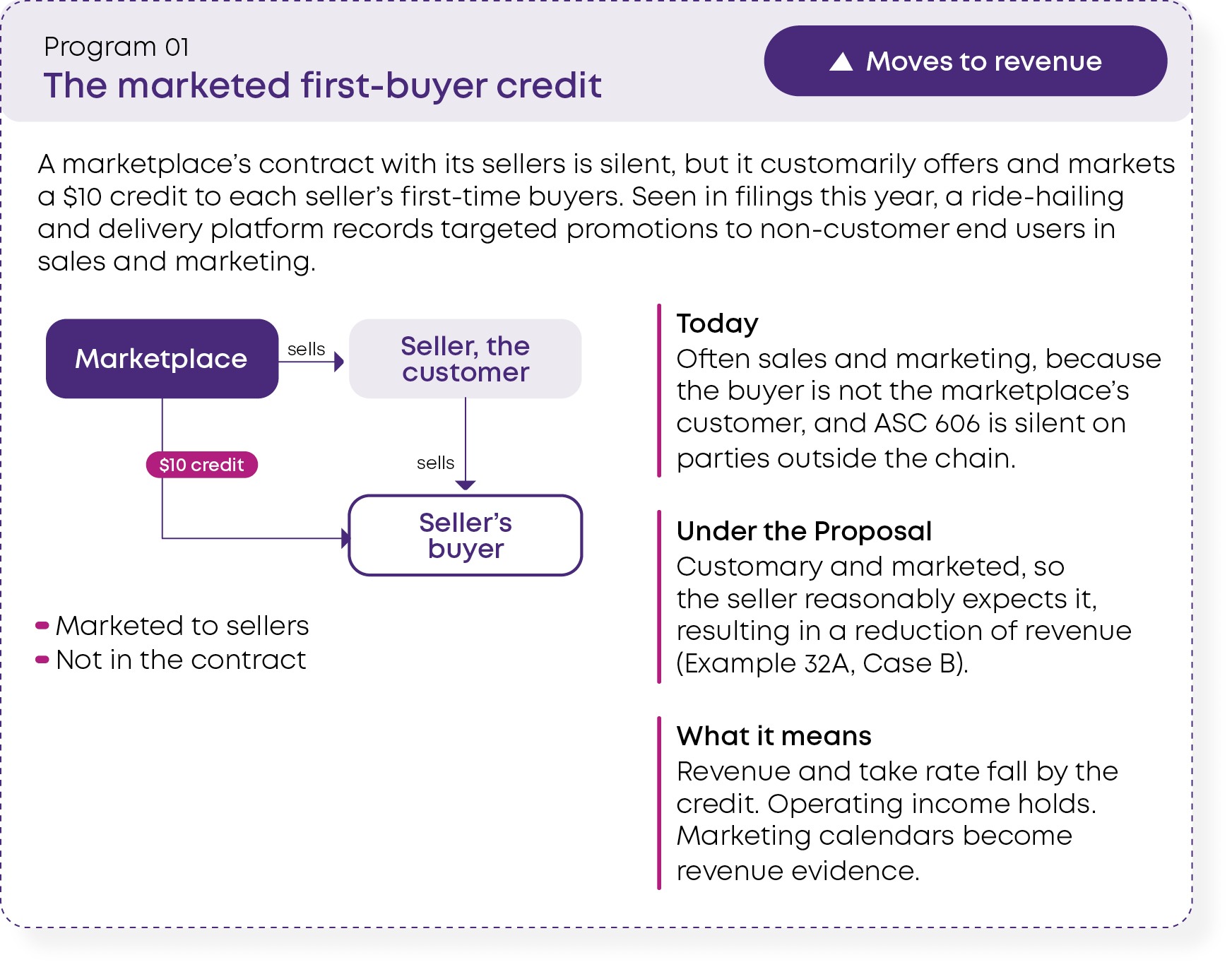
- For Program A, the restaurant contracts are silent, so there is no explicit promise. However, the platform’s published materials and customary practice create an implicit promise, and restaurants reasonably expect the discount to be offered to their new diners. (The facts mirror Example 32A, Case B of proposed ASU).
- For Program B, there is no explicit promise and nothing communicated to restaurants from which an expectation could arise. The points do not lower the price of any restaurant’s meal. Absent other facts, the payment is not made in connection with the promise to the restaurant.
Outcome
Program A is consideration payable to a customer and reduces revenue from restaurants, unless it purchases a distinct good or service. Program B remains within other GAAP and is likely to stay in sales and marketing expense, subject to judgment on how restaurants perceive it.
The Question
Why is the Board clarifying the accounting for payments that skip the chain?
01
What problem is the FASB trying to address?
ASC 606 names the customer and the customer’s customer in the distribution chain, and leaves payments that skip the chain to judgment.
1.1 The payments that skip a step
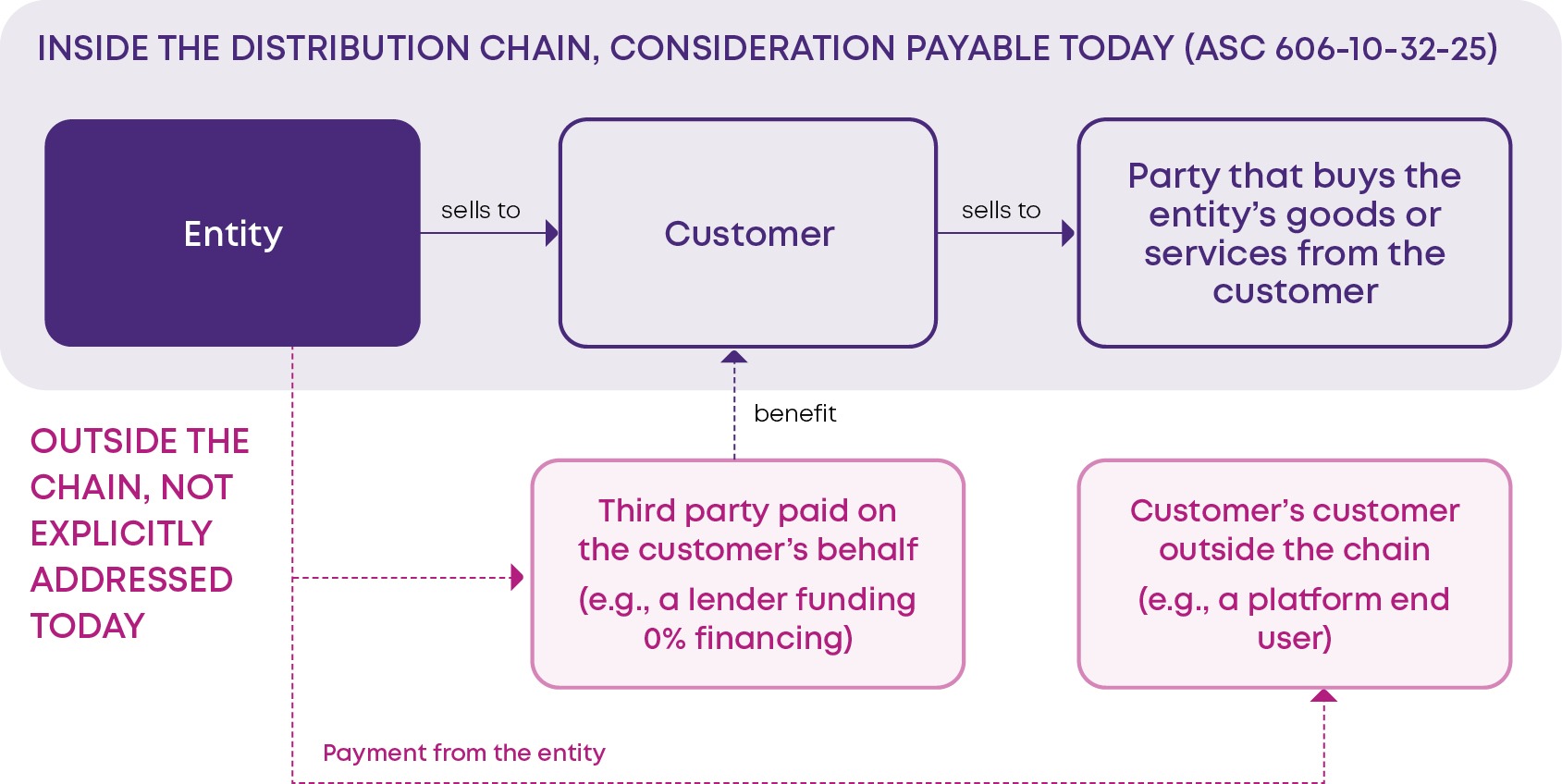
- The existing guidance is clear for payments within the distribution chain. Under ASC 606, payments made to a customer, including parties that purchase the entity’s goods or services from that customer, generally reduce revenue unless the payment is in exchange for a distinct good or service. For example, when a manufacturer provides a rebate directly to a shopper who purchased its product from a retailer, the rebate generally reduces the manufacturer’s revenue.
- The guidance is less clear for payments made outside this chain. This includes payments made on behalf of a customer to a third party, such as a retailer paying a bank to offer interest-free financing to a shopper. It also includes payments made directly to a customer’s customer who does not purchase the entity’s goods or services, such as a marketplace providing shopping credits to buyers purchasing from third-party sellers.
- There is a basis for treating these payments as expenses. A platform may view incentives offered to end users as a cost of attracting buyers and growing its network, rather than as a reduction in the revenue earned from individual sellers. Since ASC 606 does not specifically address all such arrangements, some companies have treated these payments as operating expenses.
- The result has been differences in practice. The FASB has observed that companies account for economically similar payments differently, with some reporting them as a reduction of revenue and others as operating expenses. These differences are particularly relevant for technology-driven platforms that connect buyers and sellers, although the issue is not limited to these businesses.
1.2 How the proposal developed
From agenda consultation to exposure draft
Several respondents to the FASB’s 2025 Invitation to Comment identified consideration payable to a customer as a priority, citing multi-party arrangements.
The Emerging Issues Task Force (EITF) Agenda Committee adds the issue. The Task Force develops a solution based on explicit promises and reasonable expectations.
The Board adds a project to its technical agenda to clarify the guidance in Topic 606, following the EITF’s recommendation.
Proposed ASU issued for public comment, approved by a unanimous vote of the seven Board members.
Comment period closes.
Redeliberations, a final ASU and an effective date set after the Board considers feedback.
Source: EITF Issue Summary No. 2, Consideration Payable to a Customer (June 2026), and EITF meeting summary (June 23, 2026); FASB Board meeting minutes, August 19, 2026; FASB proposed ASU, October 22, 2026.
Practical Perspective
- Improving comparability. Revenue is a key measure of business performance and company valuation. The FASB’s concern is that different accounting for similar incentives can distort comparisons across companies.
- Same economics, different reporting. Two platforms with similar business models may report different revenue, take rates and gross margins simply because they account for customer incentives differently. The proposal aims to reduce these differences.
The Question
When a payment reaches past our customer, which line does it land on?
02
The Test in Four Steps
The proposal introduces a key question. When a payment goes beyond the entity’s direct customer, was it promised explicitly or is it reasonably expected by the customer?
2.1 The “in connection with” test
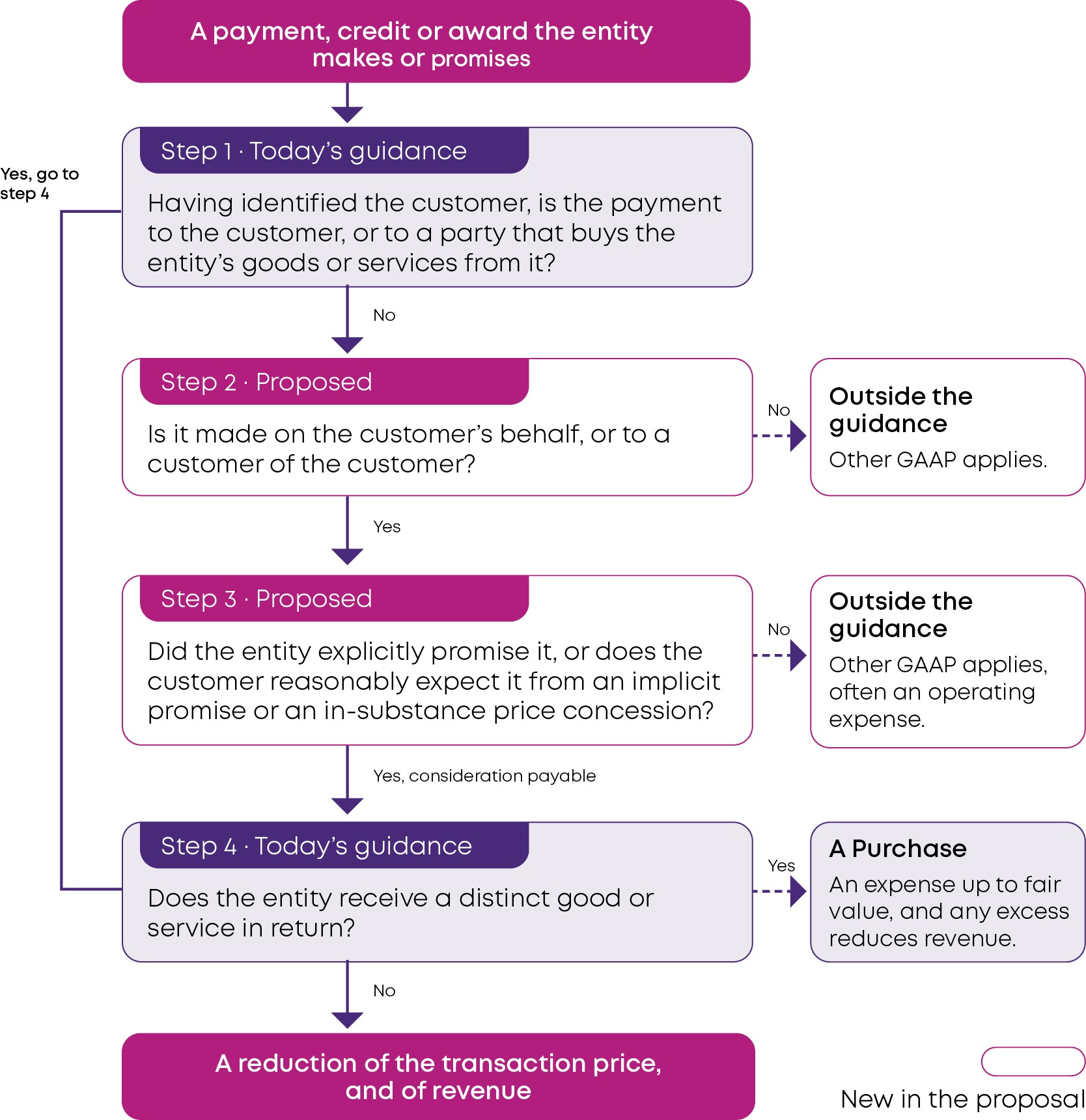
New ASC 606-10-32-25B brings payments made on behalf of a customer, or to a customer of the entity’s customer, into consideration payable to a customer when they are made in connection with the entity satisfying its promise to its customer. ASC 606-10-32-25C sets out when that link exists. The test turns on the relationship between the payment and the promise to the customer, whoever receives the cash.
The proposal adds a gate to the existing model. Steps 2 and 3 below are new. Step 4, the distinct-good-or-service test, and everything ASC 606 says about measuring and timing consideration payable stay as they are.
The decision path for a payment that skips a step
A payment, credit or award the entity makes or promises
| Step | Question | No | Yes |
|---|---|---|---|
| Step 1 · Today’s guidance | Having identified the customer, is the payment to the customer, or to a party that buys the entity’s goods or services from it? | Step 2 · Proposed | Yes, go to step 4 |
| Step 2 · Proposed | Is it made on the customer’s behalf, or to a customer of the customer? | Outside the guidance. Other GAAP applies. | Step 3 · Proposed |
| Step 3 · Proposed | Did the entity explicitly promise it, or does the customer reasonably expect it from an implicit promise or an in-substance price concession? | Outside the guidance. Other GAAP applies, often an operating expense. | Yes, consideration payable |
| Step 4 · Today’s guidance | Does the entity receive a distinct good or service in return? | A reduction of the transaction price, and of revenue | A Purchase. An expense up to fair value, and any excess reduces revenue. |
2.2 Three routes into revenue
The proposed amendment recognizes three ways in which a payment becomes linked to the promise to the customer. Each is illustrated in the new implementation guidance.
Explicit promise [32-25C(a)]
FASB illustration
- Example 32A, Case A. A platform’s contract with a seller commits it to a $10 credit for the seller’s first-time buyers.
- The credit is consideration payable to the seller.
Evidence to gather
- Contract terms, side letters and program agreements.
- Amendments and MSA versions in force when the payment was made
Implicit promise [32-25C(b)]
FASB illustration
- Example 32A, Case B. The seller contract is silent, but the platform customarily offers and markets the $10 credit.
- The seller reasonably expects it, so it is consideration payable.
Evidence to gather
- Published policies and marketing materials available to the customer
- Frequency and consistency of the practice
- Statements by sales and account teams
In-substance price concession [32-25C(b)]
FASB illustration
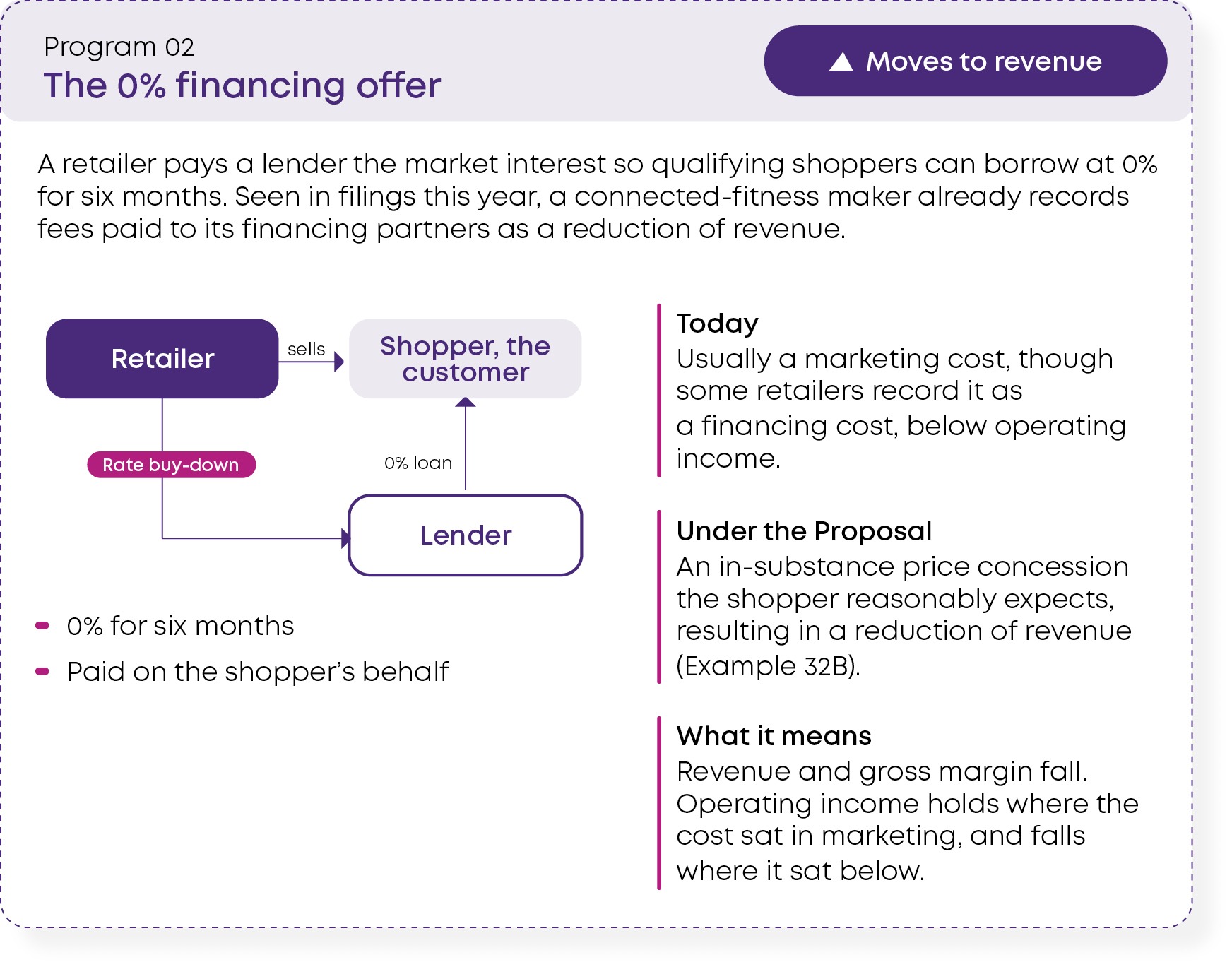
- Example 32B. A retailer pays Bank A the market interest on six-month 0% loans for customers spending over $2,000.
- The payments are consideration payable even though the retailer does not control the bank’s underwriting.
Evidence to gather
- Link between the payment and the price the customer pays
- Eligibility rules and promotional terms
- Whether the benefit is available only on purchases from the entity
Illustrative Example | Promotional financing at a retailer
Facts
A retailer sells a television for $2,400 to a customer who finances the purchase through Bank A at 0% for six months. Under the promotion, the retailer pays Bank A $96, the market interest for the six-month loan. The retailer currently presents the payment as a selling expense.
Analysis
The payment is made on behalf of the customer and is an in-substance price concession. It lowers the effective cost of the television to the customer and is available only on qualifying purchases from the retailer. The retailer receives no distinct good or service from the customer in exchange.
Outcome
Revenue is $2,304 rather than $2,400, and the $96 selling expense is removed. Operating income is unchanged. The reduction is recognized when the related revenue is recognized, because the payment is promised at the point of sale.
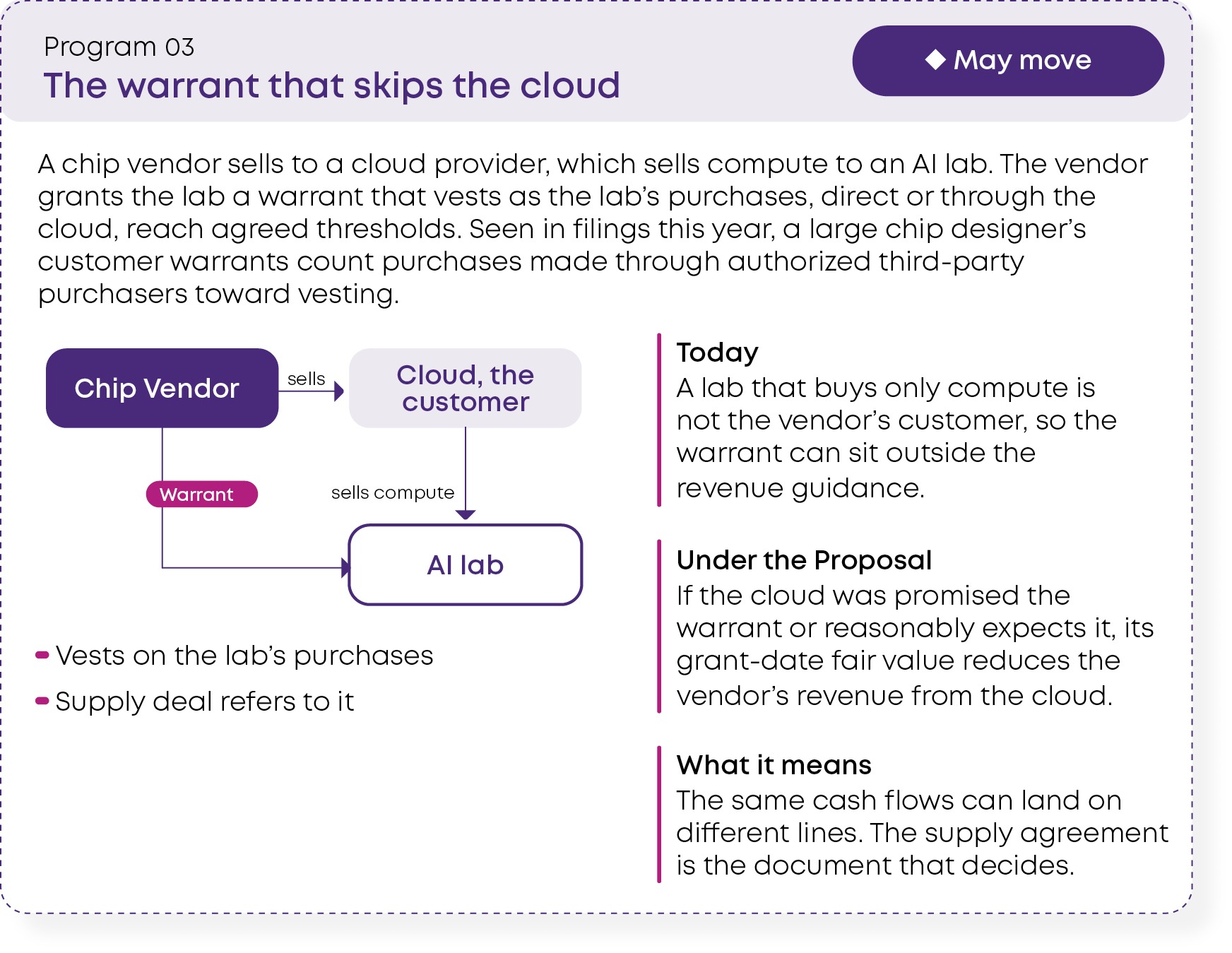
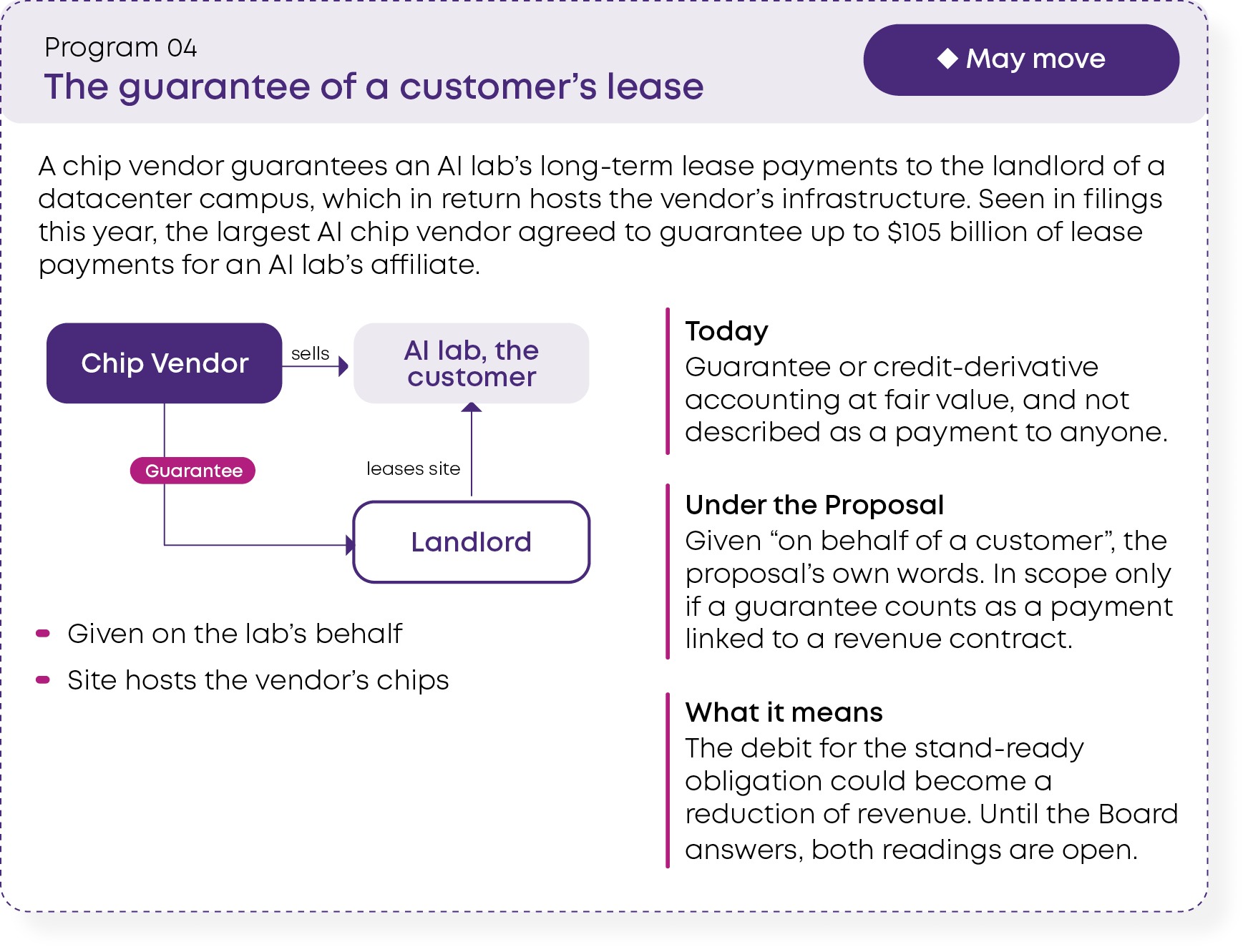
2.3 Applying the Proposed Guidance: Six Illustrative Programs
Where six programs sit today and where they land
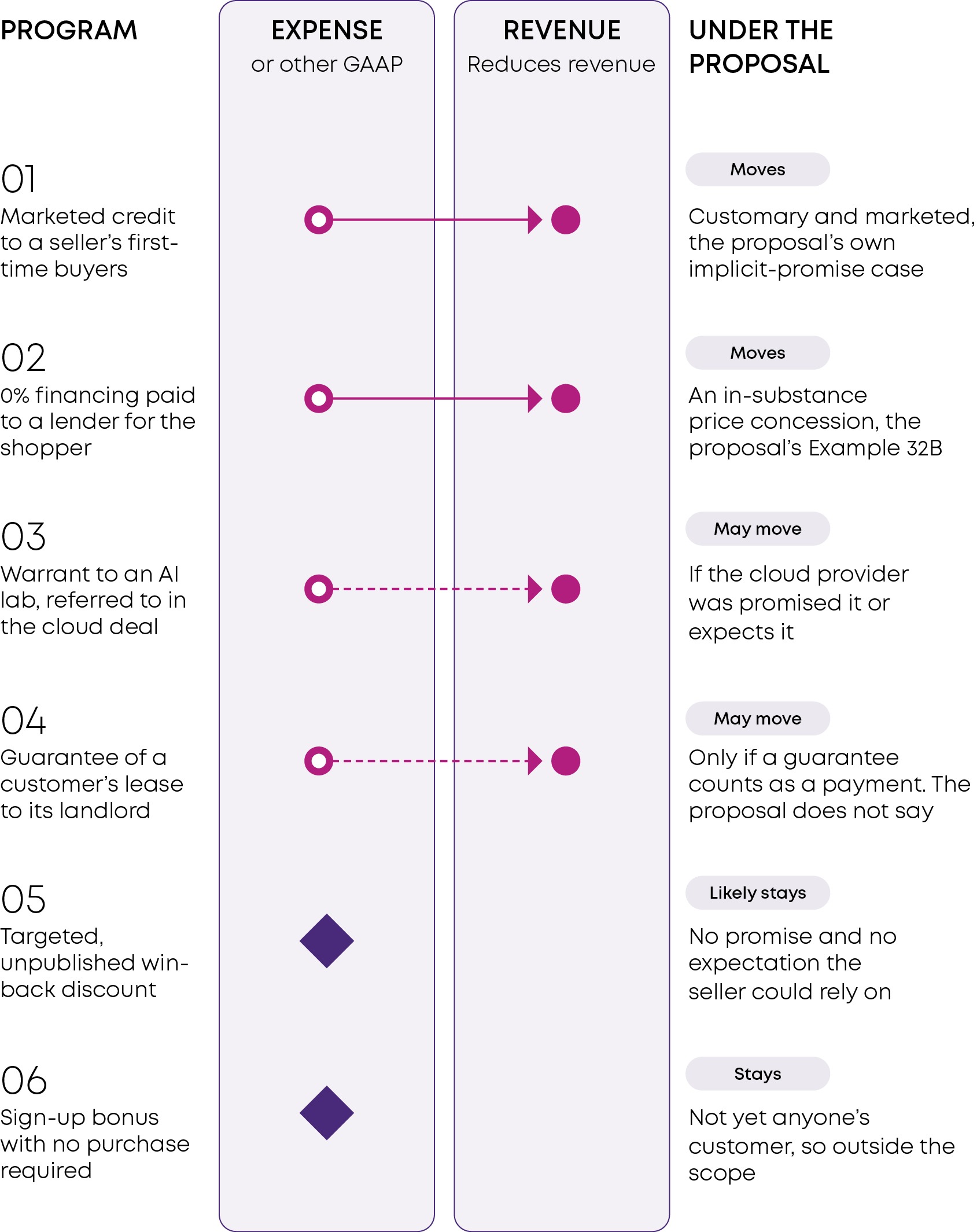
Source: Uniqus analysis of the proposed ASU for the typical case of each program.
2.4 Shares and warrants
Equity awards follow the same principle. The proposal extends the scope assessment to share-based payments made on behalf of a customer or to a customer’s customer through a conforming amendment to ASC 718 (paragraph 718-10-15-5A). Separately, ASU 2025-04, effective for annual periods beginning after December 15, 2026, and interim periods within those annual periods, treats vesting conditions linked to a customer’s purchases as performance conditions and removes the variable consideration constraint for such awards.
2.5 A grid any company can use to place its programs
Outside the scope: checked before the grid
The recipient is not a customer or a customer’s customer (steps 1–2), so the payment never reaches the test below.
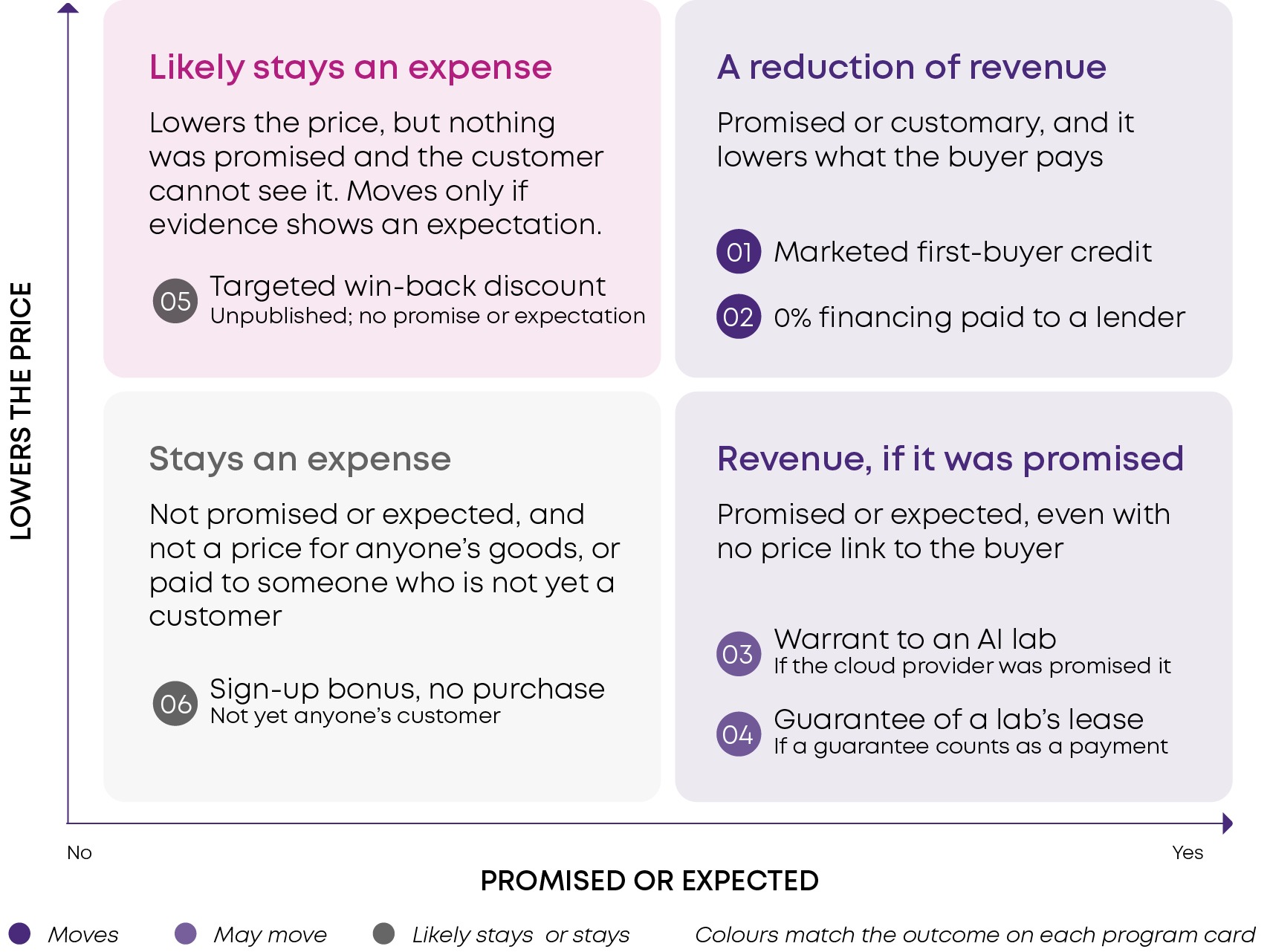
Source: Uniqus analysis of the proposed ASU; programs 1–6 as described in Section 2.
The Question
If our incentives move, what will investors, lenders and the compensation committee see?
03
What could change in the financial statements?
Profit mostly stays where it is. Revenue, take rate and gross margin fall, and operating margin rises because the denominator shrinks.
- Profit generally stays the same when only presentation changes. Moving an incentive from sales and marketing expense to a reduction of revenue lowers both revenue and operating expenses by the same amount. Operating income, net income and cash flow generally remain unchanged, assuming the timing of recognition is unaffected.
- Key performance measures may tell a different story. Revenue, take rate and gross margin may decline, while operating margin may increase because revenue, the denominator used to calculate operating margin, is lower. These changes may affect how investors assess growth, margins and operating efficiency, even though the underlying economics have not changed.
- The impact depends on how much of the incentive meets the proposed test. The following illustration shows how reported results could change when some or all of a platform’s incentives are reclassified as a reduction of revenue.
What changes and what does not in reported results
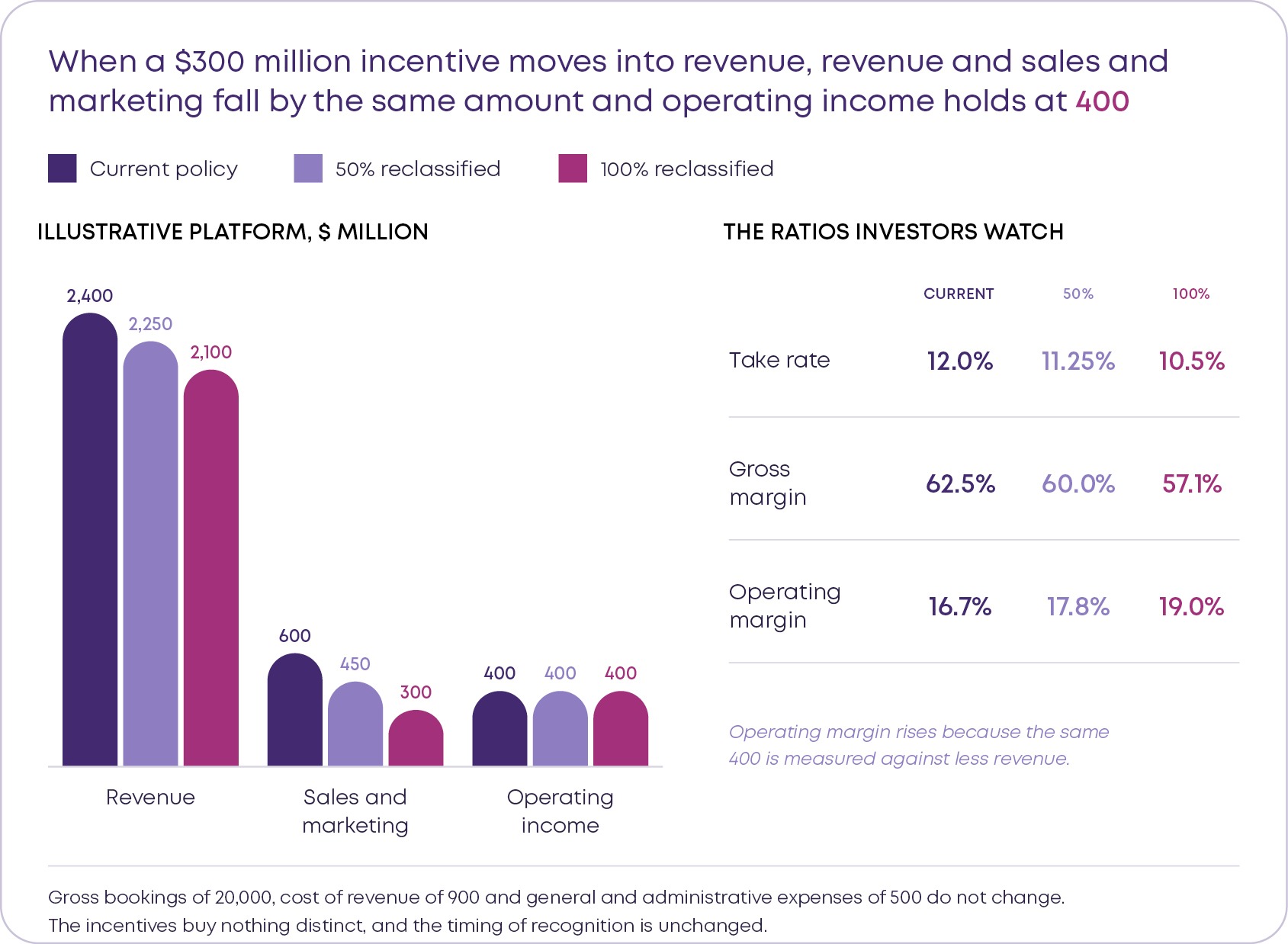
Source: Uniqus illustration with hypothetical figures.
The example assumes the platform currently records $300 million of buyer incentives in sales and marketing expense. Under the proposed ASU, the portion that meets the test is deducted from revenue instead.
| Line item | Current policy | 50% reclassified | 100% reclassified |
|---|---|---|---|
| Gross bookings | 20,000 | 20,000 | 20,000 |
| Revenue | 2,400 | 2,250 | 2,100 |
| Take rate | 12.0% | 11.25% | 10.5% |
| Cost of revenue | 900 | 900 | 900 |
| Gross profit | 1,500 | 1,350 | 1,200 |
| Gross margin | 62.5% | 60.0% | 57.1% |
| Sales and marketing | 600 | 450 | 300 |
| General and administrative | 500 | 500 | 500 |
| Operating income | 400 | 400 | 400 |
| Operating margin | 16.7% | 17.8% | 19.0% |
The example assumes $300 million of incentives are currently included in sales and marketing expense, with 50% or 100% reclassified as a reduction of revenue. The incentives do not represent payments for distinct goods or services, and the timing of recognition is unchanged.
Impact on Revenue and Operating Income
- At 50% reclassified, $150 million is deducted from revenue and removed from sales and marketing expense. Revenue falls to $2,250 million, while operating income remains $400 million.
- At 100% reclassified, the full $300 million is deducted from revenue and removed from sales and marketing expense. Revenue falls to $2,100 million, while operating income remains unchanged.
Impact on Gross Margin
- Take rate and gross margin decline. These measures reflect the lower reported revenue, even though gross bookings and cost of revenue remain unchanged.
Impact on Operating Margin
- Operating margin increases. Operating income is unchanged but is measured against a lower revenue base.
3.1 Timing can move as well as presentation
- The proposal may affect timing as well as presentation. Under ASC 606, consideration payable to a customer is generally recognized as a reduction of the transaction price at the later of when the related revenue is recognized and when the entity pays or promises to pay the consideration.
- For one-off credits, the timing impact may be limited. However, arrangements involving volume-based incentives, recurring credits or seasonal financing programs may require closer review if customary practices or other factors create an expectation of payment before it is formally agreed.
- Timing differences could affect operating income in a particular reporting period, even if the total amount recognized over the arrangement remains unchanged. This may occur when an incentive is recognized earlier as a reduction of revenue than it would have been as an expense, when a financing cost moves from below operating income into revenue, or when a share-based payment becomes subject to the revenue recognition requirements.
When the reduction reaches revenue
Was the payment promised at contract inception, explicitly or through customary practice the customer can rely on?
Priced in from inception
Revenue is reduced as the related revenue is recognized, and variable amounts are estimated and, except share-based awards, constrained.
At the later of two dates
When the related revenue is recognized, and when the entity pays or promises to pay, as with a one-off credit decided after the sale.
- Balance sheet implications should also be considered. Payments made upfront to a customer, including certain share-based awards, may be recognized as an asset when they relate to probable future revenue and meet the applicable recognition criteria. The asset is then amortized as the related revenue is recognized.
3.2 What should companies explain to investors?
| Measure | Potential impact | What management should explain |
|---|---|---|
| Revenue and revenue growth | Lower reported revenue, with growth trends potentially affected in the period of adoption. | Provide a reconciliation between the previous and new presentation, including quarterly impacts where relevant. |
| Take rate | May decline even when gross bookings remain unchanged. | Explain the impact of the reclassification and provide comparable information where available. |
| Gross margin | May decline because revenue decreases while cost of revenue remains unchanged. | Separate the impact of reclassification from changes in underlying operating performance. |
| Operating income and cash flow | Generally unchanged if only presentation changes. | Clearly explain that the accounting change does not necessarily affect profitability or cash flows. |
| Adjusted EBITDA and other non-GAAP measures | May change depending on how incentives and share-based payments are treated in the calculation. | Reassess the measures and their reconciliations to ensure they remain appropriate and comply with SEC requirements. |
The Question
How do companies like ours account for these payments today?
04
Who Could Be Affected? Assessing the Potential Impact Across Business Models
Exposure to the proposed amendment will depend largely on how a company currently accounts for payments made to parties beyond its direct customer.
- The proposal applies to both public and private companies. However, the impact is likely to be greater for businesses that provide incentives to end users or make payments to third parties on behalf of their customers.
- The impact will vary by business model. Many travel platforms and card networks already account for most incentives as reductions of revenue. In our review of 11 filers, four reported expensing at least some incentives provided to end users who were not their direct customers.
- Companies should focus on existing accounting practices. The key question is whether payments currently recorded as operating expenses would need to be reclassified as reductions of revenue under the proposed guidance.
Potential exposure by business model
| Business model | Potential exposure | Payment to review |
|---|---|---|
| Ride-hailing and delivery platforms that treat only drivers or merchants as customers | High | Targeted promotions, referral credits and refunds provided to riders or customers and recorded as sales and marketing expenses. |
| Fintech and payment apps | Medium to high | Cash-back and incentives to users who are not the contracting customer |
| Online marketplaces, ad tech, gaming and commission-sharing brokers | Medium to high | Buyer credits funded for sellers, advertisers or developers, and commission a broker shares with the other party |
| Retailers and brands that fund 0% financing or pay-later offers | Medium | Fees paid to lenders to offer interest-free financing or buy-now-pay-later arrangements. |
| Chip, cloud and AI vendors with three-party arrangements | Medium, concentrated | Awards, funding or guarantees that reach a party one step past the customer (see Section 5) |
| Travel platforms and card networks | Low | Many incentives are already reported as reductions of revenue, although individual arrangements may still require review. |
Eleven filers, two answers (expense versus reduction of revenue)
EXPENSE SOME INCENTIVES
Four filers with payments to people who are not their customer
01 Ride-hailing and delivery platform
US-listed, large-cap
- Drivers and merchants are generally treated as customers, while end users are customers only when Company provides the service directly or charges them a platform fee.
- Promotions that do not create a reasonable customer expectation are recorded as sales and marketing expenses, whereas market-wide promotions are treated as reductions of revenue
Company’s Existing Accounting Policy for End-User Incentives
Company distinguishes between targeted incentives and market-wide pricing actions:
- Targeted discounts and promotions. Offers to selected users to acquire or re-engage them are recorded as sales and marketing expenses when redeemed, if the users are not Company’s customers.
- Referral incentives. Credits to existing users for referring new users are recorded as sales and marketing expenses when earned.
- Market-wide promotions. Broad-based fare discounts, including certain subscription and rewards discounts, are recorded as reductions of revenue when the transaction is completed.
- Refunds and credits. Treatment depends on whether the end user is considered a customer in the relevant market. Refunds recovered from drivers or merchants are recorded as reductions of revenue.
Potential Impact of proposed amendment:
Potentially significant exposure. Company’s current policy distinguishes between targeted user-acquisition incentives, which are generally expensed, and market-wide pricing discounts, which reduce revenue. Under the FASB’s proposal, targeted incentives may require reassessment if they create an explicit or reasonably expected promise to a customer.
02 Rideshare platform
US-listed
- Credits and refunds to riders of $21.2 million in sales and marketing in 2025
Company’s Existing Accounting Policy for Incentive Programs
Company’s accounting treatment varies by incentive type and business model:
- Driver incentives. Volume-based incentives are generally recorded as reductions of revenue. Referral incentives for attracting new drivers or riders are recorded as sales and marketing expenses, to the extent the payment does not exceed the fair value of the benefit received. In certain markets where Company controls the transportation service, driver incentives are recorded as cost of revenue.
- Market-wide rider promotions. Discounts available for all or substantially all rides in a specific market are recorded as reductions of revenue.
- Targeted rider promotions. Limited offers, such as discounts on a capped number of rides, are generally recorded as sales and marketing expenses when redeemed. However, in markets where Company controls the transportation service, these incentives reduce revenue.
- Rider referral incentives. Credits earned when a new rider completes their first ride are recorded as sales and marketing expenses when earned.
- Refunds and credits. Non-recoverable refunds to dissatisfied riders are generally recorded as sales and marketing expenses. Credits and refunds for bike and scooter riders are recorded as cost of revenue.
Potential Impact of proposed amendment:
Targeted rider promotions and refunds warrant review. Company’s policy distinguishes between broad-based price reductions, which generally reduce revenue, and targeted promotions and referral incentives, which are generally recorded as expenses. Under the FASB’s proposal, targeted incentives may require reassessment based on whether they create an explicit or reasonably expected promise to a customer, rather than relying solely on whether a legal obligation exists.
03 Digital payments company
US-listed, large-cap
- The amount in sales and marketing is not disclosed
Company’s Existing Accounting Policy for Incentive Programs
Company provides merchants and consumers with incentives, including fee discounts, rebates, rewards and coupons, to encourage platform engagement and acquire new users.
- Customer incentives. Incentives identified as consideration payable to a customer or paid on the customer’s behalf are recorded as reductions of revenue. Performance-based incentives are recognized when earned, based on estimated customer performance, while other incentives are generally recognized ratably over the contractual term.
- Non-customer incentives. Certain incentives paid to users who are not Company’s customers are recorded as sales and marketing expenses.
Potential Impact of proposed amendment:
Impact cannot be quantified from the filing. Company’s policy distinguishes incentives based on whether the recipient is a customer or the payment is made on a customer’s behalf. Under the FASB’s proposal, incentives currently classified as sales and marketing expenses may require reassessment if they are explicitly promised or reasonably expected by a customer.
04 Mobile-games platform
US-listed, small-cap
- $6.7 million reduced revenue and $32.9 million was in sales and marketing in 2025, a critical audit matter
Existing Accounting Policy for End-User Incentives
Company distinguishes between incentives offered on behalf of game developers, for which developers have a valid expectation, and those for which no such expectation exists.
- Incentives reducing revenue. Promotions that reduce end-user entry fees and are offered on behalf of developers are recorded as reductions of revenue when developers have a valid expectation that the incentives will be provided. The assessment considers customary practices, published policies and specific statements. Company reported $6.7 million in such reductions of revenue in 2025.
- Incentives recorded as expenses. Targeted, limited-time offers intended to attract or re-engage users are recorded as sales and marketing expenses when developers do not have a valid expectation of the incentives. Company reported $32.9 million in such expenses in 2025.
- Refunds and credits. Non-recoverable refunds to dissatisfied users are recorded as sales and marketing expenses when incurred if developers have no valid expectation that Company will provide them.
Potential Impact of proposed amendment:
An existing expectation-based assessment. Company distinguishes between incentives provided on behalf of game developers and those for which developers have no valid expectation. Its disclosures provide a useful example of the evidence that may be relevant when assessing customer expectations.
ALREADY REDUCE REVENUE
Seven filers
01 Connected-fitness maker
US-listed
- Fees paid to third-party financing partners reduce revenue, as a customer sales incentive. Matches the proposal’s Example 32B
Company’s Existing Accounting Policy for third party financing fees
Company records fees paid to third-party financing partners under its consumer financing program as a reduction of revenue, treating them as customer sales incentives. In contrast, payment processing fees for credit card sales are recorded as sales and marketing expenses.
Potential Impact of proposed amendment:
An example of existing alignment. Company records fees paid to third-party financing partners for consumer financing programs as reductions of revenue. This is consistent with the treatment contemplated by the proposal for similar arrangements.
02 Two delivery platforms- Food and grocery
US-listed
Existing Accounting Policy for Incentives
These companies generally account for consumer or guest promotions as reductions of revenue, although their policies differ in certain areas.
- Accounts for contracts with consumers and generally reflects consumer promotions as reductions of revenue.
- Records certain promotional shortfalls as reductions of revenue.
Potential Impact of proposed amendment:
Largely aligned, with some areas to review. These companies generally report consumer or guest promotions as reductions of revenue. However, individual policies, including payments that exceed cumulative revenue from a customer, may warrant further assessment.
03 Home-sharing and online travel platforms
US-listed
Existing Accounting Policy for Incentives
These companies generally account for consumer or guest promotions as reductions of revenue, although their policies differ in certain areas.
- Treats both hosts and guests as customers. Payments to customers that exceed the cumulative revenue recognized from them may be recorded as operating expenses rather than reductions of revenue.
- Generally accounts for consumer incentives and promotions as reductions of revenue.
Potential Impact of proposed amendment:
Largely aligned, with some areas to review. These companies generally report consumer or guest promotions as reductions of revenue. However, individual policies, including payments that exceed cumulative revenue from a customer, may warrant further assessment.
04 Two card networks
US-listed, large-cap
Existing Accounting Policy for Client Incentives
Companies account for significant client incentives and rebates as reductions of revenue.
- Rebates and client incentives provided to customers, sellers and other business partners are recorded as reductions of net revenue.
Potential Impact of proposed amendment:
Established revenue-reduction practices. Companies report significant client incentives, rebates and similar payments as reductions of revenue. Their disclosures provide useful benchmarks for companies assessing how incentives to parties beyond the contracting customer are presented.
Source: Form 10-K filings for fiscal 2025. Policies are paraphrased from the filings.
4.1 Ride-hailing and delivery platform: Where the judgment becomes important
One US-listed ride-hailing and delivery company illustrates why the proposal may require companies to look beyond their existing accounting policies. Its reported $1.6 billion of discounts, promotions, credits and refunds to non-customer end users represents a potentially relevant population, but it is not a forecast of the amount that would be reclassified.
Why some promotions may reduce revenue
- Promotions are frequent, customary and visible to users, potentially creating a reasonable expectation of receiving them.
- Discounts may reduce the amount end users pay for services provided by drivers or merchants, raising the question of whether they represent a price concession.
- The EITF’s discussion notes that SEC staff had previously challenged sales and marketing treatment in certain circumstances.
Why other promotions may remain expenses
- Some targeted offers may be designed primarily to attract users to the platform, without creating an expectation on the part of drivers or merchants.
- Drivers or merchants may not know which users receive particular discounts, making it difficult to establish a reasonable expectation.
- The assessment cannot be based solely on who benefits most from the payment. The proposed guidance focuses on the nature of the promise and the relevant customer relationship.
Practical Perspective
- Companies with similar business models should assess each type of incentive separately rather than applying one conclusion to all promotions.
- Marketing materials, app offers, promotion terms and sales communications may provide important evidence of what customers reasonably expect.
- The proposed guidance leaves room for judgment, so companies should document their conclusions and discuss significant arrangements with their auditors early.
The Question
Does the proposal catch the circular deals in AI infrastructure?
05
Does the proposal address circular arrangements involving AI companies?
The proposal is not designed to address every form of circular arrangement. Its focus is narrower: payments or other forms of consideration that go beyond an entity’s direct customer. This distinction matters in the AI industry, where chip vendors, cloud providers and AI companies increasingly invest in one another, enter into capacity agreements and provide financial support. The proposed ASU does not mention AI, and its examples involve a platform and a retailer. The AI arrangements in this section are Uniqus illustrations of how the proposed test could apply.
- Circular arrangements take different forms. Chip and cloud vendors may invest in customers, grant them shares or warrants, purchase capacity from them, or guarantee their obligations to third parties. Although these arrangements may create the appearance of value flowing back to the vendor, their accounting depends on the substance of each transaction.
- Many arrangements already fall under existing guidance. Where a vendor provides equity to its direct customer in connection with a sales contract, the award may be consideration payable to that customer and reduce revenue. Some companies already report this treatment.
- The proposed guidance may matter more in three-party arrangements. The key question is whether a vendor’s payment or other consideration to an AI company, which buys computing capacity through a cloud provider, was promised to the cloud provider or is reasonably expected by it.
- The accounting outcome is not determined by the direction of the cash flow alone. The nature of the arrangement, the parties involved and the expectations created by the contract will all matter.
Four Types of Arrangements and What the Proposal Could Change
01 Shares or warrants linked to customer purchases
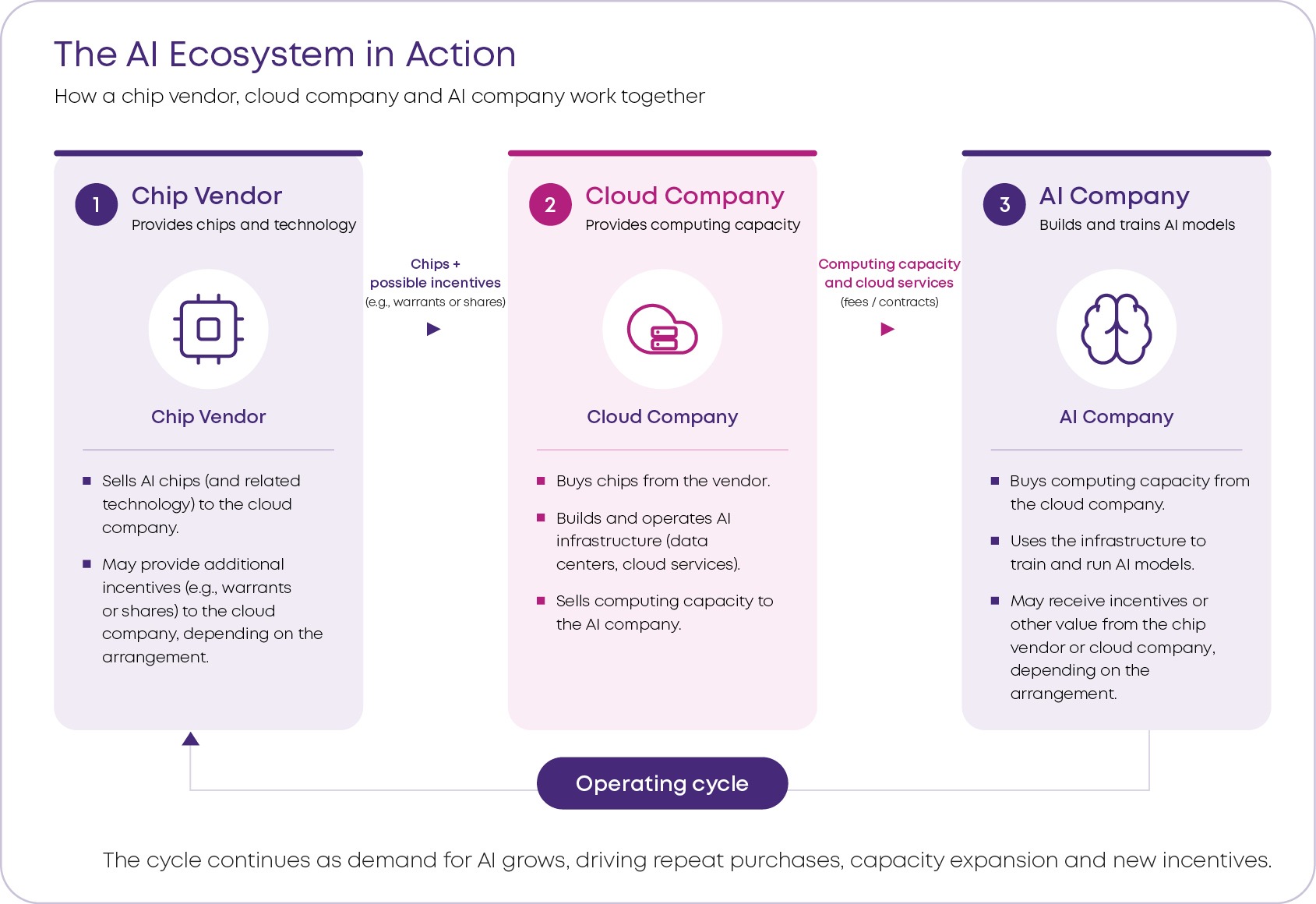
The key accounting question arises when the chip vendor provides an incentive directly to the AI company, even though the cloud company is the chip vendor’s direct customer.
Example: A chip vendor gives warrants to an AI company that buys its chips.
Accounting implication: If the warrant is consideration payable to the direct customer and does not pay for a distinct good or service, it generally reduces revenue under existing ASC 606 guidance, subject to the applicable recognition requirements.
How the proposed test could apply (Uniqus view). Usually, nothing if the AI company is the chip vendor’s direct customer. The more difficult case is when the AI company buys computing capacity from a cloud provider, but the chip vendor gives the warrant to the AI company. The proposal’s scope test then becomes relevant: was the benefit promised or reasonably expected by the chip vendor’s direct customer, the cloud provider? The proposed conforming amendment to ASC 718 could make the scope assessment relevant.
What the filings show
- A wafer-scale chip maker: customer warrant assets of $1.1 billion.
- A GPU-cloud provider: $350 million of shares to an AI lab as a contract incentive.
- A large chip designer: warrants over up to 160 million shares each to two AI customers, none vested by late June 2026.
02 An investor takes an equity stake in its customer
Example: A cloud provider invests in an AI company that also buys its cloud services
Cloud provider
Invests $500 million
AI Company
Receives investment and buys cloud services
Accounting implication: An investment made at fair value is generally accounted for as an investment and does not reduce revenue solely because the AI company is also a customer. Revenue from cloud services is accounted for separately.
How the proposed test could apply (Uniqus view). The investment itself is not the focus. However, if the investment is linked to additional benefits or payments under a revenue arrangement, those terms may need separate assessment.
What the filings show
- A software major reported $24.1 billion of revenue from an AI lab in fiscal 2026 alongside its equity-method investment.
- A cloud major: a facility of up to $20.0 billion to an AI lab that opens as compute delivery milestones are met.
03 A vendor buys capacity back from its customer
Example: A chip vendor buys unused computing capacity from an AI cloud provider.
Chip vendor
Sells chips for $1 billion
AI cloud provider — direct customer
Buys chips and later sells computing capacity back to the vendor
Accounting implication: If the vendor purchases a distinct service at fair value, it generally accounts for the purchase separately. If the payment exceeds the fair value of the service, the excess may be treated as consideration payable to the customer and reduce revenue.
How the proposed test could apply (Uniqus view). Generally, the proposal does not change this analysis when the payment is made to the direct customer. Existing guidance already addresses purchases from customers.
What the filings show
- The largest AI chip vendor: $36 billion of commitments under AI cloud agreements.
- A GPU-cloud provider: a $6.3 billion order from it for unsold capacity.
04 A vendor guarantees its customer’s obligations to a third party
Example: A chip vendor guarantees an AI lab’s lease obligations to the landlord of a data center campus.
Chip Vendor
Provides a lease guarantee
Landlord / lender
Receives credit support for lease obligations
The guarantee supports infrastructure used by the vendor’s AI customer.
Accounting implication: The guarantee may need to be accounted for under applicable guarantee or derivative guidance. A separate question is whether it qualifies as consideration within the proposed revenue guidance.
How the proposed test could apply (Uniqus view). This is an open interpretive question. The guarantee benefits a third party and may be provided on behalf of a customer, but the proposal does not clearly establish how guarantees should be treated. Clarification from the FASB would be helpful.
What the filings show
- The largest AI chip vendor: guarantees capped at $105 billion for 20-year leases covering 4.25 GW at a campus, given on behalf of an AI lab’s affiliate.
Source: Forms 10-K, 10-Q and 8-K filed between March 2025 and September 2026 by the companies described, with amounts as filed. Companies are described without being named. “How the proposed test could apply” reflects Uniqus analysis.
5.1 Where the Proposed Test Becomes Relevant
The most challenging arrangements are those involving three parties: a chip vendor supplies infrastructure to a cloud provider, the cloud provider sells computing capacity to an AI company, and the chip vendor provides equity or other financial support to that AI company.
- Start with the customer relationship. The cloud provider may be the chip vendor’s direct customer, while the AI company purchases computing services from the cloud provider. Whether the AI company falls within the relevant distribution chain is central to the analysis.
- Then assess the promise or expectation. The proposal asks whether the direct customer was explicitly promised the payment or could reasonably expect it. The answer may depend on the supply agreement, related commercial arrangements and the parties’ communications.
- Similar economics may produce different accounting outcomes. For example, the same warrant could reduce revenue if it falls within the proposed guidance, but remain outside that guidance if the relevant scope criteria are not met. The contractual terms and relationship between the arrangements therefore deserve close attention.
One Warrant, Three Possible Outcomes
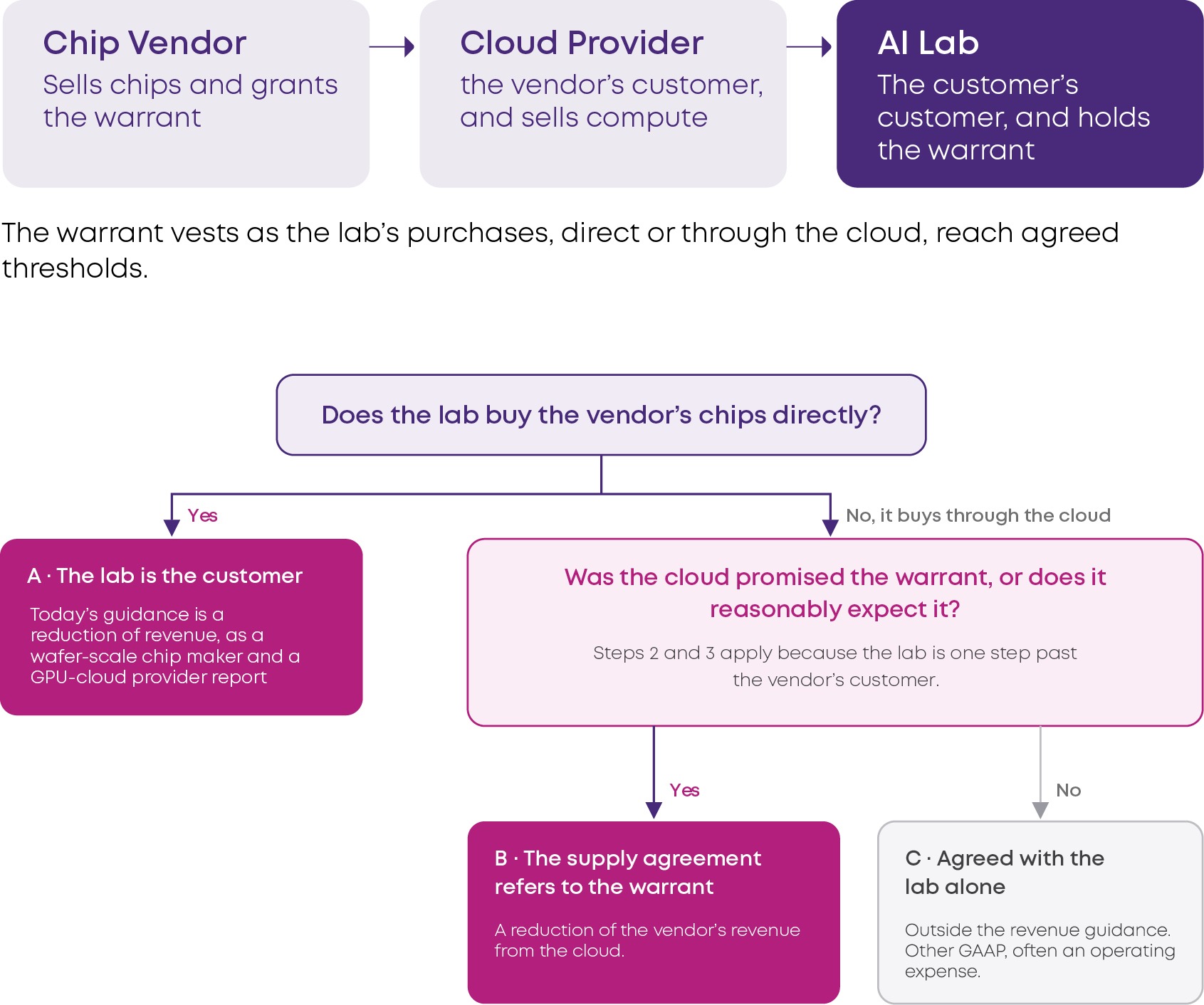
A warrant granted to an AI company could produce different accounting outcomes depending on the facts:
- Scenario A. The AI company is the direct customer. The warrant is assessed under the existing consideration-payable guidance and may reduce revenue as the related revenue is recognized.
- Scenario B. A cloud provider is the direct customer, and the award is promised or reasonably expected by the cloud provider. The proposed scope test may bring the award within the revenue guidance, subject to the other applicable requirements.
- Scenario C. A cloud provider is the direct customer, but the award was neither promised nor reasonably expected by it. The award may fall outside the proposed consideration-payable guidance, depending on the full facts and applicable requirements.
The scenarios illustrate why the commercial arrangements and the expectations they create may matter as much as the payment itself. Companies should review the supply agreement and related commitments alongside the warrant documentation.
Guarantees: An Important Open Question
Guarantees may present a more difficult question than equity awards because they are not expressly listed among the common forms of consideration payable described in ASC 606.
- Are guarantees within the proposed scope? A guarantee provided on behalf of a customer may fit the proposal’s broader objective, but the Board should clarify whether guarantees qualify as consideration payable and how the scope test applies when the customer obtains services through an intermediary.
- How should the guarantee be recorded? The applicable guidance, including ASC 460 or derivative accounting where relevant, will determine the initial recognition and subsequent measurement. Whether any amount should also be treated as consideration payable to a customer requires a separate assessment.
- How should indemnities be considered? A customer indemnity may reduce the vendor’s exposure, but the amount and timing of any recovery depend on the contractual terms and the indemnifying party’s ability to pay. The indemnity should not automatically be assumed to eliminate the risk.
Practical Perspective
Circular Economics, Different Accounting Questions
- Do not assume that circular economics automatically mean revenue should be reduced. Customer equity awards, investments and capacity purchases may already be addressed by existing guidance.
- Focus on indirect arrangements. Equity awards to an AI company purchasing through a cloud provider, and guarantees supporting a customer’s obligations to a landlord, raise questions that may not be resolved clearly by the proposed examples.
- Seek clarification from the FASB. AI companies and infrastructure vendors should consider requesting examples covering three-party equity arrangements and guarantees in their comment letters.
The central question is whether the arrangement creates consideration promised, or reasonably expected, by the vendor’s customer, and whether the proposed guidance applies to that form of consideration.
The Question
Where will we and our auditors disagree?
06
Where the Key Accounting Judgments Will Arise
The proposal adds a new assessment to existing revenue guidance. In practice, five questions are likely to drive much of the discussion between companies and their auditors. Each requires careful judgment, and the supporting evidence will be important.
Five Key Judgments Under the Proposed Guidance
“Was the payment made on behalf of a customer or to a customer of an entity’s customer?”
| Likely starting point for the assessment | Alternative view to consider | Evidence to support the conclusion |
|---|---|---|
| A payment that covers a cost the customer would otherwise have to bear may be viewed as being made on its behalf. | A payment that primarily relates to the entity’s own operations, such as its own payment-processing costs, may not be a payment on behalf of the customer. | Contractual terms, responsibility for the cost, and who would bear it if the payment were not made. |
“Could the customer reasonably expect the payment?”
| Likely starting point for the assessment | Alternative view to consider | Evidence to support the conclusion |
|---|---|---|
| Regular practices, published terms and specific communications may create a reasonable expectation, even without a contractual obligation. | A discretionary, one-off offer that is not communicated to the customer may not create such an expectation. | Marketing materials, sales communications, published policies and the frequency and consistency of past offers. |
“Is the payment an in-substance price concession?”
| Likely starting point for the assessment | Alternative view to consider | Evidence to support the conclusion |
|---|---|---|
| A payment that effectively reduces the price paid for the customer’s goods or services may be a price concession. | A payment unrelated to the price of those goods or services, such as a reward under a platform’s own loyalty program, may not be a price concession. | How the payment relates to the transaction price, eligibility requirements and the price the customer would otherwise charge. |
“Who is the customer?”
| Likely starting point for the assessment | Alternative view to consider | Evidence to support the conclusion |
|---|---|---|
| The contractual relationship and principal-versus-agent assessment help determine who the customer is for the relevant service. | In a marketplace, both sides may be customers for different services, so the conclusion may vary by arrangement. | Customer-identification analysis, principal-versus-agent conclusions and the terms of each incentive program. |
“Does the payment buy a distinct good or service?”
| Likely starting point for the assessment | Alternative view to consider | Evidence to support the conclusion |
|---|---|---|
| The existing ASC 606 requirements continue to apply. If the payment does not relate to a distinct good or service, it may reduce revenue. | If the entity receives a distinct good or service, such as advertising, data or promotional placement, the payment may be accounted for as a purchase, up to its fair value. | Evidence of the service received, whether it is distinct and its standalone fair value. Any excess over fair value generally reduces revenue. |
6.1 Negative Revenue: What Happens When Payments Exceed Revenue?
The proposal does not explain how an entity should present payments that exceed the cumulative revenue recognized from a customer. This could become more relevant if the new guidance brings additional incentives within the scope of consideration payable to a customer.
- There is no explicit floor under revenue in ASC 606. Depending on the facts and the accounting policy applied, payments may result in negative revenue. Some companies instead present amounts exceeding cumulative revenue from a customer as expenses, drawing on guidance that preceded ASC 606.
- The proposal leaves this question open. In August 2026, the FASB decided not to add a separate project on negative revenue. However, Question 4 in the proposed ASU asks whether the amendments could make negative revenue more common.
- Companies should assess whether the issue could affect them. A useful response to the FASB would quantify how often payments might exceed cumulative revenue and explain whether a cap, separate expense presentation or additional disclosure would provide more useful information.
The FASB’s request for feedback creates an opportunity for preparers to explain the practical consequences of the proposed changes and identify where further guidance would help.
When credits exceed the revenue from a customer
MARKETPLACE · ONE SELLER
When Credits Exceed Revenue
Proposal’s Question 4
THE SELLER
A marketplace earns 40 of commission from one seller in a year and funds 55 of marketed credits to that seller’s buyers.
THE NUMBERS, $ THOUSAND
| Commission from the seller | 40 |
| Credits in scope | (55) |
| Net revenue from the seller | (15) |
TWO PRESENTATIONS
- ASC 606 sets no floor, so revenue from the seller can be negative.
- Some companies cap the reduction at cumulative revenue and present the 15 as an expense.
- The proposal is silent. The policy and its disclosure carry the answer.
Source: Uniqus illustration with hypothetical figures.
6.2 Potential Differences Across US GAAP, IFRS and Ind AS
IFRS AND IND AS
The same payment may land on different lines
| US GAAP (proposed) | IFRS 15 | Ind AS 115 | |
|---|---|---|---|
| Payment past the chain | Reduces revenue if promised or reasonably expected | Judgment, with chain wording unchanged (IFRS 15.70) | Judgment, with the same wording (Ind AS 115.70) |
| Change in prospect | Final ASU after comments close November 23, 2026 | None: the IASB rated the topic low priority in 2024 | None in prospect, and any change needs notification by the Ministry of Corporate Affairs |
Groups that report under two frameworks may record the same payment on different lines. A US subsidiary of an Indian or Middle Eastern group that adopts the final ASU may reduce revenue for an incentive the group still expenses under IFRS or Ind AS. IAS 8 and Ind AS 8 let a reporter consider other standard setters’ pronouncements where a standard is silent, so the group policy can follow the US answer or track a GAAP difference.
6.3 What we would ask the Board to clarify
Add an example that concludes no.
Include an example where the payment is outside the scope. The proposed examples illustrate arrangements that qualify as consideration payable. An example concluding that a payment to a customer’s customer does not qualify would help companies understand the boundary.
Clarify when a targeted offer creates an expectation, and what evidence is enough.
Companies may struggle to assess whether a customer reasonably expects an incentive, particularly when the offer is targeted and not visible to the customer. An example addressing these facts would help reduce differences in interpretation. The Board considered and declined additional guidance on reasonable expectation (BC23), so a comment letter should explain why this fact pattern warrants it.
Add an example involving three parties.
In AI infrastructure arrangements, a chip vendor may provide shares, warrants or other benefits to an AI company that purchases computing capacity from a cloud provider. An example would help clarify how the proposed test applies when the vendor’s direct customer is an intermediary.
Explain how guarantees and other non-cash support should be assessed.
A guarantee provided on behalf of a customer raises questions about whether it falls within the scope of consideration payable and, if so, how it should be measured and presented.
Practical Perspective
The proposal provides a useful starting point, but its practical application will depend on how clearly companies can identify the customer, establish whether an expectation exists and distinguish payments for the customer’s benefit from payments made for other reasons. Further examples from the FASB would help companies apply the guidance more consistently.
07
Preparing for the Proposed Changes: Actions for Finance, SOX
Companies do not need to wait for the final ASU to understand the potential impact. Early preparation will help identify affected arrangements, assess reporting implications and avoid last-minute changes during implementation.
7.1 Actions to Take Before November 23, 2026
Identify payments that may fall within the proposed guidance.
Prepare an inventory of relevant payments and incentives, including credits, subsidies, referral payments, financing incentives, warrants and guarantees provided on behalf of customers or to parties beyond the direct customer. Record the amounts, current accounting treatment and financial statement line item for each arrangement.
Apply the proposed test to the largest arrangements.
Start with the ten largest items and document who the customer is, what was promised, whether the customer could reasonably expect the payment and whether the company received a distinct good or service in return. This assessment can also serve as the starting point for the adoption documentation.
Estimate the potential financial impact.
Prepare an illustrative analysis showing how revenue, gross margin and take rate might have changed over the last two years if the proposed guidance had applied. This will help management understand the potential impact on reported metrics and prepare for questions from investors, lenders and compensation committees.
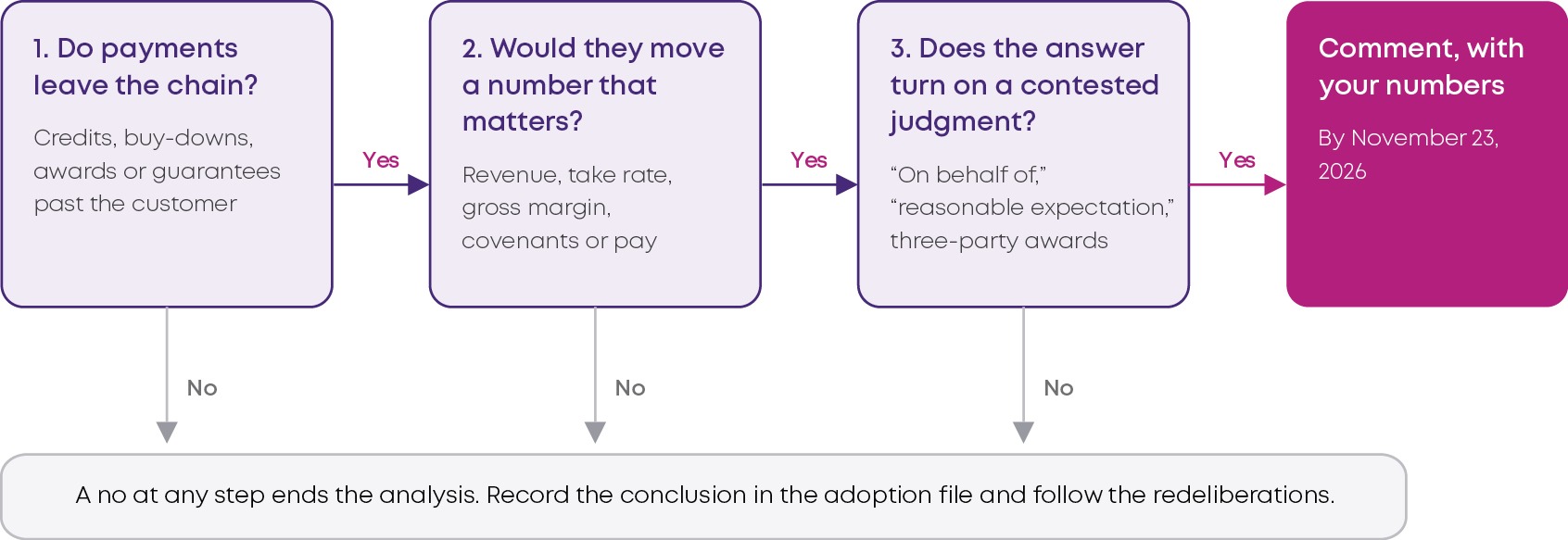
Consider submitting a comment letter.
Companies should focus on the areas where additional guidance would be most useful, including examples where a payment falls outside the scope, three-party equity arrangements, guarantees, negative revenue and the time needed to implement the changes.
Three questions decide whether to comment
7.2 Actions to Take Before Adoption
Once the final ASU is issued, companies should assess not only the accounting changes but also their wider contractual and reporting implications.
Review contracts that depend on revenue.
Changes in reported revenue may affect debt covenants, earn-outs, revenue-based compensation, revenue-sharing arrangements and customer price-protection clauses, even where operating income remains unchanged. Companies should identify arrangements that may need amendments or provisions that preserve the existing accounting basis.
Prepare for the required disclosures.
Under SEC Staff Accounting Bulletin Topic 11.M, registrants are required to discuss the expected effect of issued but not yet adopted accounting standards when the effect is known or reasonably estimable. This requirement becomes relevant once the final ASU is issued. Companies expecting a material impact should begin developing their estimates and supporting analysis early.
7.3 Controls to Consider Adding to the SOX Program
The proposed guidance may require information from teams outside finance, particularly sales, marketing and commercial operations. The following controls can help ensure that incentive programs are assessed consistently and that the underlying data is reliable.
- Review incentive programs before launch. Require Finance to document and approve the accounting assessment before a new incentive program begins. The assessment should cover customer identification, the nature of the promise, reasonable customer expectations and whether a distinct good or service is received.
- Check that all relevant payments have been captured. Each quarter, reconcile the inventory of incentive programs to the general ledger and relevant accounts for promotions, credits, subsidies and financing incentives. This helps identify new or modified programs that may not have been assessed.
- Retain evidence of what customers are told or led to expect. Marketing materials, published policies, sales communications and seller-facing terms may create an implicit promise. Establish a process to review these materials periodically and retain the evidence supporting the accounting conclusion.
- Validate data from systems outside Finance. Promotion engines and marketing platforms may provide the amounts, eligibility criteria and redemption information used in the accounting assessment. Treat these reports as information produced by the entity and test their completeness and accuracy, as appropriate.
Practical Perspective
The most effective preparation starts with the underlying commercial arrangements as well as the general ledger. Bringing Finance, Sales, Marketing, Legal and IT together early will help companies identify relevant incentives, support their judgments and assess the impact before the new requirements take effect.
08
Effective date and transition
Effective date and early adoption.
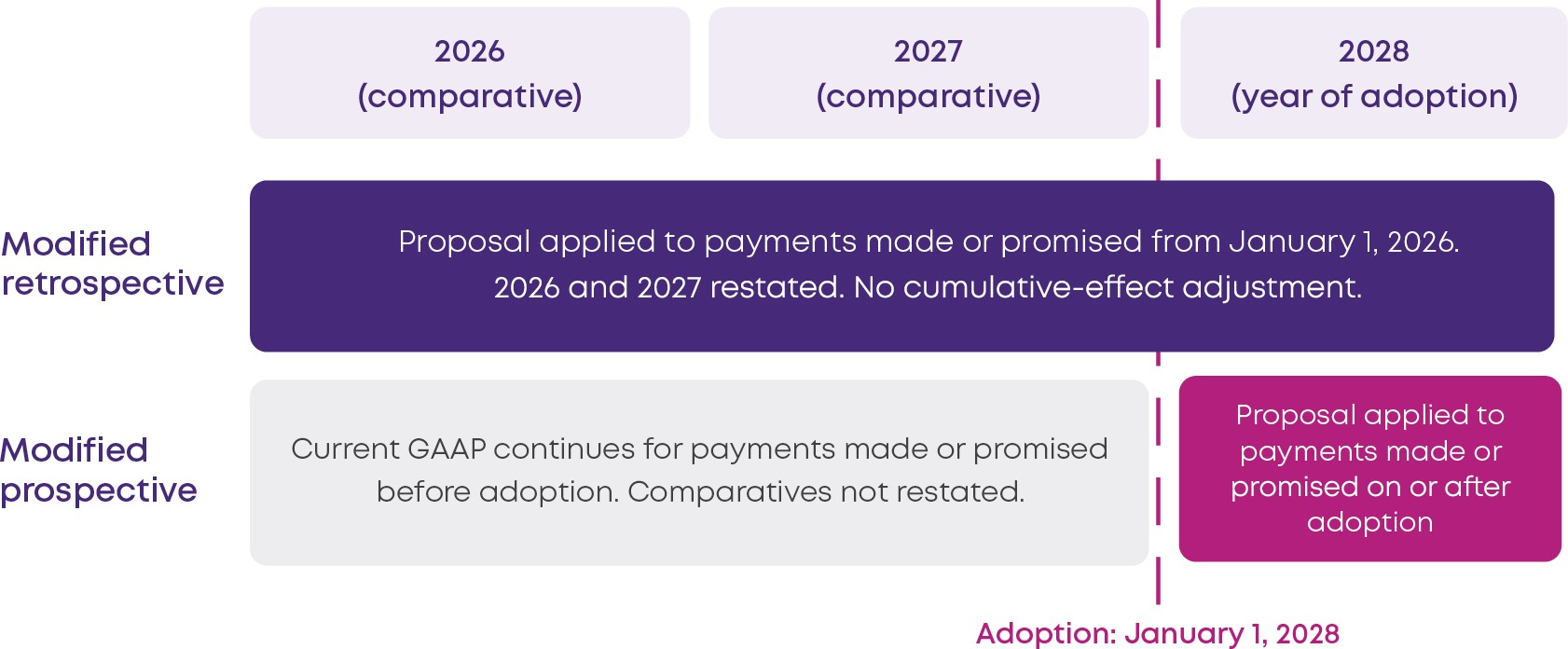
The amendments would apply to annual periods beginning after a date to be set once the Board considers feedback, and to interim periods within those years. Early adoption is permitted in any interim or annual period for which financial statements have not been issued or made available for issuance, from the beginning of that annual period. The Board also asks whether the effective date should differ for entities other than public business entities (Question 6).
Transition Method
Entities would have two transition approaches to choose from:
- Modified prospective approach. Apply the new requirements to payments made or promised on or after the date of adoption.
- Modified retrospective approach. Apply the new requirements to payments made or promised from the start of the earliest comparative period presented in the financial statements.
Transition disclosures.
Entities would need to describe why the accounting change was made, explain its nature and identify the transition method selected. Those adopting the modified retrospective approach would also report the impact on affected financial statement line items and per-share amounts for each period adjusted.
Illustration for a calendar-year entity presenting three years assuming 2028 as year of adoption
For the full text of the Proposed ASU, see the Exposure Draft on the FASB’s website.
How Uniqus Can Help
This support is most relevant for companies that provide incentives or make payments beyond their direct customers. If all your incentives are paid to direct customers and are already recorded as a reduction of revenue, you may not need this level of review.
Understand the potential financial impact
Key question: How could the proposal affect your reported results and key performance measures?
What we deliver: A two-year analysis of the potential impact on revenue, gross margin and take rate, including implications for debt covenants and management compensation.
Prepare for the year-end close
Key question: How will you demonstrate that a customer did, or did not, reasonably expect to receive an incentive?
What we deliver: An inventory of incentive programs, accounting memos for the key arrangements and a review control to assess new incentive programs before launch.
Assess complex commercial arrangements
Key question: Could an investment, warrant, guarantee or other payment be viewed as a reduction of revenue under the proposal?
What we deliver: An arrangement-specific accounting memo covering customer identification, contract combination, fair value considerations and the proposed scope test.
Align accounting policies across reporting frameworks
Key question: Should your group adopt a consistent approach to these payments across US GAAP, IFRS and Ind AS?
What we deliver: An analysis of the key differences between the reporting frameworks and a proposed group accounting policy for payments made beyond the direct customer.
Uniqus is an accounting and reporting consulting firm. Our Accounting & Reporting Consulting team works alongside clients and their auditors and brings experience in revenue recognition, share-based payments and SEC reporting across the US, India and the Middle East.