THE QUESTION
A dollar of customer spend on artificial intelligence (AI) model inference can show up as revenue in one company and as a net fee in another, with nothing different about the service that was actually delivered. Both presentations can be correct under US generally accepted accounting principles (US GAAP), which is uncomfortable for anyone trying to compare the two businesses.
The natural instinct is to look at who is running the model, and that turns out to be a poor guide. A company can own none of the hardware and never touch the inference, and still be the principal. What matters is the shape of the contracts underneath.
The General Rule
Start with what the customer is actually buying and who promised it to them (the performance obligation, and the specified good or service within it).
Then three questions. Is the end customer your customer? If not, your customer is whoever you supply, and your revenue is what they pay you. If so, two more follow. Do you control what they receive? Do you set the price and carry the risk? Yes to both makes you the principal, reporting what the customer pays. Otherwise you are an agent, reporting only your margin.
HOW IT USUALLY GOES
Four revenue streams cover nearly everything in this sector, and most providers run more than one at the same time, reaching different answers across them.
1
Sold direct.
The provider sells under its own brand, through a direct interface, a subscription, or an enterprise agreement, and rents the compute it needs.
2
Supplied to the host.
The provider gives a cloud partner the model or the capacity and the partner sells and serves it. The partner pays either a fixed rate or a share of its own revenue (a revenue sharing agreement). White label and original equipment manufacturer deals sit here too.
3
Sold alongside the host.
The same cloud arrangement, except the provider also holds its own contract with the end customer. This is how the managed model services on the major clouds are commonly structured.
4
Routing a model they chose.
The provider contracts with the customer, but the customer picks the underlying model and the provider passes the request through at a margin.
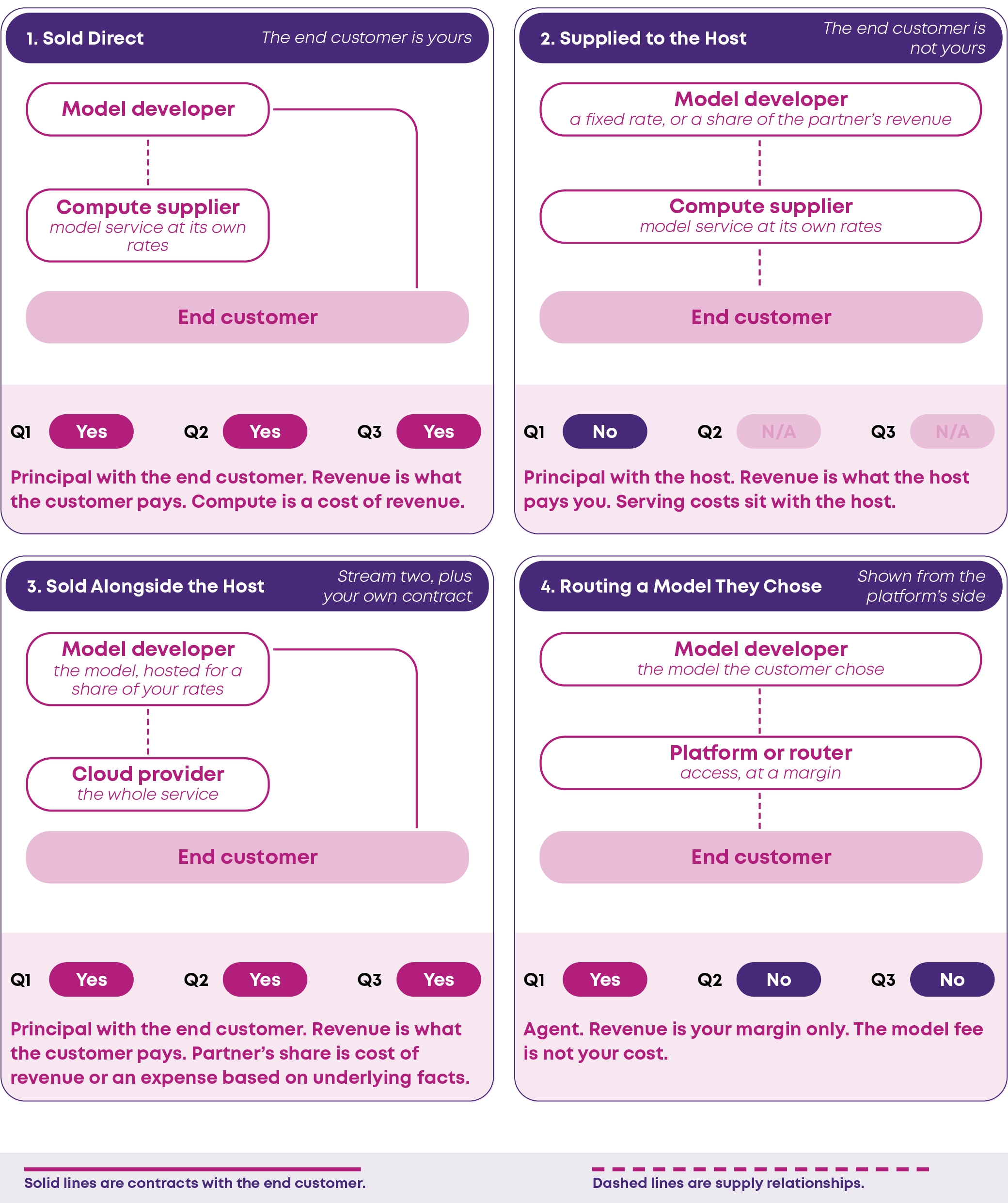
Figure 1. The three questions applied to each revenue stream, with the presentation and cost consequences that follow. The first three are shown from the model developer’s side. The fourth is shown from the platform’s, because an agent conclusion belongs to the party in the middle rather than to the company that built the model.
Streams two and three are worth sitting with, because from the outside they look like the same business. In both, the cloud partner hosts the model, runs the inference, contracts with the customer and sends the invoice. What separates them is a single document.
Where the provider also holds its own contract with the end customer, on its own terms and at its own rates, it is really serving its own customer and using the partner to host and deliver. It reports what that contract entitles it to, and the partner’s share becomes a cost. Take that contract away and the host becomes the customer, so revenue is simply what the host pays.
That one difference, rather than any difference in accounting judgment, is why two companies in much the same business can report the same dollar so differently.
THE DECIDING FACTOR
How the customer contract is designed.
Everything above comes back to a single upstream choice, which is who you have a contract with and what that contract actually promises. It is not really an accounting decision at all. It gets made when someone drafts terms of service, negotiates a partner agreement, or settles whose published rates the customer will pay, and it is usually locked in long before anyone asks how the revenue should be presented, by people who are not thinking about GAAP revenue at all.
The practical move, then, is to bring the accounting question into the contracting process alongside the legal and commercial review. Companies that do that choose their answer. Companies that do not inherit one.
WHERE WE COME IN
While we have shown the contract analysis for typical arrangements in this industry, in practice the answer sits in the detail of the documents.
We perform that detailed analysis, and we advise on contract structures that achieve the optimal revenue recognition outcome, documented well enough to survive an audit, a diligence process, and the scrutiny of a registration statement. As a firm with no audit practice, we can give you a view rather than a question.
Start a conversation at https://uniqus.com/contact-us/
GOING DEEPER
Our detailed point of view for AI application companies, Built on Borrowed Intelligence, covers the other side of these arrangements, the companies that build products on third party models. Available at uniqus.com/insights.
ABOUT BY DESIGN
By Design is a Uniqus series on the accounting decisions companies make before they know they are making them. Each issue takes one topic, sets out how the analysis usually runs, and names the single upstream choice that decides the outcome.
Technical references. ASC 606-10-55-36 through 55-40, including 55-37A(b) on control of a right to a service performed by another party, and 50-12(c) on disclosure of the judgment. IFRS 15 applies substantively identical guidance