NAVIGATING THE GLOBAL MACRO ENVIRONMENT
The global equity capital markets have experienced a journey of volatility and subsequent strong recovery through the first three quarters of 2025. The year began under a challenging macroeconomic backdrop, dominated by the possibility of persistent inflation, prolonged uncertainty over global interest rate trajectories, and new geopolitical complexities, most notably the announcement of the USA’s trade tariffs in April.
Initially, this challenging global environment led to a noticeable slowdown in global IPO activity. Major stock indices saw sharp corrections and market volatility reminiscent of the early stages of the pandemic. As uncertainty grew, investors retreated, and many prospective issuers decided to put their listing plans on hold, stepping away from the cautious optimism that had prevailed at the beginning of the year.
By the third quarter of 2025, the global landscape staged a robust and significant recovery. Softer financial conditions, easing inflation in several key economies, and a more optimistic outlook on monetary policy helped reignite momentum. Global IPO deal volume rose by 19% year-over-year in Q3, with proceeds surging by nearly 89%. But this turnaround has been selective, characterized by a “flight to quality” where investors show heightened scrutiny on fundamentals, profitability pathways, and corporate governance.
The key forces shaping market sentiment remain:
- Monetary Policy: Decisions around interest rate cuts by major central banks continue to be a central influence, directly impacting market sentiment and liquidity.
- Technological Disruption: Companies credibly embracing Artificial Intelligence (AI) and digital transformation are attracting premium valuations, reinforcing investor expectations of long-term transformative growth.
- Geopolitical Stability: While geopolitical risk is viewed as a persistent backdrop, its effects are largely localized. Markets with strong fundamentals and solid governmental support, such as those in the Gulf Cooperation Council (GCC), are showing notable resilience and have managed to remain insulated from the broader global economic slowdown.
In this fragmented but recovering global IPO landscape, IPO candidates worldwide must be agile and present a compelling equity narrative to stand out.
GLOBAL NAVIGATION & GCC RESILIENCE
Global equity markets delivered a strong performance during the first three quarters of 2025, with the UK leading the way overwhelmingly. UK’s benchmark, the FTSE 100, was the clear leader, finishing with a robust year-to-date (YTD) return of +14.41%, bolstered by substantial quarterly gains in Q3 (+6.73%) and Q1 (+5.01%), indicating continued strength in the UK growth. The USA’s benchmark, the S&P 500, also secured a strong +13.72% YTD return, along with Asia’s benchmark, the Nikkei 225, which also secured a strong +12.63% YTD return.
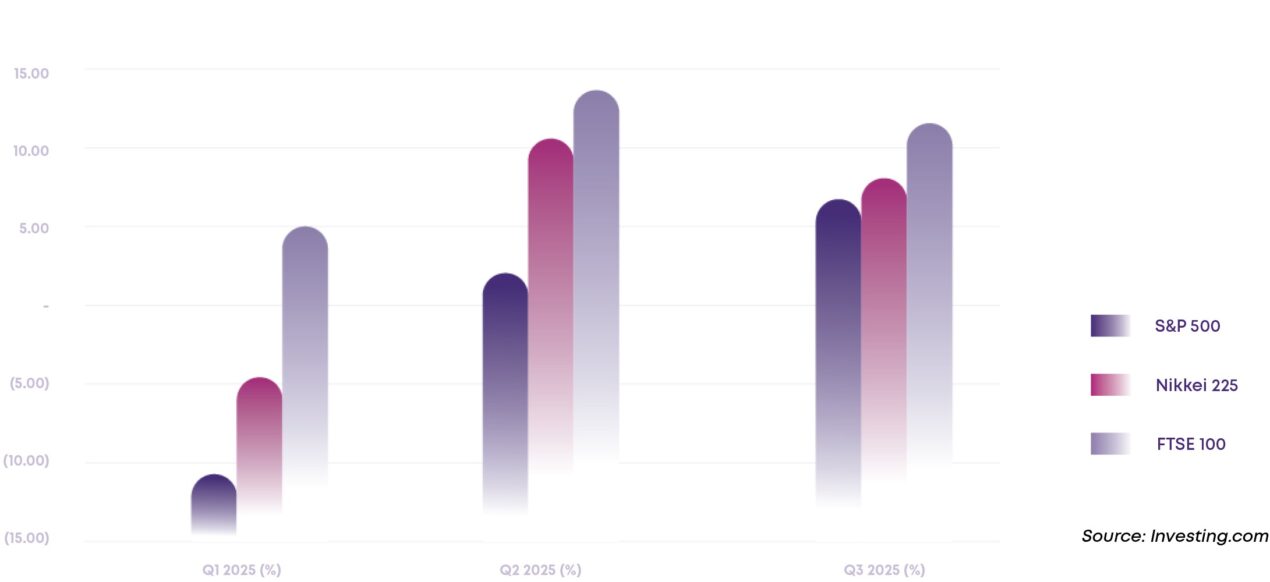
Persistent global macroeconomic headwinds, including the announcement of USA tariffs, geopolitical uncertainty, and growing fears of a global recession, have driven global equity market volatility to levels not seen since the early stages of the pandemic.
However, the GCC market has demonstrated a remarkable decoupling from these global pressures. This environment has encouraged companies to make a more thoughtful and resilient approach to going public. This shift is reflected in the robust market performance, with healthy IPO proceeds anticipated in Q4 2025. The distinct shift toward primary issuances, where funds are raised for growth and expansion rather than selling existing shares, highlights the GCC’s growing insulation and the maturity of its capital formation strategy.
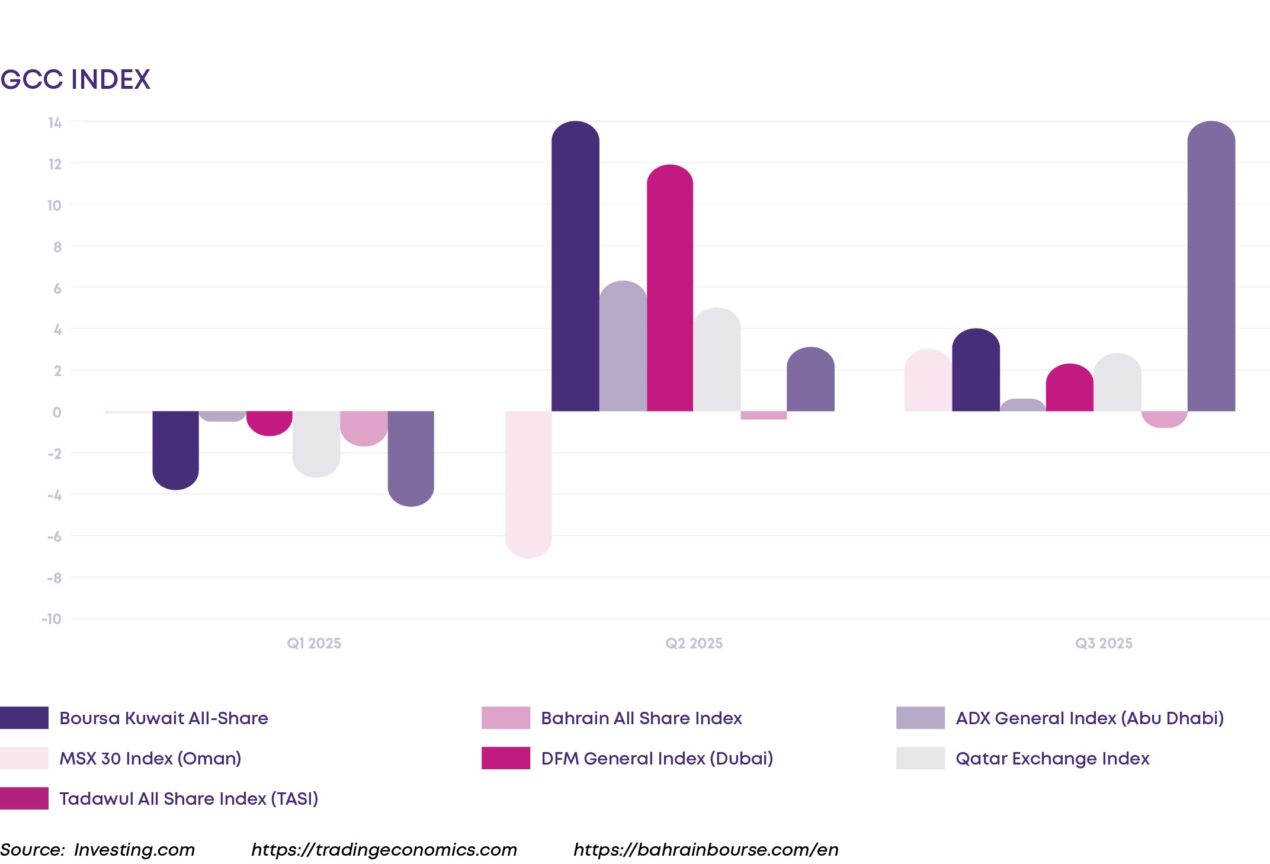
The GCC equity markets delivered a mixed yet broadly constructive performance during the first nine months of 2025, supported by resilient domestic liquidity and improving investor sentiment. Saudi Arabia’s Tadawul All Share Index (TASI) staged a notable turnaround, gaining +7.54% in September and +3.04% in Q3, signalling renewed confidence and stabilization after a softer first half. Oman’s MSX 30 led the region with +15.12% in Q3, while the Kuwait’s All Share Index (BKA) advanced by +4.03%, Qatar Exchange Index advanced by +2.82% and DFM General Index advanced by +2.35%, in Q3; reflecting broader optimism across Gulf markets. The divergence in performance highlights a transitional phase, with Saudi-led recovery momentum expected to underpin regional strength heading into year-end.
GCC: MARKET PERFORMANCE AND INDUSTRY TRENDS
The GCC IPO market through 2025 reflected a measured and sentiment-driven trajectory, shaped by macro volatility, oil price swings, and investor risk recalibration. Saudi Arabia continued to anchor regional issuance, albeit within a range-bound environment.
Q1 2025 Cautious Start:
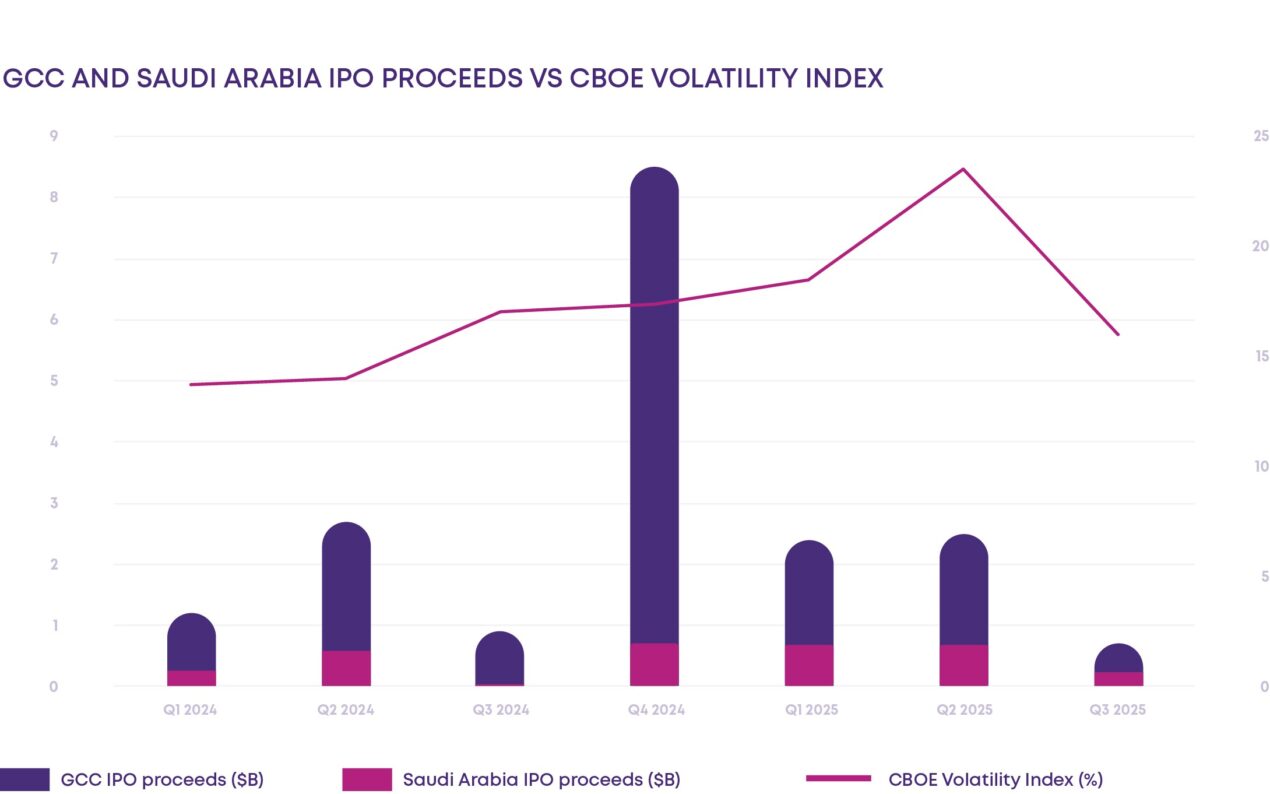
The year opened with subdued optimism as markets digested global rate uncertainty and slower growth signals. IPO activity held up reasonably well, raising USD 2.4 billion, but overall momentum was restrained by tight liquidity and valuation caution. Investors largely adopted a selective participation strategy, focusing on defensive and cash-generating sectors.
Q2 2025 Stabilization amid Sentiment Improvement:
With global volatility easing and equities consolidating, the GCC markets experienced stabilization rather than acceleration, with total proceeds marginally higher at USD 2.5 billion. The flat sequential performance suggests that while fear indicators declined, pricing discipline and investor selectivity persisted. The pipeline remained active, but issuers preferred strategic timing over rapid execution.
Q3 2025 Renewed Softness amid Macro Uncertainty:
IPO activity lost traction as policy ambiguity, oil price fluctuations, and geopolitical undertones reintroduced caution. Total proceeds fell to USD 0.7 billion, underscoring that the regional IPO window remains highly sentiment-sensitive, with investors favouring quality over quantity.
Jan-Sep 2025 In-review:
Total IPO proceeds of USD 5.6 billion in the first nine months highlight the market’s underlying strength despite quarterly swings. While Q3 historically experiences a seasonal slowdown, the stabilization in Q2 reaffirmed the region’s strong issuer pipeline and investor depth. The overall performance signals a healthy primary market foundation, with several mandates in advanced stages, positioning the GCC for a potentially firm year-end acceleration as volatility continues to moderate.
Q4 2025 Outlook:
With volatility moderating and sentiment improving, the region is well-positioned for a stronger close to 2025. Issuer pipelines remain active, and market conditions appear supportive for new listings as the IPO window reopens more broadly.
GCC Market Performance: Saudi Arabia Drives Regional Dominance (Jan-Sep 2025)
The GCC capital markets have demonstrated exceptional resilience and maturity, largely driven by the aggressive pace of economic diversification in the Saudi Arabia under Vision 2030. The first nine months of 2025 solidified Saudi Arabia’s position as the dominant hub for regional IPO activity.
Industry Trends: The Sectoral and Geographic Shift for Economic Diversification
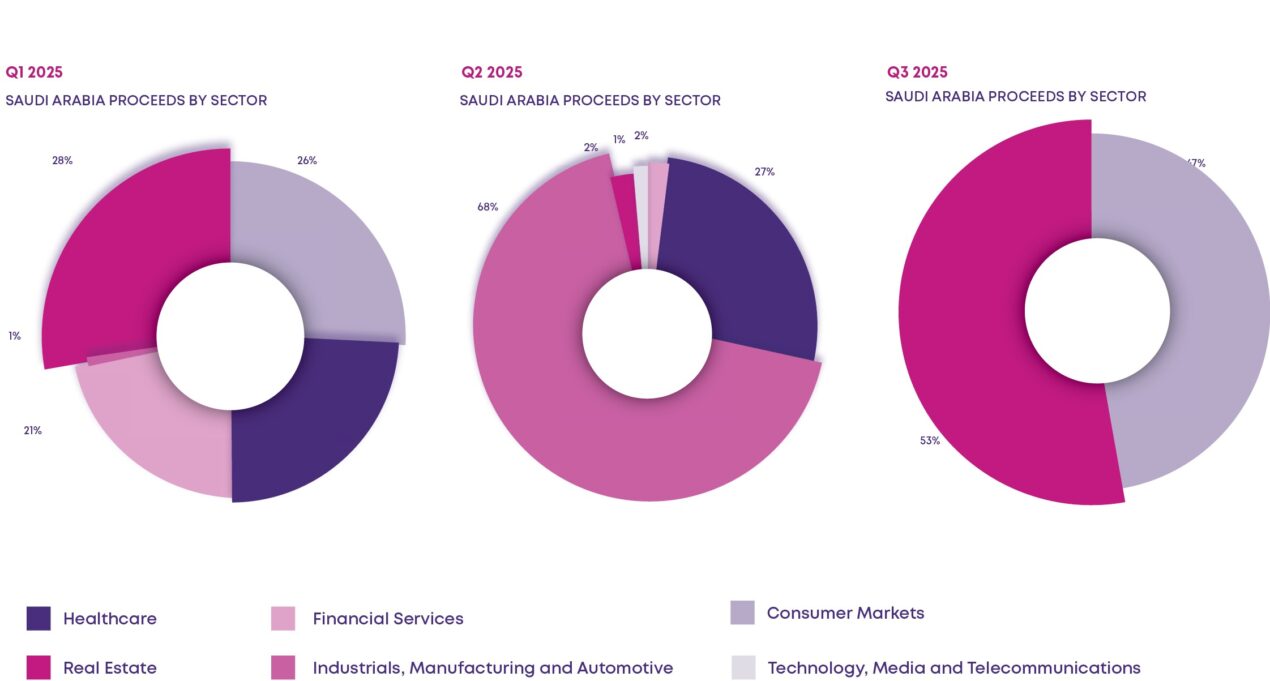
The composition of IPOs reflects the successful pivot away from oil-centric sectors. Industries driven by domestic demand and high growth potential are now the primary engines of capital formation, reflecting real progress towards the region’s broader economic diversification goals. This structural transformation is largely fueled by national initiatives, such as Vision 2030, and is evident in both sectors, attracting investor interest and driving activity through exchanges.
Saudi Arabia Sectoral Trends in 2025
- A push for domestic demand-driven sectors: consumer markets, healthcare, aviation, technology, and mobility, rather than purely upstream energy.
- A higher number of small-to-mid-cap listings leveraging the expanded criteria of the Nomu market (minimum market cap ~SAR 10 million; public float ~20%), enabling faster access but often with increased volatility.
- Looking ahead to Q4 2025, we expect continued action in industrials/transport (including logistics and ports) and materials / manufacturing / auto-components (high probability), with healthcare, consumer and financial/insurance also likely to contribute.
- Technology listings remain a watch-list rather than a core pipeline for Q4. The final mix will depend on pipeline conversions, market sentiment and any accelerated privatisation announcements by the regulator.
Source: Stock Exchange Disclosures, S&P Global, Saudi Mergers Acquisitions
Fuelling the Future of the Kingdom: Use of proceeds
The capital raised through IPOs in the Saudi Arabia plays a pivotal role in advancing the Vision 2030 agenda. While a significant portion of IPO proceeds enables shareholder monetization, a substantial share is also being deployed to support long-term national growth and economic transformation:
01. Exit and monetization
For founding families and PE sponsors, the IPO allows for partial or full monetization of their investments, often at premium valuations, especially on the Tadawul Main Market, thereby generating liquidity for further re-investment into the local economy or new ventures.
02. Strategic expansion and business scaling
Proceeds are being used to fuel strategic growth and operational scaling across high-potential sectors such as real estate, healthcare, consumer retail, and aviation. Companies are leveraging public market capital to expand footprints, strengthen regional presence, and invest in technology and operational infrastructure, supporting long-term corporate strategies and reflecting growing confidence in Saudi Arabia’s structural growth opportunities and rising domestic demand.
03. Capital expenditure and infrastructure build-out
A meaningful portion of proceeds is earmarked for infrastructure, logistics, and technology upgrades, ranging from physical assets like warehouses to digital transformation initiatives. These investments strengthen operational capabilities, efficiency, and scalability, ensuring companies are well-positioned for sustainable growth in a rapidly evolving market.
In addition to growth-oriented investments, funds are also directed toward debt reduction and strengthening working capital, providing companies with greater financial flexibility to pursue strategic initiatives and effectively manage high-growth operations.
In essence, the funds raised are a direct mechanism to scale private sector growth and unlock new sources of financing for both national megaprojects and high-potential SMEs through the Nomu-Parallel Market.
REGULATORY & MARKET-STRUCTURE ASPECTS TO CONSIDER (Saudi Arabia & UAE)
Simplified markets, stronger IPO pipeline – how eased market norms matter
Saudi Arabia
Nomu continues to be the gateway for smaller issuers: lower market-cap thresholds (e.g., SAR 10m minimum market cap), a lower mandatory float (20%), and a lighter track record requirement; useful for SME policy goals but with a trade-off in institutional investor access. Issuers can pivot from Nomu to the Main Market if they meet thresholds, as listed below:
- Organisations may only apply to transfer to the main market after two calendar years from the day on which their shares were listed on the parallel market.
- The average aggregate market value of the transferred shares must be worth at least SAR 200 million in the six-month period prior to the submission of the application.
- Submitting the board of directors’ approval on the transfer before the beginning of the trading session that follows the approval.
- The issuer must disclose the transfer to the public upon submitting the application.
- An issuer must disclose to the public the board report, which includes all related information, before submitting the application.
UAE
01. Securities and Commodities Authority (SCA) modernisation & prospectus framework: The UAE’s SCA Decision No. (02/R.M) of 2023 updated public-offering and distribution rules and tightened disclosure/marketing requirements for foreign funds and public offerings; it effectively modernised prospectus requirements and strengthened gatekeeping (KYC/AML and adviser credential checks). These requirements have resulted in rigorous scrutiny of companies’ prospectuses.
02. ADX/ DFM rulebooks clearer segment rules: Both ADX and DFM have recently updated listing and listing-segment rules (Main vs Second/Growth markets) that clarify minimum free-float, market-capitalisation thresholds, and ongoing disclosure obligations; these determine whether an issuer should target the Main Market or a growth/parallel board from day one. ADX publishes a full rules book; DFM maintains a modular listing rules document.
03. Because the thresholds (free-float, shareholder number, category eligibility) have shifted, many issuers may need to adjust their strategy (e.g., aim for “Category 2” listing, or plan for the incremental free-float build up). If you’re targeting a 2025 IPO in the UAE, treat the 2024-25 listing-rule revisions as a gating factor as mis-alignment may delay timeline or force listing on a less favourable category
04. Foreign investor access and fund distribution: Regulations published in 2023 by SCA (and incremental guidance since) have tightened the rules around foreign fund marketing and registration while also laying the foundation for clearer pathways for institutional foreign capital, meaning issuers need to design dual language disclosures, robust KYC, and clear shareholder-structure disclosure to attract global investors.