EXECUTIVE SUMMARY
On October 28, 2026, the Financial Accounting Standards Board (FASB) issued a proposed Accounting Standards Update (ASU), Investments—Equity Method and Joint Ventures (Topic 323): Equity Method of Accounting—Targeted Improvements. The proposal follows the FASB’s 2025 agenda consultation, in which stakeholders asked the Board to make the equity method a priority. Comments are due by January 11, 2027.
Under current US generally accepted accounting principles (GAAP), the threshold for applying the equity method depends on the legal form of the investee:
- Corporate investments: An investor generally applies the equity method when it has the ability to exercise significant influence over the investee. An ownership interest of 20% or more of the voting stock creates a presumption of significant influence.
- Partnerships and certain LLCs: An investor generally applies the equity method when its ownership interest is more-than-minor. In practice, this threshold has generally been interpreted as an ownership interest of more than 3% to 5%.
The FASB’s proposal would bring these requirements under a single threshold based on significant influence, irrespective of the legal form of the investee. In addition, the proposal would:
- Move the existing guidance on complex equity allocation structures for real estate investments into Subtopic 323-10, making it applicable to equity method investments across all industries.
- Include an illustrative example of one approach that investors could use when applying this guidance.
Key Takeaway
- Partnership and LLC investors are likely to be most affected. Investors with passive limited partner or LLC interests that currently qualify for the equity method under the more-than-minor threshold may no longer qualify if they do not have significant influence. These investments would generally be accounted for under Topic 321 instead.
- The 20% ownership presumption will continue, but the assessment below 20% will change. The proposal would remove the existing more-than-minor threshold for partnerships and certain LLCs. For all types of investees, investors with ownership interests below 20% would need to evaluate the facts and circumstances to determine whether they have significant influence. The presumption of significant influence for ownership interests of 20% or more would remain unchanged.
- General partners and managing members would continue to apply the equity method. A general partner or managing member of an LLC would be considered to have significant influence, even if it does not hold a controlling ownership interest.
- Guidance on complex equity allocation structures would apply across industries. The proposal would extend the existing real estate guidance on allocating equity in earnings to all equity method investments.
This Early Impressions summarizes the proposed amendments, explains how they would change the scope of the equity method under Accounting Standards Codification (ASC) 323 and the guidance on allocating earnings in complex allocation structures, and sets out the practical questions we expect investors in partnerships, LLCs, funds and joint ventures, corporate investors with minority stakes, and their audit committees to work through. It is intended for chief financial officers (CFOs), controllers, technical accounting and financial reporting teams, investment and fund accounting teams, and accounting and financial reporting professionals.
We hope you find this publication useful and welcome further discussion.
AT A GLANCE
THE BOTTOM LINE
One threshold, whatever the legal form of the investee. The FASB wants significant influence to decide when the equity method applies and wants the guidance on waterfall structures to apply beyond real estate
THE TEST
Significant influence would decide the equity method for every investee: corporation, partnership or LLC.
NUMBER THAT WEAKENS
Below 20 percent there would be no presumption either way; the indicators alone decide.
THE RULE
A noncontrolling general partner or managing member would always have significant influence, at any ownership level.
Proposed Amendments at a Glance
| Key area | Proposed amendment |
|---|---|
| Single threshold for applying the equity method | Establishes significant influence as the sole criterion for determining whether the equity method applies, irrespective of the investee’s legal form (whether the investee is a corporation, partnership or similar entity). |
| Revised guidance for partnerships | Eliminates the existing approach under which the equity method generally applies to partnership interests unless the investor’s interest is so minor that it has virtually no influence over the investee’s operating and financial policies. |
| Complex allocation arrangements | Provides guidance on determining an investor’s share of earnings or losses when the investee’s contractual allocation arrangements differ from its underlying ownership percentages, including arrangements involving non-real-estate entities. |
| Scope and potential impact |
|
Five questions a CFO will ask
01 What changes for an investor?
- The existing presumption that an investor holding less than 20% does not have significant influence would no longer apply. Board representation, including a seat on the board of managers, would be considered when assessing significant influence.
- A noncontrolling managing member would be presumed to have significant influence, regardless of its ownership percentage.
- The guidance on allocating earnings under complex arrangements would also extend beyond the real estate industry to all industries.
Refer to Section 1: What the Board Proposed
02 Which existing investments could be affected?
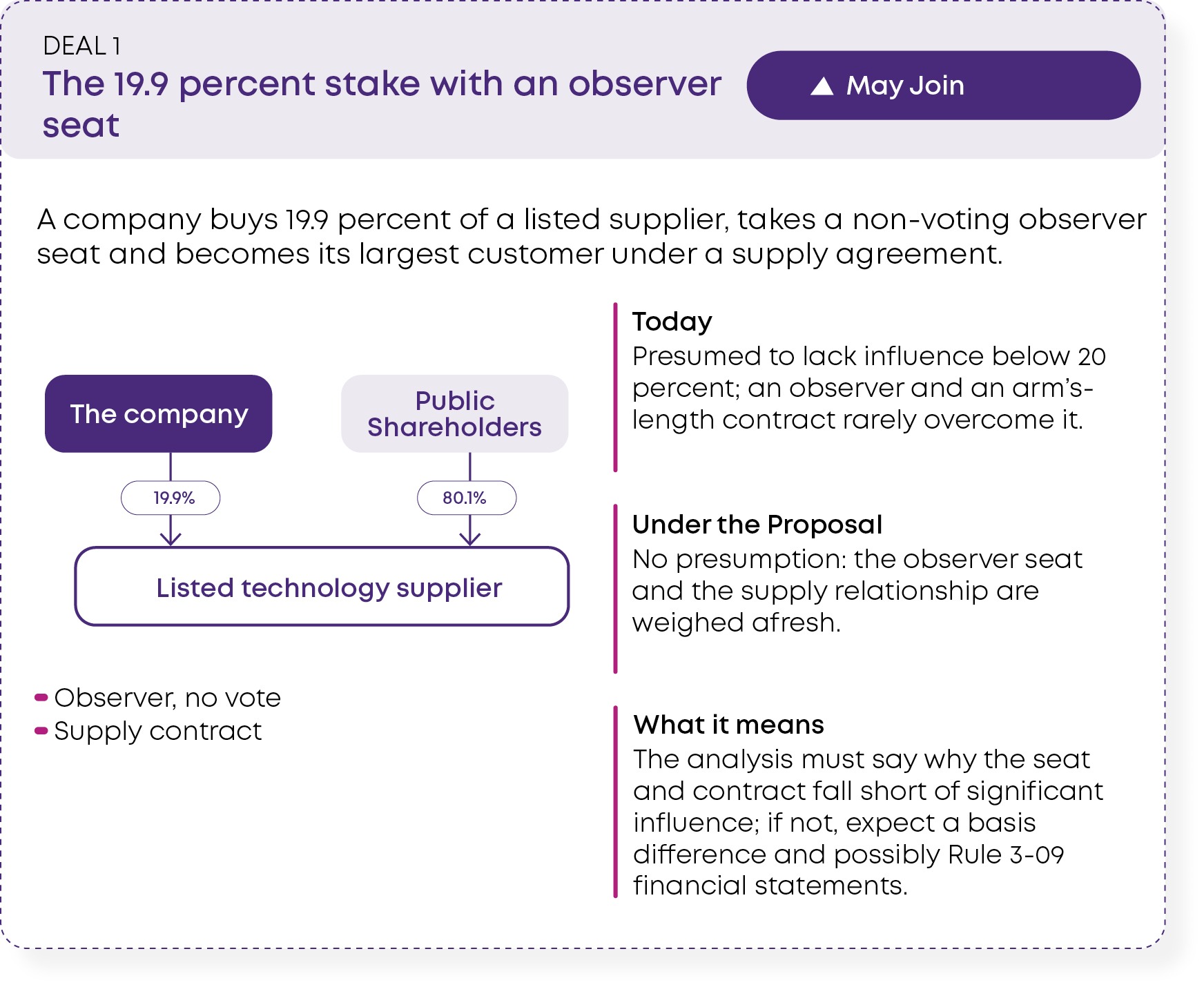
- Investments would need to be reassessed under the proposed significant influence threshold. For example, a 19.9% investment with board observer rights and significant commercial arrangements could qualify for equity method accounting.
- Conversely, an LLC investment with only protective rights and no substantive participation in decision-making could fall outside the equity method.
Refer to Section 2: Five Common Deals, Re-tested
03 What happens when the new guidance is adopted?
- Investments that no longer qualify for the equity method would generally retain their existing carrying amount as their new cost basis if the measurement alternative is elected.
- Otherwise, they would be measured at fair value, with the difference recognized in opening retained earnings.
- The proposal also clarifies that changes to earnings allocation arrangements would apply prospectively from the adoption date.
- However, it does not specifically address the transition for investments that newly qualify for the equity method.
Refer to Section 3: How to Transition
04 Will the new guidance create additional implementation and reporting requirements?
- Yes. While reviewing the investment portfolio at adoption would be a one-time exercise, companies would need to document significant influence assessments for investments below 20%, establish appropriate review controls and identify events that trigger reassessment.
- Changes in accounting methods could also require additional procedures during the financial close and Securities and Exchange Commission (SEC) reporting processes.
Refer to Section 4: Controls, Close and SEC Reporting
05 What should companies communicate to the Board and do now?
- Companies should assess the potential impact on their investment portfolios, revisit significant influence conclusions for investments below 20% and incorporate relevant indicators into investment approval and term-sheet review processes.
- They may also consider providing feedback to the FASB on areas requiring further clarification, particularly investments involving board observer rights, commercial relationships and transition requirements for investments that newly qualify for the equity method.
Refer to Section 5: What We Would Tell the Board and Section 6: What to Do Now
Practical Perspective: Significant Influence Should Drive the Accounting
- Corporate investments will need reassessment. Minority investments, particularly those below 20%, will require a fresh evaluation based on the investor’s rights and involvement.
- Passive partnership investors will be most affected. Limited partners and LLC members without significant influence would generally move from the equity method to ASC 321.
- General partners and managing members will generally continue to qualify. Noncontrolling general partners (GPs) and managing members would be considered to have significant influence, irrespective of their ownership percentage.
- The 20% presumption will remain. Investments below 20% across all entity types will require an assessment of significant influence based on the facts and circumstances.
- Improved consistency and comparability. A single significant influence threshold across different types of entities should reduce diversity in practice and improve consistency and comparability in equity method accounting.
- Complex allocation guidance will extend across industries. Applying the existing real estate guidance to all equity method investments should improve consistency in allocating earnings and losses.
EDITORIAL
ENGINEERING TO A NUMBER: THE END OF THE 20% SHORTCUT?
For more than 50 years, the 20% ownership threshold has provided investors with a relatively clear starting point for determining whether the equity method applies. The FASB’s proposal moves away from this percentage-based approach and places greater emphasis on whether an investor actually has significant influence over an investee.
How did companies use the 20% threshold?
Under the existing guidance, investments of 20% or more generally carry a presumption of significant influence, while investments below 20% generally carry a presumption that significant influence does not exist. This allowed companies to structure investments around the threshold.
For example, an investor could hold 19.9% instead of 20%, obtain board observer rights instead of a board seat, or keep commercial arrangements separate from the investment agreement to support a desired accounting outcome.
What changes under the proposal?
The proposal removes the presumption that investments below 20% do not have significant influence. Instead, investors will need to assess the actual rights and nature of their relationship with the investee. Factors such as board representation, observer rights, participation in key decisions and significant commercial arrangements may become more important in determining whether the equity method applies.
Importantly, holding 19.9% will no longer, by itself, support a conclusion that significant influence does not exist. However, this does not mean that every investment below 20% will qualify for the equity method.
What does this mean for companies?
The assessment will increasingly require finance teams to look beyond ownership percentages and review the underlying investment and commercial agreements. This may include investor rights agreements, board observer arrangements, supply agreements, transition services agreements and LLC operating agreements.
Finance teams will also need to work more closely with legal and corporate development teams to identify rights and arrangements that could indicate significant influence.
Where do we see a potential concern?
While we support the move toward a single significant influence threshold, the proposal may create additional work for corporate investors. Investments below 20% will require reassessment even where the investor has no board representation, observer rights or significant commercial relationships. Retaining a starting presumption for such corporate investments could reduce unnecessary assessment and documentation efforts without compromising the objective of the proposal.
What should CFOs do now?
CFOs should ask their corporate development and finance teams to identify all investments below 20%, obtain the related investment and commercial agreements, and reassess whether significant influence exists. This will help companies identify potential changes in accounting treatment and prepare for additional documentation and review requirements before the proposed guidance takes effect.
The 20% threshold may no longer provide a straightforward basis for avoiding the equity method. The focus is shifting from how much an investor owns to how much influence it actually has over the investee.
The Question
What precisely changes for a company that holds a stake it does not control?
1. WHAT THE BOARD PROPOSED
Two issues, one theme: the equity method should be applied based on influence and substance, not on legal form, a percentage or an industry.
1.1 Issue A: one threshold for every investee
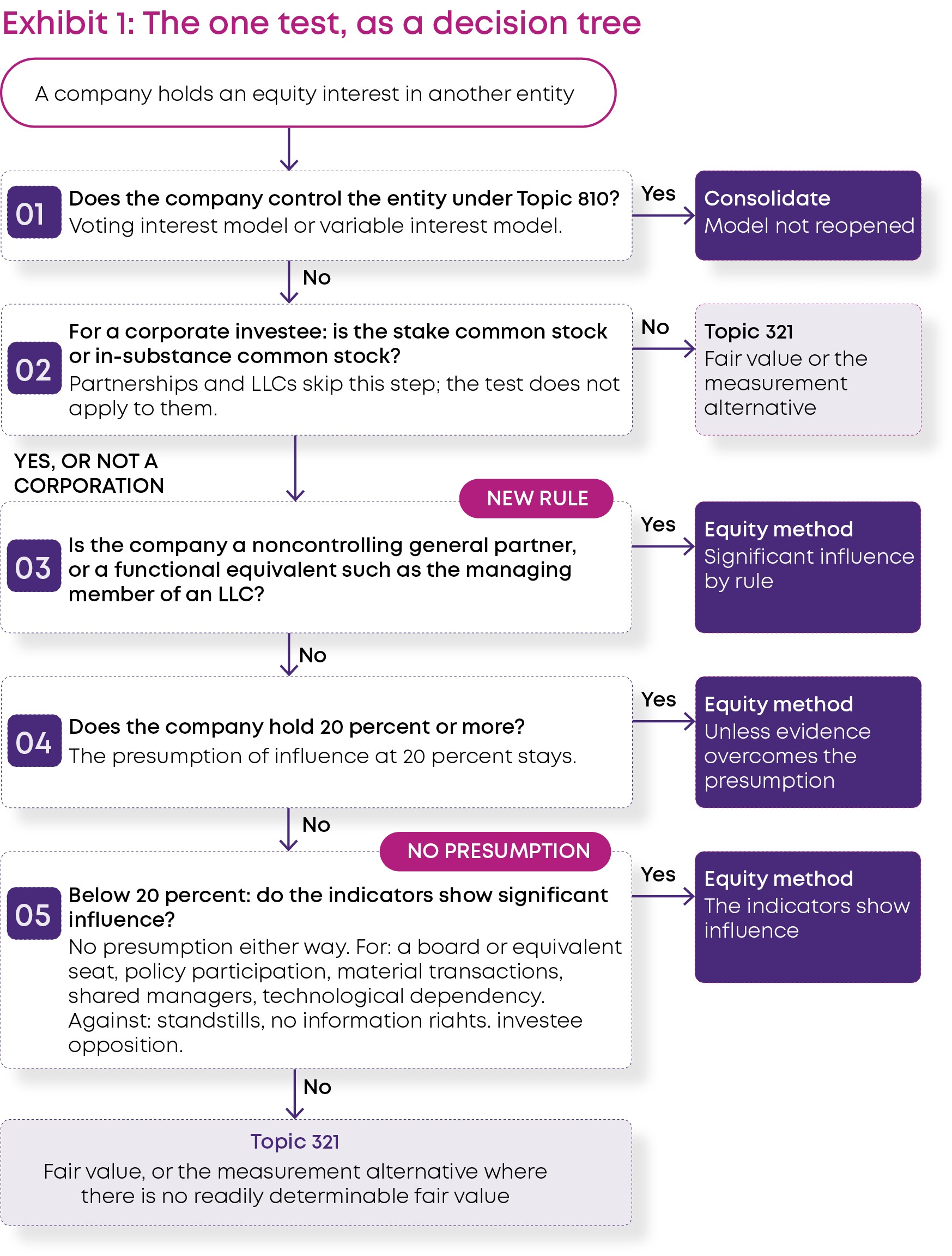
Significant influence becomes the only door. The proposal establishes significant influence as the single criterion for applying the equity method, regardless of whether the investee is a corporation, partnership, unincorporated joint venture or an LLC with capital accounts.
Under the proposed guidance, investments below 20% will no longer automatically be presumed to lack significant influence. Instead, investors will need to evaluate the relevant facts and circumstances. Investments that do not qualify for the equity method will generally be accounted for under ASC 321, either at fair value or, if eligible, using the measurement alternative (cost less impairment, adjusted for observable price changes).
| Area | Current guidance | Proposed guidance | Impact on investors |
|---|---|---|---|
| Investments below 20% | Presumed not to have significant influence. | No presumption; significant influence will be assessed based on the facts and circumstances. | All minority investments will require a documented assessment. |
| Investments of 20% or more | Presumed to have significant influence. | The 20% presumption will continue to apply across all types of investees. | No significant change for corporate investments. |
| Partnerships and LLCs | Equity method generally applies unless the investment is so minor that the investor has virtually no influence. In practice, interests above 3%–5% are generally considered more than minor. | The same significant influence test applicable to corporations will apply. | Passive investors in partnerships and LLCs without significant influence may move to ASC 321. |
| Board representation | Representation on the board of directors is an indicator of significant influence. | Representation on a board of directors or a functionally equivalent governing body will be considered. | A seat on the board of managers of an LLC will also be considered. |
| Noncontrolling general partners and managing members | Different requirements apply depending on the type of investee; real estate partnerships have specific guidance. | A noncontrolling general partner or managing member will be considered to have significant influence, regardless of ownership percentage. | Such investments will generally continue to qualify for the equity method. |
| Protective and participating rights | Considered along with other indicators when assessing significant influence. | No specific change to the existing guidance or new presumption. | Assessment will continue to depend on the nature of the rights and the overall facts and circumstances. |
| Consolidation (ASC 810) | Consolidation is assessed under the variable interest entity and voting interest models. | The overall consolidation framework remains unchanged, except for certain targeted changes relating to income allocation to noncontrolling interests and real estate ventures. | The proposal does not fundamentally change existing consolidation assessments. |
1.2 Issue B: Complex allocation structures extending waterfall guidance to all industries
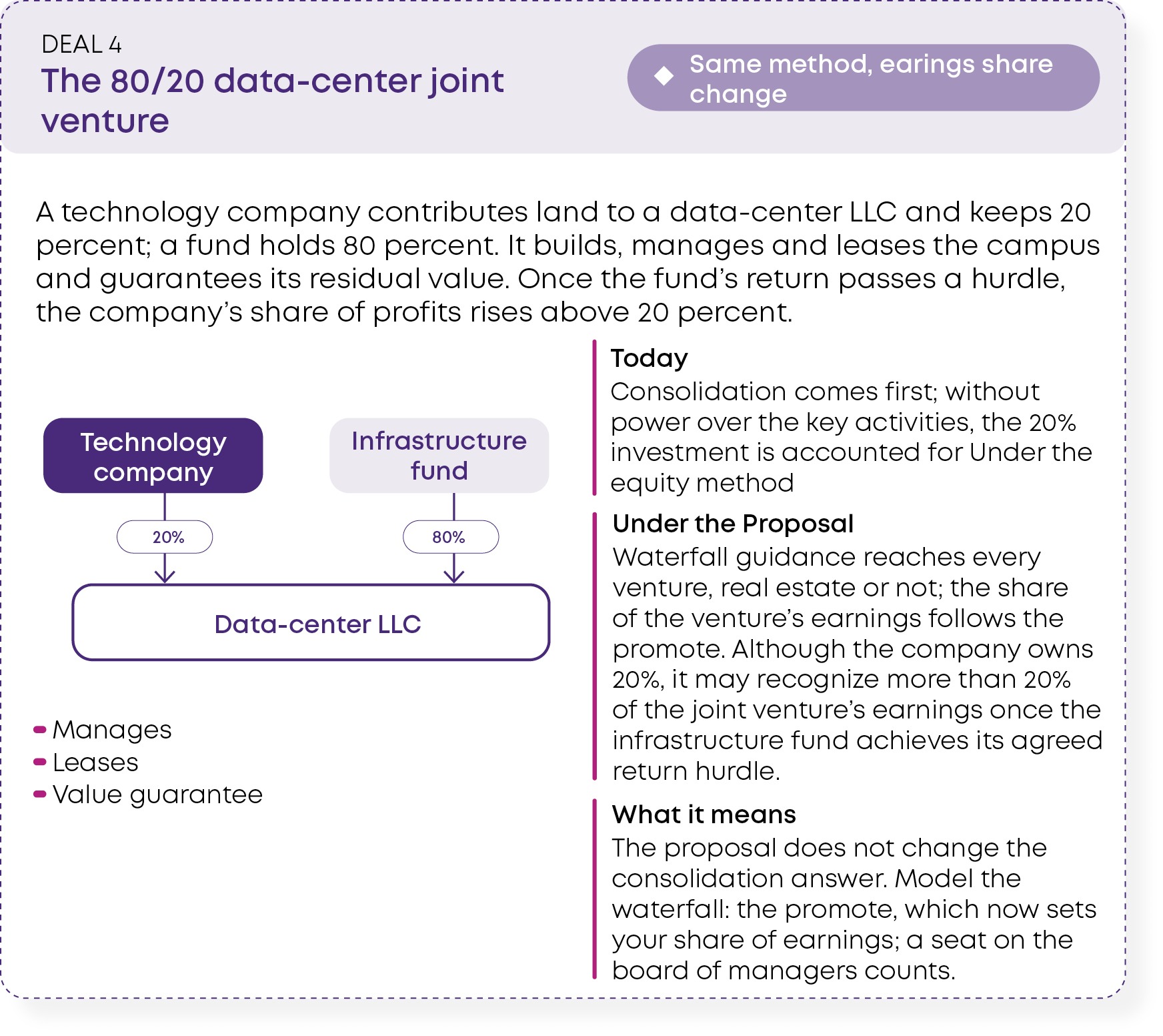
The proposal extends the existing guidance on complex earnings allocation arrangements in ASC 970-323 (which currently applies to real estate investments) to ASC 323, along with other guidance in that subtopic that is not industry- or transaction-specific. It would also add examples illustrating one possible method for allocating equity in earnings in complex allocation structures. This addresses situations where an investor’s share of an investee’s earnings or losses does not necessarily correspond to its ownership percentage.
In a simple investment arrangement, earnings and losses are generally allocated based on ownership percentages. For example, an investor holding 30% of an investee would generally recognize 30% of its earnings.
However, some investment agreements contain complex allocation arrangements (commonly known as distribution waterfalls) under which investors receive returns based on agreed priorities, such as return of capital, preferred returns, or specified profit-sharing arrangements. As a result, an investor’s economic entitlement may differ from its stated ownership percentage and may also change over the life of the investment.
Under the proposed guidance, investors would need to evaluate how changes in the investee’s net assets affect the amount each investor would receive under the contractual distribution arrangements, rather than simply applying the stated ownership percentage.
What does this mean for companies?
The proposed amendments would have the following implications:
- Broader applicability: The existing real estate guidance would extend to equity method investments across all industries, including technology, manufacturing, infrastructure and renewable energy.
- Greater focus on contractual arrangements: Companies would need to review partnership agreements, LLC operating agreements, and other investment contracts to understand how profits, losses, and liquidation proceeds are allocated.
- Ownership percentage may not determine earnings allocation: Investors may recognize a share of earnings or losses that differs significantly from their stated ownership percentage.
- Additional documentation and calculations: Finance teams may need to maintain detailed allocation models to determine each investor’s share of earnings or losses at every reporting date.
Key Takeaway
The proposal shifts the focus from how much an investor owns to how much of the investee’s economic returns it is actually entitled to receive under the investment agreement. Extending this guidance across industries should improve consistency in accounting for complex investment arrangements and reduce diversity in practice.
The Question
Which of the deals would land differently, and which structuring levers still work?
02
FIVE COMMON DEALS, RE-TESTED
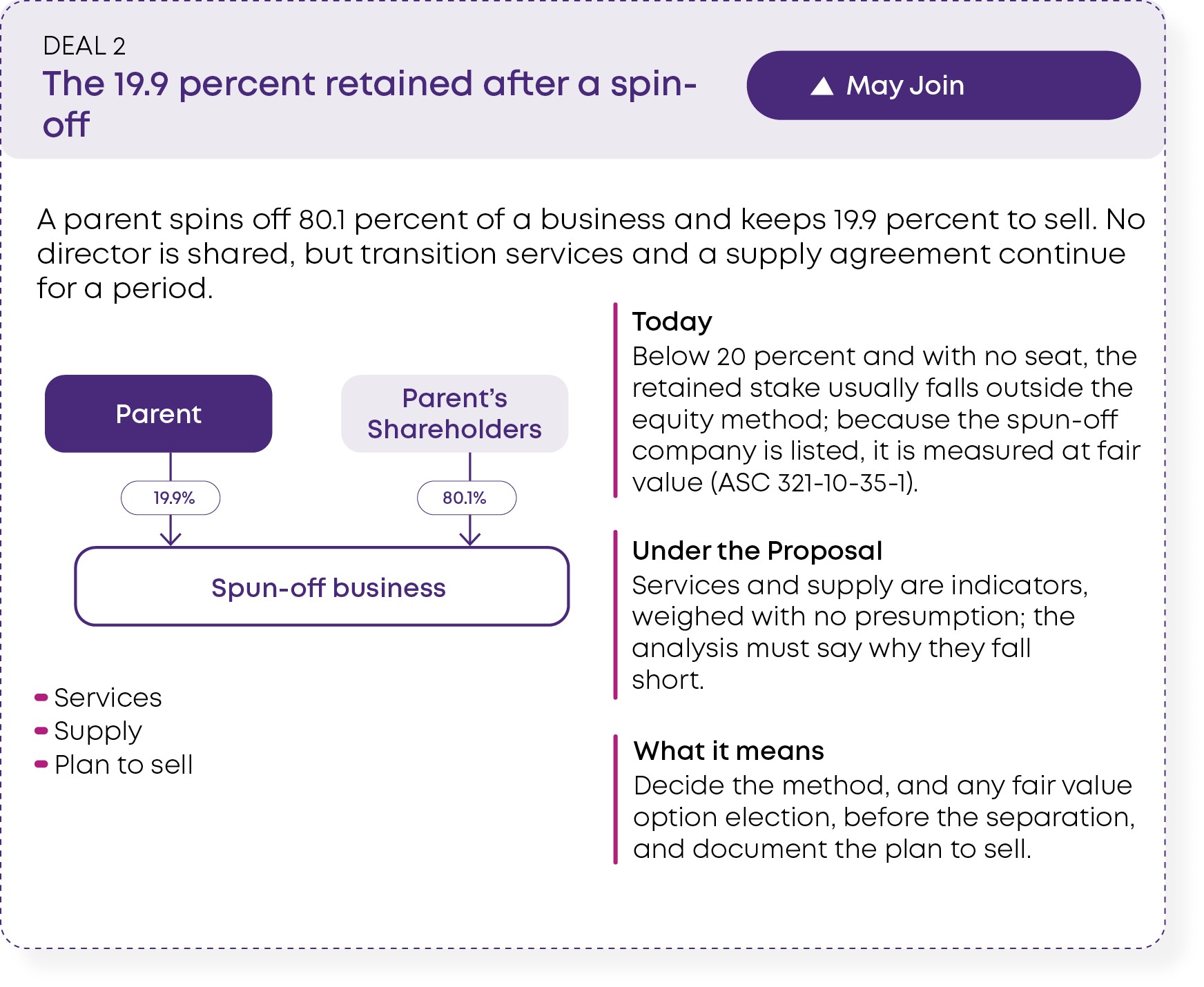
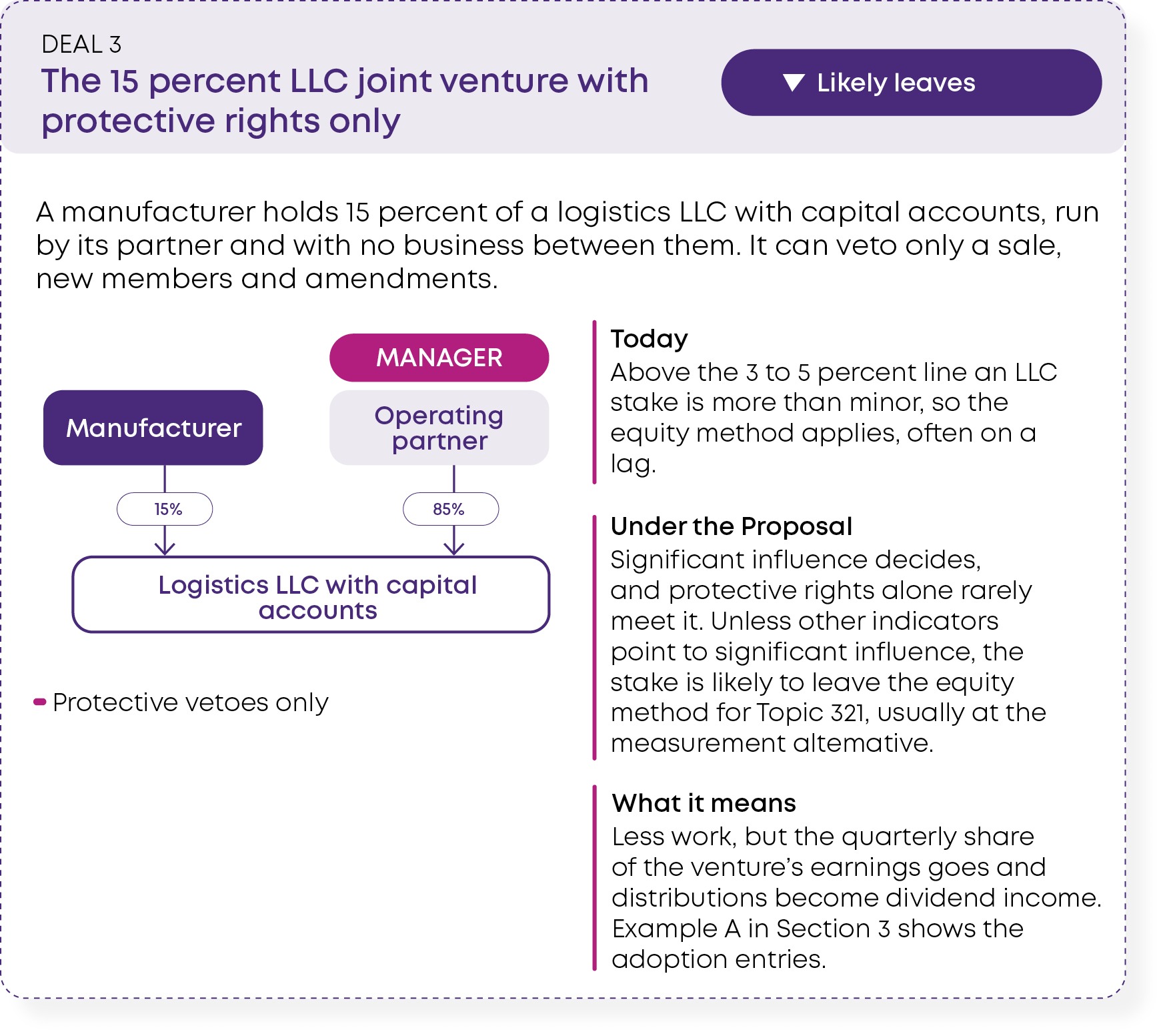
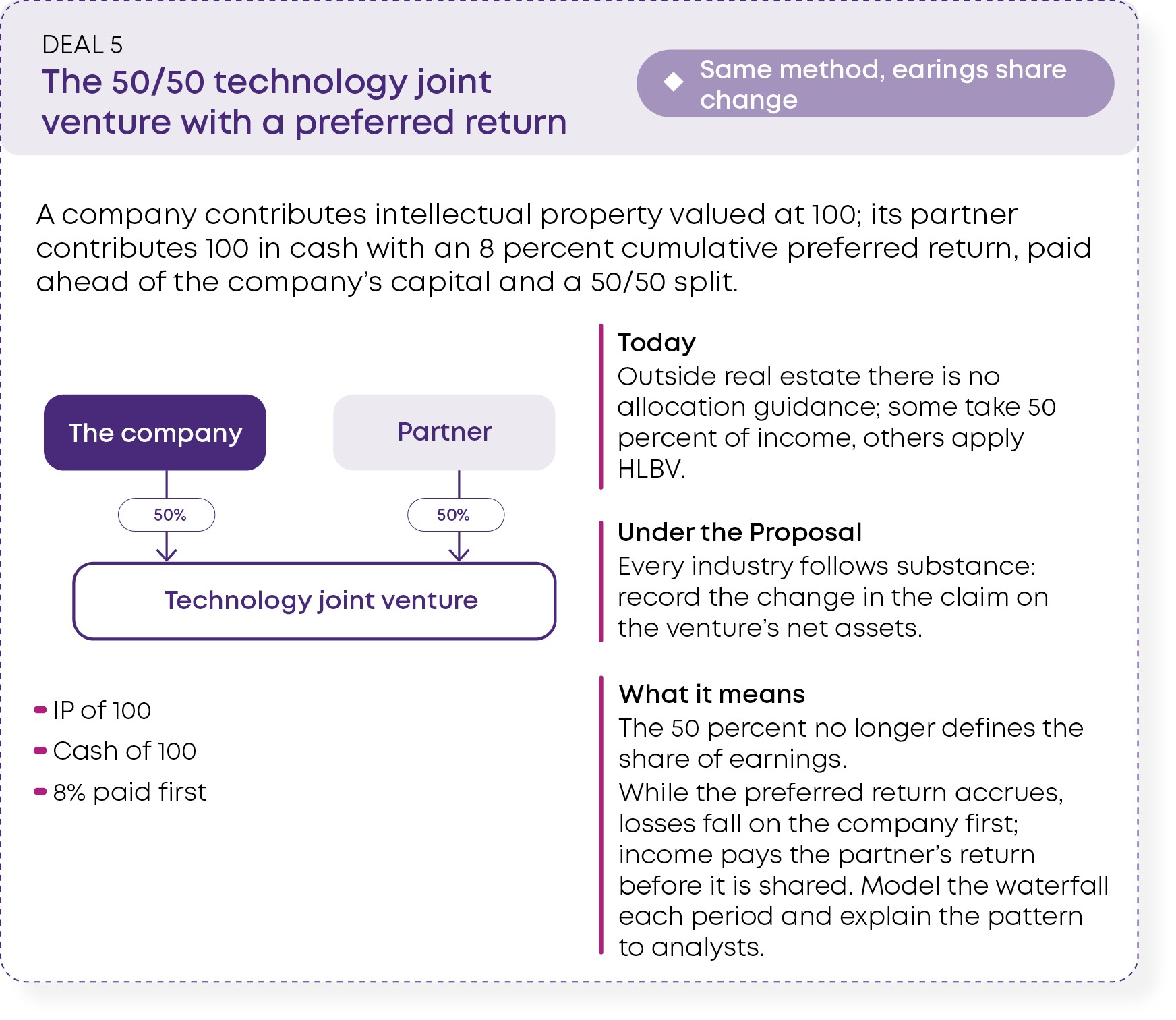
Most strategic stakes keep their accounting. Three groups move: corporate stakes with just under 20 percent and commercial ties may adopt the equity method (Deals 1 and 2); passive partnership and LLC stakes are likely to leave it (Deal 3); and joint ventures with waterfalls record different shares of earnings (Deals 4 and 5).
Exhibit 2 — Where the five deals land
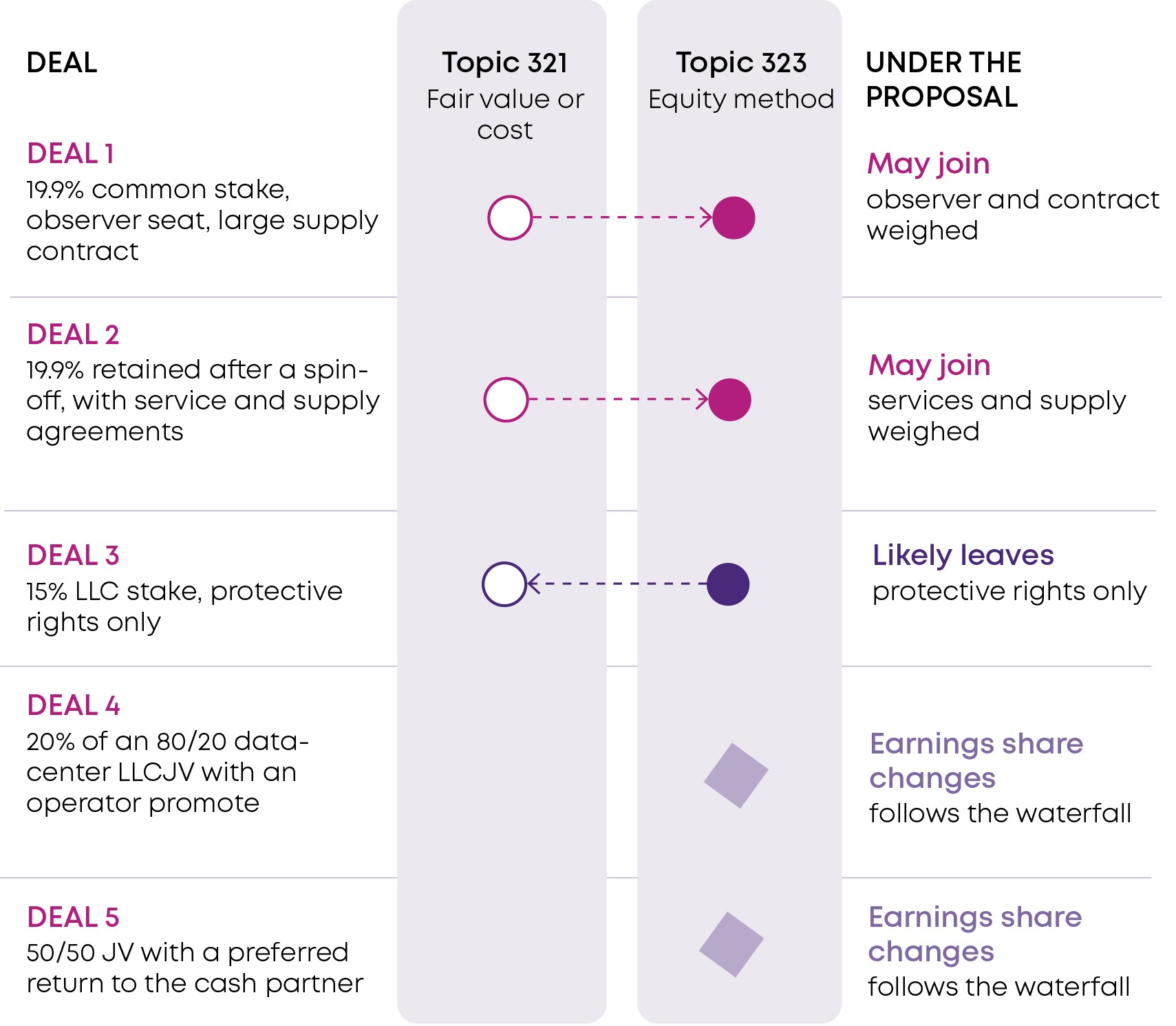
Source: Uniqus analysis of the FASB proposed Update (October 28, 2026). Hollow marker: today; filled marker: under the proposal; diamond: stays on the equity method; earnings share changes.
2.1 The playbook, re-scored
Two structuring practices change. Supply, licensing, and capacity agreements carry more weight as evidence of significant influence, and the fair value option becomes a policy set before closing, not a fix after it.
Exhibit 3 — Nine structuring levers, re-scored
WEAKENED
No longer enough alone
- Hold 19.9 percent No presumption either way below 20 percent; the indicators decide. WEAKENED
- Observer instead of a board seat Still not a seat, but attendance and information rights are weighed with commercial ties. WEAKENED
- USE INSTEAD Document each indicator, design the instrument, or elect the fair value option deliberately.
STILL WORKS
Holds under the proposal
- Preferred stock Only common or in-substance common stock can be on the equity method. Reassess on conversion. UNCHANGED
- Protective rights only Vetoes over fundamental changes are not influence. The Board added no guidance. DOCUMENT IT
- Standstill A standstill is a listed sign of no influence; it weighs more now. MORE WEIGHT
- Fair value option Stake by stake and irrevocable; Rules 3-09 and 4-08(g) still apply. UNCHANGED
CHANGED IN KIND
The question moves
- LLC or partnership form The 3 to 5 percent line made legal form a trap; legal form no longer sets the threshold. NO LONGER A TRAP
- The managing-member role A noncontrolling managing member applies the equity method at any ownership level. DECISIVE
- Kick-out rights, shared power, 49.9% Consolidation is not reopened; the fallback is the equity method with waterfall allocation. CONSOLIDATION UNCHANGED
Source: Uniqus analysis of the FASB proposed Update (October 28, 2026), paragraph 323-10-15-10 as amended, 323-10-15-13 and Subtopic 825-10
The Question
On the day we adopt, what happens to each stake, and what does it do to the numbers?
03
HOW TO TRANSITION
A stake that leaves the equity method follows one of two transition paths, depending on how it will be measured next. The proposal sets no path yet for a stake that joins, and neither path restates prior periods.
Transition: What happens when an investment changes accounting methods?
When an investment moves out of the equity method, the transition depends on how it will be accounted for under ASC 321. The proposal provides two transition approaches:
- Measurement alternative: If the investor elects the measurement alternative, the investment’s carrying amount on the adoption date becomes its new cost basis, with no adjustment to opening retained earnings (modified prospective approach). (Refer to Exhibit 5, Example A)
- Fair value: If the investment is measured at fair value, the difference between its existing carrying amount and fair value is recognized in opening retained earnings (modified retrospective approach). (Refer to Exhibit 5, Example B)
Where fair value is not readily determinable, investors may choose between these approaches, subject to eligibility for the measurement alternative.
Disclosures and early adoption
Entities would be required to disclose the nature of and reason for the change in accounting principle. If applicable, they also would disclose the cumulative effect on retained earnings (or other components of equity or net assets) at adoption in both the interim (if applicable) and annual reporting periods of the change.
Early adoption is permitted for financial statements that have not yet been issued. If adopted in an interim period, the guidance must be applied from the beginning of that fiscal year.
Two areas remain unresolved under the proposal:
- Investments entering the equity method: The proposal does not specify how investments that newly qualify for the equity method should transition. The FASB has sought stakeholder feedback on this matter (Question 13 of the proposal). (Refer to Exhibit 5, Example C)
- Existing investments with complex allocation arrangements: The new guidance on allocating earnings under waterfall arrangements would apply prospectively from the adoption date to both new and existing investments. Prior-period financial statements would not be restated. However, the proposal does not clarify how any difference between an investment’s existing carrying amount and the investor’s hypothetical liquidation entitlement at the adoption date should be treated. It remains unclear whether this difference should be retained, recognized over time, or adjusted at adoption (ASC 323-10-65-4). (Refer to Exhibit 5, Example D)
Exhibit 4 — Transition, as a decision tree
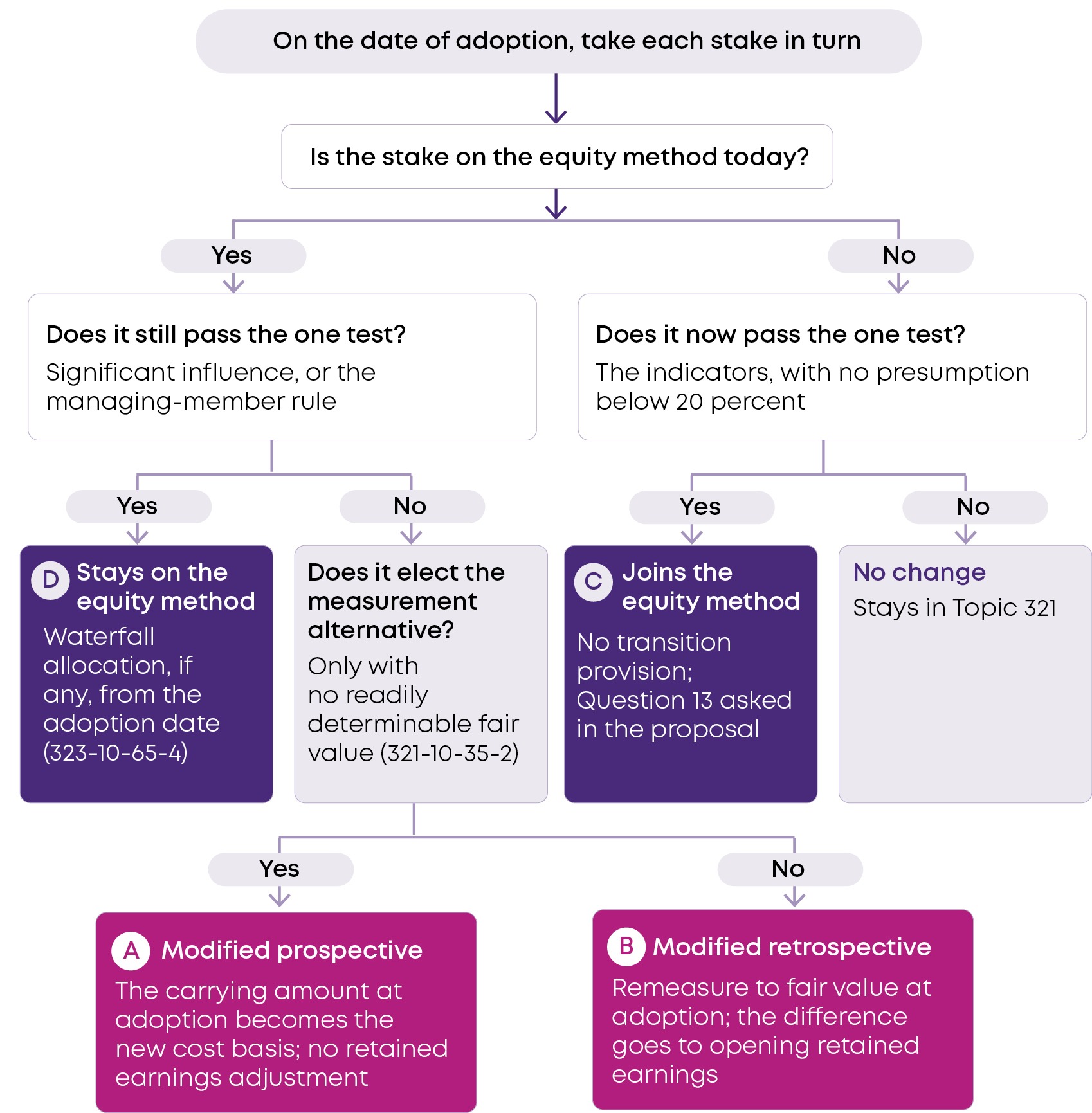
Source: FASB proposed Update (October 28, 2026), 323-10-65-3 and 65-4, Question 13;321-10-35-2
Exhibit 5 — Four stakes on the day of adoption
STAKE LEAVES • MEASUREMENT ALTERNATIVE
A Modified prospective
323-10-65-3(c)(1)
THE STAKE
Deal 3; 15 percent LLC stake with protective rights only and no readily determinable fair value.
The company elects the measurement alternative.
AT ADOPTION
| Equity method carrying amount | 42 |
| Fair value, not recorded | 50 |
| Retained earnings adjustment | None |
| New cost basis | 42 |
AFTER ADOPTION
- The LLC earns 40; the 6 (15%) share is no longer recorded.
- Distributions are dividend income.
- Assuming an observable price of 55 for identical units: remeasure, with a gain of 13.
STAKE LEAVES • FAIR VALUE
B Modified retrospective
323-10-65-3(c)(2)
THE STAKE
A 6 percent holding of listed partnership units, on the equity method today because it is above the 3 to 5 percent line.
Quoted prices mean fair value.
AT ADOPTION
| Equity method carrying amount | 30 |
| Quoted fair value | 37 |
| Increase in the investment | 7 |
| Credit to opening retained earnings | 7 |
AFTER ADOPTION
- Prior periods stay as reported.
- Fair value changes run through net income
- Distributions are dividend income; deferred tax follows the new book basis.
STAKE JOINS • NO TRANSITION PROVISION
C Equity method from adoption
Question 13 of proposal
THE STAKE
Deal 1: 19.9% of a listed supplier, carried at fair value of 280. The supplier’s net assets are 1,000. With an observer seat and a large supply contract, the company concludes it now has significant influence.
AT ADOPTION
| Carrying amount, starting basis | 280 |
| Share of net assets: 19.9% of 1,000 | 199 |
| Gap between carrying amount and share of net assets | 81 |
OPEN QUESTION
- How is the 81 gap between 280 and 199 allocated, amortized or is it treated as goodwill?
- If existing 323-10-35-33 applied by analogy, the 280 would be the starting basis and 81 would be allocated, with amortization reducing the earnings share.
- Or elect the fair value option, if adoption is a qualifying date.
What remains unclear:
The proposal does not specify whether this basis difference should be allocated and amortized or how it should otherwise be treated when an investment newly qualifies for the equity method. Investors may also consider the fair value option, if eligible and properly elected. The FASB’s clarification on transition for investments entering the equity method would therefore be important.
STAKE STAYS • WATERFALL STRUCTURE
D Prospective
323-10-65-4
THE STAKE
Deal 5: a 50/50 technology joint venture. Each partner put in 100. The partner is paid 8 a year first, then the company gets its capital back, then profits split 50/50. The venture lost 10 in year one and earned 30 in year two; adoption falls at the start of year three.
AT ADOPTION
| Carrying amount at adoption (100, less 5, plus 15) | 110 |
| Claim under the waterfall at adoption ((net assets of 220 − 16 the partner’s preferred return for 2 years)/2) | 102 |
| Difference at adoption (treatment open) | 8 |
AFTER ADOPTION
- In year three the venture earns 60. The company’s claim rises by 26 ((60 − 8)/2), not the 30.
- Years one and two are not restated.
- Open question: the proposal is silent on the 8 difference at adoption. Does it stay in the carrying amount until exit, unwind over time, or get trued up?
What remains unclear:
The proposal requires the new allocation guidance to apply prospectively, without restating prior periods. However, it does not specify how the $8 million difference at adoption should be treated. Whether this difference remains in the investment’s carrying amount, is recognized over time, or is adjusted against future earnings requires further clarification from the FASB.
3.1 What the transition paragraphs leave open
Investments entering the equity method
The transition provisions address only investments that no longer qualify for the equity method. They do not specify how investments that newly qualify should transition. Until the FASB provides further guidance in response to Question 13, companies should assess the applicable transition requirements and consider how to determine and allocate any basis difference at adoption.
Differences arising from waterfall arrangements
The new guidance will apply prospectively from the adoption date, without restating prior periods. Accordingly, the existing carrying amount will remain unchanged, while earnings will be allocated based on the contractual waterfall arrangements going forward. However, as illustrated in Example D, the proposal does not clarify how differences between the existing carrying amount and the investor’s waterfall entitlement at adoption should be treated.
Income tax implications
The transition provisions do not specifically address income tax implications. Companies should assess the impact of changes in the investment’s accounting basis on related deferred tax balances and include these in their transition planning.
Transition from ASC 321 to ASC 323
The proposal does not specify how companies should transition an investment from ASC 321 to ASC 323. However, certain proposed changes, particularly the removal of the presumption that investments below 20% lack significant influence, could result in some investments becoming eligible for the equity method. The FASB is seeking stakeholder feedback on how such transitions should be addressed.
What needs to be in place across the period-end close process, internal controls and SEC reporting before the first quarter under the new guidance?
04
CONTROLS, CLOSE AND SEC REPORTING
The equity method test moves from a percentage check to a documented judgment, which may require designing new controls. Each stake that joins or leaves the equity method brings new close and SEC reporting work.
A judgment needs documented evidence, a reviewer, and a clear trigger for reassessment, as the table sets out below:
| Area | Current practice | Under the proposal | Controls to consider |
|---|---|---|---|
| Assessing new investments | Generally, ownership of 20% or more (or 3%–5% for LLCs) is used as an indicator of significant influence. | Assess all investments based on the relevant indicators of significant influence, rather than relying mainly on ownership percentages. A managing member is considered to have significant influence. | Document the assessment of significant influence, including supporting evidence, and require technical accounting review. |
| Reassessment of significant influence | Reassessment is generally triggered by changes in ownership percentage. | Reassessment may be required when there are changes in contractual rights, board representation, key personnel, or governance arrangements. | Obtain quarterly confirmation from legal and corporate development teams and maintain a log of significant changes in contracts and governance rights. |
| Investments moving to the equity method | Not applicable under the current accounting method. | Additional accounting considerations may arise, including recognition of the investor’s share of earnings, basis differences, impairment, and potentially SEC Rule 3-09 requirements. | Establish processes to obtain investee financial information, track basis differences, assess impairment, and document the fair value option decision. |
| Investments moving out of the equity method | Recognize the investor’s share of the investee’s earnings or losses based on the investee’s financial statements. | Generally, apply ASC 321, with investments measured at fair value or, where eligible, under the measurement alternative (cost less impairment, adjusted for observable price changes). | Establish processes to monitor observable price changes and identify impairment indicators. |
Companies should consider whether their existing accounting policies, data collection processes and internal controls are sufficient to support these judgments. Particular attention may be needed where the proposal results in changes to the investments accounted for under the equity method, as this could affect financial reporting, period-end close procedures and SEC reporting requirements.
Practical Perspective
Consider the broader impact of equity in earnings
- When a company owns an investment and accounts for it under the equity method, it records its share of the investee’s profit or loss in its own income statement. This is called equity in earnings.
- Equity in earnings often flows into other important financial measures, including debt covenant calculations, segment reporting, non-GAAP metrics and employee incentive targets.
- Any investment moving into or out of the equity method could therefore affect these measures and related reporting requirements.
Consider the impact on the period-end close.
The equity method allows the use of a reporting lag in certain circumstances, whereas fair value accounting does not follow the same approach. Companies should assess how and when investee financial information will be obtained, particularly for investments moving into or out of the equity method, to ensure timely reporting and an efficient close process.
Consider the impact on other GAAP reporting.
IAS 28 and Ind AS 28 continue to presume that an ownership interest below 20% does not provide significant influence, unless there is clear evidence to the contrary. As a result, a US parent and its foreign subsidiary holding a 15% investment could reach different conclusions under US GAAP and IFRS (or Ind AS). The IASB’s revised IAS 28, expected in the first half of 2027 and effective from 2029, is expected to change how the equity method is applied, rather than the criteria for determining when it applies.
4.1 The SEC reporting implications
SEC reporting requirements under Rules 4-08(g) and 10-01(b)(1) of Regulation S-X
A change in the accounting for an investment to the equity method may trigger additional SEC reporting requirements. These include:
- Rule 4-08(g): Requiring summarized financial information about significant equity method investees in the annual financial statement notes.
- Rule 10-01(b)(1): Requiring summarized financial information about significant equity method investees in quarterly financial reports.
As a result, an investment that moves to the equity method could create additional financial statement preparation and disclosure requirements.
Consider disclosure requirements before adoption
Once the standard is finalized, companies will need to disclose its expected impact in their SEC filings before adoption, in accordance with SEC Staff Accounting Bulletin (SAB) Topic 11.M.
This includes describing the new guidance and its expected impact on the financial statements. Once the impact can be reasonably estimated, companies should also quantify the expected effect, including identifying investments that may move into or out of the equity method.
Practical Perspective
Evidence supporting significant influence
Auditors are likely to look beyond ownership percentages when reviewing investments below 20%. They may ask what factors management considered, what supporting evidence was obtained, who reviewed the assessment and what changes in circumstances would trigger a reassessment.
Controls over waterfall calculations
Companies using HLBV (Hypothetical Liquidation at Book Value) or similar methods should ensure that the underlying calculations are supported by appropriate documentation and review controls. This includes validating the inputs, confirming that the contractual terms have been correctly reflected and reviewing the calculations each reporting period.
Inadequate review of HLBV calculations can also create internal control risks. For example, a renewable energy company has disclosed a material weakness relating to its review of HLBV calculations used to allocate income to noncontrolling interests in tax equity partnerships.
If Uniqus were filing a comment letter, what would it say?
05
WHAT WE WOULD TELL THE BOARD
Support the single threshold and ask for eight changes that make it work for corporate investors on the first day.
The following are our key recommendations, aligned with the FASB’s discussion questions. For corporate investors, the most relevant questions are 3 (corporations), 4 (general partners), 7 (allocation methods), 11–13 (transition) and 15 (effective date). These recommendations reflect our views and are not predictions of the Board’s final decisions
Finalize the single threshold.
Questions 1 and 2
Significant influence should be based on the investor’s actual ability to participate in an investee’s financial and operating decisions, rather than its legal structure. The same approach should apply to governing bodies that perform similar roles.
Retain a starting presumption for corporate investments.
Questions 3
Retain the presumption below 20 percent for corporate investees, or keep it where the investor has no seat, no observer and no material transactions. The proposal’s case is about aligning partnerships with corporations.
Provide practical examples to guide the assessment.
Questions 3
Provide examples explaining how companies should evaluate board observers and information rights, supply and capacity agreements, and shared personnel when assessing significant influence. This would help companies and auditors apply the guidance consistently.
Clarify the scope of the managing-member rule
Questions 4
Clarify that a managing member with only administrative or protective responsibilities does not automatically have significant influence. Also, an advisory committee should not be treated as a governing body for this purpose.
Clarify the transition requirements for investments moving into the equity method.
Questions 13
The proposed transition guidance addresses investments moving out of the equity method but does not explain how to account for investments moving into it. Specify that the equity method should be applied prospectively to these investments and confirm that the adoption date provides an opportunity to elect the fair value option.
Address the new gap with IAS 28. Address differences with IFRS and Ind AS.
Questions 3
IAS 28 and Ind AS 28 retain the presumption that investments below 20% do not provide significant influence. Clarify whether differences in accounting outcomes under these frameworks and US GAAP are expected, so multinational groups can plan for the impact.
Require disclosure of the allocation method used.
Questions 7
If companies can use different methods to allocate earnings under the equity method, require them to disclose the method selected and the key contractual terms that influence the allocation. This will help financial statement users understand how reported earnings are determined.
Provide sufficient time for implementation.
Questions 15
Allow companies to adopt Issue B separately from Issue A. Provide public business entities at least one year after the final standard is issued to implement Issue A, with an additional year for other entities.
What should a controller and a head of corporate development do before the standard is final?
06
WHAT TO DO NOW
Start preparing now by reviewing existing investments, reassessing significant influence, understanding the financial impact and updating deal documentation before new investments are made.
For the controller and the head of corporate development, together. Each step draws on the sections before it.
Prepare a complete list of investments
Identify all investments with ownership below 20%, as well as investments in partnerships and LLCs. For each investment, document the ownership percentage, board representation, observer and information rights, significant commercial agreements, shared personnel, managing-member responsibilities and waterfall arrangements.
Reassess significant influence
Review the existing significant influence assessments without relying on the current presumption based on ownership percentages. Start with the largest investments and use Exhibits 1 and 4 to identify which investments may move into or out of the equity method and which will remain unchanged.
Assess the financial impact of changes
Estimate the impact of investments moving into or out of the equity method:
- Investments moving out: Compare their existing carrying amounts with fair value.
- Investments moving in: Determine fair value, the investee’s net assets and any resulting basis differences.
Refer to Exhibit 5 for the key considerations.
Decide the fair value option policy for stakes that may join.
Determine whether the company should elect the fair value option for investments that may qualify for the equity method. The election is irrevocable and must be made when the investment first becomes eligible. Also, note that electing the fair value option does not eliminate applicable SEC reporting requirements under Rule 3-09.
Update the investment and deal approval process
Include significant influence indicators in the term-sheet and deal review checklists. Capture board and observer rights, information rights, commercial agreements, shared management, licenses, standstill arrangements and key investment terms. Involve the accounting team early so that the potential accounting implications are assessed before a deal is signed.
Refer to Exhibit 1 for the key indicators to consider.
Review waterfall arrangements and related financial measures
Identify all investments with waterfall allocation arrangements and calculate the investor’s share of earnings under the applicable allocation method. Also assess the impact on debt covenants, segment reporting, non-GAAP measures, management incentive targets and deferred taxes.
Consider submitting comments to the FASB
Assess whether the proposed changes create practical challenges for the company, particularly around the corporate ownership presumption, managing-member guidance and transition requirements for investments moving into the equity method. The FASB is seeking feedback on implementation costs, including one-time and recurring costs (Question 16). The comment letter deadline is January 11, 2027.
Engage with the auditor and audit committee
Discuss the proposed changes with the external auditor and audit committee. Agree on the evidence, documentation and review controls needed to support significant influence assessments, particularly for investments below 20%, before the first reporting period under the new guidance.
Source: For the full text of the Proposed ASU, see the Exposure Draft on the FASB’s website.
HOW UNIQUS CAN HELP
This support is most relevant for companies with minority stakes below 20 percent, LLC or partnership interests, or joint ventures with waterfalls. If every stake you hold is above 20 percent, or is a passive holding below it with no seat, observer or commercial agreement, you may not need this level of review.
Understand the potential financial impact
Key question: Which of your stakes would join or leave the equity method, and how would that affect your reported results and key performance measures?
What we deliver: An inventory of every stake below 20 percent and every partnership or LLC stake, assessed against the single threshold, with the adoption entries for the largest and the effect on equity in earnings, debt covenants and management compensation. If you plan to comment by January 11, 2027, a draft response supported by your own numbers.
Prepare for adoption and the first close
Key question: How will you demonstrate that you do, or do not, have significant influence over a stake below 20 percent once the presumption is removed?
What we deliver: A significant influence memo template, accounting memos for the key stakes, reassessment triggers and review controls, waterfall model governance and the adoption memo.
Assess complex commercial arrangements
Key question: Could an observer seat, a commercial agreement, a managing-member role or a waterfall change the accounting for a structure, before or after it is signed?
What we deliver: A transaction-specific accounting memo covering consolidation under Topic 810, the significant influence indicators, the terms of the instrument, the allocation of earnings under any waterfall and the fair value option decision.
Align accounting policies across reporting frameworks
Key question: Should your group adopt a consistent approach to minority stakes across US GAAP, IFRS and Ind AS?
What we deliver: An analysis of the key differences between the reporting frameworks, including the presumption below 20 percent that IAS 28 and Ind AS 28 retain, and a proposed group accounting policy for minority stakes and joint ventures.
Uniqus is an accounting and reporting consulting firm. Our Accounting & Reporting Consulting team works alongside clients and their auditors and brings experience in equity method accounting, consolidation, joint ventures and SEC reporting across the US, India and the Middle East.