Executive Summary
GROWTH IN RPO
More than doubled
Combined RPO of four of the largest cloud providers at their most recent quarter ends, compared with the same quarters a year earlier
RPO EXPECTED WITHIN 12 MONTHS
Under 20% to over 75%
Range of the share of RPO expected to be recognized as revenue within 12 months, among registrants in our review that disclose the share
MOST FREQUENT SEC STAFF COMMENT
Timing of recognition
Topic raised most frequently in the publicly released comment letters we reviewed that refer to the RPO disclosure requirements
CHANGES IN THE RPO BALANCE
Rarely disclosed
Only one registrant in our review presented an analysis of the change in its RPO balance during the period
Based on our reviews, described on page 19.
Overview
US GAAP requires registrants to disclose, at the end of each annual and interim reporting period, the amount of the transaction price of their customer contracts allocated to performance obligations not yet satisfied (remaining performance obligations, or RPO). Registrants also explain when they expect that amount to be recognized as revenue. SEC rules and guidance may call for related information elsewhere in a filing, for example in the discussion of known trends and key performance indicators, such as backlog and bookings, in management’s discussion and analysis (MD&A).
RPO has also become more prominent in investor communications. Several of the largest technology registrants have highlighted RPO or backlog in recent earnings releases and in prepared remarks on earnings calls, and the SEC staff has continued to comment on the disclosure.
This publication provides a refresher on the requirements and on related information outside the RPO note, and summarizes observed disclosure practice and the themes in recent SEC staff comment letters. It then sets out disclosure practices that registrants may consider, with illustrative wording, and considerations for the next reporting cycle.
The key messages are summarized below.
RPO is not a revenue forecast
RPO is the portion of the transaction price of existing customer contracts that has not yet been recognized as revenue, measured over the period in which each contract is enforceable. Amounts that customers may cancel without a substantive penalty are therefore generally excluded, and the amount is not reduced for expected credit losses.
See pages 4 to 7
Context often sits outside the RPO note
Information that helps explain the RPO balance, such as customer concentration, credit support and lease arrangements, may appear in other notes or in MD&A. Company-defined measures such as backlog may differ significantly from RPO, and few registrants in our review reconcile the two measures.
See page 8
Disclosure practice varies widely
Registrants explain when RPO is expected to be recognized either by time period, such as within 12 months and thereafter, or in narrative form, and time periods are not defined consistently. Because some registrants apply the optional exemptions in ASC 606 and others do not, the scope of the disclosed amount also differs, and balances may not be comparable without adjustment.
See page 10
SEC staff comments focus on timing
In the comment letters we reviewed, the staff asked registrants to explain when RPO is expected to be recognized, particularly where a large portion fell in a final period with no stated end. Where backlog or bookings were presented alongside RPO, the staff often asked whether the measure should be defined and discussed in periodic reports.
See page 12
Practices registrants may consider
Timing
Present expected timing for the full RPO balance, including when the last performance obligation is expected to be satisfied.
Scope
Indicate the significance of amounts excluded from the RPO balance, such as cancelable amounts and exempted variable fees.
Related measures
Define measures such as backlog and bookings, and reconcile those measures to RPO.
Changes
Explain the main drivers of change in the RPO balance, for example in MD&A.
These practices may help investors understand the RPO balance the way management sees it. They go beyond what ASC 606 requires, although SEC rules and guidance may call for some of this information in MD&A.
RPO in context
RPO provides information about revenue that a registrant expects to recognize from existing contracts. Investors and analysts may refer to RPO when assessing future revenue.
What the disclosure is designed to show
ASC 606 introduced a requirement to disclose RPO in the notes to the financial statements, and US GAAP did not previously require a comparable disclosure. The FASB indicated that the disclosure is intended to inform users about the revenue that existing contracts are expected to produce and its timing, trends in that information, the risks to that revenue and the effect of revised judgments or changed circumstances (ASU 2014-09, BC350). The FASB also noted that backlog is usually reported outside the financial statements and, in the absence of a common definition, may not be comparable between entities (ASU 2014-09, BC349). RPO is often compared with backlog but is measured by reference to the enforceable contract.
Growth in reported balances
The combined RPO of four of the largest cloud providers more than doubled over the year to their most recent quarter ends in 2026, and combined balances increased in every sector in our review. Disclosures and earnings call commentary of several cloud providers refer to significant multi-year commitments for computing capacity, and at the most recent balance dates those providers reported most of the largest balances in our review. Some aerospace and energy registrants also expect parts of their balances to be recognized over more than a decade. For balances of this size and duration, the expected timing, the portion that customers could cancel and the concentration among customers may matter to readers as much as the total.
One disclosure across different arrangements
The same requirements apply to a one-year subscription and to a multi-year supply arrangement. Because the disclosure presents a single amount for all contracts, readers may not be able to tell how much of the RPO balance relates to each type of arrangement unless the registrant explains the composition. Figure 1 shows how the RPO balance relates to the value stated in a signed contract.
Figure 1 – How RPO relates to the value of a signed contract
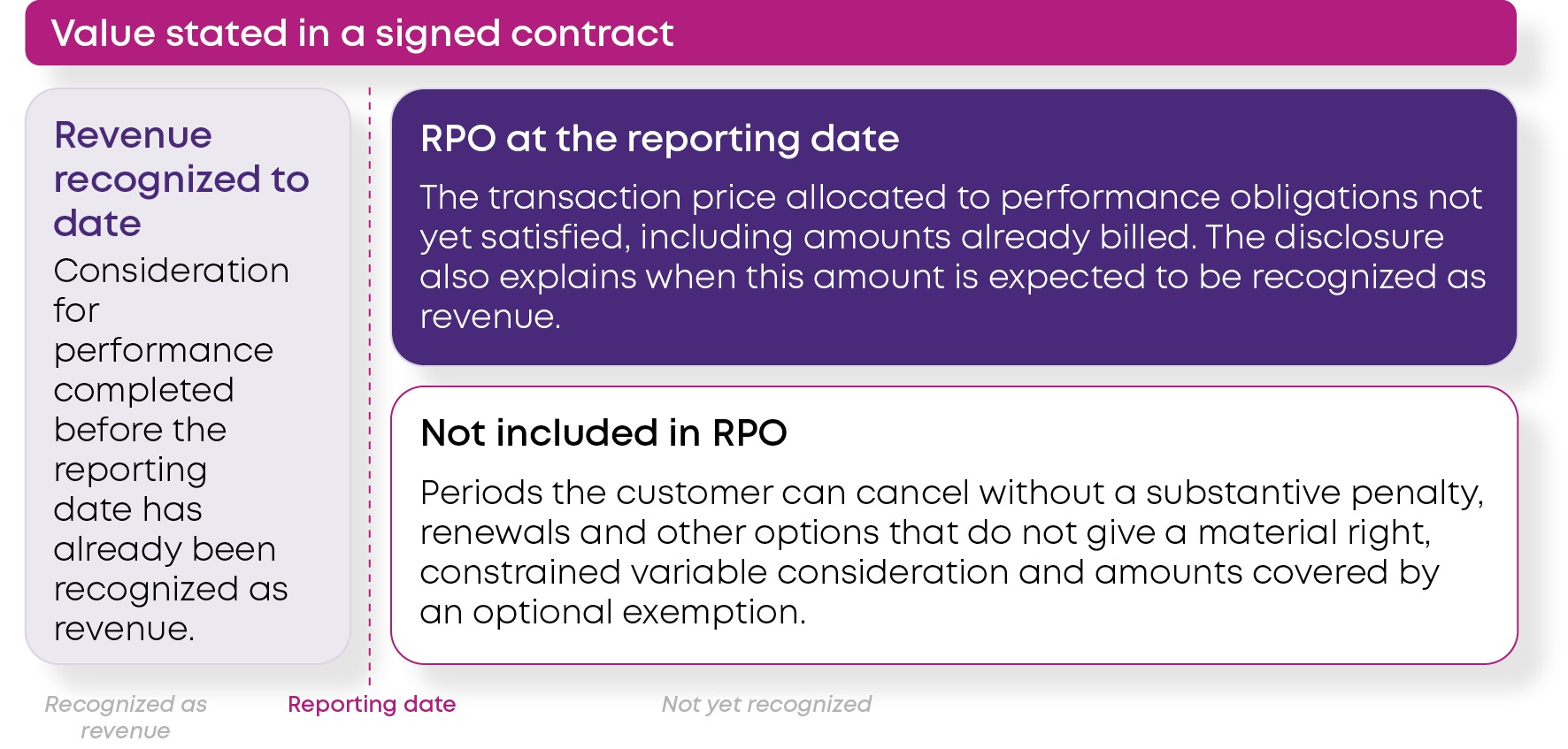
The components shown are not steps in a sequence, and more than one exclusion may apply to the same contract. RPO decreases as revenue is recognized and increases as new contracts are signed.
Requirements under ASC 606 and SEC rules
This section summarizes the requirements of ASC 606 and related SEC rules and guidance, together with the exemptions and judgments that shape the disclosed amount.
Required disclosures
A registrant discloses the amount of the transaction price allocated to performance obligations that remain wholly or partly unsatisfied at the end of the reporting period, and explains when that amount is expected to be recognized as revenue. The amount generally includes both amounts not yet billed and deferred revenue, presented as a contract liability. The explanation may be quantitative, using the time periods (time bands in ASC 606) that best suit the remaining duration of those obligations, or qualitative (ASC 606-10-50-13). Public business entities provide the disclosure in both annual and interim financial statements (ASC 270-10-50-1A, or ASC 270-10-50-34 once ASU 2025-11 is adopted).
Optional exemptions
ASC 606 also permits a registrant to omit certain amounts from the disclosure through optional exemptions. The exemptions cover contracts with an original expected duration of one year or less, obligations for which revenue is recognized in the amount the registrant has a right to invoice, and certain variable consideration, including sales-based or usage-based royalties on licenses of intellectual property (ASC 606-10-50-14 and 50-14A). Only the exemption for contracts of one year or less may be applied to fixed consideration (ASC 606-10-50-14B). Fixed amounts, such as contractual minimums, therefore remain in the disclosure when a registrant applies any of the other exemptions.
A registrant that applies an exemption states which exemption it applies and describes the nature and remaining duration of the obligations excluded and any variable consideration excluded. Each registrant also explains whether any consideration, such as constrained variable consideration, is excluded from the transaction price and so from the disclosed amount (ASC 606-10-50-15). The FASB indicated that this information need not be quantitative but could include, for example, the share of current-period revenue from exempted variable consideration or the remaining contract duration for each significant customer (ASU 2016-20, BC28 and BC30). Figure 2 summarizes these and related US GAAP requirements, with additional information that registrants may consider.
Figure 2 – Required disclosures and additional information registrants may consider
| Required by US GAAP | Additional information registrants may consider |
|---|---|
| Amount ASC 606-10-50-13(a) and ASC 270-10-50-1A The transaction price allocated to performance obligations not yet satisfied at the end of each annual and interim period. | Amounts by year Amounts expected to be recognized in each of the next five years, in the format used for debt and lease maturities. |
| Expected timing ASC 606-10-50-13(b) When the amount is expected to be recognized, using time periods suited to the remaining duration or qualitative terms. | Narrower final periods A large final period divided into narrower periods, and when the last obligation is expected to be satisfied. |
| Exemptions and exclusions ASC 606-10-50-14 to 50-15 The exemptions applied, the nature and remaining duration of excluded obligations, a description of excluded variable consideration and whether any consideration is outside the transaction price. | Significance of excluded amounts The significance of excluded amounts, for example the share of current-period revenue from exempted variable fees. |
| Contract balances ASC 606-10-50-10 An explanation of significant changes in contract assets and contract liabilities during the period. | Changes in the RPO balance Changes in the RPO balance analyzed into new contracts, modifications, terminations and revenue recognized. |
| Major customers ASC 280-10-50-42 Revenue from each customer that accounts for 10% or more of revenue. | Concentration in the RPO balance The share of the RPO balance attributable to the largest customers, where material. |
Judgments that shape the RPO amount
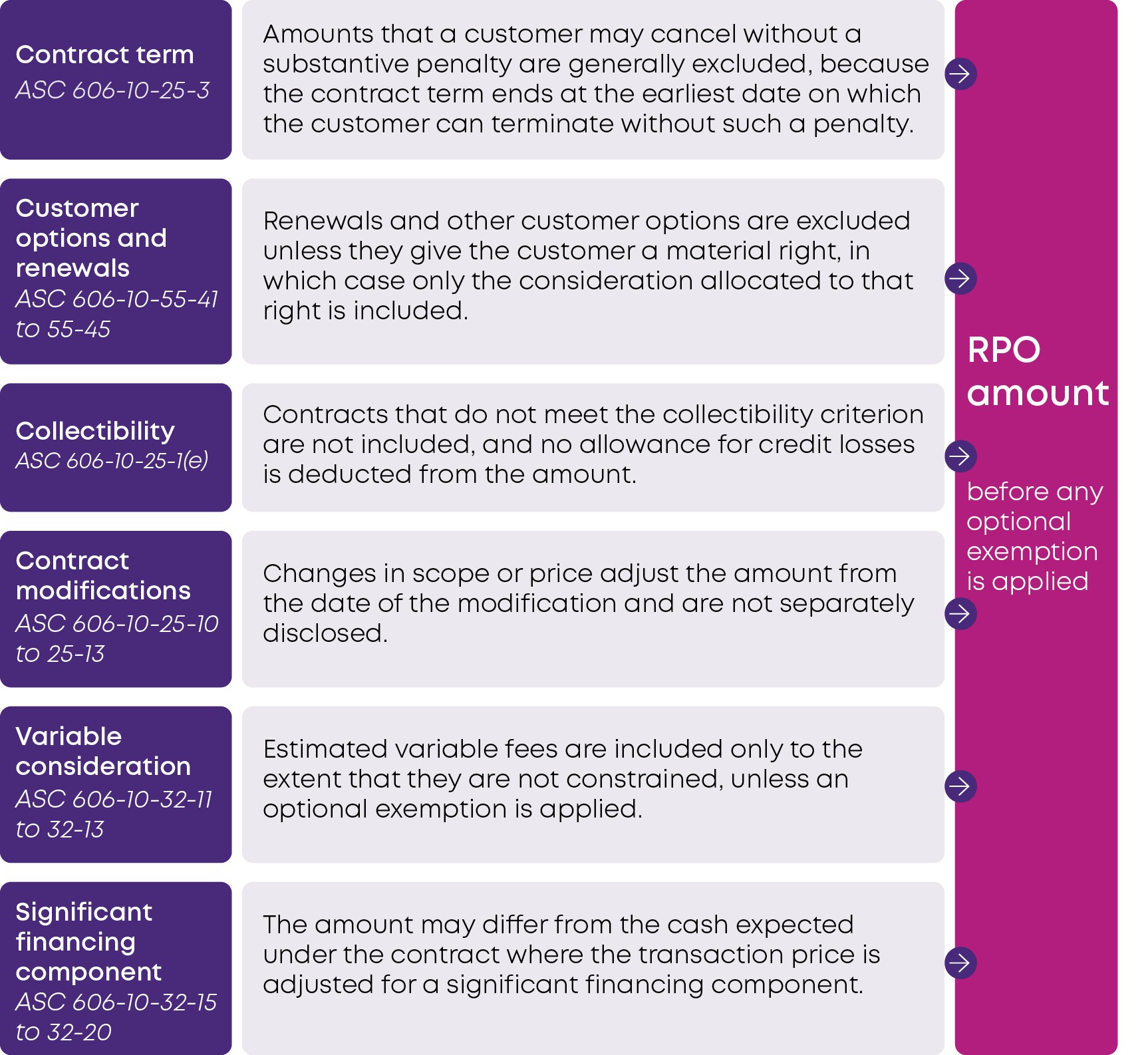
The RPO amount depends on judgments made in applying the recognition and measurement requirements of ASC 606. Figure 3 summarizes six of these judgments. The effect of each judgment on the amount is generally not disclosed separately.
Figure 3 – Judgments that may affect the RPO amount
Uniqus Insight
The judgments in Figure 3 determine what the RPO amount includes and may be less visible to readers than the time periods presented. Documenting these judgments by contract type, and revisiting them when contract terms change, may support both the accuracy of the disclosure and the response to any staff comment.
Related SEC requirements and guidance
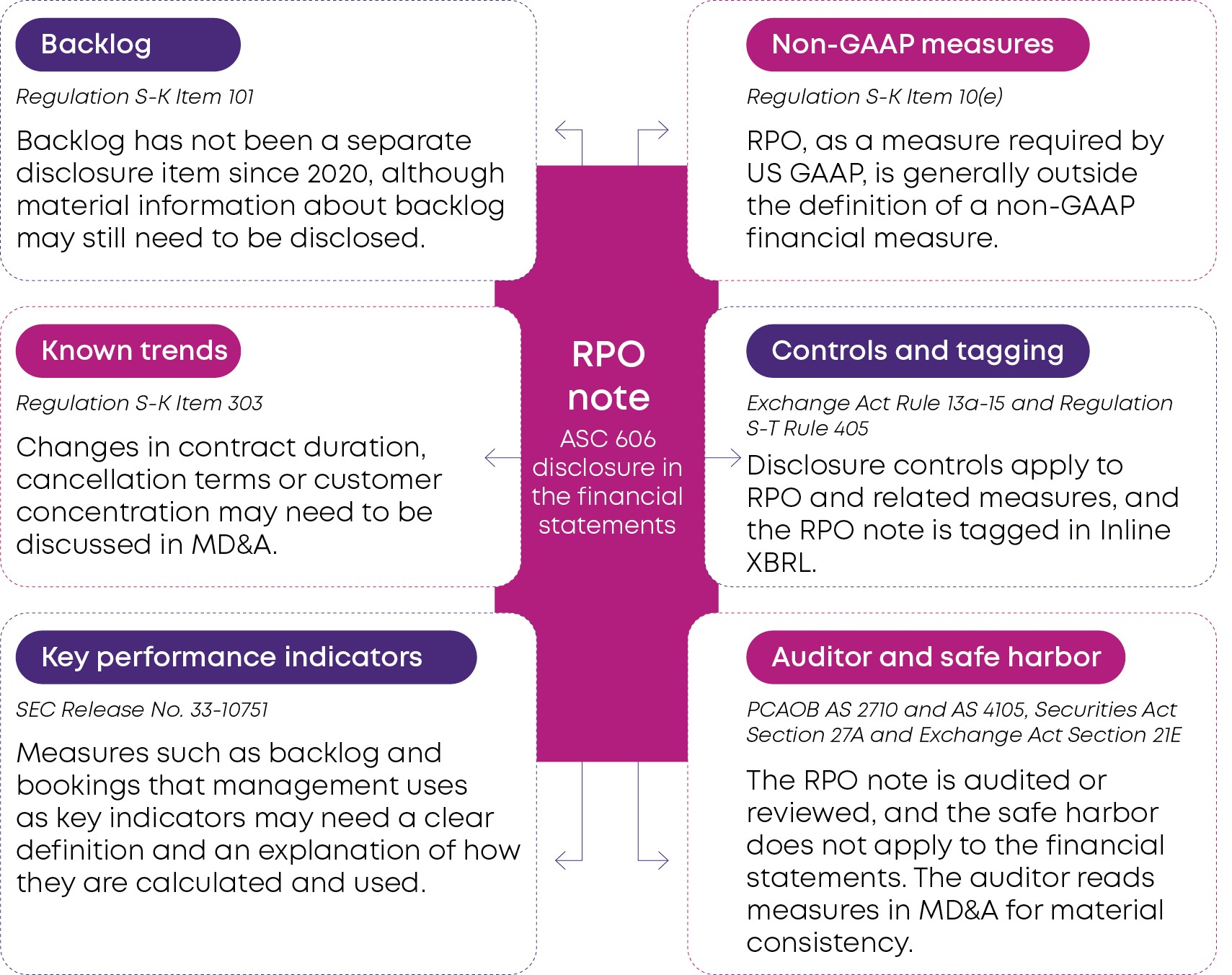
SEC rules and guidance may call for information that supplements the RPO note and may also apply to measures that registrants present alongside RPO, as Figure 4 summarizes.
Figure 4 – SEC rules and guidance relevant to RPO and related measures
Related disclosures beyond the RPO note
Some information that helps readers assess the RPO balance appears outside the RPO note. Three areas are particularly relevant for multi-year arrangements, namely capacity arrangements that contain a lease, customer concentration and company-defined measures.
Capacity arrangements that contain a lease
Arrangements for computing capacity, power or data center space may contain a lease. Lease components are outside the scope of ASC 606 and are therefore excluded from RPO (ASC 606-10-15-2(a)). Nonlease components, such as services, are generally accounted for under ASC 606 and included in RPO. A lessor that elects, where permitted, to combine lease and nonlease components accounts for the combined component under ASC 606 if the nonlease components predominate, and otherwise as an operating lease (ASC 842-10-15-42A and 15-42B).
Accordingly, the more of an arrangement that is accounted for as a lease, the smaller the amount included in RPO. Amounts accounted for as a lease are instead reflected in the lessor’s lease disclosures, which for operating leases present undiscounted lease receipts for each of the next five years and a total thereafter (ASC 842-30-50-12). A reader may therefore need both disclosures to understand the total consideration a supplier expects from such arrangements, and the two disclosures may present timing at different levels of detail. Figure 5 illustrates how one capacity arrangement may be reflected in each party’s disclosures.
Figure 5 – How one capacity arrangement may be reflected in each party’s disclosures
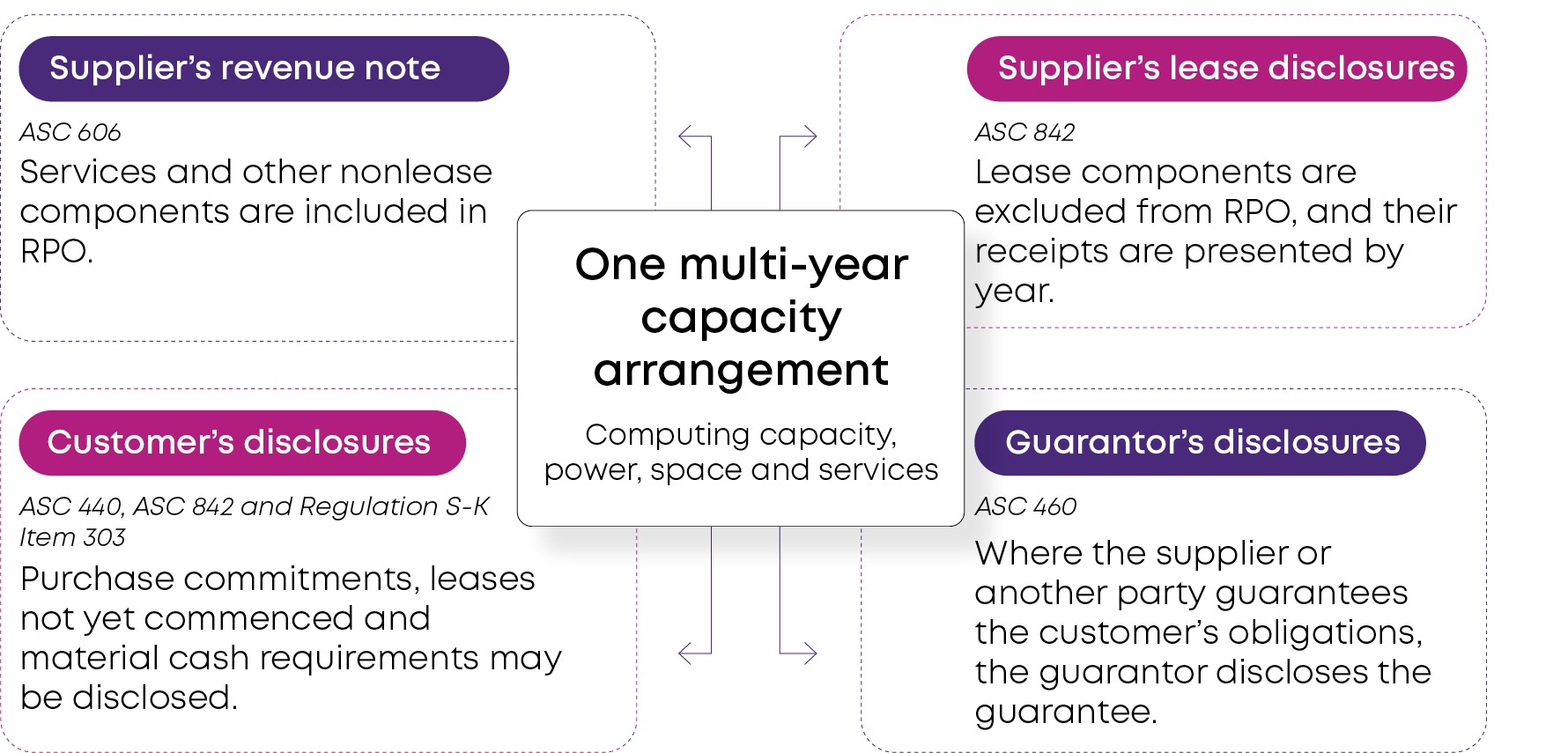
The disclosures that apply depend on how each party accounts for the arrangement. Where the arrangement contains a lease, the supplier reports the lease and nonlease components in different notes.
Customer concentration and credit support
An RPO balance concentrated in a few customers may carry different risks from a balance spread across many customers. Disclosure of customers’ shares of RPO is not required by ASC 606, and other requirements address concentration only in part. Major customer disclosure is based on revenue recognized (ASC 280-10-50-42). ASC 275 requires disclosure of certain concentrations, including concentrations in the volume of business with a particular customer, that make a registrant vulnerable to a reasonably possible near-term severe impact. Where a few customers account for most of an RPO balance that is a multiple of annual revenue, a registrant may consider whether the concentration is a known trend or uncertainty that is reasonably likely to have a material effect. If so, the concentration would be discussed in MD&A (Regulation S-K Item 303).
The risk associated with a concentrated balance may be greater where the supplier also supports a customer’s financing, for example by guaranteeing the customer’s obligations to third parties. The supplier generally discloses such a guarantee under ASC 460, including the maximum potential amount of future payments, rather than in the RPO note. Because the guarantee relates to the same customer relationship, it may be relevant to an assessment of the RPO balance.
Company-defined measures
Many registrants also present a company-defined measure alongside RPO, such as backlog, bookings or annual recurring revenue. In our review, such measures ranged from below the reported RPO amount to more than twice that amount. Some measures assume that renewal options will be exercised or include amounts that customers may cancel. Few registrants reconcile the two measures quantitatively, and where no reconciliation is provided, readers may not be able to understand the reasons for the difference.
Current disclosure practice
RPO disclosures in the filings we reviewed differ significantly in the presentation of expected timing and in the scope of the disclosed amount.
Presentation of expected timing
Registrants present the expected timing of RPO at different levels of detail. In our review, registrants were divided approximately evenly between those presenting several time periods and those presenting a single cutoff, typically 12 months, with the remaining amount shown as one figure. Approximately one in ten registrants disclosed only an average remaining life or a qualitative description. Registrants presenting an open-ended final period rarely disclosed when the last performance obligation is expected to be satisfied.
The share of RPO expected to be recognized within 12 months ranged from under 20% to over 75% among registrants that disclose the share or the amounts needed to calculate it. For two thirds of these registrants, the share was between 30% and 55%. A lower share generally indicates longer-dated commitments. Approximately a quarter of the registrants that disclose an RPO total did not disclose the share. Figure 6 shows the range by sector.
Figure 6 – Share of RPO expected to be recognized within 12 months
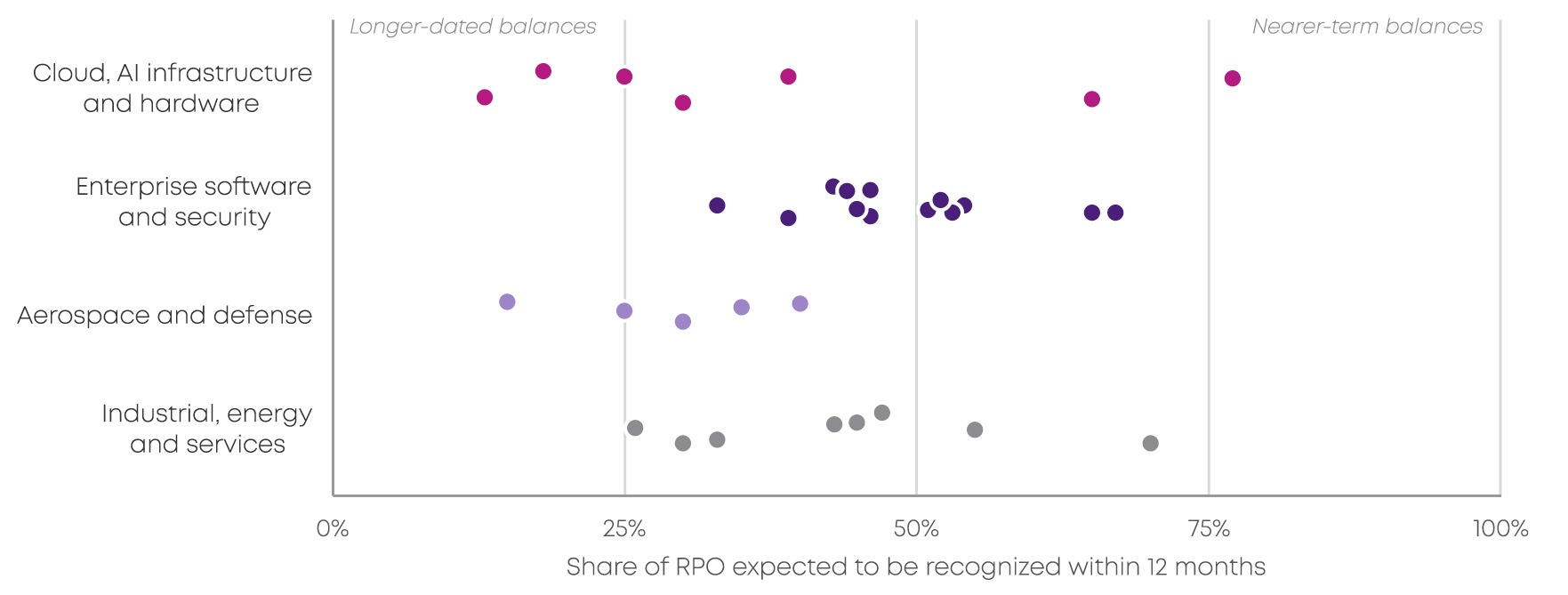
Each dot represents one registrant that discloses the 12-month share or the amounts needed to calculate it.
Time periods are also not defined consistently. Some registrants use a 24-month cutoff, some use calendar years and some extend the periods presented for service contracts to 15 years. As a result, balances may not be comparable by timing without recalculation.
Scope of the disclosed amount
Some registrants exclude contracts of one year or less, while others include such contracts. Approximately a quarter of the notes we reviewed state that amounts a customer can cancel without a substantive penalty are excluded, while most do not address such amounts. No note quantifies the excluded amounts. Figure 7 summarizes these observations.
Figure 7 – Observed disclosure practice at a glance
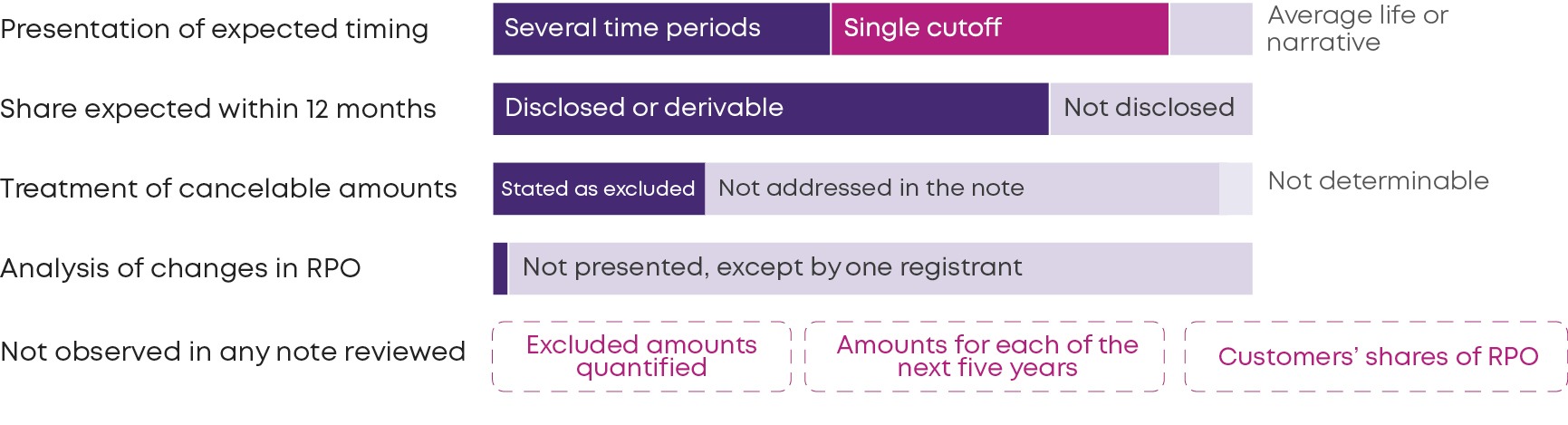
Based on the revenue notes of the 45 registrants in our review that disclose an RPO total.
SEC staff focus areas
SEC staff comments on RPO have continued as balances tied to computing capacity and other long-term commitments have grown, and as registrants have given greater prominence to RPO, backlog and bookings in investor communications.
Figure 8 summarizes the themes in comment letters dated from January 2023 to early October 2026 in which the staff referred to the RPO disclosure requirements. It also covers letters on backlog, orders and bookings over the same period, because registrants often present these measures alongside RPO.
Figure 8 – Themes in SEC staff comment letters
| Letters referring to the RPO disclosure requirements | Relative frequency | |
|---|---|---|
| Timing of recognition | The staff asked registrants to explain when RPO will be recognized, particularly amounts in an open-ended final period, using additional time periods or qualitative information. | Most frequent |
| Omitted or limited disclosure | The staff asked registrants to provide the disclosure where omitted, or to explain the basis for limiting the disclosure, including any exemption relied on. | Frequent |
| Contract term and cancellation | The staff asked whether amounts beyond a customer’s termination notice period are included and how the contract term was determined. | Frequent |
| Concentration and changes | In a few reviews, the staff asked for a customer’s share of the RPO balance or an analysis of changes in that balance. | Infrequent |
| Letters on backlog, orders and bookings | Relative frequency | |
|---|---|---|
| Measures outside the filing | The staff asked whether a measure presented in earnings materials is a key performance indicator and, if so, asked registrants to define and discuss the measure in periodic reports. | Most frequent |
| Disaggregation and firmness | The staff asked for backlog by segment or contract type, the firmness of orders and the expected timing of conversion to revenue. | Frequent |
| Relationship to RPO | The staff asked registrants to explain differences between backlog or bookings and RPO, deferred revenue or revenue. | Occasional |
Outcomes of the reviews
In most reviews, the matters raised were resolved through expanded disclosure in the filing under review or in later filings, often through additional time periods or amounts. Responses on registration statements were more varied, and some registrants explained that an exemption applied or that the amounts were not material. Most reviews of backlog and bookings concluded with the registrant agreeing to expand the disclosure, in whole or in part, and in a few reviews the registrant stopped presenting the measure.
These outcomes suggest that some staff questions can be anticipated. A large open-ended final period, or a contracted measure presented to investors without a definition, may attract a comment. Each comment letter, however, responds to an individual registrant’s disclosure, and a comment issued to one registrant may not apply to another. Because the SEC generally releases comment letters and responses on EDGAR no earlier than 20 business days after it completes a filing review, we encourage registrants to monitor newly released letters.
Enforcement actions involving backlog and similar measures
The SEC enforcement actions we reviewed in this area did not concern the RPO note. They concerned company-defined measures of future business, namely backlog, pipeline and preorder figures. According to the SEC’s announcements of these settled actions in September 2022, September 2023 and February 2024, a figure had been presented as firmer than the underlying commitments or had been managed without disclosure to investors. In each case, the company neither admitted nor denied the SEC’s findings. These actions illustrate why a clear definition of such a measure, and a reconciliation to RPO where both are presented, may matter to investors.
Uniqus Insight
Where a large portion of the RPO balance falls in an open-ended final period, registrants may consider whether additional time periods or a description of the remaining duration would address the question the staff raises most often. Registrants that present backlog or bookings in earnings materials may also consider whether the measure is a key performance indicator that should be defined in the periodic report and related to RPO.
Enhancing the RPO disclosure
ASC 606 sets the minimum content of the RPO disclosure. The practices below draw on formats that US GAAP already requires for other long-dated amounts and may help readers interpret the RPO balance.
US GAAP requires maturities of long-term debt (ASC 470-10-50-1) and of lease liabilities (ASC 842-20-50-6) to be disclosed for each of the next five years, and requires reconciliations from opening to closing balance of product warranty liabilities (ASC 460-10-50-8) and unrecognized tax benefits (ASC 740-10-50-15A). Neither form of disclosure is required for RPO, although a registrant may provide either voluntarily. Where optional exemptions cover only part of a registrant’s contracts, the disclosed amount may combine contracts measured on different bases. A registrant may consider whether explaining the effect, or not applying an exemption, would make the disclosure easier to interpret. Figure 9 compares common wording with wording that applies these practices.
Figure 9 – Common wording and enhanced wording
The wording in Figures 9 to 12 is illustrative and does not reproduce any registrant’s disclosure. Bracketed items are placeholders that may not apply to every registrant.
| Common wording | Enhanced wording | |
|---|---|---|
| Timing | Approximately [XX]% of remaining performance obligations are expected to be recognized as revenue over the next 12 months, with the remainder thereafter. | The Company expects to recognize approximately [XX]% of remaining performance obligations as revenue within 12 months, [XX]% in months 13 to 36, [XX]% in months 37 to 60 and the remainder by [20XX], when the last of these contracts ends. |
| Scope | Remaining performance obligations exclude contracts with an original expected duration of one year or less. | Remaining performance obligations exclude contracts with an original expected duration of one year or less, [usage-based fees above committed minimums] and amounts customers may cancel without a substantive termination penalty. [The excluded usage-based fees relate to contracts with remaining terms of one to five years.] |
| Related measures | Backlog increased [XX]% from the prior year to $[XX] billion. | Backlog, defined as signed contract value including [cancelable amounts and renewals the Company expects to be exercised], was $[XX] billion. Backlog exceeds remaining performance obligations of $[XX] billion, mainly because backlog includes [those amounts], as reconciled in MD&A. |
| Changes in RPO | Remaining performance obligations increased [XX]%, reflecting strong demand. | Remaining performance obligations increased by $[XX] billion. New contracts added $[XX] billion and modifications $[XX] billion, while revenue recognized reduced the balance by $[XX] billion and terminations by $[XX] billion. |
The notes to the financial statements present the amount required by US GAAP and the expected timing of that amount. A reconciliation to a company-defined measure and an analysis of changes in the RPO balance may be better suited to MD&A, where company-defined lines can be explained and accompanied by cautionary language.
Illustrative disclosures
Figures 10 to 12 illustrate how a fictional company, ABC Cloud Co., might apply these practices. Amounts are in millions of dollars.
Figure 10 – Sample note disclosure
Remaining performance obligations
ABC’s remaining performance obligations are the transaction price of its customer contracts allocated to services not yet provided. They include amounts already billed and recorded as deferred revenue and amounts not yet billed. At December 31, 20X5, remaining performance obligations were $10,000. ABC expects to recognize this amount as revenue as follows.
| Expected recognition | Amount | Percentage |
|---|---|---|
| Within 12 months | 3,100 | 31% |
| 13 to 36 months | 3,900 | 39% |
| 37 to 60 months | 2,200 | 22% |
| After 60 months | 800 | 8% |
| Total | 10,000 | 100% |
Amounts expected after 60 months relate mainly to [two capacity contracts], and the last of these contracts ends [seven] years after the balance sheet date. The amounts exclude [usage-based fees above committed minimums]. ABC applies the optional exemption in ASC 606-10-50-14A(b) to these fees, which are allocated entirely to future months of service. The fees vary with each customer’s monthly usage, and the variability is resolved as the usage occurs. The excluded usage-based fees relate to contracts with remaining terms of [one to five] years. The amounts also exclude contracts with an original expected duration of one year or less, mainly [short-term support services] (ASC 606-10-50-14(a)). Amounts that customers may cancel without a substantive termination penalty, and [performance-based fees] that ABC has constrained, are not included. The expected timing is an estimate and may change as a result of contract modifications, customer usage and the timing of capacity coming into service.
Figure 11 – Sample reconciliation of RPO to backlog, in MD&A
ABC defines backlog, a key performance indicator that is not defined by US GAAP, as the total value of signed customer contracts not yet recognized as revenue, including amounts customers may cancel, renewal and expansion options ABC expects to be exercised and estimated usage above committed minimums. Remaining performance obligations are disclosed in Note [X]. The table below reconciles remaining performance obligations to backlog.
| At December 31, 20X5 | Within 12 months | Total |
|---|---|---|
| Remaining performance obligations (Note [X]) | 3,100 | 10,000 |
| Amounts customers may cancel without a substantive penalty | 900 | 2,600 |
| Renewal and expansion options expected to be exercised | 300 | 1,100 |
| Estimated usage above committed minimums | 300 | 500 |
| Contracts with an original expected duration of one year or less | 400 | 400 |
| Backlog | 5,000 | 14,600 |
Figure 12 – Sample analysis of changes in RPO, in MD&A
| Year ended December 31, 20X5 | Amount |
|---|---|
| Remaining performance obligations at January 1 | 8,600 |
| New contracts and renewals | 4,100 |
| Modifications of existing contracts, net | 300 |
| Terminations | (200) |
| Revenue recognized in the year from amounts included in RPO | (2,900) |
| Foreign currency and other | 100 |
| Remaining performance obligations at December 31 | 10,000 |
Preparing for the next reporting cycle
The considerations below are intended for those responsible for preparing and overseeing the RPO disclosure, including controllers, chief accounting officers and Sarbanes-Oxley (SOX) program leaders. The considerations describe voluntary practices rather than requirements, and their relevance depends on the significance of the RPO balance to the registrant and its investors.
Figure 13 – Considerations by role
Controller and chief accounting officer
Document contract term judgments
Record by contract type whether termination penalties are substantive and whether renewals give a material right.
Review the final time period
Consider narrower periods where a large final period is open-ended, and state when the last obligation is expected to be satisfied.
Identify lease components
Confirm which capacity contracts contain a lease, and the amounts excluded from RPO as a result.
Assess concentration in the RPO balance
Consider whether the largest customers’ shares of RPO, and any credit support, call for discussion in MD&A.
SOX program leader
Support the RPO balance with complete data
Derive the amount from a contract repository that is subject to controls.
Bring related measures within controls
Assign an owner to each measure presented to investors, and document its definition and its reconciliation to RPO.
Capture contract changes
Reflect modifications, terminations and collectibility reassessments in the RPO balance promptly.
Analyze changes in the RPO balance
Use a quarterly analysis to test earlier estimates of timing.
Based on ASC 606, ASC 842, ASC 275, Regulation S-K Item 303, Exchange Act Rule 13a-15 and SEC Release No. 33-10751.
Looking ahead
A proposed change in reporting frequency may affect how registrants present RPO and related measures.
In May 2026, the SEC proposed amendments that would permit registrants to file semiannual reports on a new Form 10-S in place of quarterly reports on Form 10-Q (SEC Release No. 33-11414). As of the date of this publication, we are not aware that the proposal has been adopted. If the proposal were adopted as proposed, a registrant electing semiannual reporting would, in our view, present the RPO disclosure in its semiannual and annual reports, while possibly continuing to publish quarterly earnings materials. Contracted measures presented between filings, and their reconciliation to RPO, may then become more important to investors.
The FASB’s 2024 post-implementation review concluded that ASC 606 achieves its stated purpose, and we are not aware of a current FASB project that would change the RPO disclosure.
How Uniqus can help
Uniqus supports controllers, chief accounting officers and SOX program leaders at registrants where RPO, backlog or bookings are important to investors. Where the RPO balance is less significant, the considerations for the next reporting cycle set out in this publication may be sufficient.
Before the next quarterly filing
RPO disclosure benchmarking
- A comparison of your disclosure with peer practice and recent comment letter themes, covering time periods, exclusions, metrics and gaps
- A marked-up draft of the note and the related metric definitions
Before the year-end audit
Contract term documentation
- Termination, modification and lease versus service conclusions by contract type
- Prepared to support audit review
Before the next earnings call
Metric reconciliation and controls
- Each published contracted measure reconciled to RPO
- Disclosure controls over each measure, with assigned owners
Before an IPO, a debt raise or a rating review
RPO schedule, reconciliation and concentration analysis
- The RPO balance by year, and a reconciliation by cause for recent quarters
- Customer shares, credit support and capacity dependence