Executive Summary
Generative AI has triggered an unprecedented corporate investment cycle. When ChatGPT launched in November 2022, Amazon, Microsoft, Alphabet, and Meta collectively spent approximately USD 158 billion per year on capital expenditures, comfortably funded by free cash flow. Four years later, the same companies have guided to approximately USD 760 billion for 2026 and consensus for 2027 now clusters at USD 1.0–1.3 trillion.
Against this backdrop, this publication examines the AI infrastructure investment cycle and its implications for hyperscalers, investors, and financial reporting.
First, how big has the investment become?
We look at how capital spending has changed since 2022 and normalize the reported numbers to make meaningful comparisons across the major hyperscalers. Capital spending by the four largest spenders has grown about 4.8 times since 2022.
(Refer Section 1: The Three Eras of Hyperscaler Capital, and Section 2: Why Simple Comparisons Can Be Misleading).
Second, how is the buildout being funded?
We examine what the four companies reported in July 2026 and how they are funding the next phase of investment. At this scale, profits alone are no longer enough to fund the buildout.
(Refer Section 3: What the four companies actually reported in July 2026 and Section 4: Funding the AI Buildout)
Third, when does the financial impact show up?
Much of the earnings impact of today’s spending is still ahead. Capital spending does not hit the income statement immediately. Depreciation does, and it continues for years. The useful lives assigned to these assets can therefore have a significant impact on reported earnings
(Refer Section 5: Depreciation is the bill that arrives later)
Fourth, what will all this capacity earn?
We look at the revenue side of the equation, which often gets less attention than the investment itself. There is already USD 1.69 trillion of demand under contract, but the price of AI output continues to fall as models become more capable and computing becomes cheaper. The ability to turn capacity into sustainable revenue and margins will be critical.
(Refer Section 6: The Revenue Side: The Price of AI is falling)
Finally, what does this mean for financial reporting and controls?
We set out the key accounting, reporting, and control issues that companies will need to address as the AI buildout moves into its next phase.
(Refer Section 7: Key Accounting, Reporting and Control Considerations)
Uniqus Point of View: The Balance Sheet Behind AI
- AI is no longer just a technology investment; it is becoming a balance-sheet story. GenAI is pushing asset-light businesses traditionally toward large-scale investments in data centers, graphics processing units (GPUs), and other infrastructure.
- The focus needs to move beyond the GPUs. For CFOs, audit committees, and investors, the bigger questions are how these assets are valued, depreciated, and tested for impairment as technology and economics change rapidly.
- How you structure the investment matters. Lease-versus-buy decisions, VIE consolidation, capitalized interest, and other financing structures can significantly affect the balance sheet and financial statements.
- Controls will become increasingly critical. As AI infrastructure and spending scale, companies will need stronger controls around capitalization, useful lives, impairment, estimates, and related financial reporting.
- In our view, the next phase of the AI cycle will be defined by financial discipline. Companies that can align AI investment, accounting judgments, and controls will be better positioned to turn massive infrastructure spending into sustainable value.
The AI story is moving from “How much are we investing?” to “How well are we managing and monetizing that investment?”
1. The Three Eras of Hyperscaler Capital
Era I — The cloud buildout (2015–2022): disciplined and self-funded
- The first phase of hyperscaler investment was largely about building the cloud infrastructure needed to support a growing digital economy. In 2015, the Big-4 hyperscalers invested USD 23.8 billion in data center infrastructure. Through 2020, annual capex growth averaged roughly 32%, funded entirely from operating cash flow. By 2022, combined spend had reached approximately USD 158 billion, with capex-to-revenue ratios in the low-to-mid teens.
- For investors, this period was defined by capital discipline. Spending was expected to support clear growth opportunities and remain within the company’s ability to generate cash. When Meta increased its capital spending plans by two-thirds in 2022, at a time when the advertising market was weakening, the market reacted sharply.
Era II — The inflection (2023–2025): AI changes the scale of investment
- The launch of ChatGPT brought a new dimension to the infrastructure equation. Generative AI showed how much computing power is required not only to train large models, but also to run them at scale. Hyperscalers responded with a rapid increase in spending.
- Combined capex across the five largest players has grown at an average of roughly 72% per year since the release of GPT-4. On a Big-4 basis, annual spending increased from USD 152 billion in 2023 to USD 251 billion in 2024 and USD 416 billion in 2025. That represents two consecutive years of approximately 66% growth.
- All four companies reached record levels of capital intensity during this period. At Amazon and Meta, free cash flow also began to decline, providing the first clear indication that the traditional model of funding the buildout from internally generated cash was coming under pressure.
Era III — The next phase (2026–2030): spending moves toward a trillion dollars
- The scale of investment has increased again in 2026.
- Amazon has raised its planned capital spending to USD 220 billion. Alphabet has raised its outlook twice, most recently to USD 195–205 billion. Microsoft has maintained its capital spending outlook at USD 175 billion, down from an earlier USD 190 billion following a shift in the treatment of certain leases from finance to operating. Meta has raised the lower end of its range to USD 130–145 billion.
- Memory and component inflation has also become a factor, with three of the four companies citing higher costs. Looking ahead, current consensus estimates put 2027 hyperscaler capex at around USD 1.0–1.3 trillion.
The changes across these three eras are significant. What began as a relatively disciplined, internally funded cloud investment cycle has evolved into a much larger infrastructure buildout, with funding, depreciation, and returns increasingly important to the investment story.
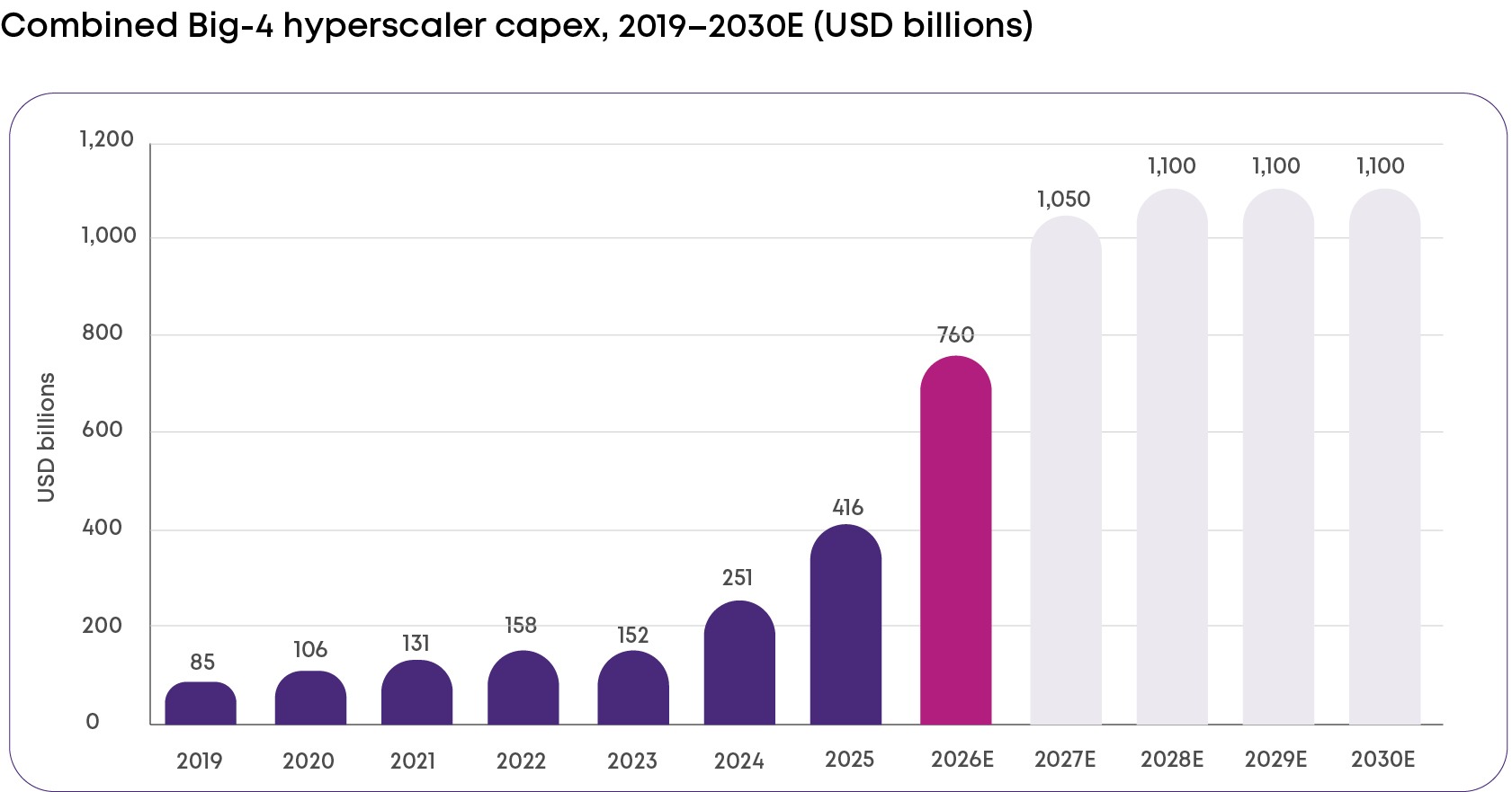
Source: Company filings and guidance (Amazon, Microsoft, Alphabet, Meta); includes finance leases where disclosed; calendar-year basis. 2026 reflects guidance as raised through the 29–30 July 2026 earnings reports. 2027–2030 is an illustrative base case consistent with Street 2027 consensus of $1.0–1.3 trillion.
2. Why Simple Comparisons Can Be Misleading
- Comparing hyperscaler capex is not as simple as putting the numbers side by side. Each company uses slightly different definitions and reporting practices. For example, Microsoft includes finance lease right-of-use assets and accrued but unpaid property, plant, and equipment (PP&E) in its reported capex. Meta includes principal payments on finance leases, while Alphabet reports cash purchases of PP&E.
- These differences can have a meaningful impact on the headline numbers. For 2024, estimates of combined Big-4 capex range from USD 226 billion to USD 251 billion, largely depending on how finance leases are treated.
- The gap becomes more important as spending increases. For 2026, estimates of Big-4 capex range from around USD 730 billion on a cash basis to USD 760 billion or more when finance leases are included. Microsoft also disclosed in July that a change in accounting classification will affect how it reports capex going forward.
- The bottom line is that reported capex is not always a like-for-like measure of investment. As AI infrastructure spending reaches unprecedented levels, differences in accounting and reporting can materially alter the comparison. The numbers, therefore, need to be normalized before drawing conclusions about the scale of investment.
Practical Perspective
Microsoft is the clearest example of how accounting changes the headline
Microsoft provides a useful example of how accounting changes can affect the reported capex number without changing the underlying investment plan.
On its results call for the quarter ended 30 June 2026, Microsoft cut its calendar 2026 capital expenditure expectation from about USD 190 billion to about USD 175 billion. Nothing about the investment plan changed.
Two accounting decisions did the work. From the financial year 2027, Microsoft is extending the useful life of data centers and office buildings from 15 years to 25 years. More importantly for the headline, more future data center leases will be classified as operating leases rather than finance leases. Finance leases sit inside reported capital expenditure. Operating leases do not.
Chief Financial Officer Amy Hood told investors the underlying investment plans remain unchanged, and that the building life extension has only a minimal benefit to operating income in the financial year 2027.
Roughly USD 15 billion moved off a reported line without a single dollar of spending being canceled. That is the whole point about normalization.
To Summarize:
- Headline capex does not tell the full story. A growing share of AI infrastructure is being funded through leases, joint ventures, and other financing structures. As a result, some AI-related investments may not appear in “purchases of property and equipment” in the cash flow statement. This makes simple capex comparisons between hyperscalers or between different years potentially misleading.
- Our approach: We normalize the data using cash PP&E purchases plus new finance leases, measured on a calendar year basis.
3. What the four companies actually reported in July 2026
In July 2026, all four hyperscalers reported their latest results. All four also raised or extended their spending plans. Their results show a common theme: AI investment is growing rapidly, but the impact on growth, cash flow, and profitability is not the same across the four companies.
The key numbers from their latest reported results are set out below:
| Company | Revenue and growth | Cloud performance | Cash position |
|---|---|---|---|
| Amazon | USD 200.6bn, up 20% | AWS revenue of USD 42.2bn, up 36.7% — its fastest growth in 18 quarters | Trailing twelve-month free cash flow was an outflow of USD 7.6bn |
| Microsoft | USD 90.0bn, up 18% | Azure up 43% and crossed USD 100bn of annual revenue for the first time | Operating cash flow of USD 55.4bn; free cash flow of USD 19.6bn, down from the prior year |
| Alphabet | USD 119.8bn, up 24% | Google Cloud revenue of USD 24.8bn, up 82%, with a 35.6% operating margin | USD 44.9bn of capital spending contributed to its first negative free cash flow quarter, with an outflow of USD 5.9bn |
| Meta | USD 60.8bn, up 28% | Not a cloud seller; advertising revenue increased 27% | Operating cash flow of USD 31.9bn against USD 31.1bn of capital spending, leaving free cash flow of USD 784m |
Sources: Amazon Form 8-K and press release, 30 July 2026 (sec.gov); Microsoft financial year 2026 fourth quarter release, 29 July 2026 (microsoft.com/investor); Alphabet second quarter 2026 release, 22 July 2026; Meta second quarter 2026 release, 29 July 2026 (investor.atmeta.com). Microsoft is reporting a June financial year-end, so its figures are for the fourth quarter and the full year.
The numbers show why the current investment cycle deserves a closer look. Revenue is growing strongly across the group, and cloud growth is particularly strong at Microsoft and Alphabet. At the same time, the cash cost of building AI infrastructure is becoming increasingly visible. Amazon and Alphabet reported negative free cash flow on the measures highlighted above, while Meta’s free cash flow was only USD 784 million after USD 31.1 billion of capital spending.
Amazon’s quarter also included an unusual item that is important when looking at its reported earnings. Net income of USD 62.6 billion included USD 53.4 billion of pre-tax gains recorded outside operating income, arising mainly from its investment in Anthropic. This is a valuation gain on a private investment rather than cash generated from selling an asset.
The broader point is the change in capital intensity. Capex-to-revenue ratios of 31% to 62% across the Big-4 (refer to the chart below) are a long way from the asset-light model that defined these businesses for much of the cloud era.
As the balance sheets become more capital-intensive, growth and margins are no longer enough to understand the performance of these companies. Return on invested capital, asset utilization, depreciation, and funding will increasingly matter alongside revenue growth and operating margins.
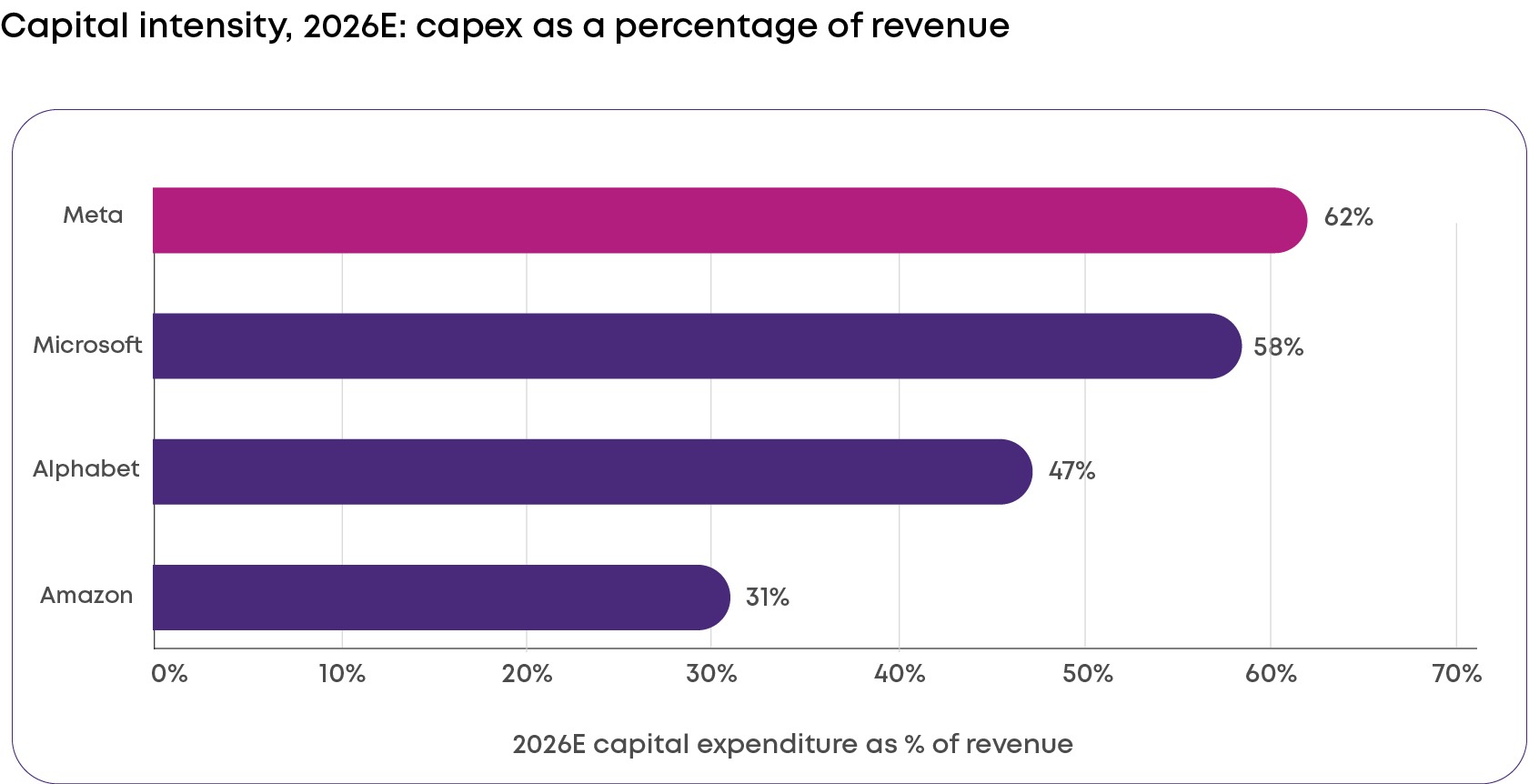
Source: Uniqus estimates, based on companies’ latest 2026 CapEx guidance and consensus revenue estimates; Microsoft presented on a fiscal-2026 basis.
4. Funding the AI Buildout
4.1 The funding model has flipped
- For most of the last decade, hyperscalers funded their investment largely from operating cash flow. That model is now under pressure.
- J.P. Morgan Asset Management estimates that bonds issued by these companies accounted for about 2% of total US dollar investment-grade issuance between 2022 and 2024. It expects that share to reach about 9% in 2026, with roughly USD 300 billion of investment-grade debt issuance from the group over the coming year. It also expects free cash flow across the group to turn negative in the near term.
- External capital is therefore becoming a much larger part of the funding mix. Alphabet priced an USD 84.75 billion equity offering in June 2026 to support its AI infrastructure and compute investments. Morgan Stanley estimates that global data center investment could face a financing gap of around USD 1.5 trillion through 2028, with private credit, corporate debt, and securitized markets expected to help fill the gap. Goldman Sachs also notes that infrastructure funds raised a record USD 221 billion in 2025 and had around USD 400 billion of available capital as of September 2025.
- The pressure is already visible in the latest results. Amazon’s trailing free cash flow had moved to an outflow of USD 7.6 billion. Meta’s quarterly free cash flow fell 91% to USD 784 million, while Alphabet reported its first quarter of negative free cash flow.
- As more outside capital enters the market, the way AI infrastructure is financed is also changing. Capacity is increasingly being developed through build-to-suit arrangements, leases, joint ventures, and special-purpose vehicles. Meta’s USD 14 billion El Paso data center, for example, sits in a vehicle in which funds managed by BlackRock hold an 80% interest. About USD 12.5 billion of the funding is provided through debt, with Meta remaining the sole tenant.
This is the part that changes the balance sheet question
- A company can be the sole tenant of a large data center, operate the facility and depend on its capacity, while owning only a minority interest in the entity that holds the asset.
- That raises an important accounting question: does the asset, and the related debt, belong on the company’s balance sheet?
- The answer is not determined simply by looking at who owns the equity. It depends on who controls the structure and who bears its economic risks.
- Under US GAAP, this is addressed through the variable interest entity (VIE) assessment. Under IFRS, the analysis is based on control. The frameworks are different, and companies reporting under both may need to consider both assessments.
4.2 How this looks from outside the companies
- The funding shift is not limited to the hyperscalers themselves. It is becoming a broader feature of the data center market.
- The Bank for International Settlements (BIS) examined the issue in January 2026. It concluded that the scale of planned investment will require a move away from funding primarily through operating cash flow toward debt, with private credit expected to play a growing role. It assessed the broader macroeconomic and financial stability risks as moderate, but noted that the sustainability of the investment cycle depends on AI companies meeting high earnings expectations. It also observed that equity valuations have moved ahead of what debt markets are pricing.
- The BIS estimated that private credit to AI-related borrowers had already exceeded USD 200 billion and could reach USD 300–600 billion by 2030.
- The scale of the underlying infrastructure market is also expanding quickly. Dell’Oro Group raised its forecast for worldwide data center capital expenditure in August 2026 to more than USD 3 trillion by 2030, almost twice its earlier February forecast of USD 1.7 trillion.
This means the funding question is becoming a reporting question as well. As more AI infrastructure is financed through debt, private capital, leases, and joint ventures, investors will need greater visibility into where the assets sit, who controls them, who carries the debt, and what commitments sit outside the reported capex number.
For companies, this makes the quality and transparency of financial reporting increasingly important—not just for accounting compliance, but for giving investors a clear picture of the risks and commitments behind the AI buildout.
5. Depreciation is the bill that arrives later
- Capital spending is a cash outflow, but it does not reduce reported profit when the cash is spent. The expense is recognized on the income statement later, through depreciation, spread over the asset’s useful life.
- This is why much of the earnings impact of the spending over the last three years is still ahead. Microsoft provides a clear example. Its depreciation expense increased from USD 11.0 billion in the financial year 2023 to USD 15.2 billion in 2024 and to USD 22.0 billion in 2025, according to its annual report. The increase reflects infrastructure that has already been built and placed in service, rather than spending that is still to come.
- Morgan Stanley estimates that Microsoft, Oracle, Meta, and Alphabet could record more than USD 680 billion of cumulative depreciation over four years and this will only increase if we factor Amazon into the mix, which had previously reduced the server lifespan from six years to five years. The estimate illustrates the potential scale of the earnings impact as today’s infrastructure moves through its useful lives.
- Alphabet provides another useful example. Its servers are depreciated over six years, which means assets being installed today could continue to affect earnings well into the early 2030s. Alphabet has also warned that higher infrastructure investment will increase depreciation and related data center operating costs, putting pressure on its profit and loss account.
5.1 The Useful-Life Estimate Matters More Than It Looks
One of the most important assumptions in depreciation accounting is the useful life assigned to an asset. It is a judgment, and even a relatively small change can have a meaningful effect on reported earnings.
The hyperscalers have changed their useful-life assumptions in both directions in recent years:
| Company | Current position | Recent change and effect |
|---|---|---|
| Amazon | Servers and networking equipment: 5 years | Reduced from 6 years to 5 years from January 2025. Amazon’s decision to shorten the useful life reduced 2025 operating income by approximately USD 0.7 billion. The company also recognized a USD 920 million accelerated depreciation charge in the fourth quarter of 2024. |
| Microsoft | Servers and network equipment: up to 6 years; Buildings: 25 years | Building useful lives extended from 15 years to 25 years from the financial year 2027. Microsoft described the expected benefit to 2027 operating income as minimal. |
| Alphabet | Servers and network equipment: 6 years | Useful life extended to 6 years from 2023. |
| Meta | Certain servers and network assets: 5.5 years | Change effective January 2025, deferring roughly USD 2.9 billion of depreciation. |
Sources: company Forms 10-K and 10-Q filed with the SEC; Amazon’s fourth quarter 2024 useful-life study and 2025 quarterly disclosures; Microsoft financial year 2026 fourth quarter earnings call.
The question is no longer how long the machine runs.
- A server may physically operate for six years. The accounting question is whether it is expected to remain productive and generate economic benefits for that period.
- That judgment is becoming harder as the pace of technological change increases. New generations of chips are introduced frequently and can deliver significantly more performance for the same amount of money. At the same time, the price of AI output is falling, which puts additional pressure on the economics of older infrastructure.
- This makes useful-life assessments increasingly important. If an asset’s useful life is extended while the economics of its output are changing, the company needs evidence to support that judgment. Technology roadmaps, workload migration patterns, utilization data, and the expected value of the equipment can all be relevant considerations.
5.2 Power and memory
The constraints on AI infrastructure are also changing.
GPUs remain constrained, but advance commitments are making them easier to secure. Power and the infrastructure needed to deliver it are becoming a more significant constraint. J.P. Morgan estimates that 122 GW of global data center capacity will be installed between 2026 and 2030, highlighting the scale of the power and construction investment required to support the AI buildout.
Input costs are also affecting the spending mix. Amazon attributed the increase in its 2026 capital spending outlook from USD 200 billion to USD 220 billion primarily to higher memory costs. The company also indicated that, despite the additional spending, AWS would remain short of capacity relative to demand through 2026 and 2027.
The result is a more complicated investment equation. Companies are spending more to build capacity, while also having to consider how quickly that capacity becomes obsolete, how long it will remain productive, and what economics it can generate over its useful life.
6. The Revenue Side: The Price of AI is falling
Every dollar of this capex ultimately produces one product: computed intelligence, sold by the token, the seat, or the impression. The capex side of the ledger is disclosed in exhaustive detail. The revenue side also needs more attention.
6.1 Demand under contract is clear
Today’s AI infrastructure is being deployed against identifiable customer demand, with major cloud providers reporting large contracted backlogs and persistent capacity constraints.
The demand evidence strengthened materially in July. Microsoft’s commercial RPO rose 84% to USD 678 billion; Google Cloud’s backlog reached USD 514 billion and AWS reported USD 496 billion together representing approximately USD 1.69 trillion of contracted future revenue. All three companies indicate demand still outpaces supply. If that revenue curve materializes, today’s infrastructure spending would represent capacity built against substantial contracted and emerging demand, not speculative capacity for its own sake.
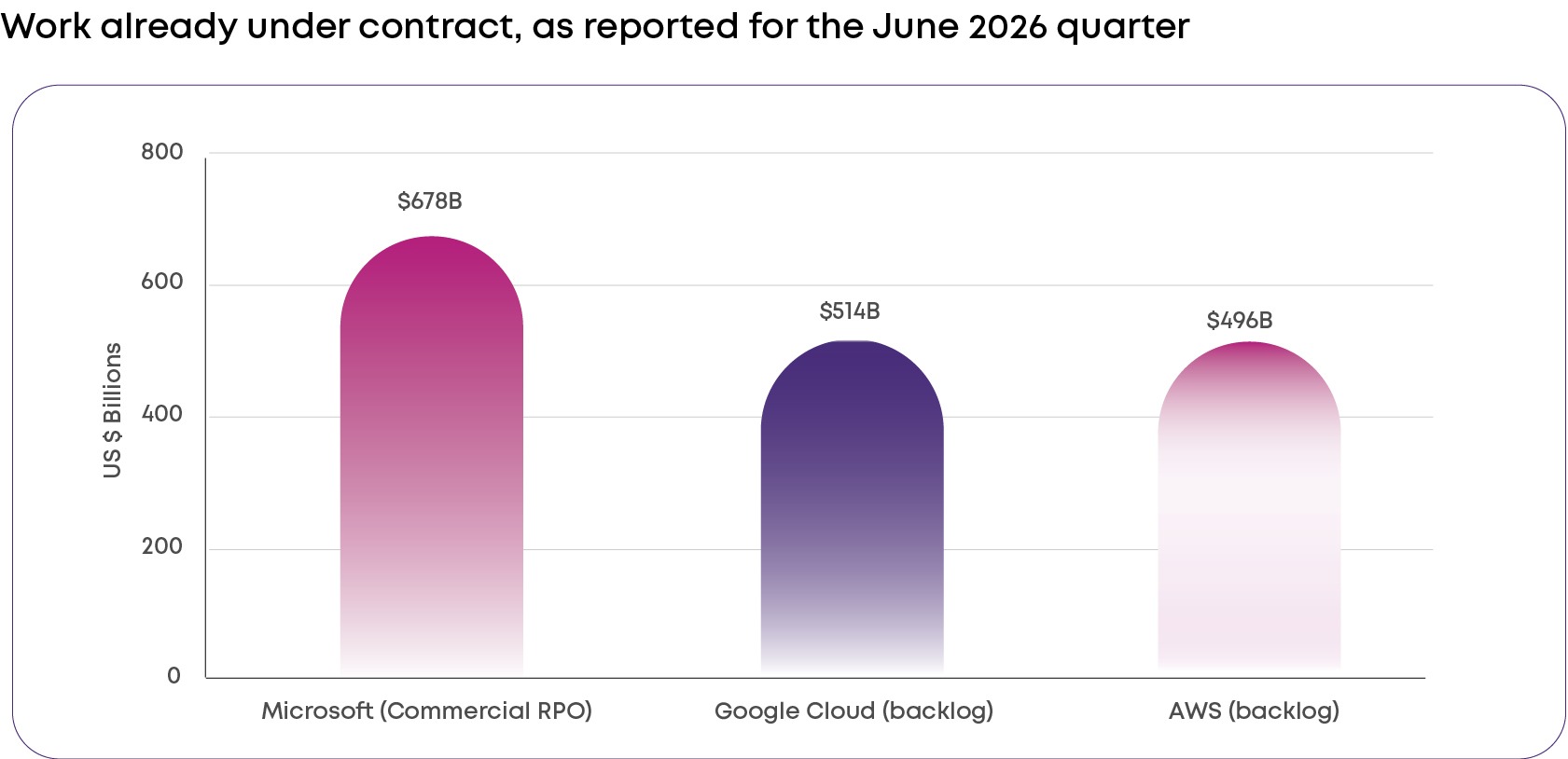
Sources: Microsoft financial year 2026 fourth quarter release; Alphabet second quarter 2026 release results. The AWS figure of USD 496 billion is drawn from secondary reporting of Amazon’s second quarter.
6.2 But the prices are falling
AI intelligence is becoming a commodity. As with other commodities, prices tend to move toward the cost of the lowest-cost provider that can deliver adequate quality.
Today, the cost of one million tokens varies dramatically: about USD 56 for premium frontier models, USD 26 for mid-tier models, around USD 1–USD 1.50 for efficient models from companies such as Meta and Google, and as low as USD 0.50 for leading Chinese open-weight models. That means a 112x price difference for models whose quality is increasingly similar on public benchmarks. As model performance converges, price and cost efficiency are likely to become increasingly important.
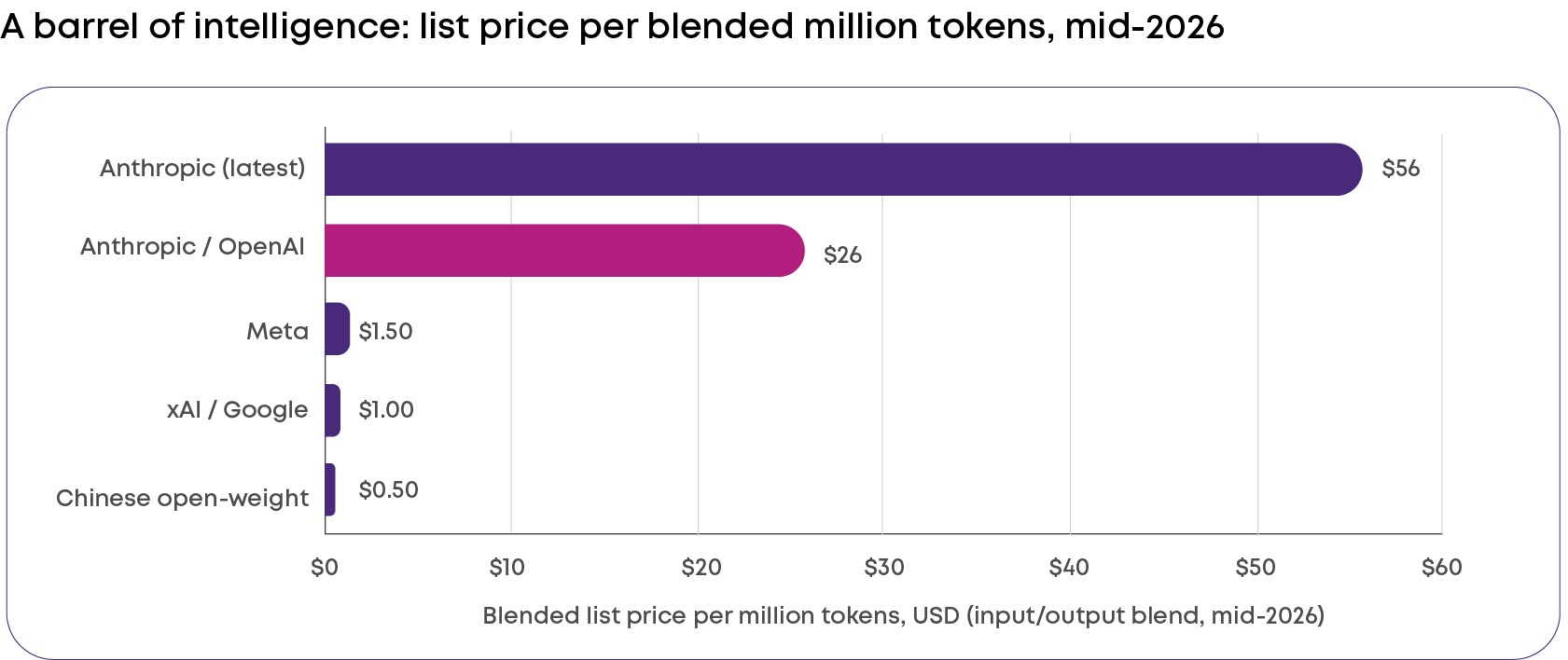
Source: Published list API prices (blended input/output), company pricing pages, Artificial Analysis, mid-2026. Actual negotiated and committed-use prices could be lower. Approximate; tiers and models change frequently.
6.3 But it is showing up inside customers’ own costs
The decline in AI prices is not limited to the companies building the models. For enterprises, AI costs can still add up quickly, particularly when teams use expensive frontier models for tasks that could be handled by lower-cost models.
This is already becoming a bigger focus for companies managing their cloud spend. The FinOps Foundation’s 2026 survey of 1,192 practitioners, representing more than USD 83 billion of annual cloud spend, found that 98% are now managing AI spend. This compares with 63% a year earlier and 31% two years earlier.
As AI use expands, companies will need to pay closer attention to the cost of each use case. This could lead CFOs and technology teams to introduce tighter controls over AI spending, including monitoring token usage, selecting the right model for each task, and understanding the cost of AI across different applications.
The issue is therefore not simply how much AI a company is using, but whether it is using the right level of AI capability for the job at the right cost.
The shale playbook
Between 2014 and 2016, oil prices fell from around USD 100 to below USD 30 a barrel. The decline was not driven solely by weaker demand; lower-cost producers continued to bring additional supply to the market.
The response from major oil companies shaped the next decade: lower costs, better technology, and greater focus on the most efficient production assets.
The lesson for hyperscalers is similar. As AI computing becomes more abundant and prices come under pressure, scale alone may not determine who wins.
The key question for hyperscaler boards is: Are we a low-cost producer of AI compute?
For hyperscalers, that will depend increasingly on the economics of their infrastructure:
- Custom chips and how effectively they perform against workloads;
- Infrastructure utilization and the ability to keep expensive compute capacity productive; and
- Power costs, which are becoming an increasingly important component of data center economics.
The companies that can deliver AI compute at the lowest sustainable cost may be better positioned to compete as the market becomes more price-sensitive.
6.4 The scissor analysis: 24x volume against 96% deflation
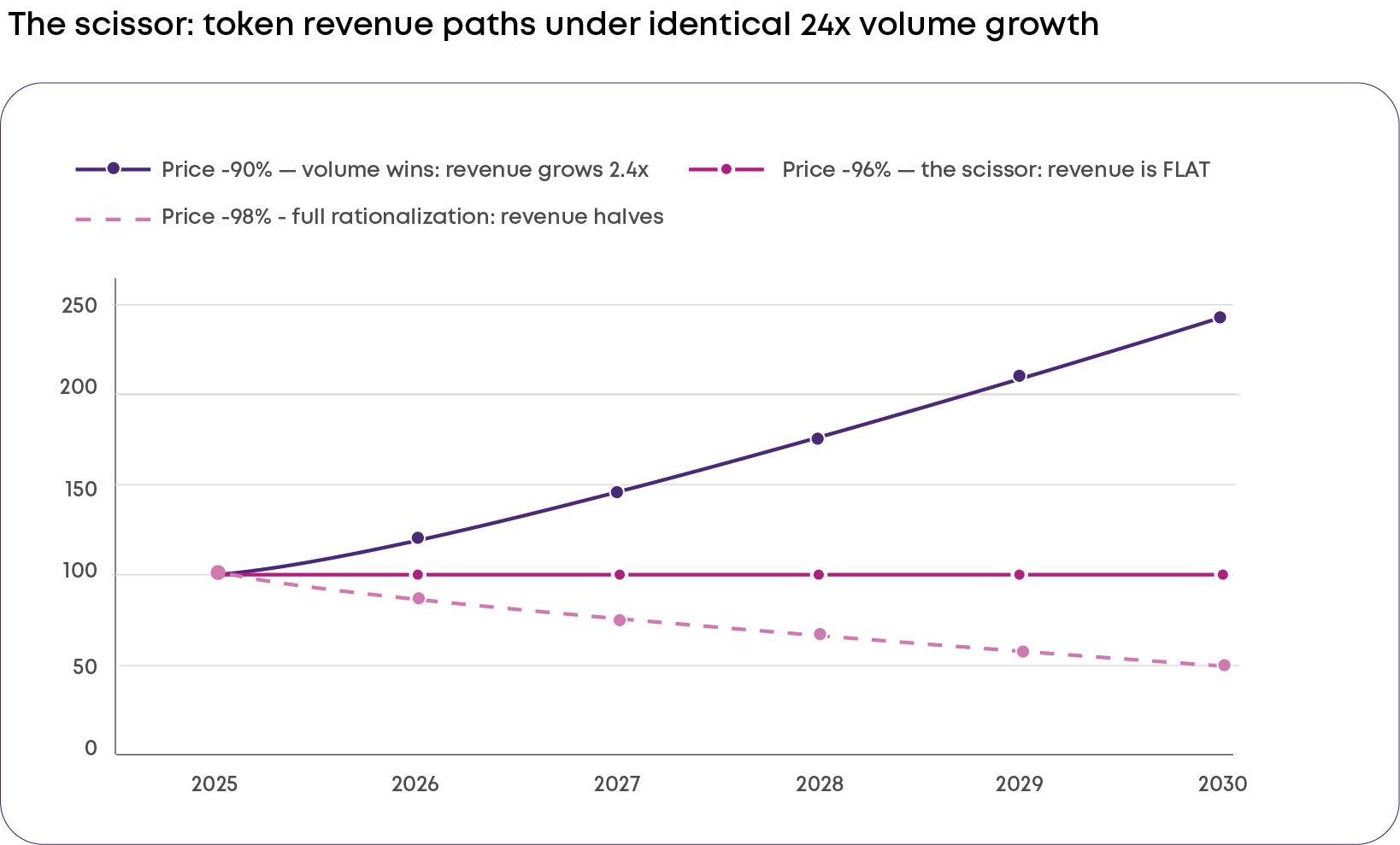
- Goldman Sachs estimates that AI token usage could grow by about 24x by 2030.
- But higher usage does not automatically mean higher revenue. The price paid for each token is also falling rapidly, with some estimates showing around a 96% decline across comparable model generations.
- The chart shows what happens when these two trends move together:
- If prices fall by 90%, the 24x increase in usage more than offsets the price decline, and token revenue grows to about 2.4x.
- If prices fall by 96%, the increase in usage is almost exactly offset by the price decline, leaving revenue broadly flat.
- If prices fall by 98%, the price decline is faster than the growth in usage, and revenue falls by about half.
- This creates a “scissor” effect: the same growth in AI usage can produce very different revenue outcomes depending on how quickly prices fall.
- The key question is therefore not only how much AI will be used, but how quickly the price of AI will decline.
- For the companies investing billions in AI infrastructure, this is an important economic risk. Demand may continue to grow strongly, but if AI prices fall faster than usage increases, more and more volume will be needed just to maintain revenue.
Source: Uniqus illustration. Volume path: approximately 24x growth to 2030 (Goldman Sachs projection); price paths show cumulative declines of 90%, 96% and 98% over the same period. Indexed to 2025 = 100. Illustrative — realized prices, mix, and committed use discounts will differ.
Read the comparison carefully
- The price decline is not the same as the price customers actually pay. The comparison measures the price of tokens for a similar level of capability. In practice, customers are also moving to newer and more capable models, which can keep the average price from falling as quickly.
- Token revenue is not the same as revenue per customer. An AI agent may use 100 times more tokens to complete a task, while the customer may still pay a similar amount for that task.
- Hyperscalers earn revenue from more than tokens. Their businesses also include model training, fine-tuning, and traditional cloud workloads. These other sources of revenue provide some protection against falling token prices.
- The analysis is therefore a sensitivity, not a forecast. It shows how different rates of price decline could affect revenue if AI usage grows by the same amount.
- For boards, the key question is whether growth in AI usage can keep pace with the decline in AI prices. This will be an important factor in assessing the returns from the significant investment being made in AI infrastructure.
7. Key Accounting, Reporting, and Control Considerations
Most of the discussion around AI infrastructure focuses on chips, data centers, and power. But behind the investment is another set of issues that will increasingly matter to CFOs, finance teams, audit committees, and auditors. These include accounting estimates, asset valuation, financing arrangements, revenue visibility, and internal controls. Seven areas stand out.
7.1 Useful lives
As discussed in Section 5 above, even a small change in the useful life of servers and other AI infrastructure can have a meaningful impact on reported earnings. This is likely to attract greater attention from investors, auditors, and regulators as the asset base grows.
Boards and audit committees should expect companies to have a clear, evidence-based process for setting and revisiting useful lives. This should be more than an annual policy exercise. The assessment should consider factors such as technology changes, workload migration, asset utilization, and the expected economic life of the equipment.
Key accounting implications:
- Useful life assumptions for servers, accelerators, networking equipment, and other AI infrastructure can have a significant impact on depreciation expense and reported earnings.
- Rapid technology changes and falling AI compute prices make it important to assess whether the estimated useful life continues to reflect the period over which an asset is expected to generate economic benefits.
- Changes in useful life are generally changes in accounting estimates and should be supported by evidence and applied prospectively under the applicable accounting framework.
- Management should maintain clear support for these estimates, including technology roadmaps, expected utilization, workload migration plans, replacement cycles, and evidence of technological obsolescence.
- The key question is not simply how long the equipment can physically operate, but how long it is expected to remain economically useful.
Accounting recommendation
- Our recommendation: establish a formal, useful life assessment framework for AI infrastructure, with periodic reviews aligned to technology refresh cycles and major changes in AI economics.
- The assessment should consider both physical durability and economic obsolescence, supported by utilization data, technology roadmaps, expected replacement cycles, and changes in the cost and performance of newer generation equipment.
- Significant changes in assumptions should be reviewed by the controllership function and audit committee, where appropriate, before they are reflected in the financial statements.
7.2 Componentization, residual values, and end-of-life obligations
AI infrastructure is not a single, homogeneous asset. Data centers typically comprise servers, accelerators, networking equipment, power systems, and other components that may have different useful lives and disposal profiles. As the market for used AI equipment develops and companies enter into more complex infrastructure and site arrangements, questions around componentization, residual values, and end-of-life obligations are becoming increasingly relevant. These considerations can affect both the amount and timing of depreciation and the recognition of related liabilities.
Key accounting implications:
Componentization
AI infrastructure often consists of components with different useful lives. Companies should assess whether significant components require separate depreciation rather than applying a single useful life to the entire asset. The accounting requirements differ across frameworks. US GAAP permits, but does not require, component depreciation, whereas IFRS and Ind AS require that significant components with different useful lives be depreciated separately.
Residual Value
A developing secondary market for accelerators and other specialized equipment may make residual value more relevant. Assuming a zero residual value should therefore be supported by the asset’s expected economics rather than applied automatically.
End-of-life obligations
Companies should also review contracts and site arrangements for obligations to remove equipment, restore facilities, or return sites to their original condition. Where such obligations meet the applicable recognition requirements, they may need to be recognized as a liability, with the related amount included in the cost of the asset.
Accounting recommendation
- Our recommendation: consider componentizing significant AI infrastructure assets where different components have materially different useful lives or residual values.
- Management should also periodically reassess residual values based on observable secondary market activity and expected disposal economics.
- In parallel, legal and procurement teams should work with accounting to identify restoration, removal and other end of life obligations at the time contracts are entered into, rather than waiting until the asset is retired.
7.3 Impairment
The rapid pace of change in AI technology and economics creates a greater need to assess whether AI infrastructure will continue to generate the expected economic benefits over its useful life. Falling compute prices, changes in customer demand, lower-than-expected utilization, and faster technology cycles could affect the future cash flows associated with these assets. As the scale of investment increases, companies will need to consider whether these factors indicate impairment and whether existing asset groupings remain appropriate.
Key accounting implications:
- Rapid changes in AI technology mean impairment assessments may need to consider more than physical obsolescence or underutilization.
- A sustained decline in the price of AI compute could reduce the future cash flows expected from infrastructure. If prices decline faster than usage increases, this could indicate impairment.
- Asset grouping is also important. Training clusters, inference infrastructure, and data centers may share assets but generate or support cash flows at different levels.
- Companies should ensure that impairment assessments reflect the economics of the underlying assets, including expected utilization, pricing, technology changes, and future demand.
- The recognition and measurement requirements differ under US GAAP, IFRS, and Ind AS, making framework-specific analysis important for companies operating across jurisdictions.
Accounting recommendation
- Our recommendation: incorporate AI-specific indicators into its impairment monitoring process, rather than relying only on traditional indicators such as declining utilization or adverse financial performance.
- These indicators could include sustained declines in AI compute pricing, accelerated technology replacement, changes in customer demand, lower-than-expected utilization, and deterioration in expected returns.
- Companies should also ensure that the level at which assets are tested for impairment appropriately reflects how the related cash flows are generated.
7.4 Leases, joint ventures and special purpose vehicles
The scale of AI infrastructure investment is also driving greater use of alternative financing and ownership structures, including leases, joint ventures, and special-purpose vehicles. These arrangements can change how assets, liabilities, and commitments are reflected in the financial statements, even where the underlying economic exposure remains significant. The accounting assessment, therefore, needs to look beyond legal ownership and consider the rights, obligations, control, and risks associated with each arrangement.
Key accounting implications:
- The way AI infrastructure is financed or structured can significantly affect what appears on the balance sheet.
- Build-to-suit arrangements, leases, joint ventures, and special-purpose vehicles may result in different accounting outcomes depending on the rights, obligations, and level of control involved.
- Under US GAAP, companies need to consider the variable interest entity requirements under ASC 810. Under IFRS, the analysis focuses on control under IFRS 10.
- Lease arrangements also require assessment under ASC 842 or IFRS 16, as applicable.
- Companies should look beyond ownership and consider residual guarantees, purchase options, take-or-pay commitments, and other contractual terms that may create significant economic exposure.
- A reduction in reported capex does not necessarily mean a reduction in the underlying investment or commitment. Investors may need to consider the broader financing structure to understand the economics of the buildout.
Accounting recommendation
- Our recommendation: Establish a centralized accounting review for significant AI infrastructure arrangements before contracts are finalized.
- Accounting, legal, treasury, and business teams should jointly assess lease classification, consolidation, VIE/control considerations, guarantees, and other contractual commitments. The analysis should capture both balance-sheet recognition and disclosure implications so that arrangements that reduce reported capex do not inadvertently obscure the company’s underlying economic exposure.
7.5 Construction accounting, capitalized interest, and Construction in progress (CIP)
The scale and duration of the AI infrastructure buildout are making construction accounting increasingly important. Data center projects can involve significant investments in land, buildings, power infrastructure, servers, and other equipment, often developed over multiple years and across different locations. Determining which costs qualify for capitalization, how long capitalization should continue, and when an asset is ready for its intended use can therefore have a meaningful impact on the timing of asset recognition and depreciation.
Key accounting implications:
- The size and duration of AI infrastructure projects increase the importance of project-level accounting and controls.
- Companies should have clear policies for identifying costs that qualify for capitalization, including construction costs, directly attributable costs, and, where applicable, capitalized interest.
- Debt-funded construction can result in significant capitalized interest under the applicable accounting requirements, including ASC 835-20 and IAS 23.
- The timing of when an asset is ready for its intended use is particularly important. Depreciation generally begins when the asset is placed in service, even if utilization takes time to ramp up.
- Canceled, delayed, or materially re-scoped projects should be reviewed for recoverability and potential write-downs.
- Strong project accounting is increasingly important as multiple data centers, power infrastructure, and technology assets are developed simultaneously across different locations.
Accounting recommendation
- Our recommendation: implement a standardized project-accounting framework across major AI infrastructure programs. This should clearly define capitalizable costs, capitalization periods, capitalized interest, project status, and the criteria for determining when an asset is ready for its intended use.
- Finance teams should also establish periodic reviews of construction-in-progress to identify delayed, canceled, or re-scoped projects that may require changes in accounting treatment.
7.6 Revenue, backlog, and disclosure quality
As AI infrastructure investment continues to grow, the focus is shifting from the scale of investment to the ability to convert that capacity into sustainable revenue. Large customer commitments and backlog can provide visibility into future demand, but the underlying economics may change as AI compute prices, usage patterns, and customer requirements evolve. Contract duration, usage-based pricing, cancellation rights, and potential repricing can therefore affect both the timing and economics of future revenue.
Key accounting implications:
- Backlog and remaining performance obligations can provide useful visibility into future revenue, but the headline amount does not necessarily translate into revenue at today’s pricing or margins.
- Contract duration, cancellation rights, usage commitments, pricing mechanisms, and potential repricing can affect both the amount and timing of revenue.
- As AI compute prices decline, changes in customer usage and contract pricing could affect the revenue profile of existing commitments.
- Companies should also consider whether arrangements with strategic investors, partners, or related parties create additional disclosure considerations.
- Greater visibility into depreciation and amortization through the income statement and disaggregated expense information can help investors understand the earnings impact of the infrastructure buildout.
- Fair value changes in private AI investments can also create significant earnings volatility. Where material, companies should provide sufficient information about valuation methods, key assumptions, and sensitivity to help investors understand the impact.
Accounting recommendation
- Our recommendation: strengthen the link between commercial commitments and financial reporting. Management should regularly assess whether backlog and remaining performance obligations remain representative of expected revenue, particularly where contracts include usage-based pricing, cancellation rights, or repricing provisions.
- Disclosure should provide enough context for investors to understand not only the size of contracted demand, but also the expected timing, pricing, and profitability of that demand. Material private AI investments should similarly be supported by robust valuation processes and appropriate disclosures.
7.7 Controls over a large spending program
The scale and pace of AI infrastructure investment increase the complexity and risk of the underlying financial reporting process. With significant amounts being spent across multiple projects, locations, and contractual arrangements, companies need reliable processes to ensure that costs are appropriately captured, capitalized, and depreciated, and that key accounting judgments are consistently applied. The effectiveness of these controls becomes increasingly important as the investment program expands and the number of estimates, transactions, and reporting requirements increases.
Key accounting implications:
- The scale of AI infrastructure investment increases the risk of errors in capitalization, project accounting, depreciation, impairment, and financial statement disclosures.
- Companies should have effective controls over capital approvals, project costs, construction-in-progress, placed-in-service dates, and depreciation commencement.
- Controls should also cover the estimates and judgments that can materially affect reported results, including useful lives, residual values, impairment assessments, and lease or SPV conclusions.
- Management review controls become particularly important where significant accounting conclusions depend on forecasts, technology assumptions, or complex contractual arrangements.
- Companies should maintain clear documentation supporting key judgments so that conclusions can be reviewed by internal audit, external auditors, and audit committees.
- Controls should also address commitments, contingencies, and contractual obligations arising from the broader AI infrastructure program.
- Given the pace of investment, control frameworks should evolve alongside the program rather than being strengthened only after the complexity has increased.
Accounting recommendation
- Our recommendation: treat AI infrastructure as a significant financial reporting program, rather than simply a technology investment program. A dedicated control framework should cover the full lifecycle—from capital approval and procurement through construction, capitalization, depreciation, impairment, and eventual disposal.
- Management should also identify the key accounting judgments and related controls upfront, with clear ownership, evidence requirements, and periodic testing. As the investment program scales, the control environment should evolve with it.
Practical Perspective
The accounting implications of the AI buildout are interconnected. Useful lives affect depreciation; depreciation affects earnings; falling AI prices can affect impairment; financing structures affect balance sheet presentation; and the scale of investment increases the importance of controls and disclosures.
We recommend that companies establish a cross-functional AI infrastructure and accounting governance framework that brings together accounting, finance, treasury, tax, legal, procurement, technology, and internal audit. The framework should focus on four areas:
- Accounting estimates — useful lives, residual values, impairment, and depreciation.
- Transaction structures — leases, JVs, SPVs, financing arrangements, and contractual commitments.
- Financial reporting — revenue, backlog, disclosures, and transparency around the economic impact of AI investment.
- Controls and governance — capitalization, project accounting, placed-in-service dates, estimates, and management review controls.
This approach would allow companies to address accounting conclusions before the financial reporting issue arises, rather than revisiting significant judgments after the infrastructure has already been deployed.
Cross-border implications — US GAAP and IFRS
The buildout is global, but the accounting frameworks diverge in areas that matter directly to AI infrastructure economics.
- Component depreciation is required under IAS 16 and only permitted under US GAAP
- Impairment uses the discounted value in use under IAS 36, against the undiscounted screen in ASC 360
- Borrowing costs follow IAS 23 against ASC 835-20
- Consolidation follows IFRS 10 against ASC 810
- Lease classification follows the single model in IFRS 16 against the dual model in ASC 842
Groups reporting under both, and Indian groups applying Ind AS, need one set of judgments that holds up in every framework they report under.
How Uniqus Can Help
Uniqus advises companies across the AI infrastructure value chain: hyperscaler suppliers and partners, data center operators and independent cloud providers, enterprises capitalizing on AI investments, and investors underwriting the buildout. We work across the United States, the Middle East, and India, under US GAAP, IFRS, and IndAS.
Technical accounting & policy
- Useful life and componentization studies, and depreciation policy design
- Impairment frameworks under both US GAAP and IFRS, including monitoring for output price triggers
- Lease against own analysis, and consolidation assessments for joint ventures and special purpose vehicles
- Backlog and repricing analysis under revenue standards
- Capitalized interest and construction in progress policy
- Readiness for expense disaggregation reporting
Controls & governance
- Control design for large capital programs
- Management review controls over estimates, built to withstand regulatory inspection
- Delegation of authority and capital approval frameworks
- Cost governance for enterprise AI consumption
- Audit committee education on AI infrastructure reporting risk
Transactions & capital markets
- Financial reporting for data center acquisitions, carve-outs, and joint venture formations
- Listing readiness for AI infrastructure and independent cloud businesses in the US and India
- Disclosure frameworks for unit economics, including revenue per unit of compute
- Purchase price allocation and valuation, including private AI stakes
Cross-border reporting
- US GAAP and IFRS conversion and dual reporting for global infrastructure ventures
- Reporting frameworks for sovereign-backed ventures in the Middle East
- Advisory on India’s data center buildout under Ind AS, with outputs comparable to US reporting
Our closing view
The AI infrastructure cycle is creating a new category of accounting risk. Assets are being deployed at unprecedented scale while the economics supporting those assets can change at unprecedented speed.
The companies best positioned for the next phase will be those that can connect capital allocation, accounting judgments, financial reporting and controls into one coherent framework, and show the evidence behind it.