Navigating Ind AS Transition in the Indian Insurance Sector

Lorem ipsum dolor sit amet, consectetur adipiscing elit. Phasellus pharetra tortor eget lacus ullamcorper, posuere fringilla justo convallis.

Early Impressions

Navigating Ind AS Transition in the Indian Insurance Sector

An Overview and Key Considerations

11, March 2026

Introduction

The Indian insurance sector has long operated under a financial reporting framework shaped by the Insurance Act, 1938, a framework designed primarily to support prudential oversight and policyholder protection, rather than to serve the informational needs of a globally connected investor base. While this framework has served its purpose well, the evolving dynamics of global capital markets, increasing foreign investment in Indian insurance companies, and the widespread international adoption of IFRS 17 have made a structured transition to Ind AS both relevant and necessary.

Ind AS, which is substantially converged with IFRS, has already been implemented across most of India’s corporate sector. Banks and Non-Banking Financial Companies (NBFCs) have been reporting under Ind AS since 2018-19. The insurance sector was the remaining significant exception, and the IRDAI’s March 2026 Exposure Draft closes that gap decisively.

The proposed implementation is uniform: all insurers, regardless of size, listing status, or business mix, shall adopt Ind AS from 1st April 2026. During the first year, insurers will be required to submit both Ind AS financial statements (statutory reporting) and Indian GAAP-based financial information (special-purpose regulatory submission) in parallel, enabling a rigorous impact assessment of the transition.

The key concepts introduced under Ind AS that will fundamentally alter insurance accounting in India are:

Ind AS 117 (Insurance Contracts): A comprehensive, principle-based framework for recognition, measurement, presentation, and disclosure of insurance contracts, introducing measurement models such as the General Measurement Model (GMM), Premium Allocation Approach (PAA), and Variable Fee Approach (VFA)

Ind AS 109 (Financial Instruments): Governing the classification, measurement, and impairment of financial assets and liabilities, including the forward-looking Expected Credit Loss (ECL) model

Ind AS 1 (Presentation of Financial Statements): Prescribing the overall structure and minimum content of financial statements

Ind AS 113 (Fair Value Measurement): Providing the framework for fair value determination across asset and liability classes

This Early Impressions piece outlines the key assessment areas, proposed regulatory solutions to critical policy choices, and a practical implementation agenda for insurers, CFOs, and Boards navigating this transition.


What Does It Mean for Insurers?

A Fundamental Shift in How Profit is Measured and Reported

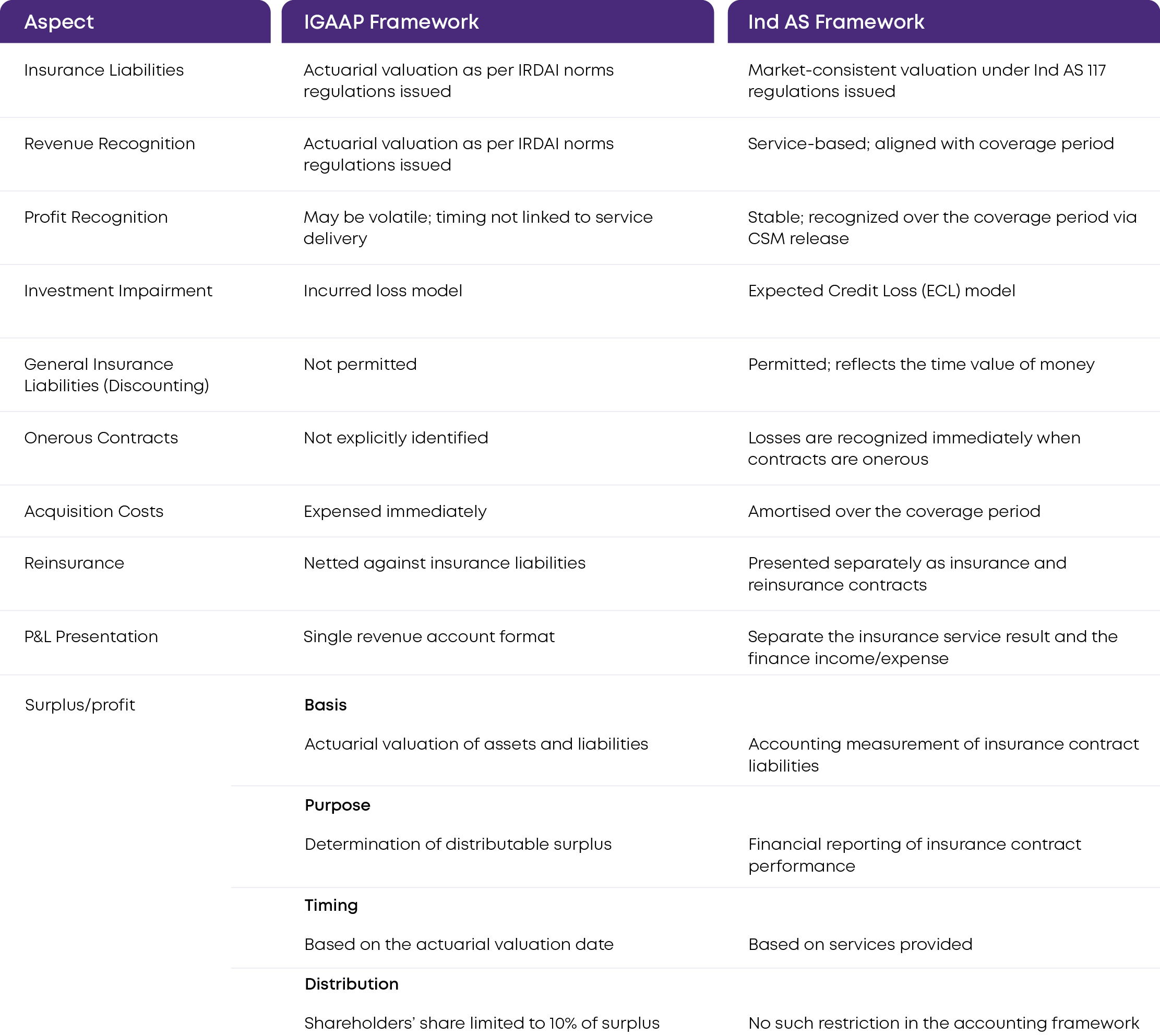
The transition from IGAAP to Ind AS is not an incremental update. It is a structural change in the economics of financial reporting. The table below summarises the most significant differences:
 

The Regulatory Catalyst: Why April 2026?

The IRDAI’s decision to mandate full adoption from 1st April 2026 reflects both the global imperative and the industry’s demonstrated preparedness. Globally, IFRS 17 has been effective since 1st January 2023 across major jurisdictions, including the European Union, Australia, Canada, Singapore, Malaysia, Hong Kong, South Africa, and the UAE. India’s delayed adoption has increasingly positioned Indian insurers as outliers in an otherwise converged global reporting landscape, constraining comparability with international peers and limiting the attractiveness of Indian insurance companies to foreign institutional investors.

The timing may also reflect a compelling domestic catalyst. The Sabka Bima Sabki Raksha (Amendment of Insurance Laws) Act, 2025, now permits foreign investment in Indian insurance companies up to 100% of the paid-up equity capital. Non-IFRS financial statements represent a material barrier to unlocking this investment potential. Ind AS adoption directly addresses this by providing globally comparable, transparent financial reporting that international investors can benchmark and rely upon.


Key Assessment Areas

1. Ind AS 117: The New Architecture of Insurance Accounting

What is changing?

Under the existing IGAAP framework, insurance liabilities are measured using actuarial valuation norms prescribed by IRDAI. These valuations are primarily designed to support solvency monitoring and policyholder protection, not to reflect current market-consistent economic assumptions. As a result, profit patterns under IGAAP often do not clearly reflect the economic performance of insurance contracts, and the reported financial position may diverge materially from economic reality.

Ind AS 117 replaces this with a comprehensive, current-value measurement framework built on three measurement models:

Three concepts in particular will require significant recalibration of systems, actuarial processes, and finance functions:

A. Fulfillment Cash Flows

Under Ind AS 117, insurers must estimate probability-weighted, discounted future cash flows, encompassing future premiums, claims, expenses, and acquisition costs, updated at every reporting date. These estimates are no longer anchored in historical assumptions; they reflect current best estimates and include an explicit risk adjustment for non-financial risk. This represents a fundamentally different approach to liability valuation from the actuarial norms currently prescribed under IRDAI regulations.
 

Practical Consideration

The requirement to update assumptions at every reporting date has significant operational implications. Actuarial models that have historically run on an annual cycle will need to be restructured for quarterly or half-yearly updates. This places a premium on automation, data quality, and actuarial-finance system integration.

B. Contractual Service Margin (CSM)

The CSM represents the unearned profit embedded in an insurance contract at inception, and Ind AS 117 prohibits its immediate recognition. Instead, the CSM is released into the income statement systematically over the coverage period as insurance services are delivered. This is perhaps the most transformative concept of the new standard: it decouples revenue recognition from premium receipt and ties it to service delivery.

For insurers with large portfolios of long-term life contracts, the effect is a significant deferral of profit relative to IGAAP. The CSM also serves as an adjustment mechanism; favourable changes in future cash flow estimates are absorbed into the CSM rather than being recognised immediately in profit or loss, thereby smoothing earnings volatility.

Practical Consideration

The CSM requires computation, tracking, and roll-forward at the level of groups of insurance contracts. This is a new capability requirement for most Indian insurers, one that demands dedicated CSM calculation engines integrated with actuarial and finance systems.

C. Separate Presentation of Insurance Service Results and Finance Components

The Ind AS 117 income statement requires an explicit bifurcation between: – Insurance Service Result: comprising insurance revenue and insurance service expenses (the underwriting performance of the business) – Insurance Finance Income or Expense: reflecting the effect of changes in discount rates and other financial assumptions.

This separation is a significant improvement in transparency for investors and analysts. It enables a clear distinction between underlying business performance and the impact of financial market movements, two drivers that have historically been conflated within the single revenue account format prescribed under IGAAP.

IGAAP vs. Ind AS: The Key Distinctions

The shift in profit recognition is one of the most consequential practical impacts of Ind AS 117. Under IGAAP, profit recognition is primarily driven by premium receipts and actuarial surplus determination. Under Ind AS 117, profit emerges through the systematic release of the CSM as coverage is provided. This creates a fundamentally different earnings profile, particularly for long-term life contracts, that will require careful communication to investors, boards, and rating agencies.

2. Ind AS 109: From Incurred Loss to Expected Credit Loss

What is changing?

Under the current IGAAP framework, investment impairment is recognised on an incurred loss basis, meaning credit losses are recognised only when a loss event has already occurred. This approach tends to delay the recognition of credit deterioration and can result in a sudden step-change in reported losses when defaults materialize.

Ind AS 109 replaces this with a forward-looking Expected Credit Loss (ECL) model. Under ECL, impairment is recognised based on probability-weighted estimates of future credit shortfalls, regardless of whether a loss event has yet occurred. Financial assets are classified into three categories:

  • Amortised Cost: for assets held to collect contractual cash flows
  • Fair Value through Other Comprehensive Income (FVOCI): for assets held to collect cash flows and sell
  • Fair Value through Profit or Loss (FVTPL): for all other assets

Practical Consideration

Indian insurers hold large portfolios of fixed-income instruments, including government securities, corporate bonds, and money market instruments. The implementation of ECL will require significant investment in credit risk modelling capabilities, including probability of default (PD) models, loss-given-default (LGD) estimates, and exposure-at-default (EAD) computations. This is a new technical discipline for most insurance finance teams.

3. Key Policy Choices: Navigating the Interplay Between Ind AS and the Insurance Act, 1938

The IRDAI Consultation Paper acknowledges several areas where the requirements of Ind AS and the provisions of the Insurance Act, 1938, give rise to notable implementation complexity. The proposed solutions are pragmatic and carefully considered, but their implementation will require robust governance and clear stakeholder communication.

A. Policyholder and Shareholder Fund Segregation

The challenge: Section 11 (2) of the Insurance Act requires insurers to maintain and separately report policyholder and shareholder funds. Ind AS, aligned with IFRS, requires entity-level financial statement presentation without such segregation. Analysis of IFRS financial statements of global insurers confirms that primary statements are presented at the entity level, with fund-level information disclosed through notes and schedules where jurisdictional requirements exist.

Proposed solution: Primary financial statements (Balance Sheet, Statement of Profit and Loss, Statement of Changes in Equity, and Statement* of Cash Flows) shall be prepared at the entity level, in line with global IFRS practice – A separate Revenue Account representing the policyholder fund shall be prepared to satisfy the Insurance Act requirement – Segregation of policyholder and shareholder funds shall be maintained through relevant schedules forming part of the financial statements.

Practical Consideration

This dual-track approach is conceptually sound. However, it implies that insurers will need to maintain two parallel reporting frameworks within their finance systems, one for the Ind AS primary statements and another for the statutory segregated accounts. Chart-of-account design and general ledger mapping will need to explicitly support this bifurcation.


B. Annual Cohort Requirement for Participating Business

The complexity: Ind AS 117 (Para 22) mandates that insurance contracts issued more than one year apart shall not be included in the same group, the “annual cohort” requirement. This is designed to ensure the timely identification of profitability trends and prevent cross-subsidization between generations of policyholders. However, participating contracts in India are managed as a single unified fund, with bonuses declared from the overall fund surplus and assets and liabilities tracked at the fund level, not the cohort level. This creates significant operational complexity.

What is changing globally: The European Commission introduced an optional exemption from the annual cohort requirement for “intergenerationally mutualized” contracts in 2021. However, the IASB explicitly declined to extend a blanket exemption, and analysis of IFRS financial statements across jurisdictions indicates that the annual cohort requirement has largely been retained globally, using the limited transition relief and permitted higher-level aggregation mechanisms.

Proposed solution: Insurers shall comply with the annual cohort requirement for participating businesses, with a graduated retrospective application: – 10 years retrospective for financial statements prepared for FY 2026-27 – 15 years retrospective for financial statements prepared for FY 2027-28 – 20 years retrospective for financial statements prepared for FY 2028-29.

Practical Consideration

This is a demanding pathway. The retrospective cohort construction for participating businesses will require significant historical data retrieval, potentially going back two decades. Actuarial models will need to be redesigned to track contracts at the cohort level, and this will require a sustained multi-year systems investment programme.


C. Distribution of Surplus in Participating Business

The divergence: Under Section 49 of the Insurance Act, the distribution of surplus to policyholders and shareholders is governed by actuarial valuation, and the shareholders’ share is capped at 10% of actuarial surplus. Under Ind AS 117, profit recognised via CSM release reflects accounting performance over the coverage period, which may differ in both basis and timing from actuarial surplus. Insurers sought clarity on whether Ind AS accounting profit constitutes distributable surplus.

Proposed solution: Actuarial surplus determined under Section 49 of the Insurance Act shall continue to govern surplus distribution, with the shareholder’s participation capped at 10% – Profit recognised under Ind AS 117 represents accounting profit for financial reporting purposes only and does not constitute distributable surplus – Insurers shall provide appropriate reconciliation disclosures between actuarial surplus and Ind AS accounting profit.

Practical Consideration

The parallel existence of two profit constructs, actuarial surplus (for distribution) and Ind AS accounting profit (for reporting), will require careful governance. Boards and audit committees will need to understand and articulate the distinction clearly. Management reporting packs, investor presentations, and annual report narratives will need to explain this dual framework explicitly to avoid market confusion.


D. Transitional Arrangements: Parallel Reporting and Risk-Free Rate Alignment

Two additional transitional considerations deserve the focused attention of CFOs and finance teams.

Parallel Reporting: During the first year of Ind AS implementation, insurers will be required to submit both Ind AS financial statements (statutory reporting) and IGAAP-based financial information (special-purpose regulatory submission) for the same reporting period. This parallel run means that finance teams will be simultaneously managing two closing cycles, two distinct accounting frameworks, and two sets of reporting formats. The operational burden of this requirement is frequently underestimated in transition planning and must be factored explicitly into resourcing and timeline decisions.

Risk-Free Rate Alignment: Under Ind AS 117, the discounting of future fulfilment cash flows requires the use of a current market-consistent risk-free rate. To promote standardization and consistency across the industry, IRDAI proposes aligning the risk-free rate used for Ind AS 117 discounting with the methodology prescribed under the proposed Risk-Based Capital (RBC) framework. This linkage between financial reporting and regulatory capital measurement is a sensible step toward operational coherence. However, it also means that any future evolution in the RBC framework’s risk-free rate methodology will feed directly through into reported insurance liabilities, CSM movements, and profit, creating a connection between regulatory and financial reporting frameworks that will require ongoing monitoring.

Looking Ahead: Ind AS 118 on the Horizon

While the immediate imperative for insurers is the April 2026 transition to Ind AS 117 and Ind AS 109, it is equally important to plan with a two-year horizon in view. Ind AS 118 (Presentation and Disclosure in Financial Statements), India’s convergence with IFRS 18, is expected to become applicable from 1st April 2027, just twelve months after the Ind AS 117 effective dates. This effectively means that Indian insurers face two consecutive waves of financial reporting transformation within the span of a single year.

Ind AS 118 will replace Ind AS 1 and introduce a fundamental restructuring of financial statement presentation. Its key requirements include:

  • Mandatory five-category classification of income and expenses into Operating, Investing, Financing, Income Tax, and Discontinued Operations categories
  • New required subtotals in the income statement, including Operating Profit and Profit before Financing and Income Taxes, subtotals that will directly alter widely used financial metrics and KPIs, and may impact loan covenants tied to operating profit definitions
  • Management Performance Measures (MPMs): Non-GAAP metrics communicated publicly, such as adjusted operating profit or combined ratio adjustments disclosed in investor presentations and earnings releases, must now be formally defined, disclosed within the financial statements, and reconciled to the nearest Ind AS subtotal, bringing them within the scope of statutory audit for the first time

For insurers, the timing creates a specific planning challenge. The financial statement formats prescribed under the draft IRDAI (Actuarial, Finance and Investment Functions of Insurers) (Amendment) Regulations, 2026, including the Statement of Profit and Loss, are built around Ind AS 117 requirements. Once Ind AS 118 is formally notified, these formats will need to be revisited to reflect the mandatory income statement restructuring it introduces, requiring yet another round of regulatory updates, systems changes, and chart-of-account realignment.

Organizations that design their systems, chart-of-accounts, and reporting architecture today with both transitions in mind will avoid the significant cost and operational disruption of a full redesign within just twelve months of completing their initial Ind AS 117 transitions. The ability to plan and execute both transformations in an integrated manner represents a material strategic and cost advantage.

Industry Readiness: Progress Made, Execution Risk Remains

IRDAI has adopted a structured and phased readiness approach since 2022, including the constitution of a Mission Mode Team and an Ind AS Expert Committee, mandatory gap assessments across all insurers, capacity-building programmes conducted jointly by ICAI and IAI, and phased submission of Ind AS-compliant proforma financial statements.

All 61 insurers across three phases have completed and submitted their gap assessments. Proforma Ind AS financial statements for FY 2023-24 have been submitted across all phases, and most Phase 1 insurers have also submitted statements for FY 2024-25. This demonstrates that the industry has developed the capability to generate Ind AS-compliant statements, a commendable achievement given the complexity of the transition.

However, it is critical to recognise that proforma readiness is not the same as statutory reporting readiness. The transition from a guidance-led proforma exercise to a fully audited Ind AS statutory account, with parallel IGAAP submission, independent IRDAI-mandated validation, and complete reconciliation disclosures, represents a materially higher bar.

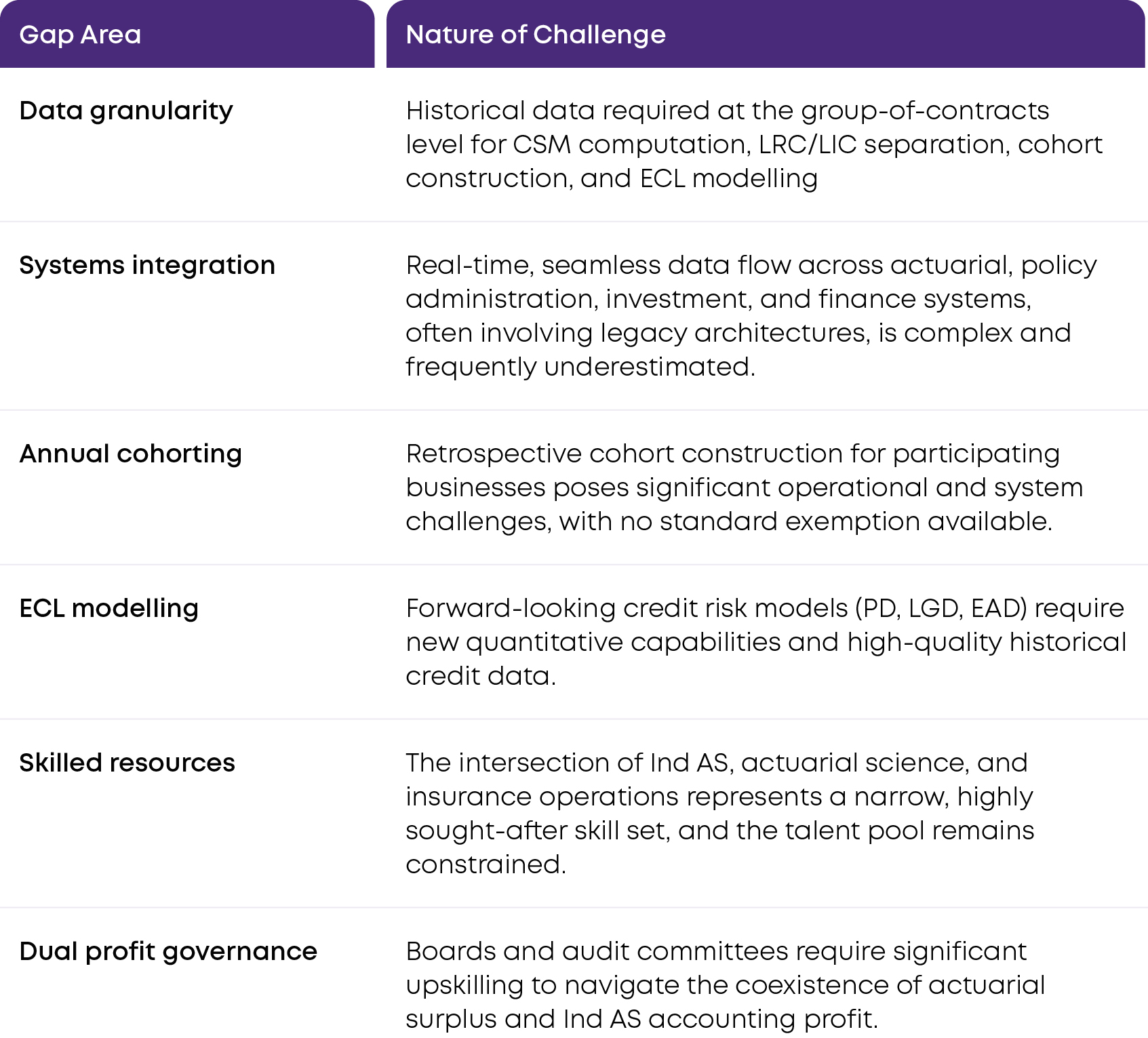
The major gaps that persist across the industry are summarised below:


Uniqus View: A Practical Implementation Agenda

Organizations that approach this transition strategically, rather than as a compliance exercise, will emerge with stronger finance functions, more credible financial narratives, and a meaningful competitive advantage in the capital markets. Entities shall consider the following implementation priorities:

01. Validate Transition-Date Opening Balances 

The opening balance sheet under Ind AS 117, including initial measurement of CSM, Liability for Remaining Coverage (LRC), and Liability for Incurred Claims (LIC), requires significant actuarial and accounting effort. Errors at the transition date compound across all subsequent reporting periods. A rigorous, independently validated opening balance sheet exercise shall be completed well in advance of the effective April 2026 date.


02. Build a CSM Calculation Engine and Data Infrastructure 

The CSM is the most data-intensive new requirement of Ind AS 117. Insurers shall invest in dedicated CSM engines capable of computing, tracking, and rolling forward the CSM at the group-of-contracts level and redesign their data warehouses to support the granular historical data requirements of the standard.


03. Redesign Systems for Seamless Integration 

Real-time integration between actuarial engines, policy administration systems, investment management platforms, and finance reporting systems is a non-negotiable requirement under Ind AS 117 and Ind AS 109. Siloed architectures will not support the disclosure, reconciliation, and roll-forward requirements of the new standards. A Business Requirements Document (BRD) for data and systems gaps shall be prepared and technology partners engaged at the earliest. 

Importantly, insurers should also be aware that Ind AS 118 (Presentation and Disclosure in Financial Statements), India’s convergence with IFRS 18, is expected to become applicable from 1st April 2027. Ind AS 118 will require a fundamental restructuring of the income statement into five prescribed categories and mandate new subtotals and disclosures around Management Performance Measures. Systems, chart-of-account structures, and financial statement templates being designed today for Ind AS 117 compliance must therefore be built with the flexibility to absorb these further presentation changes without requiring a full systems overhaul within the very next year.


04. Establish Board-Level Governance for the Dual-Profit Framework 

Boards and audit committees must develop clear policies on the distinction between actuarial surplus (for distribution) and Ind AS accounting profit (for reporting). Governance frameworks, including audit committee charters, management reporting packs, and investor communication templates, shall reflect this distinction explicitly. Many companies are likely to underestimate the governance and audit effort associated with this dual-framework environment.


05. Develop Cohort Modelling Capabilities for Participating Business 

Given the graduated retrospective application required (10, 15, and 20 years), insurers shall initiate cohort modelling for participating contracts immediately. This includes data retrieval, model redesign, and scenario testing, and will require sustained collaboration between actuarial, finance, and IT teams over multiple years.


06. Engage Early with IRDAI-Empanelled Auditors for Independent Validation 

In the first year of implementation, insurers are required to obtain independent validation of Ind AS financial statements from IRDAI-empanelled auditors, in addition to the statutory audit. This dual-assurance requirement adds significant effort to the audit cycle. Early engagement with validation partners, well before the year-end close, is essential to ensure a smooth process.


07. Invest in Cross-Functional Capability Building 

The Ind AS transition requires coordination across finance, actuarial, IT, investor relations, treasury, and other functions. Role-based training programmes, tailored for CFOs and finance teams, actuaries, Board members, and audit committees, shall be designed and implemented ahead of the effective date. On-call technical support during the initial reporting cycles will be equally important.

The Strategic Dividend of Ind AS Adoption

Beyond compliance, Ind AS adoption carries a genuine and enduring strategic dividend for the Indian insurance sector:

For investors and analysts, Ind AS-compliant financial statements provide globally comparable information, enabling meaningful benchmarking with international insurance peers. This directly supports better-informed valuation, improved analyst coverage quality, and enhanced attractiveness to foreign institutional investors, particularly significant given the 100% FDI ceiling now available under the 2025 amendment.

For insurers, the rigorous data and governance requirements of Ind AS 117, including granular contract-level data, cash flow projections, risk adjustments, and CSM tracking, will strengthen actuarial discipline, financial governance, and risk management. Organizations that invest well in this transition will build finance functions that are fundamentally more capable and data-driven.

For regulators, the separation of financial reporting from solvency reporting enables more targeted and risk-sensitive regulatory oversight. The proposed alignment of the Risk-Free Rate (RFR) under Ind AS 117 with the Risk-Based Capital (RBC) framework is a sensible step toward coherence between the two frameworks.

For policyholders, enhanced disclosures under Ind AS 117, including reconciliations of insurance liability movements, explicit risk adjustments, and clear separation of underwriting from financial performance, will meaningfully improve the transparency of insurers’ financial health and service performance.

For India’s financial system, Ind AS adoption by the insurance sector completes the long-pending unification of financial reporting standards across the country’s major financial institutions, covering NBFCs, banks, large corporates, and now insurers, creating a consistent and comparable financial reporting environment.


The organizations that will derive the greatest strategic dividend from this transition are not simply those that comply, but those that lead. Approached with the depth of preparation it demands, Ind AS adoption has the potential to fundamentally elevate the quality, credibility, and global relevance of Indian insurance financial reporting. With Ind AS 118 following just twelve months later, the window to plan both transitions in an integrated manner is narrow. The clock has started. The opportunity is real.


How Uniqus Can Help

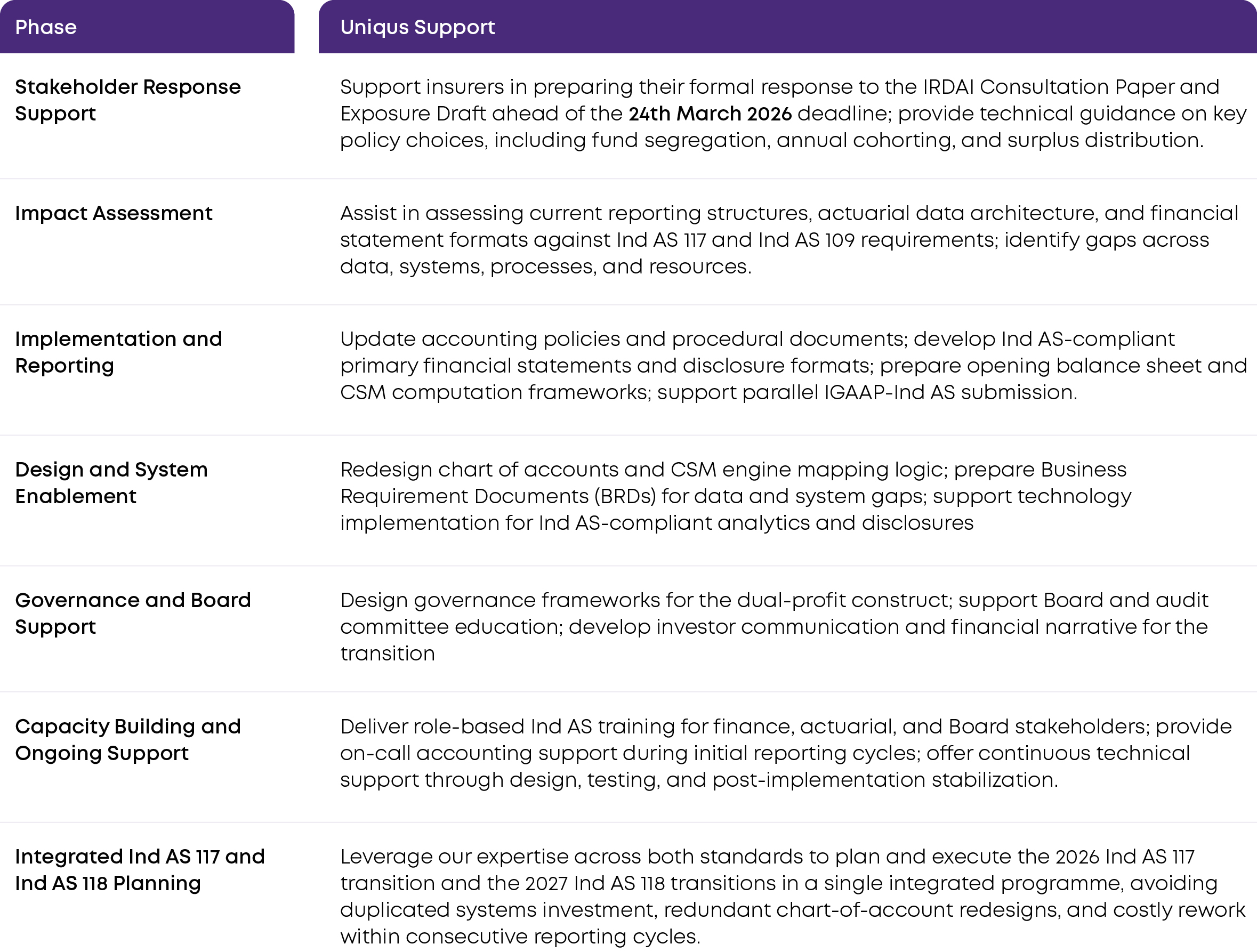
Uniqus Consultech brings deep expertise in accounting standard transitions, actuarial-finance integration, and finance function transformation, combined with proprietary AI-enabled tools, to support insurers at every stage of the Ind AS journey:

Topics in this article

Related

Early Impressions

Raising the Bar on Private Capital

Key Changes in the 2025 Guidelines The 2025 Guidelines address eight substantive areas. Some represent clarification of existing principles; others introduce new or expanded guidance that will require firms to revisit their current approach. Price of Recent Investment In earlier...

Uniqus Insights

Building the AI Backbone

The Data Center Boom: Scale, Scope, and Strategic Context  The Investment Landscape The numbers are staggering. S&P Global research indicates that data center and AI-related investments accounted for approximately 80% of U.S. private domestic demand growth in the first half...

Uniqus Insights

Internal Controls Over Generative AI

1. Why This Matters Now: The Convergence of AI Adoption and Regulatory Expectations The adoption of generative AI in finance functions has accelerated dramatically. Across Corporate America, GenAI tools are being deployed for invoice processing, journal entry preparation, account reconciliation,...

Download the pdf of this publication


This will close in 0 seconds