Purpose
In today’s era, most entities are focusing on inorganic growth as a mechanism to grow in size, diversify their product offerings, or expand into new markets or geographies. To achieve synergies in business opportunities, entities engage in acquisitions, mergers, or reverse mergers as a growth strategy. Business acquisition accounting can be complex and begins with determining whether an acquisition should be accounted for as a business combination.
ASC 805 addresses the financial accounting and reporting requirements for a business combination transaction, which is defined in the ASC master glossary as “a transaction or other event in which an acquirer obtains control of one or more businesses.”
This publication provides an overview of the key accounting considerations and implementation matters relating to ASC 805 (Business Combination). The technical views and accounting positions on the framework keep enhancing.
We sincerely hope you find this quick reference guide informative in identifying and evaluating the issues related to the Business Combination. We will be happy to participate in any discussions required to clarify our views, which are enclosed in the attached publication. We look forward to hearing from you.
Background
ASC 805 requires an entity to account for a business combination by using the acquisition method of accounting. Before applying the accounting principles, the first step includes assessing whether the acquisition transaction meets the definition of a business combination. Generally, a business combination occurs when an entity purchases the equity interests or the net assets of one or more businesses in exchange for cash, equity interests of the acquirer, or other consideration.
A transaction that does not meet the definition of a business combination should be accounted for as an asset acquisition as per the ASC 805-50 principles.
Summary of Topic
1 Business Combination Vs. Asset Acquisition
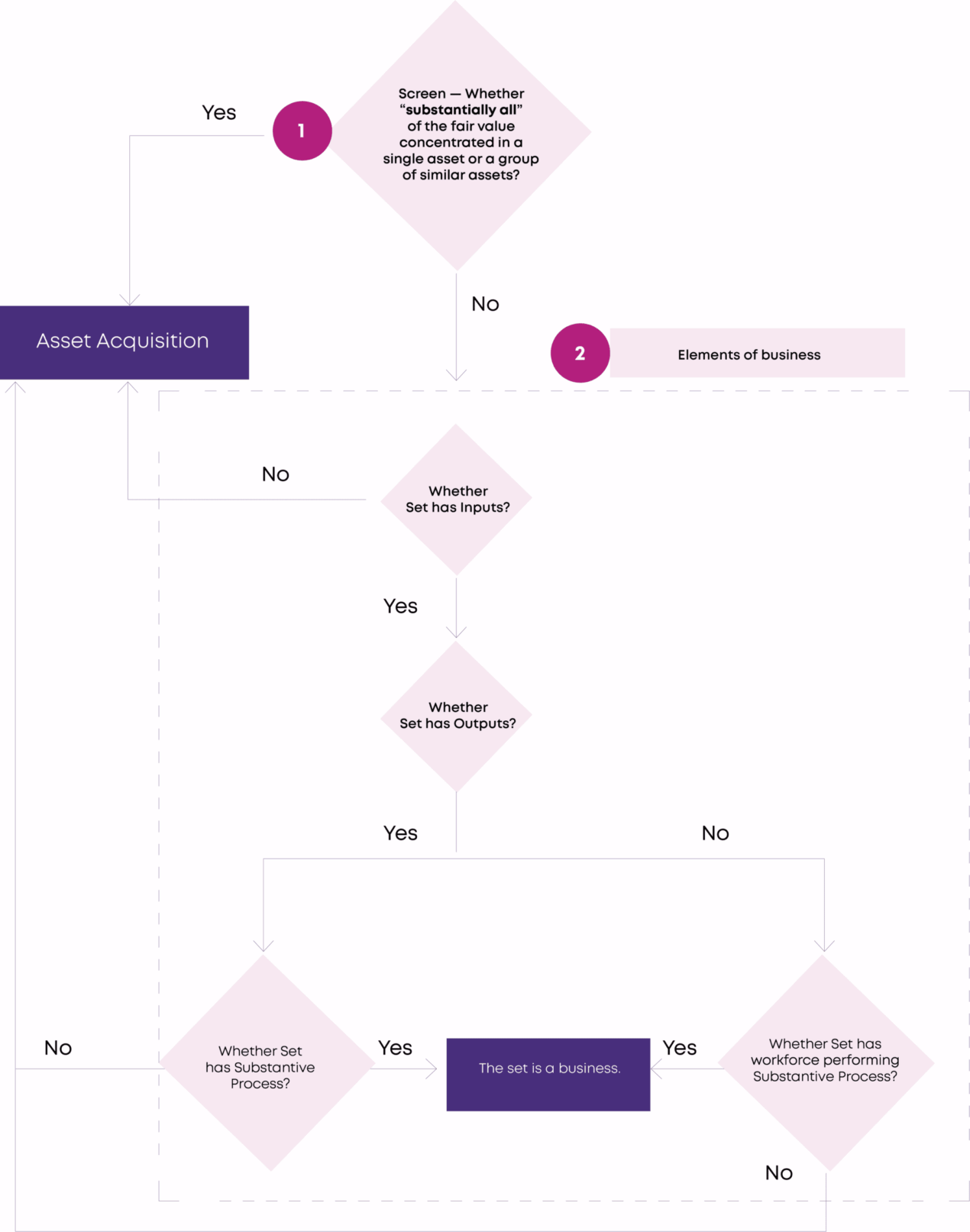
Distinguishing between a business combination and an asset acquisition is important because there are many differences between the accounting for each. Determining whether an acquisition is a “Business Combination” or an “Asset Acquisition” is a two-step process.
Step 1: Applying the ‘substantially all’ threshold
This step includes using a “screen” to assess whether substantially all of the fair value of the gross assets acquired is concentrated in a single identifiable asset or group of similar identifiable assets. If that threshold is met, the set is not a business and does not require further evaluation.
Step 2: Determining whether inputs and a substantive process exist
If the screen is not met, the entity must apply a “framework” to determine whether the acquired set includes, at a minimum, an input and a substantive process that together significantly contribute to the ability to create outputs. If so, the acquired set is a business.
The following decision tree summarizes key steps in assessing “Business Combination Vs. Asset Acquisition”:
To read this section in detail, download PDF.
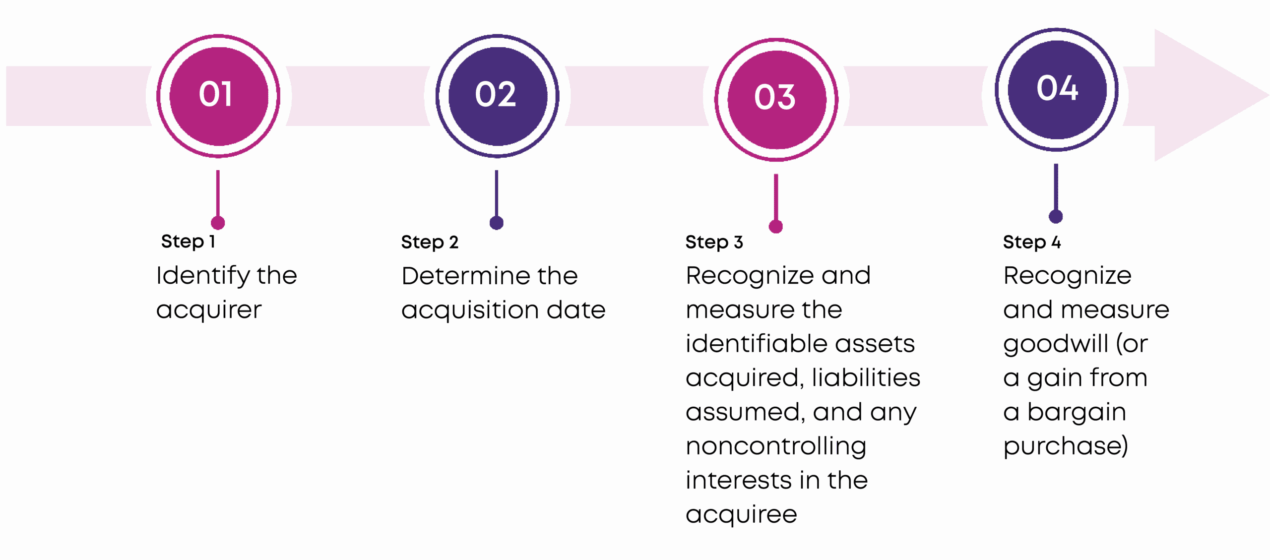
2 Business Combination Accounting
The acquirer entity shall apply the acquisition method of accounting to account for the Business Combination. The acquisition method of accounting includes the following steps:
To read this section in detail, download PDF.
3 Application Issues
3.1 Consideration transferred
Consideration transferred refers to the total value exchanged by the acquiring company to obtain control over the acquired entity in a business combination. Under ASC 805, consideration transferred is comprised of the acquisition-date fair values of Assests transferred, Liabilities incurred, Equity interests issued.
It encompasses various components such as cash, tangible and intangible assets, a business or subsidiary of the acquiring entity, instruments of the acquiring entity (e.g., common stock, preferred stock, options, warrants, and debt instruments), or other promised future payments of the acquiring entity, including contingent payments.
3.2. Business Combination achieved in stages
- Business combinations achieved in stages or step acquisition refer to transactions where an acquirer obtains control of an acquiree in more than one step.
- For example, on December 31, 2023, Entity A holds a 35 percent noncontrolling equity interest in Entity B. On that date, Entity A purchased an additional 40 percent interest in Entity B, which gave it control of Entity B.
3.3. Measurement period adjustment
- The measurement period is the time frame following the acquisition date during which an acquirer can adjust provisional amounts as it finalizes the fair values of acquired assets and liabilities in a business combination transaction. The measurement period is intended to allow the acquirer to obtain additional information to finalize the initial accounting for the business combination.
- The measurement period cannot exceed one year from the acquisition date, providing companies with a reasonable timeline to complete the valuation process.
3.4. Accounting for Common Control transactions
- ASC 805-50 (“Business Combinations — Related Issues”) provides guidance on transactions between entities under common control, which are not considered business combinations for accounting purposes. This is different from typical business combinations covered by ASC 805-10 through 805-30.
- Common control transactions include transferring net assets or exchanging equity interests between entities under common control.
- Although a transfer between entities under common control may appear to change control from the viewpoint of the standalone reporting entity, there is no change in control at the level of the ultimate parent or controlling shareholder. As a result, unlike typical business combinations, these transactions are not accounted for using fair value. Instead, common control transactions are generally recorded using the carrying amount of the net assets or equity interests being transferred.
- Since transactions between entities under common control do not result in a change in control at the ultimate parent level, they have no impact on the consolidated financial statements of the parent. Any difference between the consideration exchanged and the carrying value of the net assets is treated as an equity transaction. These differences are eliminated in consolidation, and no gain or loss is recognized in the parent’s consolidated financial statements.
3.5. Preexisting relationships between parties to the business combination
- The acquirer and the acquiree may have a preexisting relationship or other arrangement before negotiations for the business combination began, or they may enter into an arrangement during the negotiations that is separate from the business combination.
- A business combination involving parties with a preexisting relationship must be assessed to determine whether it includes the settlement of that prior relationship. Such a transaction is considered a multiple-element arrangement, with one component representing the business combination and the other representing the settlement of the existing relationship.
3.6. Non-Controlling Interest
Noncontrolling interest (NCI) represents the portion of a subsidiary’s ownership that isn’t held by the parent. This can include common stock, options, warrants, or preferred stock outside investors own.
3.7. Reverse Acquisition
In a reverse acquisition, the roles are flipped from a typical merger. Here’s how it generally works:
- The company that issues shares or pays for the transaction (also referred to as “the legal acquirer”) is considered the “accounting acquiree”.
- Conversely, the company whose shares are acquired (also referred to as “the legal acquiree”) is treated as the accounting acquirer.
- Essentially, the legal acquirer, despite issuing shares, becomes the company that is “acquired” for accounting purposes. This legal acquirer usually continues to exist as the main legal entity of the combined company. Even though the legal acquirer maintains its financial statements, these statements are often presented under the name of the legal acquiree (the accounting acquirer).
- The financial information reported will primarily be that of the accounting acquirer (the legal acquiree). The only exception is the equity section, which is retroactively adjusted to reflect the equity of the accounting acquiree (the legal acquirer).
3.8. Push down accounting
In some business combinations, the company being acquired may prepare its separate financial statements following the acquisition. In these situations, the acquiree can choose between using its historical amounts for its assets and liabilities or adopting the acquiring company’s basis of accounting. When the acquiree adopts the acquirer’s basis of accounting in its separate financial statements, this approach is referred to as “pushdown accounting.”
3.9. Business Combinations involving a “NewCo” or “Newly-formed entity”
A business combination may be carried out through the formation of a new entity (often referred to as a “Newco”) that engages in no significant activities prior to the combination, except for issuing shares to the shareholders of the merging entities. In these cases, irrespective of how many entities are involved in the transaction, ASC 805-10-55-15 precludes Newco from being identified as the acquirer, unless NewCo has been involved in significant pre-combination activities (e.g., raising capital, identifying acquisition targets, negotiating transactions, and promoting the business combination) and hence is determined to be substantive.
For example, Company A and Company B agree to merge and form a new entity. In such a case, the accounting rules require that one of the original companies involved in the merger (e.g., Company A or Company B) must be identified as the acquirer. This approach aligns with the underlying principle of accounting for these transactions: that an actual pre-existing business is acquiring another pre-existing business, even if a new legal shell is used to facilitate the deal.
To read this section in detail, download PDF.
FASBs’ Accounting Standard Update (ASU-2025-03)
On May 12, 2025, the FASB issued an ASU 2025-03 to improve the requirements in ASC 805 for identifying the accounting acquirer. The amendment provides guidance on determination of accounting acquirer in the acquisition transaction effected primarily by exchanging equity interests, wherein legal aquiree is a Variable Interest Entity (VIE) that meets the definition of business.
Key Highlights of amendments in ASU
- The amendment requires entities to consider the general factors in Topic 805 when the acquisition of a VIE is primarily effected by issuing equity for determination of accounting owner, rather than restricting the conclusion to primary beneficiary as per existing guidance.
- The amendment applies to the combinations that are primarily effected by issuing equity because reverse acquisitions are more prevalent for those types of transactions. This is because the former owners of the legal acquiree often become owners of the legal acquirer in the equity exchange and therefore several of the general factors above (e.g. relative voting rights, governance and management composition) could indicate the legal acquiree is the accounting acquirer (resulting in a reverse acquisition).