Purpose
ASC 350, “Intangibles – Goodwill and Other,” provides guidance on how to account for and report goodwill and other intangible assets after they have been initially recognized. This includes how to measure them subsequently and test them for impairment. However, ASC 350 does not cover the initial accounting for goodwill and intangible assets when they are first acquired as part of a business combination or by a not-for-profit entity; that initial recognition is addressed by other accounting standards, such as ASC 805, “Business Combinations.”
This publication provides an overview of the key accounting considerations and implementation matters relating to ASC 350. The technical views and accounting positions on the framework keep enhancing.
We sincerely hope you find this quick reference guide informative in identifying and evaluating the issues related to the Intangibles. We will be happy to participate in any discussions required to clarify our views, which are enclosed in the attached publication. We look forward to hearing from you.
Background
The scope of ASC 350, “Intangibles – Goodwill and Other,” primarily covers the subsequent accounting and reporting for two main categories of assets:
1. Goodwill
- Focus: As noted above, while other accounting standards provide guidance on recognition and initial measurement of goodwill, ASC 350 provides guidance on the subsequent accounting for goodwill acquired in a business combination or resulting from a joint venture formation. ASC 350 dictates that goodwill is not amortized except when the accounting alternative is available for specified companies. Instead, its primary accounting treatment under ASC 350 is impairment testing.
- Impairment Testing: This involves assessing, at least annually (or more frequently if triggering events occur), whether the fair value of the reporting unit to which goodwill is assigned is less than its carrying amount. If so, an impairment loss is recognized.
- Scope Exclusion: Crucially, ASC 350 does not cover the initial recognition and measurement of goodwill when it arises from a business combination. That initial accounting is governed by ASC 805, Business Combinations. Similarly, it doesn’t cover the initial accounting for goodwill in an acquisition by a not-for-profit entity.
2. Other Intangible Assets (i.e., assets other than goodwill):
- Indefinite-Lived Intangible Assets: These are the assets that do not have a determinable useful life (e.g., certain trademarks, brand names). Like goodwill, they are not amortized but are subject to annual impairment testing (or more frequently if triggering events occur)
- Definite-Lived Intangible Assets: These are assets with a determinable useful life (e.g., patents, customer lists with a fixed term, software). They are amortized over their useful life. While ASC 350 addresses their subsequent measurement (including amortization), their impairment testing, when triggering events occur, generally falls under ASC 360, Property, Plant, and Equipment.
- Internal-Use Software (ASC 350-40): This specific subtopic within ASC 350 provides detailed guidance on accounting for costs incurred in developing or obtaining software for a company’s internal use. It specifies which costs should be capitalized and which should be expensed, based on the stage of the software development project.
To read this section in detail, download PDF.
Summary of Topic
1. Applicable accounting guidance

2. ASC 350-20 – Goodwill
2.1. Initial Recognition and Measurement Principles
ASC 805 mandates the initial recognition of goodwill as an asset in financial statements. Its measurement is determined by the excess of the acquisition-date fair values of the consideration transferred, any noncontrolling interest, and any previously held equity interest in the acquiree, over the acquisition-date fair values of the net identifiable assets acquired. Intangible assets that do not satisfy the criteria for separate asset recognition are subsumed into goodwill.
2.2. Subsequent Recognition and Measurement Principles
ASC 350-20 dictates how companies should account for goodwill after its initial recognition. Instead of amortizing goodwill over time, the standard mandates an annual impairment test. This test must be conducted at a specific operational level within the company, known as the reporting unit, and no other level is permitted for this purpose. Impairment is the condition that exists when the carrying amount of a reporting unit, including goodwill, exceeds its fair value.
2.3. Implementation matters
Testing Different Reporting Units on Different Dates
- ASC 350-20 allows companies to set different annual goodwill impairment testing dates for each of their reporting units, meaning they don’t all have to be tested concurrently
- Despite this flexibility, it’s a common practice for entities to choose the same testing date for all their reporting units, often aligning it with the impairment testing of other indefinite-lived intangible assets.
- When selecting this annual testing date for various reporting units, a company might consider several practical factors:
- Public Reporting and Deadlines: For public companies, aligning the testing date with external reporting requirements and filing deadlines can streamline the financial reporting process.
- Seasonal Business Cycles: The timing might be influenced by the seasonality of a reporting unit’s business, where certain periods offer more representative or predictable financial data for valuation.
- Resource Allocation: Companies evaluate the time and effort involved in conducting each annual assessment, aiming for efficiency across multiple units.
- Information Availability: The chosen date often correlates with the timing and availability of crucial information needed for the assessment, such as finalized annual budgets and forecasts.
- Coordination with Other Intangibles: To optimize the overall impairment testing process, companies frequently synchronize the goodwill impairment testing with testing other indefinite-lived intangible assets.
- No matter when a company chooses to conduct its annual goodwill impairment test for a specific reporting unit, that chosen date must be applied consistently year after year for that unit unless it changes the testing date as per applicable guidance.
To read this section in detail, download PDF.
3. ASC 350-30 – Intangible Assets other than goodwill
3.1 Initial Recognition and Measurement Principles
Under US GAAP, the initial recognition of intangible assets (other than goodwill) is governed primarily by ASC 350, Intangibles—Goodwill and Other, with specific guidance also found in other topics for certain asset types (e.g., software costs under ASC 985-20). The recognition principles differ based on how the intangible asset is acquired or developed.
3.2 Subsequent Recognition and Measurement Principles
Once an intangible asset is recognized, a company must determine how long it expects to benefit from that asset. This “estimated useful life” classifies the intangible asset as either indefinite-lived or finite-lived.
The subsequent accounting for an intangible asset varies considerably on the basis of whether the useful life of the asset to the entity is considered indefinite or finite. An intangible asset with a finite useful life is amortized, while an intangible asset with an indefinite useful life is not amortized but is tested at least annually for impairment.
3.3 Implementation matters
1. Testing Different Indefinite-Lived Intangible Assets on Different Dates
ASC 350 allows an entity to assign different annual impairment testing dates to different indefinite-lived intangible assets or units of account. This flexibility acknowledges that various assets may have different operational cycles, risk profiles, or business contexts that justify staggered testing dates.
Key Considerations
- Consistency in Testing – Once a specific annual testing date is established for a particular asset, the entity must use that date consistently from year to year, unless a change is justified.
- Documented Rationale – Assigning different testing dates should be supported by a clear rationale, such as alignment with internal reporting cycles, business seasonality, or strategic timing.
- Triggering Events Still Apply – Regardless of the annual test date, interim testing is still required if a triggering event suggests that the asset may be impaired before the next scheduled test.
4. ASC 350-40 – Internal use Software
ASC 350-40 provides explicit guidance on costs incurred for computer software developed or obtained for internal use.
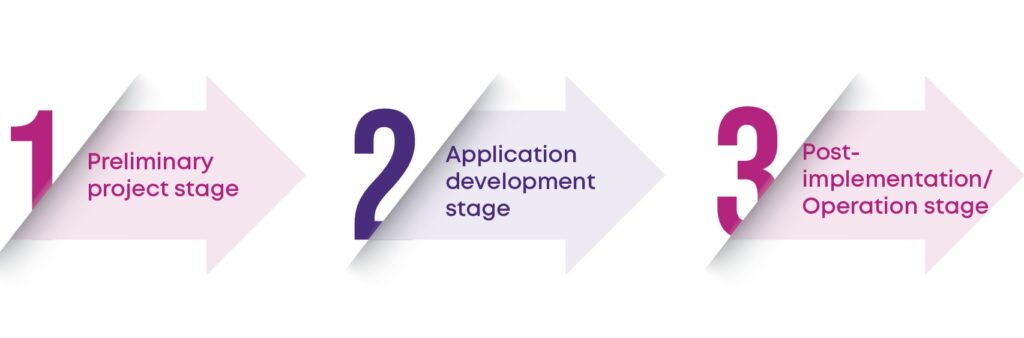
Under the existing guidance on accounting for costs incurred towards internal use software, Subtopic illustrates various stages of development, i.e., the preliminary project stage, the application development stage, and the post-implementation stage. Whether cost incurred need to be expensed off or capitalized is depended upon the nature of the costs and the project stage to which it relates. Applying this guidance is challenging, particularly in an iterative development environment.
4.1 Initial Recognition and Measurement Principles-
Stages for software development
4.2 Subsequent Recognition and Measurement Principles
Amortization Considerations
- Capitalized costs associated with internal-use software are amortized over the software’s estimated useful life, typically using the straight-line method, unless another systematic and rational basis more accurately reflects its consumption.
- Amortization commences once the software is ready for its intended use, irrespective of whether it has been formally deployed. This readiness is achieved upon the completion of all significant testing.
- The start of amortization should be evaluated at the individual module or component level. For example, an accounting software system might comprise distinct modules such as a general ledger, accounts payable subledger, and accounts receivable subledger. Each of these can be considered a separate module within the larger system.
- However, if a specific software module’s functionality is entirely contingent upon the completion of other modules (even if those dependent modules are not yet fully designed, but their completion is probable), then amortization for that module should be deferred until all such dependent modules are also ready for their intended use.
Impairment Considerations
- Internal-use software, once capitalized, is considered a long-lived intangible asset and is subject to impairment testing as per the principles of ASC 360-10.
- When to Test for Impairment: Impairment testing for internal-use software is not performed annually, but rather when events or changes in circumstances indicate that its carrying amount may not be recoverable. These “triggering events” suggest that the software’s value might have significantly decreased. Examples include:
- Significant adverse changes in the extent or manner in which the software is being used, or its physical condition.
- A significant decrease in its market price (if a comparable market exists for such software).
- Technological obsolescence that renders the software less useful or effective.
- An accumulation of costs significantly in excess of the amount originally expected for the software’s development or modification.
- A current period operating or cash flow loss combined with a history of losses or a projection of continuing losses associated with the software’s use.
- A decision to abandon or suspend the software project before it is ready for its intended use, or a decision to replace it with new software.
- Significant adverse changes in legal factors or the business climate.
- Unit of account: Internal-use software does not generate independent cash flows on its own. In such cases, the software is grouped with other assets and liabilities at the lowest level for which identifiable cash flows are largely independent of the cash flows of other asset groups. This “asset group” is then tested for impairment. The impairment loss, if any, is allocated to the long-lived assets within that group on a pro-rata basis.
Two-Step Impairment Test: If a triggering event occurs, a two-step impairment test is performed:
Step 1: Recoverability Test (Undiscounted Cash Flows)
- The company estimates the undiscounted future cash flows expected to be generated from the use and eventual disposition of the software (or the asset group that includes the software).
- If the carrying amount (book value) of the software (or asset group) is greater than the sum of these undiscounted future cash flows, then the asset is considered not recoverable, and an impairment loss may exist.
- If the undiscounted cash flows are greater than or equal to the carrying amount, no impairment is recognized, and no further steps are needed.
Step 2: Measurement of Impairment Loss (Fair Value)
- If the software fails the recoverability test (i.e., its carrying amount exceeds undiscounted cash flows), an impairment loss is then measured.
- The impairment loss is the amount by which the carrying amount of the software exceeds its fair value.
- Fair value is typically determined using valuation techniques such as market approaches (if comparable assets exist), income approaches (discounted cash flow analysis using discounted future cash flows), or cost approaches. Impairment loss, once recognized, is not reversible.
4.3 Implementation matters
1. Upgrades and enhancements
ASC 350-40 stipulates that upgrades and enhancements to existing internal-use software qualify as modifications resulting in additional functionality. For the expenditures related to such specified upgrades and enhancements to be capitalized, it must be probable that these expenditures will indeed lead to the aforementioned additional functionality.
In essence, costs incurred for improvements to internal-use software are eligible for capitalization only when there is a high likelihood that these expenditures will introduce new capabilities or significantly augment existing functionalities of the software asset.
Modifications to existing internal-use software that result in additional functionality (i.e., enabling the software to perform tasks it was previously incapable of performing) are accounted for similar to new software development, meaning qualifying costs are capitalized following the rules of the Application Development Stage.
Costs for routine maintenance, bug fixes, and minor upgrades that do not add significant new functionality are expensed as incurred. If a company cannot reasonably separate maintenance costs from minor upgrades/enhancements, the entire cost should be expensed.
4.4 FASBs’ Proposed Accounting Standard Update (ASU)
On October 29, 2024, the FASB issued a proposed Accounting Standards Update (ASU) to update the guidance on accounting for internal-use software. On May 7, 2025, after discussions and deliberations on software cost accounting changes, FASB has issued directions to staff to finalize targeted improvements to improvise the internal-use software accounting guidance in ASC 350-40. The proposed amendment is intended to introduce new capitalization considerations and eliminate existing software project stage accounting guidance.
The proposed amendments eliminate references to the aforesaid prescriptive and sequential stages of software development in existing GAAP and require the same recognition guidance for all software within the scope of Subtopic 350-40. The improvement is intended to align the recognition requirements for internal-use software costs with those requirements for licensed, sold, or otherwise externally marketed software.
The amendments in proposed ASU are effective for annual reporting period beginning after December 15, 2027, and interim reporting periods in fiscal years beginning after December 15, 2027. Early adoption is permitted. It shall apply to all entities, including private companies.
Highlights of Proposed amendments to Sub-topic 35-40
As per the existing guidance, software development costs incurred for internal-use software are capitalized once the preliminary project stage is complete. With the key focus to remove all references to a sequential software development method (referred to as “project stages”) throughout Subtopic 350_40, the proposed ASU instead provides the following two criteria’s in ASC 350-40-25-12 that must be met for entities to commence capitalizing software costs:
- Management, with the relevant authority, implicitly or explicitly authorizes and commits to funding a computer software project. (Criterion 1)
- It is probable that the project will be completed, and the software will be used to perform the function intended (referred to as the ‘probable-to-complete recognition threshold’). (Criterion 2)
With a shift in software development process from a sequential/linear process in orientation with several stages to agile software development (i.e., lightly planned and completed through a series of shorter time-frame development sprints), there is a need to align the guidance as proposed by ASU, which can be applied to all types of software development.
To learn more about the amendment in ASU, refer to our recent publication titled, Early Impressions “FASBs’ Accounting Standard Update (ASU-2025-03) Business Combinations (Topic 805) and Consolidation (Topic 810).
5. ASC 350-50 – Website Development Cost
5.1 Initial Recognition and Measurement Principles
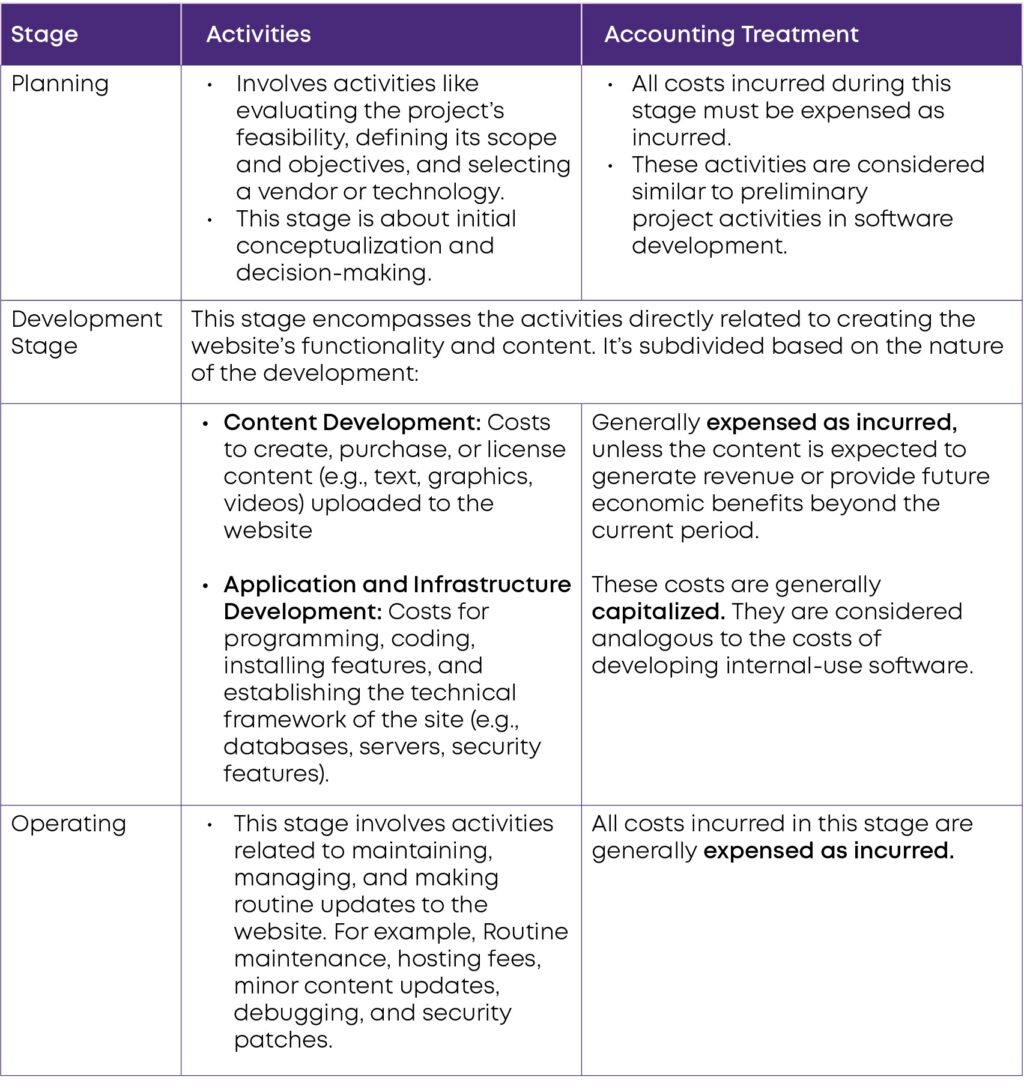
ASC 350-50 categorizes website development activities into distinct stages, dictating whether associated costs should be expensed or capitalized.
5.2 Subsequent Recognition and Measurement Principles
In essence, ASC 350-50 provides specific guidance for websites but aligns closely with the principles in ASC 350-40 for internal-use software in respect of subsequent recognition and measurement principles.
For detailed guidance on amortization consideration and impairment consideration, refer to Section 4. ASC 350-40 – Internal use Software above.
6. ASC 350-60 – Crypto Assets
Accounting for crypto assets under US GAAP has undergone significant changes recently, with the issuance of ASU 2023-08, Intangibles—Goodwill and Other—Crypto Assets (Subtopic 350-60): Accounting for and Disclosure of Crypto Assets. This new guidance, effective for fiscal years beginning after December 15, 2024 (meaning it’s effective for calendar year-end companies starting January 1, 2025), fundamentally shifts how many commonly held crypto assets are accounted for.
Before ASU 2023-08, most cryptocurrencies were treated as indefinite-lived intangible assets under ASC 350 (Intangibles—Goodwill and Other). This meant they were recorded at historical cost and then tested for impairment. A key criticism of this approach was the “cost-less-impairment” model, which allowed for write-downs but no write-ups, failing to reflect the volatile nature and potential fair value increases of crypto assets.
Key Changes Introduced by ASU 2023-08 (ASC 350-60):
- The new standard introduces a specific framework for “crypto assets” that meet certain criteria. These criteria generally include:
- Meeting the definition of an intangible asset as defined in the Codification.
- Not providing the holder with enforceable rights to or claims on underlying goods, services, or other assets.
- Being created or residing on a distributed ledger based on blockchain or similar technology.
- Being fungible (interchangeable).
- Not being created or issued by the reporting entity or its related parties.
For crypto assets that meet these criteria, the key accounting considerations are:
6.1 Initial Recognition and Measurement Principles
ASC 350-60 specifies that entities should initially measure and recognize crypto assets by applying other US GAAP. A company should evaluate the nature of the transaction through which it obtains crypto assets to determine their initial accounting.
The following summarizes several ways in which crypto assets can be obtained and the corresponding guidance that is generally applied to initially measure and recognize them.
6.2 Subsequent Recognition and Measurement Principles
Entities are required to measure in-scope crypto assets at fair value each reporting period. Changes in fair value (unrealized gains and losses) are recognized directly in net income for each reporting period. This is a significant departure from the old impairment model, where only losses were recognized. Fair value measurement should follow the guidance in ASC 820, Fair Value Measurement.
Comparison with IFRS
US GAAP (Generally Accepted Accounting Principles) and IFRS (International Financial Reporting Standards) have some significant differences in their treatment of intangible assets, including recognition, measurement, amortization, and impairment. These differences can impact a company’s financial statements and comparability across different regions.
To read this section in detail, download PDF.