Executive Summary
On December 4, 2025, the FASB issued ASU 2025-10, Accounting for Government Grants Received by Business Entities (or “ASU”), marking a significant step toward creating a comprehensive and consistent framework for accounting for government grants in US GAAP. For many years, the absence of explicit authoritative guidance resulted in diversity in practice, with entities drawing on analogy-based models, including those in IFRS. The issuance of ASU 2025-10 is therefore a meaningful development—one that enhances comparability, transparency, and decision-usefulness for users of financial statements.
The new standard draws upon the foundational principles in IAS 20 Accounting for Government Grants and Disclosure of Government Assistance, while incorporating targeted refinements and aligning certain requirements with the existing government assistance disclosure framework in ASC 832 Government Assistance. By doing so, the FASB has provided a structured model for recognition, measurement, and presentation that business entities can apply consistently across industries and types of government programs.
ASU 2025-10 also introduces flexible transition options—modified prospective, modified retrospective, or full retrospective—giving entities the ability to select an approach that best suits their systems, historical data availability, and reporting objectives.
With an effective date beginning December 15, 2028, for public business entities, and one year later for all other entities, organizations have adequate time to assess the operational and financial reporting implications of the new guidance. Early adoption is permitted, enabling entities to achieve comparability sooner if they are prepared to do so.
This Thought Leadership aims to provide a clear, practical, and insightful discussion of the new standard. We explore the core principles of ASU 2025-10, highlight key differences from prior practice, outline transition considerations, and share perspectives on potential implementation challenges. As entities begin evaluating and preparing for adoption, understanding the nuances of the new model will be essential to ensuring a smooth and compliant transition.
Background
Historically, US GAAP did not provide authoritative guidance for business entities on the accounting for government grants. In practice, companies were required to analogize to other models—most commonly IAS 20, and in some cases the not-for-profit contribution model in ASC 958-605 (958 Not-for-Profit Entities- 605 Revenue Recognition) or the contingent gain model in ASC 450 Contingencies. This led to significant diversity in recognition timing, measurement approaches, and presentation across industries.
Recognizing the need for clearer and more consistent principles, the FASB issued ASU 2025-10, Accounting for Government Grants Received by Business Entities, on December 4, 2025. The standard amends ASC 832, establishing a comprehensive US GAAP framework for recognizing, measuring, and presenting government grants. The guidance builds on the foundational concepts in IAS 20 while introducing targeted improvements and aligning certain existing disclosure requirements.
ASU 2025-10 Summary at Glance
Objective of the ASU
- Establishes a comprehensive US GAAP framework for recognition, measurement, presentation, and disclosure of government grants received by business entities.
- Aligns broadly with IAS 20 with targeted U.S.-specific enhancements.
Scope
- Applies to government grants received by business entities, except those within the scope of Topic 740 (income taxes), Topic 606/610 (exchange transactions), Topic 450 (contingencies), and grants to not-for-profit entities under ASC 958.
- Covers both monetary and nonmonetary assistance.
Grant Types
Two categories:
- Grant related to an asset — conditioned on acquisition, construction, or purchase of an asset;
- Grant related to income — all other grants, typically reimbursement of operating expenditures.
Recognition Criteria
- Grant cannot be recognized until it is probable that
- the entity will comply with grant conditions, and
- the grant will be received.
- Asset-related grants also cannot be recognized before related costs are incurred.
Measurement
- Monetary grants measured at the amount received/receivable;
- Nonmonetary grants measured at fair value.
Accounting for Asset-Related Grants
- Two policy choices:
- Deferred Income Approach — recognize liability and amortize to earnings over periods of related expense;
- Cost Accumulation Approach — reduce the carrying amount of the asset (net basis).
- Policy applied consistently for similar grants.
Accounting for Income-Related Grants
- Recognized in earnings on a systematic and rational basis over periods in which related costs are incurred.
- Deferred credit recorded if cash is received before costs are incurred.
Statement of Cash Flows Presentation
- No prescriptive rules; entity applies ASC 230 principles.
- Cash flows may be classified as operating, investing, or financing, depending on the nature of the grant and timing of cash receipts.
- Requires consistent accounting policy.
Disclosures (Annual)
- Required disclosures include:
(i) nature of the grant;
(ii) accounting policy applied;
(iii) affected financial statement line items;
(iv) significant terms & conditions.
- Additional disclosures required depending on whether deferred income or the cost accumulation method is used.
Transition Options
- Entities may adopt using
- modified prospective or
- modified retrospective, or
- full retrospective application.
- Early adoption permitted.
Effective Dates
- PBEs: annual periods beginning after Dec 15, 2028 (including interim periods).
- All other entities: one year later.
- Early adoption allowed for any period not yet issued.
Scope Applicability
Scope Inclusion:
The scope includes all government grants, which are defined as the transfer of a monetary asset or tangible nonmonetary asset—other than in an exchange transaction—from a government to a business entity.
Scope Exclusions:
ASU applies to all business entities (Other than Not-for-profit entities, which continue applying ASC 958-605 and Employee benefit plans within ASC 960, 962, and 965) receiving government grants from domestic or foreign, national, regional, state, or local governments, including entities related to those governments. However, the guidance in ASU is not applicable to following transaction types:
- Transactions within the scope of Topic 740 on income taxes (for e.g., nonrefundable, nontransferable income tax credits).
- Below-market interest rate loans
- Government guarantees
- Transfers of intangible assets or the provision of services
- A reduction of an entity’s liabilities (for example, sales, property, payroll, or other tax abatement).
- Government equity participation
- A contribution to a business entity from a nongovernmental source within the scope of Subtopic 958-605 on not-for-profit entities — revenue recognition.
- A transaction within the scope of Topic 606 on revenue from contracts with customers or Subtopic 610-20 on other income — gains and losses from the derecognition of nonfinancial assets.
Click here to read more.
Key Highlights of Amendment in ASU
A. Recognition Principles
ASU 2025-10 establishes a principles-based model for accounting for government grants. The accounting depends on whether the grant is related to an asset or to income, with specific recognition criteria that apply to both types.
1. Grant Categories
The ASU classifies grants into two categories:

1.1 Grant Related to an Asset
A grant is considered asset-related when it or part of it is conditioned on the purchase, construction, or acquisition of an asset, such as a long-lived asset or inventory.
- Additional conditions may apply, including:
- Restrictions on the type or location of the asset
- Requirements on the timing of acquisition or usage
- Limitations on disposal or minimum holding periods
These grants are directly tied to capital investment activity.
1.2 Grant Related to Income
A grant is considered income-related when it is not associated with an asset.
Typical examples include:
- Reimbursements for operating expenses
- Grants supporting training costs, R&D efforts, or general operating activities
The guiding principle is that these grants compensate the entity for periodic operating costs or losses.
2. Core Recognition Criteria Applicable to All Grants
Regardless of type, a government grant cannot be recognized until it is probable that:
2.1 Compliance with Conditions Is Likely
The entity must determine that it is probable (a term defined in US GAAP as ‘likely to occur’) it will meet all conditions attached to the grant. These may include performance requirements, spending thresholds, hiring commitments, or other compliance obligations.
2.2 Receipt of the Grant Is Probable
The entity must also conclude that it is probable the grant will be received, considering approval processes, eligibility assessments, and administrative steps required by the government.
These criteria form the foundation of recognition under ASC 832-10-25-1(a).
3. Recognition Timing for Asset-Related Grants
For asset-related grants, recognition is further constrained:
3.1 Recognition Cannot Occur Before Costs Are Incurred
An entity may not record:
- A grant receivable, or
- Any related grant income
until it has incurred the costs that the grant is intended to reimburse (e.g., construction costs, capital expenditures).
3.2 Nonmonetary Grants Follow the Same Principles
If the government transfers a tangible nonmonetary asset—such as land or a building—the recognition and measurement, follow the same model as for monetary grants. The distinction is only in form, not in accounting treatment.
4. Recognition Timing for Income-Related Grants
Income-related grants follow a matching principle:
4.1 Systematic and Rational Recognition in Earnings
Grant income must be recognized over the same periods in which the entity recognizes:
- The operating costs, or
- The expenses
that the grant is intended to compensate.
This ensures that the grant’s economic benefits are reflected in earnings in a manner consistent with the related expenditures.
B. Recognition, Measurement, and Presentation framework- Asset-Related Grants
ASU 2025-10 provides two permissible approaches for recognizing a grant related to an asset:

The following sections outline the principles, mechanics, and implications of each approach.
1. Deferred Income Approach
Under this approach, the government grant is recorded as a deferred income liability and subsequently recognized in earnings over the periods in which the related costs are recognized.
1.1 Initial Measurement
- Monetary Grants: Deferred income is initially measured at the amount of cash received or expected to be received once the recognition criteria in ASC 832-10-25-1(a) are met (i.e., probable compliance and probable receipt).
- Nonmonetary Grants (e.g., land, buildings, equipment): Deferred income is measured at the fair value of the nonmonetary asset received on the date the recognition criteria are achieved.
1.2 Subsequent Recognition
Deferred income is recognized in earnings on a systematic and rational basis, aligned with the period(s) in which the entity incurs the costs that the grant is intended to offset.
- For depreciable assets, recognition generally follows the asset’s depreciation pattern.
- For non-depreciable assets (e.g., land), recognition occurs over the periods in which the entity incurs the associated costs, since no depreciation exists.
1.3 Presentation in Earnings
ASU 2025-10 allows flexibility in presentation:
- Presented as “other income”, or
- Shown as a reduction of the related expense.
Important Clarification:
The term “other income” in ASC 832 does not carry the same meaning as in SEC Regulation S-X. It simply refers to income that is not revenue under ASC 606. Entities may present this amount within operating income, depending on their facts and circumstances.
2. Cost Accumulation Approach
Under this method, the government grant is reflected as a reduction of the cost basis of the related asset.
2.1 Initial Measurement
- For monetary grants, the asset is recorded at its gross acquisition or construction cost, reduced by the grant amount once the recognition criteria are met.
- For nonmonetary asset transfers, the asset is recognized at its cost to the entity, which may be zero or nominal.
2.2 Subsequent Measurement
Because the grant is embedded within the asset’s carrying amount:
- There is no separate deferred income balance,
- No separate recognition in earnings, and
- The asset’s net carrying value is subject to standard depreciation, impairment, and other applicable ASC guidance (e.g., ASC 360 or ASC 330).
This means the benefit of the grant flows through earnings indirectly, via a lower depreciation or cost of goods sold amount.
2.3 Timing Considerations
The timing of asset acquisition and the timing of meeting grant recognition criteria may differ. Entities should adjust the asset’s carrying amount when the criteria are met, even if the asset was acquired earlier.
3. Accounting Policy Considerations
ASU 2025-10 requires entities to make a policy election for asset-related grants. Key principles include:
3.1 Consistency Requirement
Once an entity selects either:
- the Deferred Income Approach, or
- the Cost Accumulation Approach,
it must apply the election consistently to similar types of grants.
3.2 Changes in Accounting Policy
Under ASC 250:
- A change in approach is permitted only if it is preferable, and
- Must follow the change-in-accounting-policy guidance in ASC 250.
3.3 Transition for Entities Previously Using Analogies
Entities currently analogizing to IAS 20 or ASC 958-605 (e.g., for nonrefundable, transferable tax credits or other government transfers not explicitly within ASC 832) may:
- Apply the transition guidance under ASU 2025-10, and
- Elect a new accounting policy to align with ASC 832 going forward.
Many entities may conclude that the updated ASC 832 framework is now the most suitable US GAAP model for transactions involving government transfers that are not otherwise addressed by specific guidance.
Click here to read more.
C. Recognition, Measurement, and Presentation framework- Income-Related Grants
Income-related grants follow a distinct recognition pattern based on alignment with the costs they are intended to offset.
1. Recognition Principle
A grant related to income must be recognized in earnings on a systematic and rational basis over the periods in which the entity identifies the corresponding costs.
2. Timing Scenarios
A. Grant Received Before Costs Are Incurred
If an entity receives an income-related grant in advance of the related expenditures:
- A deferred credit liability is recorded.
- The liability is reduced, and grant income is recognized as the related expenses are incurred over future periods.
B. Grant Received After Costs Are Incurred
If the entity incurs qualifying costs before receiving the grant:
- Grant income is recognized in the period the ASC 832 recognition criteria are met (probable compliance and probable receipt).
- Recognition may therefore occur before cash is received.
3. Presentation in Earnings
Consistent with the presentation alternatives for asset-related grants under the deferred income approach, ASU 2025-10 allows two options:

Entities should apply their presentation policy consistently and disclose the chosen approach.
Click here to read more.
D. Statement of Cash Flow Presentation
ASU 2025-10 does not prescribe specific cash flow classification requirements for government grants. Instead, it directs entities to apply the general principles in ASC 230, Statement of Cash Flows. Because of this principles-based approach, entities must use judgment when determining the classification of grant proceeds.
The following subsections outline the key considerations and recommended practices.
1. Principles-Based Approach to Classification
The Board clarified in the ASU’s Basis for Conclusions (BC59) that:
- Proceeds from income-related grants may be classified as operating or financing cash flows.
- Proceeds from asset-related grants may be classified within operating, investing, or financing activities.

2. Key Considerations Affecting Classification
The appropriate classification of grant proceeds—particularly for asset-related grants—depends on three key factors:
- Nature of the underlying asset (productive vs. operating asset)
- Timing of cash flows (received before or after qualifying costs are incurred)
- Relevant ASC 230 principles for analogous transactions
These factors often require nuanced evaluation, and entities should document the rationale supporting their classification conclusions.
Click here to read more.
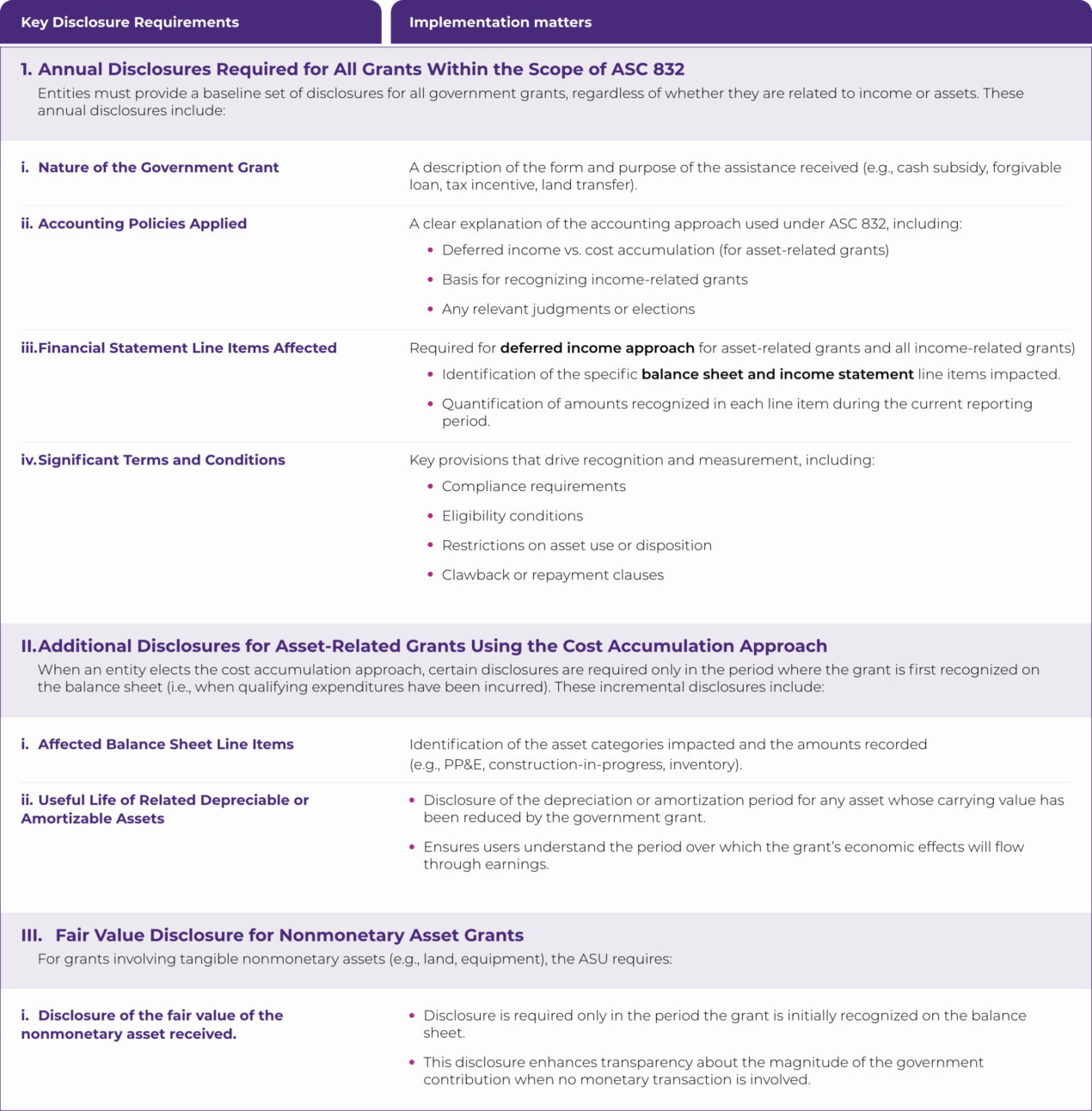
E. Disclosure Requirements
The amendment in ASU expands and aligns the disclosure framework for all government grants within the revised scope of ASC 832, Government Assistance. Entities must apply the existing annual disclosure provisions in Topic 832, with additional requirements depending on the type of grant and the accounting approach applied.
The following subsections summarize the key disclosure expectations.

F. Other Matters
1. Forgivable Loans
Board clarified in basis of conclusion that forgivable loans fall within the scope of the new government grant guidance once an entity concludes that the recognition criteria are met. Specifically, a forgivable loan should be accounted for as a government grant when it becomes probable that (1) the entity will comply with the loan’s terms of forgiveness, and (2) the proceeds will be received.
The Board noted that a forgivable loan is economically equivalent to a direct government cash grant. In both cases, the entity assesses whether the underlying conditions will be satisfied such that the amount will not need to be repaid. Accordingly, the ASU requires entities to evaluate forgivable loans using the same principles applied to monetary grants—focusing on the substance of the arrangement rather than its legal form.
Click here to read more.
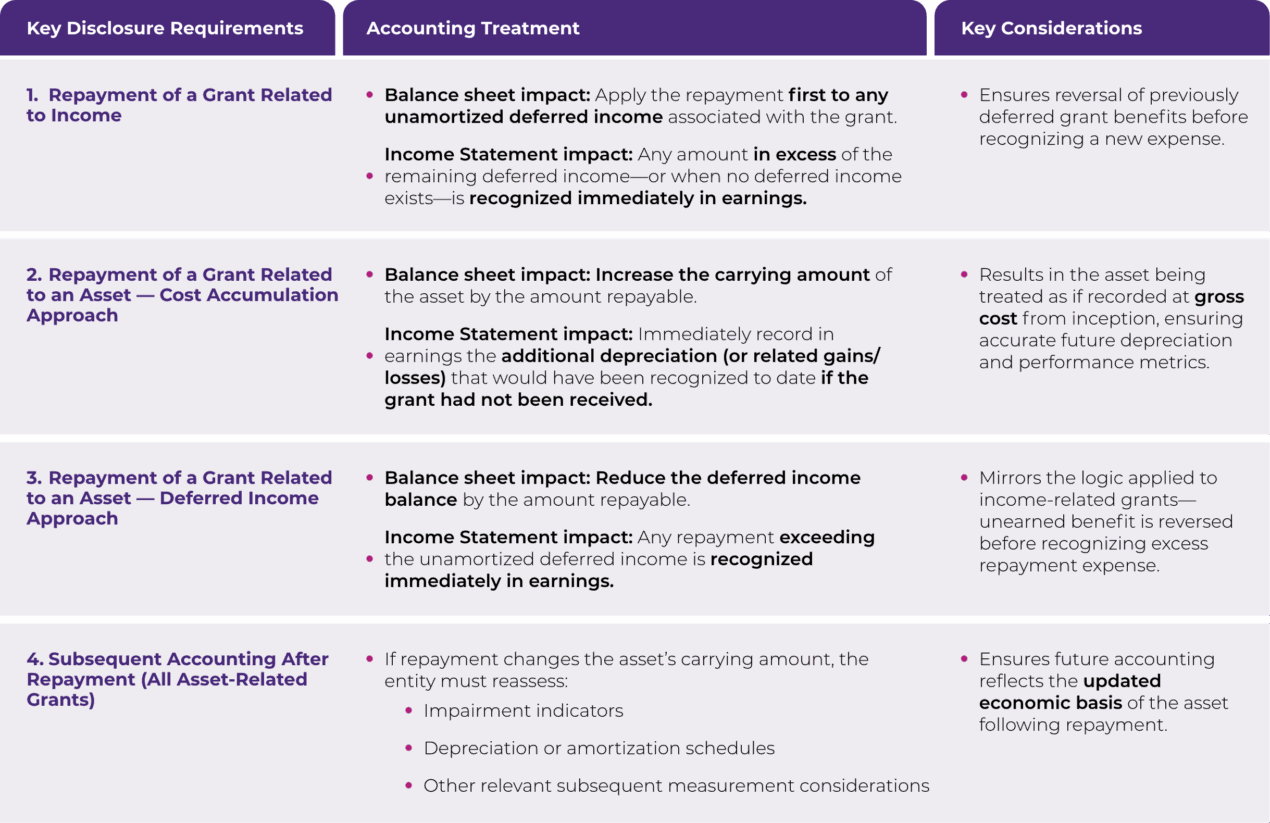
2. Repayment of Government Grants
If circumstances change and a previously recognized government grant becomes repayable, ASU 2025-10 provides specific guidance on how to account for the repayment. The required treatment depends on the type of grant and the accounting policy applied (deferred income approach or cost accumulation approach). The key principles are summarized below:
3. Recognition and measurement of Government Grants acquired in a Business Combinations
ASU 2025-10 introduces targeted guidance on how government grants—particularly grants related to income—should be recognized and measured when acquired in a business combination. The Board concluded that Topic 805, on its own, does not provide sufficient clarity for these situations, prompting the need for explicit direction to promote consistency and reduce unnecessary valuation complexity.
Recognition of Income-Related Grants Acquired in a Business Combination
The ASU requires an acquirer to recognize deferred income associated with a grant related to income at the acquisition date, unless the acquiree has already fully satisfied the grant conditions before the acquisition.
- If the acquiree has not yet complied with the grant conditions – the acquirer recognizes deferred income.
- If the conditions have been fully met prior to acquisition – no deferred income is recognized.
The deferred income recognized by the acquirer should generally be similar to the amount recorded by the acquiree immediately before acquisition, promoting continuity and avoiding remeasurement at fair value.
Measurement Exception for Income-Related Grants
The Board acknowledged that measuring deferred income from government grants at fair value under Subtopic 805-20 can be difficult because such grants typically lack observable market-based inputs.
To reduce cost and complexity, ASU 2025-10 introduces a measurement exception:
- Deferred income associated with a grant related to income is not remeasured at fair value.
- Instead, it is carried forward at the amount recognized under ASC 832 by the acquiree, subject only to adjustments for compliance conditions.
Treatment of Other Grant-Related Assets and Liabilities
All other assets acquired, and liabilities assumed that arise from a government grant—such as property, equipment, or obligations tied to grant conditions—remain within the scope of Subtopic 805-20.
These items must be recognized and measured at fair value as of the acquisition date, consistent with standard business combination accounting.
Click here to read more.
Effective date and transition
Effective Date
PBEs
Effective for fiscal years beginning after December 15, 2028, including interim periods within those fiscal years.
Non-PBEs
Effective for fiscal years beginning after December 15, 2028, including interim periods within those fiscal years.
Early Adoption
Permitted for any annual or interim period not yet issued. Entities may early adopt across all grant types within the scope of ASC 832.
Transition Provision
Entities must select one of the three transition methods and apply it consistently. Transition choice may affect comparability across periods.
Modified Prospective
Amendments in the ASU are applied to-
- Government grants that are not complete1 as of the adoption date (i.e., the beginning of the adoption period) and
- Any new government grants entered into after that date.
There is “no cumulative-effect adjustment to the opening balance of retained earnings” under the modified prospective approach.
Click here to read more.
Modified Retrospective
Amendments in the ASU are applied to-
- Government grants that are not complete2 as of the beginning of the earliest period presented, and
- All new grants thereafter.
Requires a cumulative-effect adjustment to opening retained earnings and restatement of prior periods presented.
Click here to read more.
Full Retrospective
Amendments in the ASU are applied to-
- All grants, whether complete or not, for all periods presented.
Requires a cumulative-effect adjustment as of the earliest period presented.
Click here to read more.
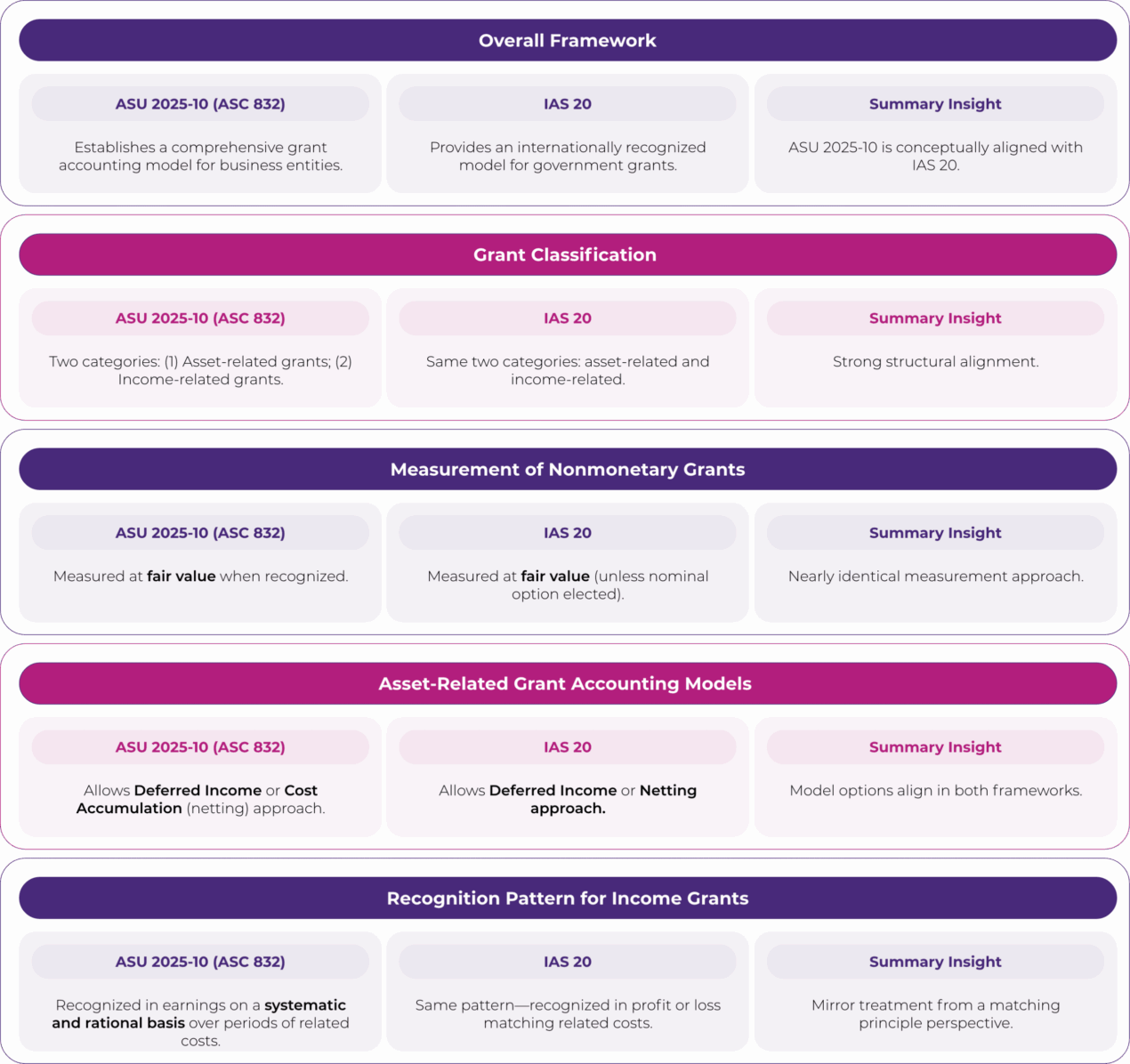
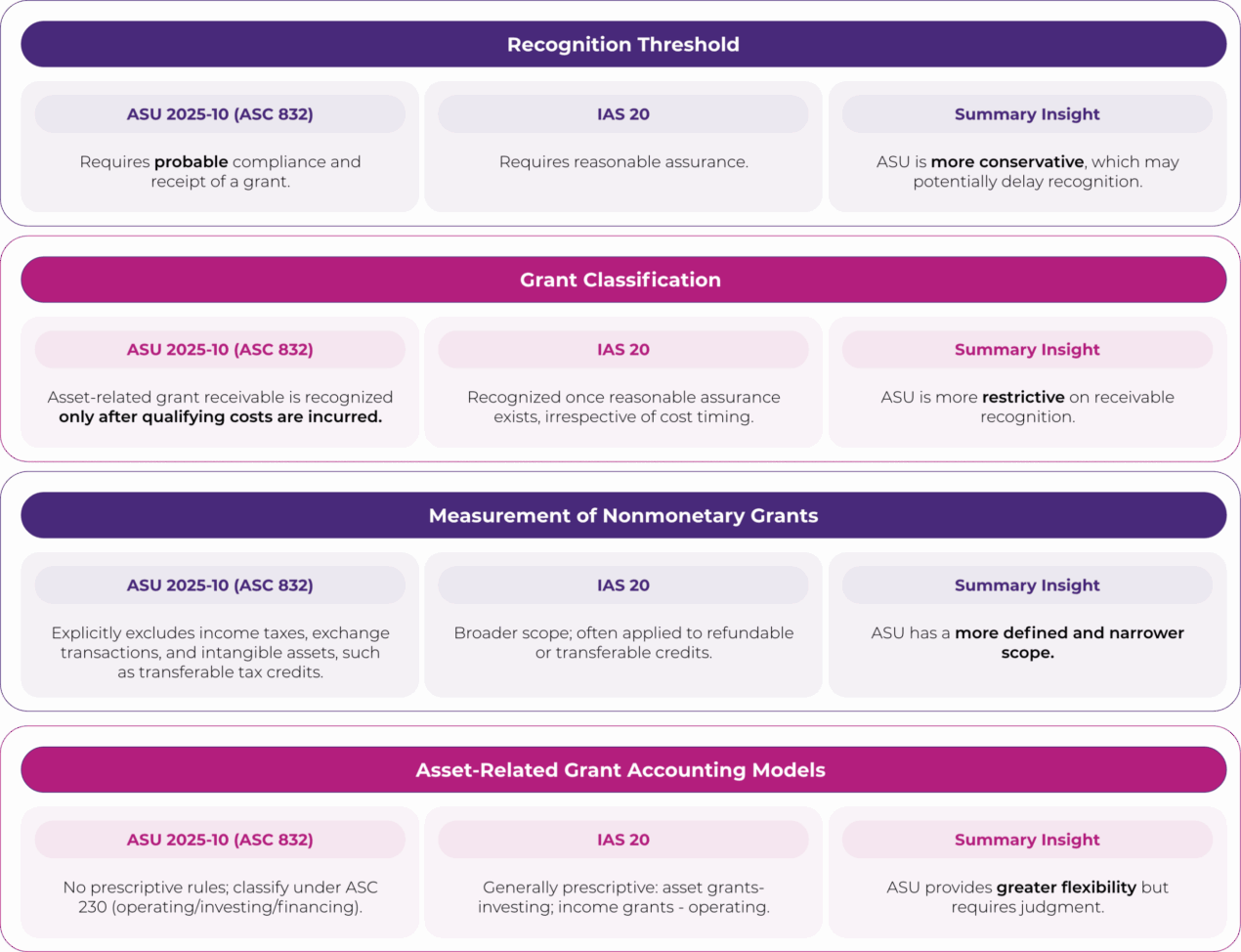
Comparison of ASU 2025-10 and IAS 20
Key Similarities
Key Differences
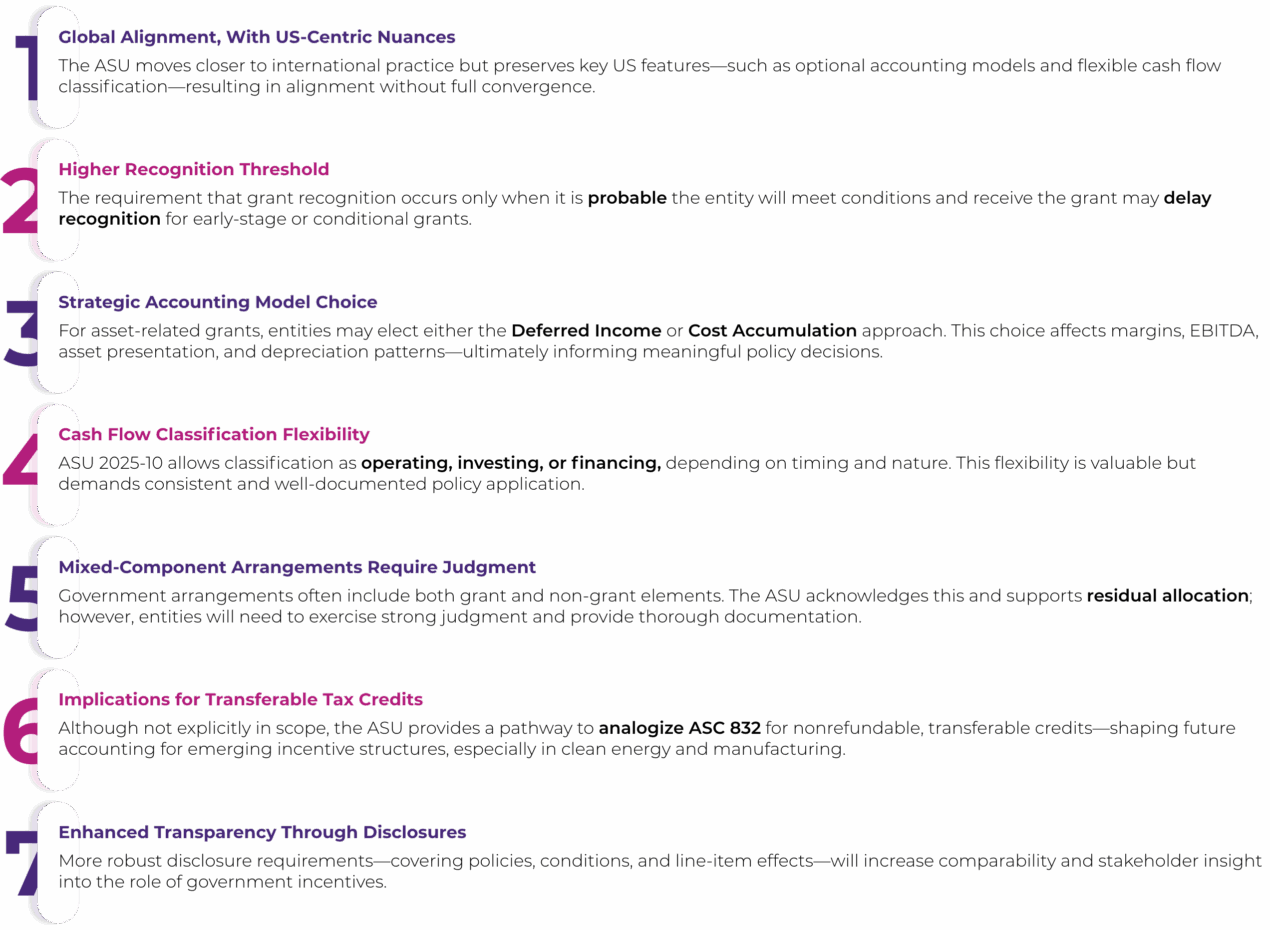
Uniqus Perspective of amendments
ASU 2025-10 introduces a comprehensive framework for government grant accounting under US GAAP. While aligned with IAS 20 in principle, it introduces several US-specific judgments and strategic considerations that will shape how entities report and interpret government assistance going forward.
For more information on the proposed Accounting Standard Update, see the press release on the FASB’s website.