1
Executive Summary
On May 19, 2026, the FASB issued ASU 2026-02, Environmental Credits and Environmental Credit Obligations (Topic 818) — a comprehensive U.S. GAAP framework covering recognition, measurement, presentation, and disclosure for environmental credits and the regulatory compliance obligations (ECOs) they are used to settle.
Historically, U.S. GAAP did not specifically address environmental credits. Entities relied on drawing analogies to various topics, including Topic 330 (Inventory), Subtopic 350-30 (Intangibles), and Topic 450 (Contingencies) — producing material diversity in how cap-and-trade allowances, Renewable Identification Numbers (RINs), Renewable Energy Certificates (RECs), and carbon offsets were recognized, measured, and disclosed.
Topic 818 introduces a single, principles-based framework anchored on three pillars: probability-based asset recognition model, dual classification of environmental credits (compliance vs. noncompliance), and a funded/unfunded measurement model for ECOs. Credits acquired solely for voluntary initiatives — such as net-zero or carbon-neutral commitments — are expensed when incurred.
Effective for public business entities for annual periods beginning after December 15, 2027 (and interim periods within), and one year later for all other entities. Early adoption is permitted. The transition is retrospective, with a cumulative-effect adjustment to opening retained earnings.
This Early Impressions highlights what has changed, why it matters, and the key implementation considerations for CAOs, CFOs, controllers, and accounting professionals – as well as for Chief Sustainability Officers, ESG controllers, carbon and REC procurement managers, and sustainability reporting teams who are often the front-line owners of the instruments and programs that Topic 818 now governs.
Topic 818 — Structure at a glance
Topic 818 — Environmental Credits and Environmental Credit Obligations
1
Subtopic 818-10
Overall (scope & definitions)
2
Subtopic 818-20
Environmental credits
Asset recognition, classification, measurement, derecognition, presentation, disclosure
3
Subtopic 818-30
Environmental credit obligations
Liability recognition, funded / unfunded measurement, derecognition, disclosure
We hope you find this publication valuable and welcome further discussion.
2
Background
Why environmental credits matter
Environmental credit markets have grown significantly in recent years due to expanding regulatory programs, growing voluntary corporate climate commitments, and rising investor focus on climate-related disclosures. As a result, environmental credits such as emissions allowances, RINs, RECs, and carbon offsets have become increasingly important for entities across industries. What was once viewed as a niche compliance matter is now often a significant financial reporting and balance sheet consideration.
The diversity-in-practice problem
Hitherto, U.S. GAAP did not specifically address environmental credits. Entities applied a patchwork of analogies — inventory (Topic 330), intangibles (Subtopic 350-30), contingencies (Topic 450), or government-grant style approaches for regulator-granted allowances — producing inconsistent outcomes for economically similar transactions. Measurement, presentation (gross vs. net, current vs. non-current), and disclosure varied widely, particularly when market prices moved or compliance requirements changed.
Uniqus View- Why this matters now
Topic 818 closes a recurring topic on the regulator and audit-committee agenda. As environmental credit volumes — and prices — rise, the cost of accounting diversity grows in lockstep. CAOs and CFOs should view 2026 as the year to baseline their portfolio of credits and obligations, codify accounting policies, and design the controls needed before the standard becomes effective.
3
Summary at a Glance
The infographic below highlights the six key dimensions of the standard.
1
Objective
Improve decision-usefulness and comparability of financial information about environmental credits and regulatory compliance obligations (ECO) settled with such credits.
2
Scope
All entities that buy/receive transferable environmental credits, generate environmental credits, or have enforceable regulatory compliance obligations settled with such credits.
3
Recognition principle
- Environmental credit is recognized as an asset when it is probable that it will be used to settle an ECO, transferred in an exchange, or used in a nonreciprocal transfer.
- All other credits are expensed when incurred.
4
Measurement
- Compliance credits — at cost (no impairment). Noncompliance credits — at cost, less impairment (no reversal). Optional FV election by class for eligible noncompliance credits.
- Internally generated / regulator-granted credits measured at transaction cost (if any).
5
Presentation
- Compliance environmental credit assets must be presented separately from related ECO liabilities — no net presentation.
- Current vs non-current split.
6
Effective date and transition
- PBEs: annual periods beginning after Dec 15, 2027 (interim included). Non-PBEs: after Dec 15, 2028.
- Early adoption permitted. Retrospective with cumulative-effect adjustment to opening retained earnings.
Uniqus View- A new Topic — broader than expected
- Although positioned as an environmental credits standard, Topic 818 effectively establishes an accounting framework for a new class of assets.
- The guidance introduces new considerations around asset recognition, classification, and funded versus unfunded liability accounting models.
- Implementation is expected to impact not only accounting policies, but also systems, internal controls, valuation processes, treasury, tax, and ESG reporting alignment.
- As a result, the adoption effort is likely to extend well beyond the financial close and reporting process.
4
Scope Applicability
Topic 818 establishes a definition-driven scope. To be subject to the new Subtopic 818-20, an item must first meet the definition of an environmental credit. The new Subtopic 818-30 then applies to the regulatory compliance obligations that may be settled using those credits.
Environmental Credit Assets
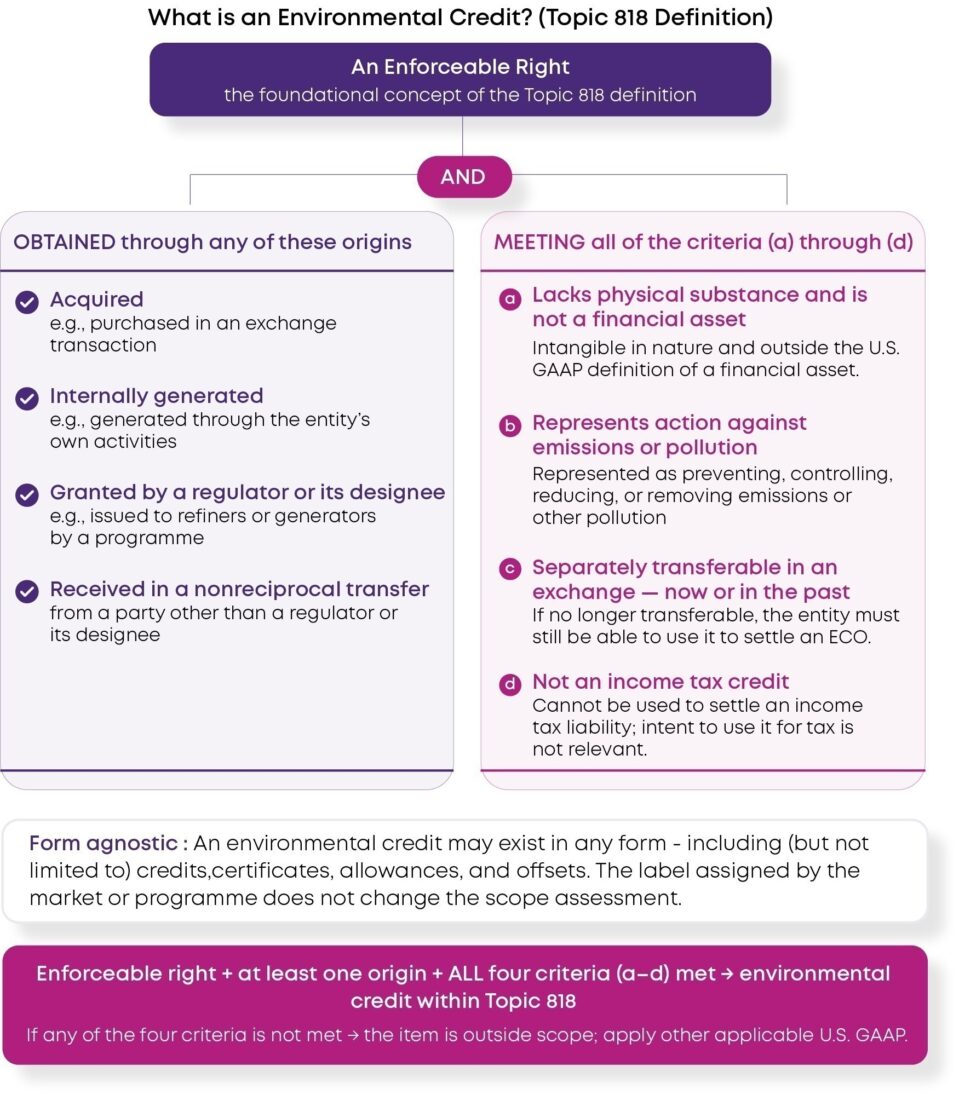
The Topic 818 definition has a layered structure. At its foundation, an environmental credit is an enforceable right. That right must originate from at least one of four permitted sources, and the right itself must meet all four lettered criteria (a) through (d). The visual below sets out each element.
Uniqus View-Form-agnostic, origin-agnostic — and related-party transfers are not excluded
- Topic 818 does not prescribe a particular legal form: Environmental credits can present as credits, certificates, allowances, or offsets — what matters is whether the definition above is met (foundational enforceable right + qualifying origin + all four lettered criteria), not the label assigned by the market or the issuing program.
- The origin of the credit is equally neutral: Credits may be acquired in the market, granted by a regulator (including grants made in return for performance), generated by the entity’s own activities, or received in a non-reciprocal transfer. Credits obtained from related parties also remain within scope.
In our view, the assessment, therefore, is one of substance — what the credit is and what it can be used for — rather than how it was obtained or who provided it.
Examples in scope vs common look-alikes:
Several instruments resemble environmental credits but fall outside Topic 818 because they fail one or more of the lettered criteria. The comparison below highlights the most frequent in-scope categories and the look-alikes that should not be confused with them.
IN SCOPE — Examples
- Emission allowances e.g., cap-and-trade compliance programs
- Renewable Energy Certificates (RECs) U.S. state renewable portfolio standards
- Renewable Identification Numbers (RINs) U.S. Renewable Fuel Standard
- Carbon offsets voluntary or compliance project-based credits
LOOK-ALIKES — Out of Scope
- Transferable clean-energy tax credits These remain income tax credits and are governed by Topic 740 — irrespective of whether the entity intends to use the credit against tax.
- Wetland, habitat, or stream restoration credits Not represented as preventing, controlling, reducing, or removing emissions or pollution — therefore outside Topic 818.
Environmental Credit Obligations— what makes an obligation an ECO
The standard also governs the recognition and measurement of environmental credit obligations —regulatory compliance liabilities that environmental credits are typically used to settle.
ECO is a regulatory compliance obligation arising from existing or enacted laws, statutes, or ordinances designed to prevent, control, reduce, or remove emissions or other pollution that may be settled with environmental credits.
What Makes an Obligation an Environmental Credit Obligation (ECO)?
All three elements below must be present for a liability to fall within Subtopic 818-30.
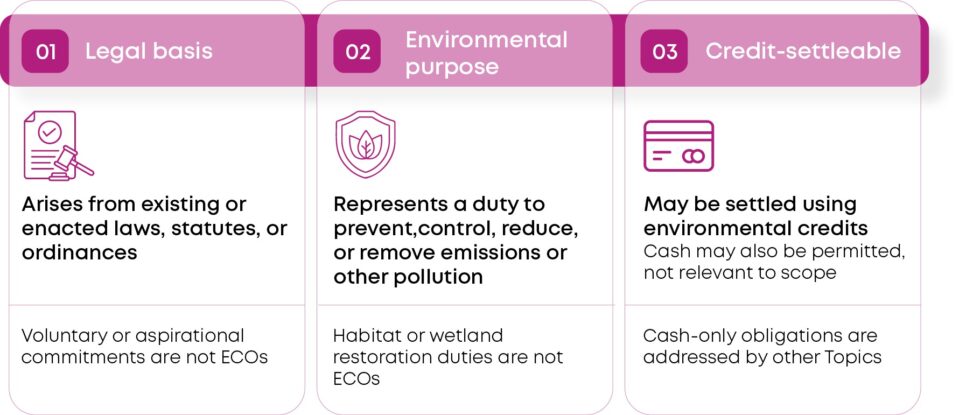
All three present → Environmental Credit Obligation (ECO) within Subtopic 818-30
Carve-out: obligations within scope of Subtopic 410-30 (Environmental Obligations) are excluded and remain under Subtopic 410-30.
Illustrative ECO Example — In scope (state cap-and-trade compliance)
Fact pattern: Company P operates a power generation facility in a state that enacted a cap-and-trade program. Under the program, each entity must remit one allowance for every metric ton of CO2 emitted during a calendar compliance year, with remittance due by March 31 of the following year. The program permits settlement using allowances or, where unavailable, cash at a statutory rate.
Analysis: All three elements of an ECO are present. The obligation originates from enacted state law (legal basis), it is designed to control and reduce CO2 emissions (environmental purpose), and it is settleable using environmental credits — the allowances (credit-settleable). The fact that cash is also permitted does not affect the assessment. Company P recognizes an ECO liability under Subtopic 818-30 as emissions occur over the compliance year.
Illustrative ECO Example — Out of scope (Subtopic 410-30 remediation order)
Fact pattern: The same Company P is also subject to a state environmental remediation order requiring clean-up of historical soil and groundwater contamination at a decommissioned plant site. The order specifies the remediation activities to be performed, is settled through clean-up work, and the associated costs cannot be discharged using environmental credits.
Analysis: Although the remediation order arises from law and addresses environmental harm, it cannot be settled using environmental credits and is within the scope of Subtopic 410-30. It is therefore not an ECO under Topic 818 and continues to be accounted for under Subtopic 410-30 — separate from Company P’s cap-and-trade compliance liability.
In-scope arrangements
The amendments apply to all entities that engage with environmental credits or environmental credit obligations, including entities that:
- Buy or receive transferable environmental credits and use those credits to settle an ECO, transfer them in an exchange transaction, transfer them in a nonreciprocal transfer (e.g., distribution to an investor), or meet voluntary environmental initiatives (e.g., carbon neutral or net-zero).
- Generate environmental credits internally — for example, a tree-farm operator that earns carbon offsets through a third-party registry, or a power generator that earns RECs.
- Have enforceable regulatory compliance obligations arising from existing or enacted laws, statutes, or ordinances that prevent, control, reduce, or remove emissions or other pollution and that may be settled with environmental credits.
Practical Insight – Two-step scope assessment
Scoping under Topic 818 is a two-step exercise. First, confirm the item meets the four-pronged environmental credit definition (enforceable right; lacks physical substance and is not a financial asset; represented to reduce emissions or other pollution; separately transferable in an exchange; not an income tax credit).
Second, determine the entity’s intent and use case — settle ECO, exchange transaction, nonreciprocal transfer, or voluntary purpose. The intended use drives asset vs. expense recognition, and within asset recognition, it drives the compliance vs. noncompliance classification.
5
Key Highlights of Amendment
This section walks through the substantive requirements of ASU 2026-02. The standard introduces a new Topic 818 with two Subtopics: Subtopic 818-20, governing environmental credits (the asset side), and Subtopic 818-30, governing environmental credit obligations (the liability side). The recognition-to-presentation workflow below summarizes how the model operates.
Topic 818 — End-to-end workflow
A
Identification of Environmental Credit
Does it meet the EC criteria?
B
Recognition & classification
Environmental Credit. Asset vs expense (compliance / noncompliance)
C
Initial measurement
Environmental Credit. Cost or transaction cost (often $0 if granted)
D
Subsequent measurement
Environmental Credit. Cost / cost less impairment / FV option
E
Environmental Credit Obligations
Recognition & measurement (funded / unfunded)
F
Presentation & disclosure
Gross balance sheet + required disclosures
A. Identification of Environmental Credit
The first step in the flow includes identification of environmental credit, which is defined as an enforceable right that is acquired, internally generated, granted by a regulatory agency or its designee(s), or received in a nonreciprocal transfer that is not a grant from a regulator, and meets all the following criteria:
- Lacks physical substance and is not a financial asset.
- Is represented to prevent, control, reduce, or remove emissions or other pollution.
- Is, or previously was, separately transferable in an exchange transaction. If no longer separately transferable, the entity must be able to use the item to satisfy an environmental credit obligation.
- Is not an income tax credit that may be used to settle an entity’s income tax liability.
Environmental credits may take many forms — credits, certificates, allowances, offsets — and the FASB intentionally adopted a principles-based definition to accommodate evolving markets.
B. Recognition and classification — Environmental Credit (asset vs expense)
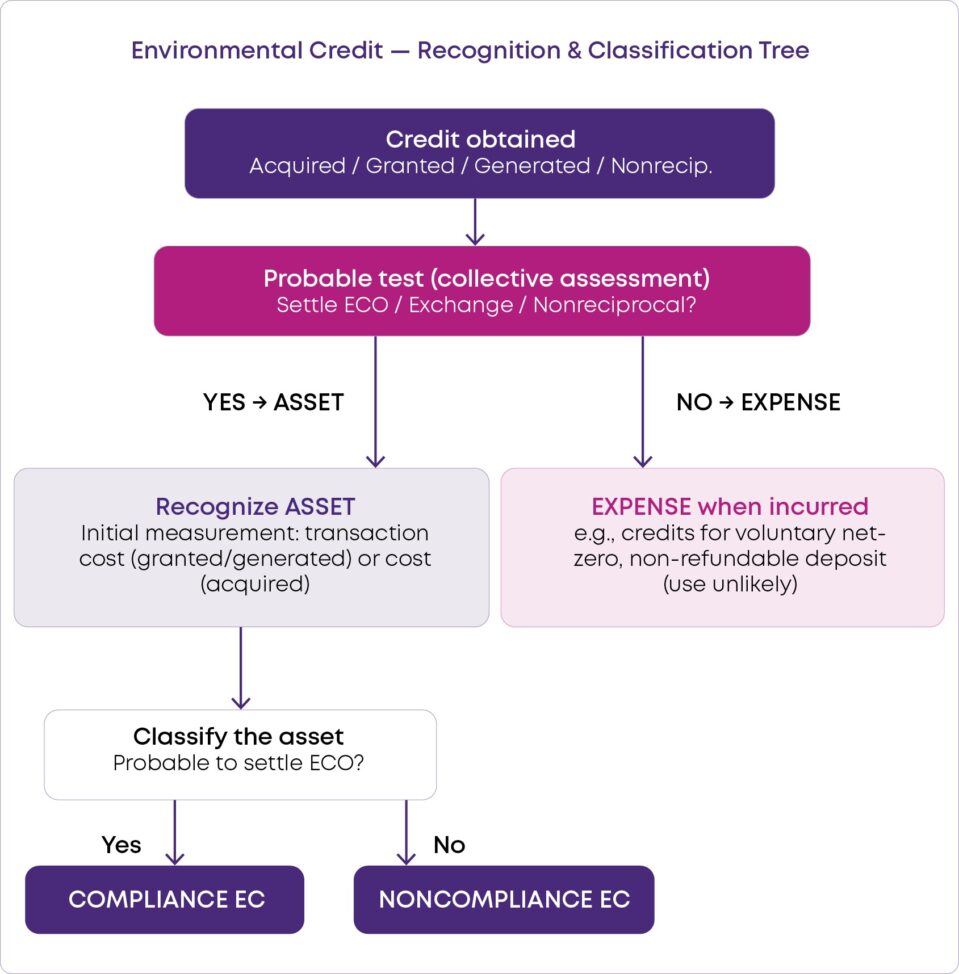
- Paragraph 818-20-25-1 requires an entity to recognize an environmental credit as an asset only when it is probable that the credit will be used to:
- (i) settle an environmental credit obligation;
- (ii) be transferred in an exchange transaction; or
- (iii) be used in a nonreciprocal transfer (i.e., not retire for voluntary purposes).
- For all other environmental credits (e.g., those acquired solely to satisfy a voluntary net-zero initiative), the entity must recognize an expense when costs are incurred and is prohibited from including those costs in the carrying amount of another asset.
- The probability assessment is a collective evaluation — the entity assesses whether any of the three permitted uses is, in aggregate, probable. The FASB clarified that the assessment need not be performed at the individual environmental credit level; entities may apply the recognition criteria to portfolios of similar credits.
- Once recognized as an asset, the credit is classified into one of two categories — Compliance or Noncompliance by determining whether it is probable that the credit will be used to settle an ECO. If so, the credit is classified as compliance credit. If not, the credit is a noncompliance credit.
Illustrative application of the probability assessment model
Fact pattern: A manufacturing entity operates in a jurisdiction that requires environmental credits to settle emissions-related compliance obligations. Although the entity generally generates sufficient credits internally, fluctuations in production volumes and emissions levels may increase future compliance requirements. To manage this uncertainty, the entity purchases additional environmental credits in the market at the beginning of the compliance period.
The entity purchases 1,000 environmental credits at $10 per credit. Based on management’s assessment, there are:
- a 45% likelihood that the credits will be used to satisfy compliance obligations,
- a 35% likelihood that the credits will be sold in the market, and
- a 20% likelihood that the credits will ultimately be retired to support sustainability goals.
Analysis: Under ASU
Analysis: Under ASU 2026-02, environmental credit is recognized as an asset when it is probable that the credit will be used to settle an ECO, transferred in an exchange transaction, or used in a nonreciprocal transfer. The recognition test is a collective assessment of whether any of those qualifying uses is probable; it is not a bright-line percentage, and the individual likelihoods of different uses are not summed to reach a threshold. In this fact pattern, management concludes that it meets the criteria for asset recognition, because taken together, it is probable the credits will be put to a qualifying use – they were purchased to be either applied against compliance obligations or sold into the market, and retirement is the least likely outcome.
Accordingly, the entity would initially recognize the credits at cost.
Classification requires a separate assessment of whether use for compliance purposes is probable on a standalone basis, i.e., that the credit will be used to settle an ECO. Here, management does not consider compliance use probable on its own – the entity is at least as likely to sell the credits as to apply them against an obligation – so the purchased credits are classified as noncompliance environmental credits rather than compliance environmental credits. Note: The percentages are illustrative of management’s judgment and are not a substitute for the qualitative probable assessment the standard requires.
This example illustrates that ASU 2026-02 requires separate evaluations for recognition and classification, which may result in credits being recognized as assets but classified as noncompliance credits.
Practical Insight — Probability determination — judgment factors
- FASB has outlined several factors entities may consider in assessing whether the use of environmental credits for a specified purpose is ‘probable’. Probable for this purpose is defined as the future event/events that are likely to occur, and not as a bright-line test. These include the purpose for acquiring the credits, the quantity held compared to current and expected compliance obligations (ECOs), expected changes in future compliance requirements, historical usage patterns, contractual commitments to transfer credits, and planned internal emission-reduction initiatives.
- As a result, companies may need to establish more robust forward-looking forecasting processes that connect emissions data, production levels, and regulatory requirements with expected credit demand.
- Topic 818 accounting treatment does not affect the GHG Protocol or registry validity of retiring offsets or RECs for sustainability reporting purposes — the two systems operate in parallel.
- Companies will need to maintain separate tracking for financial statement purposes and GHG inventory purposes — these are not the same ledger.
- Investor-facing communications should clearly distinguish between financial statement language (e.g., ‘we incurred $X of voluntary credit expense’) and sustainability disclosure language (e.g., ‘we retired Y tonnes of offsets’)
- This may require closer coordination between finance, operations, and ESG/sustainability functions, as information traditionally used for sustainability reporting could now directly affect financial reporting outcomes.
C. Initial measurement principles – Environmental Credit
Initial measurement depends on how the credit was obtained — whether it was acquired, granted, internally generated, or received via nonreciprocal transfers.
How environmental credits enter an entity
Each origin drives a different initial measurement basis
| Acquired | Granted | Internally generated | Nonreciprocal |
|---|---|---|---|
| Exchange transaction | Regulator grant | Own activity | Transfer from non-regulator |
| e.g., purchased allowances on auction | e.g., RINs granted to refiners by EPA | e.g., tree-farm carbon offsets, renewable RECs | e.g., contribution from investee |
| Measure: cost (Subtopic 805-50) | Measure: transaction cost (often $0) | Measure: transaction cost (often $0) | Measure: per other Topic |
Under ASU 2026-02, environmental credit assets are generally measured initially at cost. However, the guidance provides two key exceptions:
- Internally generated or regulator-granted credits: These are initially measured at the transaction or certification costs incurred, if any. In practice, many such credits may be recognized at minimal amounts, primarily reflecting registration or certification costs.
- Credits acquired in transactions governed by other GAAP topics: If environmental credits are obtained as part of a transaction accounted for under another ASC Topic, the initial measurement follows the guidance of that applicable Topic rather than ASC 818.
A nonrefundable deposit made to obtain credit for which use is not probable for a specified purpose is expensed when incurred.
D. Subsequent measurement principles – Environmental Credit
At each reporting date, the entity first reassesses whether it remains probable that an environmental credit will be used (818-20-40-2) and then determines whether the credit is a compliance or noncompliance credit (818-20-35-3 and 35-4).
- Compliance environmental credits — measured at cost (using average cost, FIFO, or specific identification, applied separately by classification) and not tested for impairment. Compliance credits are not remeasured while they remain in that classification.
- Noncompliance environmental credits — measured at cost less any impairment. Impairment is recognized when carrying value exceeds fair value, measured as the excess of carrying value over fair value. Subsequent reversal of a previously recognized impairment loss is prohibited.
- Fair value accounting policy election — An entity may elect, by class, to subsequently measure eligible noncompliance environmental credits at fair value, with changes recognized in earnings. Eligible classes are those obtained through an exchange transaction, a nonreciprocal transfer (not a grant from a regulator), or a business combination. Internally generated and regulator-granted credits are not eligible for the FV election.
- Reclassification — If a credit is reclassified from compliance to noncompliance (or vice versa), the entity applies the impairment requirements before applying subsequent-measurement guidance to the new classification. Environmental credits are not amortized.
Illustrative Example
Fact pattern: Assume the same facts as the earlier example in which a manufacturing entity purchased 1,000 environmental credits at $10 per credit and initially classified them as noncompliance environmental credits because compliance use was not considered probable at acquisition. Accordingly, the credits were initially recognized at a carrying amount of $10,000.
On March 31, 2026, the entity reassesses its expected use of the credits and continues to expect they will most likely be sold rather than used for compliance purposes. Therefore, the credits continue to be classified as noncompliance environmental credits. On this date, the market price of the credits increases to $14 per credit.
As of June 30, 2026, updated production forecasts and emissions estimates indicate that the entity will need the credits to settle its environmental compliance obligation. As a result, the entity concludes that compliance use is now probable. The market price of credits on June 30, 2026, remains $14 per credit.
Analysis: Under ASU 2026-02, noncompliance environmental credits are subject to periodic reassessment and impairment evaluation. As of March 31, 2026, although the fair value of the credits exceeded their carrying amount, no impairment was recognized because the credits were not impaired.
On June 30, 2026, the entity reassesses the expected use of the credits. It reclassifies them from noncompliance environmental credits to compliance environmental credits because settlement of the compliance obligation is now considered probable. The entity also evaluates the credits for impairment at the date of reclassification and concludes that no impairment exists because fair value exceeds carrying value. From this point forward, the credits would not be subject to impairment testing unless they are reclassified.
This example highlights that ASU 2026-02 requires ongoing reassessment of the intended use of environmental credits, which may result in reclassification between compliance and noncompliance categories as facts and circumstances change.
E. Environmental Credit Obligations — Recognition and Measurement
Recognition of Environmental Credit Obligations (ECOs)
An environmental credit obligation (ECO) is recognized when activities or events occurring on or before the reporting date create an obligation under the applicable regulatory program. In assessing whether an ECO exists, entities must evaluate the obligation as if the reporting date were the end of the compliance period.
The assessment should be based only on emissions or qualifying activities that have occurred up to the reporting date and should not incorporate expectations regarding future emissions, production levels, or operational changes. Once recognized, the related cost may be recorded in earnings or capitalized to another asset, as required under applicable accounting guidance.
ECO recognition focuses on current-period emissions, not expected future activity
- In threshold-based compliance programs, an ECO is recognized only after actual emissions or qualifying activities exceed the specified regulatory threshold. Accordingly, entities should not accrue obligations in advance based on forecasted future emissions.
- For compliance programs measured over a reporting or compliance period, entities should recognize an ECO when activities completed as of the reporting date would require settlement through environmental credits, regardless of whether future actions may later reduce the obligation.
- This model may require entities to implement enhanced tracking processes over emissions data and qualifying activities at each reporting date, particularly where compliance thresholds or periodic measurement mechanisms apply.
- Companies should also evaluate whether existing sustainability and operational reporting systems provide sufficiently granular and timely information to support financial reporting conclusions under Topic 818.
Sustainability strategy implication — What CSOs should consider:
- Programme review: Entities should review whether voluntary offset programmes remain fit for purpose now that the full cost appears in the income statement in the period of purchase. Phased purchasing tied to annual budget cycles may become more common.
- Quality over volume: Immediate expensing removes the balance-sheet optionality that previously softened the financial impact of offset purchases. This may increase scrutiny of offset quality and additionality, thereby creating an indirect incentive to issue higher-quality credits.
- Investor communication: Boards and IR teams should be prepared for investors to distinguish between ‘operational decarbonization spend’ and ‘offset spend’ once the latter is a visible expense line. CSOs should prepare investor-facing language that explains the spending in the context of the overall climate strategy.
- Net-zero claims: The accounting treatment of voluntary credits does not invalidate a company’s carbon-neutral or net-zero claims under frameworks such as the GHG Protocol or SBTi. However, sustainability reports and financial statements will need to be explicitly aligned so that investors and stakeholders understand their relationship.
Measurement of Environmental Credit Obligations (ECOs)
Under ASU 2026-02, the measurement of an environmental credit obligation (ECO) is tied to the cost of the environmental credits expected to be used for settlement.
Measurement of the ECO liability is bifurcated into a funded portion (carrying amount of compliance credits on hand) and an unfunded portion (fair value of credits needed to settle the shortfall, with limited exceptions for firm commitments or cash settlement).
Initial and subsequent measurement — a four-layer cascade
Topic 818 introduces a distinctive feature in liability accounting: the ECO is measured in a manner that is “linked” to the cost basis of the credits the entity expects to use to settle the obligation. The carrying amount of the liability is therefore not determined in isolation; it is anchored to the underlying credits and contractual rights.
Four factors drive measurement at every reporting date —
- the entity’s intent on how it will satisfy the obligation,
- the credits are already on hand,
- the entity’s contractual or regulator-granted rights to receive future credits, and
- the market for the required credits at the balance sheet date.
In practice, the measurement model operates as a four-layer cascade. Each layer covers the portion of the obligation to which it applies; any remainder is passed to the next layer until the full liability has been measured.
ECO Measurement Cascade — How Each Portion is Measured
At each reporting date, the ECO is measured layer-by-layer in the order shown. Each layer covers the portion of the obligation it applies to; any remainder cascades into the next layer until the full liability has been measured.
Total Environmental Credit Obligation (ECO) — measured as the sum of the four layers below.
01
Funded Portion
Portion covered: Environmental credits already on hand at the reporting date
Measurement: Cost basis of those credits — using the same costing method (average, FIFO, or specific identification) applied to the asset.
Measured after the asset is recognised and reassessed for the period — asset and liability are linked.
02
Cash Settlement
Portion covered: Any portion the entity intends and is able to settle in cash
Measurement: Cash remittance amount required to discharge the obligation
Only available where cash is an acceptable form of settlement with the regulator.
03
Firm commitment Or unconditional Right to receive
Portion covered: Portion to be satisfied with credits the entity will receive under either a fixed-volume / fixed-price contract OR an unconditional right to receive credits from a regulator
Measurement: Cost basis of the credits to be obtained — may differ from the contract’s fixed price, or be zero where credits are granted by a regulator.
04
Remaining Unfunded Obligation
Portion covered: Any portion still unmeasured after layers 01 to 03
Measurement: Fair value of the credits needed to settle, measured per ASC 820
This is where market volatility enters earnings — fair value is remeasured at every reporting date.
Period-over-period measurement and derecognition
The measurement principles above are applied at every interim and annual balance sheet date. The change between the current-period measurement and the previous-period measurement is recognized in earnings — unless the cost forms part of another asset under a different Codification topic (for example, inventory or property, plant, and equipment), in which case it follows that other Topic’s treatment. The liability is derecognized when the entity remits the necessary environmental credits (or, where permitted, cash) to the regulator.
Uniqus View- What the “linked” ECO model means in practice
The asset-liability linkage at the heart of Subtopic 818-30 is the standard’s most distinctive design choice. For finance leaders, it has three practical consequences.
- First, granted-at-zero credits drive zero ECO recognition for the corresponding portion. An entity that receives compliance credits at no cost from a regulator and expects to use them to settle its obligation will record both the asset and the matching portion of the liability at zero. Significant compliance activity can therefore occur with no balance-sheet impact — until the entity needs to acquire additional credits at market or the unfunded shortfall arises.
- Second, an unconditional right to receive future credits behaves like a firm commitment. Where the entity has a legally enforceable right to receive credits from a regulator at a future date, those credits are pulled into ECO measurement on the same cost basis as credits already contracted from a third party — extending the linked model forward in time.
- Third, the order of operations matters. The funded portion can only be measured after the underlying asset has been recognized, classified, and reassessed for the period. Any change in intent — for example, a credit reclassified from compliance to noncompliance — flows through the asset side first, and the linked liability is then re-measured accordingly. Entities should design their close calendar so that the asset reassessment is completed before the liability calculation begins.
Illustrative Example: Measurement of Funded and Unfunded Portions of an Environmental Credit Obligation
Fact pattern: Assume the same facts as the previous example. At the start of the compliance period, ABC Inc. receives 500 environmental credits from the state regulator under the program’s allocation mechanism. The credits qualify as environmental credits under Topic 818. Since ABC Inc. did not incur any registration, certification, or acquisition costs in obtaining the credits, the credits are initially recognized at a zero carrying value.
ABC Inc. does not intend to settle its obligation through cash payments and has no contractual arrangements in place to purchase additional credits.
As of March 31, 2026, ABC Inc. determines the measurement of its 600-credit ECO based on its electricity consumption during the period. The market value of an environmental credit on March 31, 2026, is $5 per credit.
Analysis: Under ASU 2026-02, the measurement of an ECO is linked to the carrying amount of the environmental credits expected to be used in settlement.
ABC Inc. expects to partially settle its obligation using the 500 regulator-granted credits. Because those credits have a carrying value of $0, the funded portion of the ECO related to those credits is also measured at $0.
The remaining obligation of 100 credits is an unfunded amount because ABC Inc. does not currently hold sufficient credits to settle it. Accordingly, the unfunded portion of the ECO is measured using the current market price of environmental credits, resulting in a liability of $500 (100 credits × $5 per credit).
This example highlights the dual measurement model under ASU 2026-02, where the funded portion of an ECO is measured using the carrying value of held credits, while the unfunded portion is measured at current market value.
How does the above compare to current practice
- Most often purchased credits are treated by entities as intangible assets under Subtopic 350-30 (indefinite or finite-lived, carried at cost, tested for impairment), or as inventory under Topic 330 (lower of cost or net realizable value) when held for sale or for use in production. Measurement, therefore, swings between cost-with-impairment and lower of cost or net realizable value.
- Regulator-granted allowances are generally accounted for by applying government grant accounting by analogy.
- Compliance obligations are typically accrued as a liability under Topic 450 (Contingencies) as the emissions occur. Still, the measurement basis varies: some entities use the carrying amount of allowances held, others the current market price, and others a blend. There is no required link between how you measure the liability and how you measure the credits that will be used to settle the obligation.
F.Presentation and disclosure
Presentation
- Separate presentation — Environmental credit assets and Environmental credit obligations (ECOs) are required to be presented separately on a gross basis in the balance sheet and should not be offset against each other. Net presentation is prohibited.
- Classified balance sheet — Environmental credit assets expected to be utilized, transferred, or derecognized within one year should be classified as current assets, while ECOs expected to be settled within one year should be presented as current liabilities. All remaining balances should be classified as noncurrent.
Practical Insight — Linked measurement does not permit balance sheet netting
ASU 2026-02 distinguishes between the measurement of an ECO and its balance sheet presentation.
- While the ECO measurement may be linked to the carrying value of environmental credits held for settlement, entities are still required to present environmental credit assets and ECO liabilities separately on a gross basis.
- Accordingly, the linked measurement approach does not permit balance sheet offsetting under existing U.S. GAAP offsetting guidance.
Disclosure
For each annual reporting period, entities are required to provide disclosures regarding environmental credit assets held and environmental credit obligations (ECOs), including information on the related regulatory compliance programs, accounting policies, measurement approaches, and financial statement impacts.
| Disclosure Area | Environmental Credit Assets | Environmental Credit Obligations (ECOs) |
|---|---|---|
| Nature and purpose | Types of environmental credits held, how they were obtained (e.g., purchased, internally generated, regulator-granted), and intended use | Nature of the regulatory programs giving rise to ECOs, including activities triggering the obligation and settlement requirements |
| Accounting policies | Accounting policies applied to environmental credit assets | Accounting policies applied to ECOs |
| Key judgments and estimates | Significant assumptions and judgments used in applying Topic 818 | Significant assumptions and judgments used in measuring and recognizing ECOs |
| Balance sheet presentation | Current and noncurrent classification of compliance and noncompliance credits, including related balance sheet captions | Current and noncurrent classification of funded and unfunded ECOs, including related balance sheet captions |
| Income statement impact | Expense recognized for credits not capitalized or subsequently derecognized, including related income statement captions | Total expense recognized for ECOs during the reporting period, including related income statement captions |
| Impairment / measurement changes | Impairment losses recognized, nature of impaired credits, and key events leading to impairment | Description of how the unfunded portion of ECOs is measured |
| Changes in use or intent | Financial statement impact arising from changes in the intended use of environmental credits | Costs capitalized into other assets in connection with ECOs, including the nature of such assets |
| Fair value disclosures | Applicable ASC 820 fair value disclosures for credits measured at fair value | Applicable ASC 820 fair value disclosures for ECOs measured at fair value |
Practical Insight — Topic 818 expands income statement disaggregation disclosures
- ASU 2026-02 also amends the expense disaggregation guidance under ASC 220-40. As a result, entities may need to separately disclose key environmental credit-related expenses within the required tabular expense disclosures.
- These disclosures include:
- expenses for environmental credits not recognized as assets or subsequently derecognized,
- impairment losses on environmental credits, and
- expenses related to environmental credit obligations (ECOs).
- Companies should evaluate whether existing financial reporting systems capture these expense categories separately to support the enhanced disclosure requirements.
G. Illustrative comprehensive example
Comprehensive Example — Cap-and-trade compliance year (Industrial manufacturer)
Fact pattern: Company E (industrial manufacturer) is subject to a domestic cap-and-trade program. Forecast 2026 emissions require 12,000 allowances. During 2026, it:
- Purchases 9,000 allowances on January 15, 2026, at $80 each ($720,000) plus $5,000 in transaction fees;
- Receives a grant of 2,000 allowances from the regulator on June 1, 2026 (no transaction costs);
- Determines on December 31, 2026, it will be 1,000 allowances short of the 12,000 needed (forecast emissions: 12,000; total credits held: 11,000). Market price per allowance on Dec 31, 2026 = $95.
Accounting analysis
Step 1 — Recognition. All 11,000 allowances (9,000 acquired + 2,000 granted) are likely to be used to settle the 2026 ECO. They are recognized as ‘compliance environmental credit assets’.
Step 2 — Initial measurement. 9,000 acquired allowances at $725,000 (cost including fees, per Subtopic 805-50). 2,000 regulator-granted allowances at $0 (no transaction costs). Total credit asset = $725,000.
Step 3 — ECO recognition (Dec 31, 2026). An ECO is recognized because emissions on/before the reporting date give rise to a regulatory remittance obligation. The 12,000-allowance ECO is bifurcated:
- Funded portion (11,000 allowances): carrying amount of the credits held = $725,000.
- Unfunded portion (1,000 allowances): fair value at year-end = 1,000 × $95 = $95,000.
- Total ECO liability = $820,000.
Step 4 — Subsequent measurement. Compliance credit assets are not remeasured. The unfunded portion of the ECO is remeasured to fair value at each subsequent reporting date until additional credits are obtained or the obligation is settled.
Before settlement, Company E purchases the 1,000-allowance shortfall. Assuming it acquires those allowances at the $95 market price, it records an additional $95,000 of compliance environmental credit assets, bringing total credits held to 12,000 and the recorded asset to $820,000.
Step 5 — Derecognition. When Company E remits 12,000 allowances to the regulator on March 31, 2027 (after purchasing the 1,000-allowance shortfall), the credit assets and the ECO liability are derecognized. No further gain or loss arises on settlement. Any movement in the market price between December 31, 2026, and the purchase date would adjust the cost of the shortfall allowances and the remeasured unfunded portion through earnings.
Practical Insight — Operational tracking is non-trivial
The cost-based accounting for compliance credits is conceptually simple but operationally demanding. Entities will need a credit-by-credit (or vintage-by-vintage) ledger that records: source (acquired/granted/generated), classification (compliance/noncompliance), costing method (average/FIFO/specific ID), carrying amount, intended use, and the linkage to the ECO it is expected to settle.
Many will rely on existing emissions-management or commodity-trading systems, but these were not designed for financial-reporting precision. A reconciliation between the operational EMS and the financial ledger should be designed during the 2027 dry runs.
Companies will need to maintain separate tracking for financial statement purposes (cost basis, classification, expense recognition, disclosure) and for GHG inventory purposes (vintage, geography, retirement registry, program attribution). These are not the same ledger and should not be conflated. Entities using existing emissions management systems should assess whether those systems can support both sets of tracking requirements or whether supplementary systems are needed.
6
Effective date and transition
Effective Date & Adoption Timeline
Retrospective transition with cumulative-effect adjustment to opening retained earnings
1
May 19, 2026
ASU 2026-02 issued by FASB
2
2026 – 2027
Early adoption permitted
3
Dec 15, 2027
PBE annual periods beginning after
4
Dec 15, 2028
Non-PBE annual periods beginning after
Effective date
The amendments are effective as follows:
- Public business entities (PBEs) annual reporting periods beginning after December 15, 2027, including interim periods within those annual periods.
- All other entities — annual reporting periods beginning after December 15, 2028, including interim periods within those annual periods.
- Early adoption — permitted in any interim or annual reporting period for which financial statements have not yet been issued (or made available for issuance). Adoption in an interim period must be applied as of the beginning of the annual reporting period that includes that interim period.
Transition method
Entities apply ASU 2026-02 on a retrospective basis, through a cumulative-effect adjustment to the opening balance of retained earnings (or other appropriate components of equity / net assets) as of the beginning of the annual reporting period of adoption. An entity should not recast any financial statement information before the period of adoption.
At the date of initial application, an entity shall:
- Recognize an environmental credit asset if, at that date, it is probable the credit will be used to settle an ECO, transferred in an exchange transaction, or used in a nonreciprocal transfer. For all other environmental credits (voluntary), the entity derecognizes their carrying amounts (unless previously capitalized as part of another asset, e.g., inventory). The carrying amount of any non-refundable deposit is also derecognized if the related credit use is not probable.
- Any environmental credits capitalized as part of another asset before the date of initial application will continue to be accounted for as such. Any other environmental credits to be recognized as assets will be measured as follows:
- Compliance environmental credits using the entity’s carrying amount at the date of initial application.
- Noncompliance environmental credits at the lower of carrying amount or fair value at the date of initial application.
- Optional alternative — entity-wide election to measure all internally generated or regulator-granted credits at their transaction costs at adoption.
- Fair value election — for any class of eligible noncompliance credits for which a FV accounting policy is elected, measure those credits at fair value at the date of initial application.
- Recognize and measure environmental credit obligation liabilities by applying the Subtopic 818-30 requirements at the date of initial application.
- Apply the amendments to Topic 805 (Business Combinations) prospectively to transactions occurring after the date of initial application.
Required transition disclosures
At the date of initial application (and in interim periods, where applicable), entities provide the transition disclosures required by Topic 250 (Accounting Changes and Error Corrections), including:
- Nature of the change in accounting principle and a description of the new measurement approach.
- Cumulative-effect adjustment to retained earnings (or other equity / net assets) as of the beginning of the annual reporting period of adoption (rather than the earliest period presented).
- Effect on income statement line items and per-share amounts for the current period, and on retained earnings.
Illustrative transition example
Transition example — Calendar-year PBE adopted on January 1, 2028
Facts: Company F (PBE, calendar-year) holds 50,000 carbon offsets as of December 31, 2027, with an inventory-model carrying amount of $4,500,000. Of these, 30,000 are expected to be used to settle a 2028 ECO (compliance), and 15,000 are expected to be sold in an exchange transaction within 12 months (noncompliance; fair value on January 1, 2028, = $1,200,000; carrying amount = $1,350,000). The remaining 5,000 were acquired solely for a voluntary net-zero commitment.
Transition entries on January 1, 2028:
- 30,000 compliance credits — measured at carrying amount: $2,700,000 (no change).
- 15,000 noncompliance credits — measured at lower of carrying ($1,350,000) and FV ($1,200,000) = $1,200,000. Impairment of $150,000 recorded against opening retained earnings.
- 5,000 voluntary credits — carrying amount of $450,000 derecognized against opening retained earnings (these credits are expensed prospectively, not capitalized).
- Cumulative-effect adjustment to opening retained earnings = $(150,000) + $(450,000) = $(600,000), pre-tax.
- ECO liabilities (818-30) recognized and measured by applying the Subtopic at the transition date (funded portion = $2,700,000; any unfunded portion at FV).
Practical Insight — Transition is more than a one-off accounting entry
The retrospective-with-cumulative-effect transition appears simple but conceals several judgment areas:
- identifying the universe of environmental credits and ECOs in scope (including credits historically capitalized into inventory or PP&E);
- assessing probable use at the transition date for each portfolio;
- determining fair value at the transition date for any FV-elected classes; and
- aligning derecognition of voluntary credits with prior-period earnings narratives.
Entities should perform a transition data assessment in 2026, target a parallel-ledger run-forward through 2027, and engage auditors early on transition assumptions, particularly fair value inputs.
7
Uniqus Perspective
Topic 818 is one of the most consequential standards FASB has issued for entities exposed to climate-related markets, regulatory compliance programs, or voluntary climate commitments. Drawing on our work with clients across power and utilities, oil and gas, transportation, manufacturing, technology, and financial services, we share six key takeaways.
1
Closes a long-standing U.S. GAAP gap
Topic 818 resolves more than a decade of diversity in practice and aligns U.S. GAAP with the rising materiality of these assets. Audit committees and analysts will focus on transition disclosures — particularly cumulative-effect adjustments and policy elections.
2
Probability-based recognition demands forecasting discipline
The ‘probable use’ threshold is the linchpin of the standard. Entities must translate forward-looking operational data — emissions forecasts, expected ECOs, reduction plans — into a financial-reporting input, supported by a recurring assessment process and clear documentation.
3
Dual classification creates a measurement bifurcation
Compliance credits (at cost, no impairment) and noncompliance credits (at cost less impairment, with optional FV election) will produce different P&L profiles for economically similar instruments. Intent documentation and classification governance will be key audit focus areas.
4
Funded vs unfunded ECO reintroduces fair value into earnings
Entities short of credits at the reporting date measure the shortfall at fair value — bringing market volatility into the income statement even where credit assets are held at cost. Procurement and hedging strategies should be revisited.
5
Voluntary credits become period expense
Voluntary climate commitments do not create an ECO; credits acquired solely for those commitments are expensed when incurred. Entities should anticipate a meaningful expense line and reconcile ESG narrative disclosures with financial statement amounts.
6
Implementation is data-, control-, and disclosure-intensive
Adoption requires an enterprise-wide inventory of credits and ECOs, classification and probability assessments by portfolio, a credit ledger reconciled to emissions-management systems, and disclosure-ready data architecture. Plan a multi-quarter readiness program — not a single-quarter policy change.