With the aim to design a framework to increase board accountability over internals, the UK Government and the FRC initiated the overarching framework “SOX-lite regime” after years of consultation. However, the proposed framework is focused on a combination of regulatory rules, statutory provisions, standards, guidance and voluntary compliance and disclosure requirements.
It’s worth emphasizing that the Code maintains its “principles-based” approach, differing from the rigidly prescribed statutory requirements of the Sarbanes-Oxley Act 2002 in the United States. While the new requirements may create some apparent similarities, it’s crucial to note that the FRC lacks enforcement authority over the Board, thus limiting parallels to the SOX regime.
The most significant change brought in the revised Code is introduction of Provision 29 in Section 4. This requires the Board to provide an explicit statement about their assessment of the effectiveness of the internal control systems and the basis for the same. Due to this change and its similarity to US-SOX Act, some quarters have unofficially named the revised Code as UK-SOX. However, there is a fine print that differentiates the FRC’s revised requirements from the SOX Act 2002.
Provision 29 has a potential scope broader than internal controls over financial reporting, i.e., the traditional “SOX” and rather extends into non-financial reporting and compliance as well. This will significantly impact how organizations manage and report on the effectiveness of their risk and control systems. Another major difference is that the Code has from SOX is related to the requirement for an auditor to attest to management’s assertions on the effectiveness of internal controls wherein FRC hasn’t included any mandate for such attestation from an auditor yet.
Application
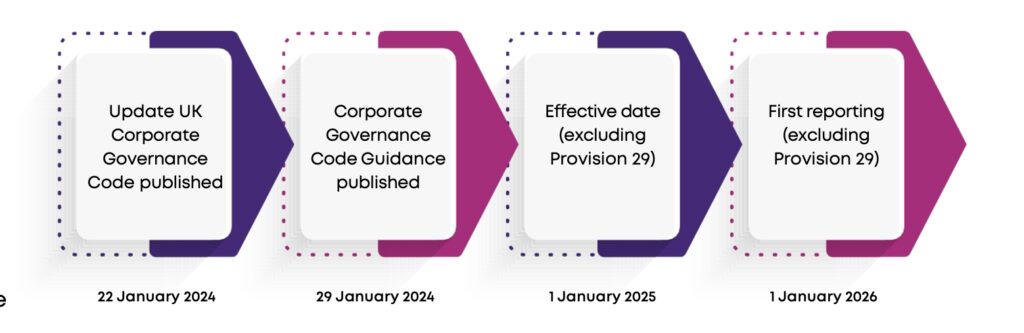
The new Code will apply to all premium listed companies (or “equity shares commercial companies”-listed companies when the FCA’s single segment listing reforms take effect) with financial years starting on or after 1 January 2025.
Cognizant of the time and efforts involved in the implementing the most important change introduced by the new Code as prescribed under provision 29 of Section 4 i.e. enhanced disclosures concerning risk management and internal controls; FRC has delayed the implementation for such requirements by another year and will only apply for financial years starting on or after 1 January 2026 (to give companies more time to prepare for making these new disclosures). Until such time, provision 29 of the existing 2018 Code will continue to apply.
Uniqus Point of View
When releasing the new Code, the FRC emphasized the essence of the ‘comply or explain’ principle. This means compliance is expected unless a clear and compelling rationale for departure from the Code is presented. This stands in contrast to the perception held by some companies that the investor community adopts a ‘comply or else’ attitude towards the Code’s reporting principle. In the press release for the new Code, the CEO of the FRC is quoted as saying: It is important that the flexibility of the ‘comply or explain’ principle is properly utilized. The FRC is clear that compliance can mean either complying with the Code provisions as set out or providing a cogent and justified explanation for why a provision is not suitable in the specific circumstances for the company while demonstrating the principles of good governance.
Amongst several minor and major changes, the most important change being made to the Code is to expand the existing disclosure and responsibility of the Board concerning the company’s risk management and internal control systems. This change represents a significant tightening up on what the Board currently has to say in the annual report about how satisfied they are about the effectiveness of their company’s risk management and internal controls systems.
Embracing a commitment to transparency aligns with regulatory principles and empowers investors with the information necessary for prudent decision-making. As discussed in section 4 above, in contrast to United States’ SOX Act, 2002, which focuses on financial reporting, the new Code revisions encompasses all operational activities, including financial and non-financial reporting and compliance. To meet these requirements, companies will need to maintain a thorough understanding of their operations and controls. Despite its similarity to the SOX Act of 2002, the UK Code is not prescriptive and does not mandate an external audit of internal controls.
This update of the Code, though limited in scope, strikes the right balance between introducing elements that will provide the biggest impact while minimizing the reporting burden as well as leaving the companies with the flexibility to apply the Code, customized to their unique circumstances. FRC’s vision is that the Code delivers regulatory objectives to enhance trust and confidence in governance while supporting economic growth and competitiveness.