GLOBAL NAVIGATION & GCC RESILIENCE
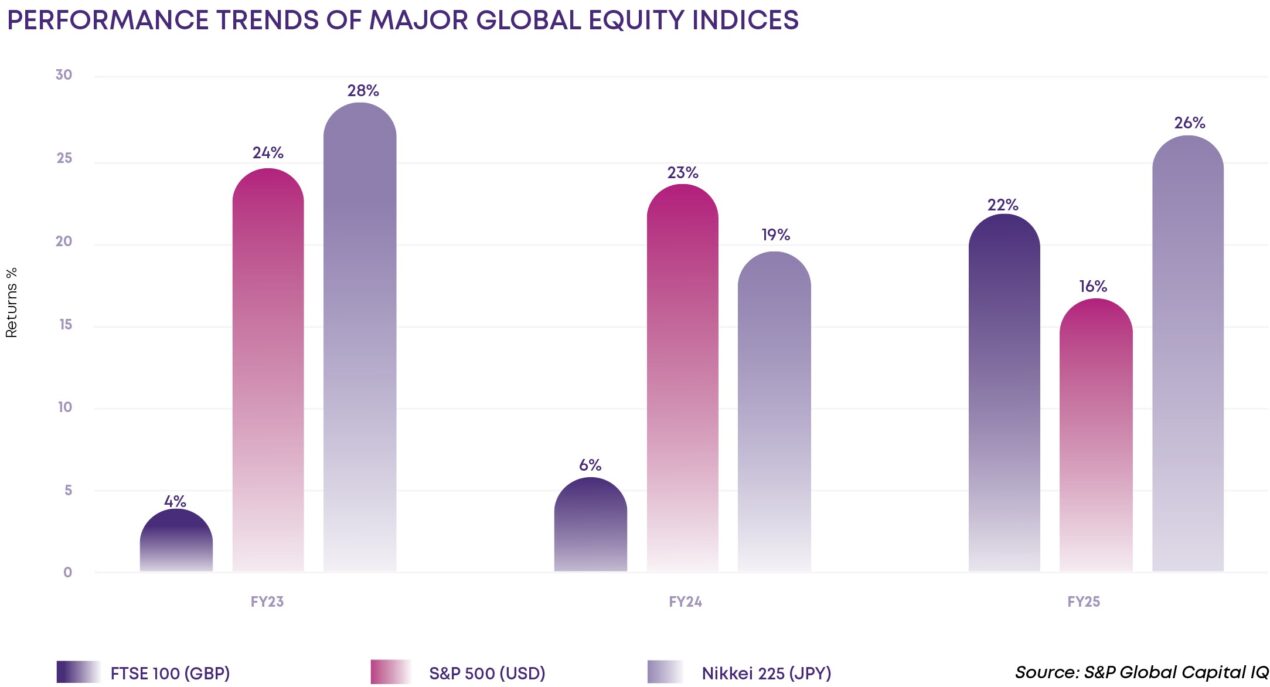
FY25 was characterized by a global equity market environment that remained constructive but increasingly selective. Major developed market indices delivered positive full-year returns, with the FTSE 100 (GBP) (+21.51%), S&P 500 (USD) (+16.39%), and Nikkei 225 (JPY) (+26.18%) reflecting stabilising macro expectations and improved earnings visibility across key sectors. However, dispersion across benchmarks highlighted a market environment in which performance was driven by index composition and sector exposure rather than by broad-based risk appetite. For global IPO markets, this translated into episodic issuance windows, with execution success closely tied to valuation discipline and issuer quality.
In contract, GCC equity markets exhibited materially wider dispersion in FY25, reflecting a combination of domestic factors, sector concentration, profit normalization following prior years of strong performance and evolving liquidity dynamics. While Oman’s MSX 30 Index (+28.19%), Boursa Kuwait All Share (+20.99%), and DFM General Index (+17.22%) delivered positive returns, other regional markets recorded more modest gains, including ADX General Index (+6.09%), Bahrain All Share (+4.06%), and Qatar Exchange Index (+1.81%). Notably, Saudi Arabia’s Tadawul All Share Index (TASI) declined by 12.84% over FY25, marking a divergence from both global benchmarks and select regional peers. This decline was primarily influenced by index concentration and earnings normalization in a limited number of large-cap, oil-linked constituents that carry disproportionate weight in the index, rather than a broad-based weakening in underlying market fundamentals or capital-raising activity.
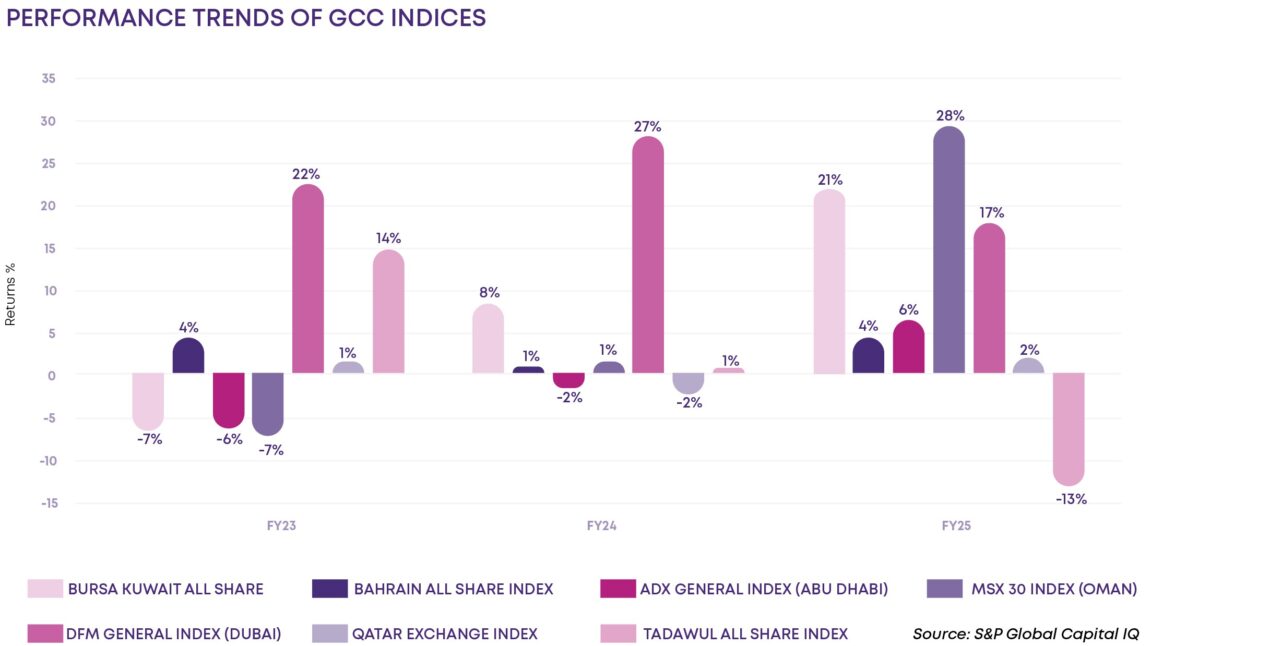
The correction in Saudi equities reflected cyclical and index-specific dynamics rather than structural weakness. Oil price moderation, earnings normalization across large-cap constituents, and index concentration effects weighed on headline performance, even as the broader economy continued to expand and reform momentum remained intact.
Crucially, this divergence between secondary market performance and primary market activity was evident across the GCC, particularly in Saudi Arabia. Despite the decline in TASI, IPO activity on Saudi Arabia stock exchange remained supported by deep domestic liquidity, sustained retail participation, and government-linked issuance pipelines, reinforcing a growing decoupling between short-term index movements and IPO execution. Although opportunistic exits were a notable feature of FY25 activity, listings were also driven by primary capital raises aligned with growth funding needs, balance-sheet optimization, and strategic sector diversification.
Taken together, FY25 highlighted a clear distinction between global and GCC capital market dynamics. Globally, IPO execution remained closely linked to market windows and valuation sensitivity. In contrast, the GCC, with Saudi Arabia stock exchange at its centre, demonstrated a more structurally anchored IPO environment. Strong domestic capital availability, continued policy-driven reforms, and increasing issuer preparedness enabled the region to sustain capital formation despite uneven secondary-market performance, reinforcing Tadawul’s position as a differentiated IPO venue amid a selective global cycle.
IPO INDUSTRY TRENDS IN SAUDI ARABIA
IPO activity in Saudi Arabia during FY25 resulted in USD 4.97 billion of capital raised across 39 issuers1. Market activity was characterised by larger average deal sizes, increased sector concentration, and a stronger emphasis on earnings visibility and execution readiness across listings.
Saudi Arabia remained the dominant IPO market in the region, accounting for approximately 75% of total GCC IPO proceeds and anchoring GCC issuance in both value and sectoral breadth. Activity in Saudi Arabia continued to shape regional IPO dynamics, reinforcing Saudi Arabia stock exchange’s role as the primary platform for capital formation and long-term value creation across the GCC.
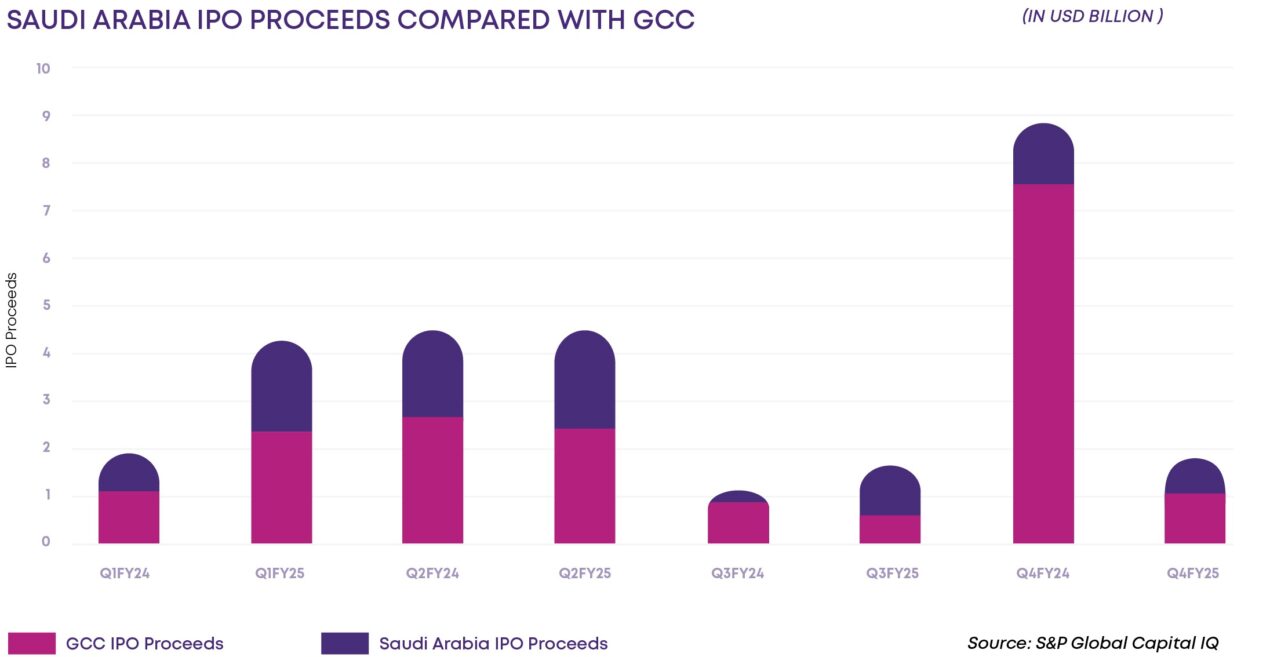
Capital allocation in FY25 was increasingly concentrated in consumer-facing, real asset, and services-led sectors, reflecting investor preference for demand-led business models, asset-backed structures, and scalable platforms. The overall market profile points to a transition toward higher-conviction IPOs, supported by improved market depth and heightened investor selectivity.
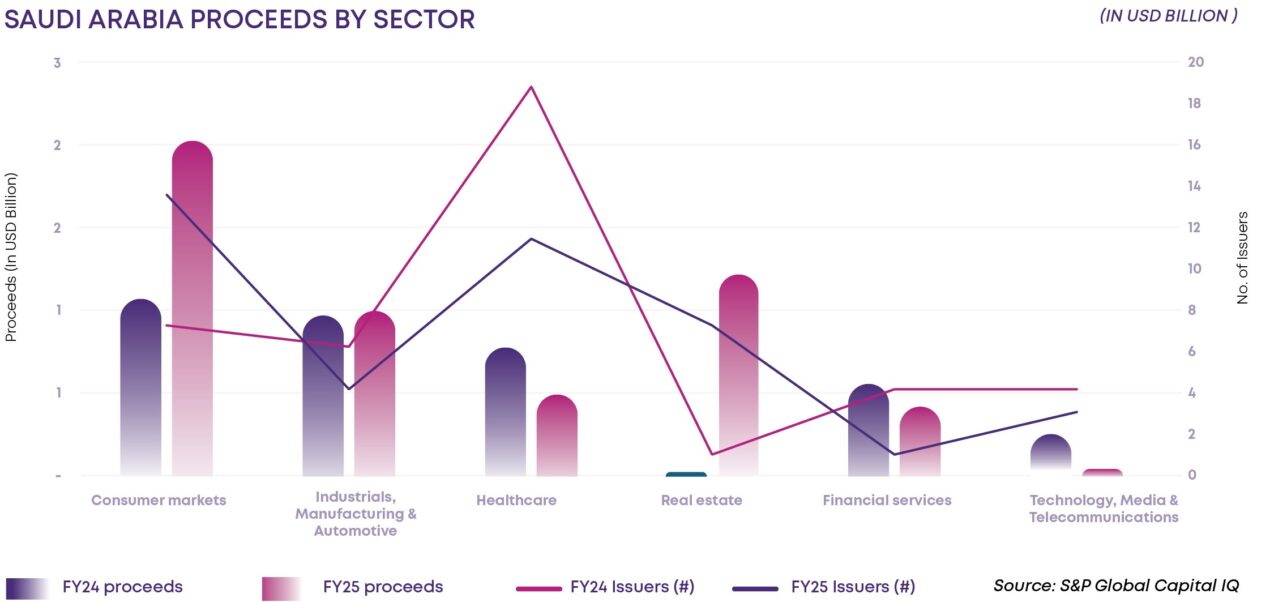
Consumer Markets emerged as the largest contributor to IPO proceeds, reflecting sustained demand for consumption-led listings. Healthcare was characterised by a higher concentration of proceeds relative to issuer count, indicating fewer but larger, scale-driven transactions.
Real Estate represented a significant share, underscoring renewed momentum in asset-backed and yield-oriented listings. Financial Services and Technology, Media & Telecommunications recorded more measured activity, with lower proceeds and selective issuance, positioning technology-led listings as opportunistic rather than core drivers of FY25 IPO volumes.
Overall, FY25 IPO activity across Saudi Arabia and the GCC reflects a market increasingly defined by sector concentration, larger transaction sizes, and a continued emphasis on quality and execution, with Saudi Arabia maintaining its position as the principal driver of regional IPO activity.
SAUDI ARABIA IPO LISTING PIPELINE
Beyond completed IPO activity in FY25, Saudi Arabia’s primary market continues to stand out for the depth and visibility of its forward listing pipeline. Market and exchange disclosures indicate a pipeline approaching 100 companies across early-stage preparation, adviser appointment, and CMA review, with only a subset expected to convert into near-term listings.
The breadth of this pipeline across multiple sectors highlights sustained issuer readiness and supports more consistent issuance sequencing. In parallel, Saudi Arabia stock exchange remained the dominant driver of regional IPO activity during FY25, reinforcing Saudi Arabia’s position as the region’s leading IPO market and underpinning expectations for continued listing momentum into FY26.
SAUDI ARABIA: FOREIGN INVESTMENT Participation
Historically, foreign participation in the Saudi equity market was permitted through restricted channels such as Qualified Foreign Investors (QFI), Foreign Strategic Investors (FSI), swap arrangements, and CMA-managed portfolios, with ownership capped at 10% per non-resident foreign investor and an aggregate ownership cap of 49% per issuer (excluding foreign strategic investors). Saudi Arabia is transforming its capital markets, positioning Saudi Arabia stock exchange as a global competitive venue for IPOs. Recent regulatory reforms mark a decisive shift simplifying foreign access and enhancing Saudi Arabia stock exchange’s alignment with global capital markets.
Direct investment
- Transitional measures (2025):
GCC-resident individuals are allowed to invest directly within existing ownership limits. - Amended rules (effective 1 February 2026)
All foreign investors, whether resident or non-resident, will be allowed to make direct investments in Saudi Arabia stock exchange. Existing Qualified Foreign Investors (QFI) requirements and swap agreements will be abolished, simplifying market access.
Key Ownership Limits
- Transitional measures (2025):
- Non-resident foreign investors: <10% per issuer
- Aggregate foreign ownership: < 49%
- Foreign strategic investors: Subject to 2-year lock-up
- Amended rules (effective 1 February 2026)
CMA has confirmed that existing ownership limits continue to apply under the amended framework. Any revisions to per-issuer or aggregate ownership caps will be addressed through separate regulatory actions, if and when announced.
Regulatory Simplification
- Transitional measures (2025):
Investment channels were fragmented, requiring multiple approvals for different investor types. - Amended rules (effective 1 February 2026)
Single, streamlined access for all foreign investors with reduced administrative requirements, promoting liquidity and market efficiency.
These reforms mark a significant transformation of Saudi equity markets, shifting Saudi Arabia stock exchange from a controlled, restricted market towards a more open, globally accessible platform. By eliminating legacy structures such as QFI and swap agreements and allowing all foreign investors direct access, Saudi Arabia is demonstrating its commitment to integrating Saudi Arabia stock exchange with global capital markets, encouraging both strategic, long-term investments and broader portfolio diversification.
Pricing outcomes observed through FY25 highlight that issuers were valued within the prevailing ownership and regulatory frameworks, with investors placing greater emphasis on earnings visibility, governance quality, and post-listing execution. These dynamics continue to influence how current pipelines are being positioned, particularly for issuers targeting institutional participation.
At the same time, recent regulatory reforms signalling a clear intent to broaden foreign investor participation in the Saudi equity market are already shaping issuer behaviour. In anticipation of future investor scrutiny, IPO candidates are increasingly strengthening corporate governance, disclosure quality, financial reporting discipline, and equity story articulation well ahead of formal regulatory implementation, rather than limiting preparation to the minimum requirements applicable at the time of listing.
KNOWLEDGE CORNER
FINANCIAL INFORMATION AND RESTATEMENT CONSIDERATIONS
Companies preparing for an IPO on the Saudi Arabia stock exchange are required to prepare their financial statements in accordance with International Financial Reporting Standards Accounting Standards (“IFRS Accounting Standards”) that are endorsed in the Kingdom of Saudi Arabia and other standards and pronouncements that are endorsed by the Saudi Organization for Chartered and Professional Accountants, covering the last 3 financial years (Main market)/ 1 financial year (Nomu-Parallel) and any interim periods, to ensure transparency and comparability for investors.