Executive Summary
India is in the process of implementing a comprehensive overhaul of its labour laws through a new set of Labour Codes. While these reforms are often viewed locally as regulatory and compliance-driven, their implications extend well beyond payroll administration—particularly for multinational groups reporting under US GAAP.
For US GAAP reporters with significant operations or shared service centres in India, the Labour Codes introduce changes that can alter the measurement and recognition of long-term employee benefit obligations, including gratuity and leave-related liabilities. These changes affect not only future cash outflows, but also balance sheet recognition, equity movements, and earnings volatility—often earlier and more abruptly than expected.
This publication provides an early accounting perspective on the Labour Codes through a US GAAP lens. Rather than focusing on legal interpretation, we highlight how the revised statutory wage definitions may be viewed as plan amendments under US GAAP, triggering immediate balance sheet impacts and heightened disclosure considerations. Importantly, we also address why management actions—such as prospective salary restructuring—do not defer or eliminate the initial accounting consequences.
Given the phased implementation and evolving state-level rules, companies face a narrow window to assess exposure, align stakeholders across HR, legal, and finance, and prepare for quarter-end reporting implications. Our objective is to help finance leaders anticipate these impacts early and respond with clarity and discipline.
Background to the Labour Codes Amendment
India’s labour law framework historically consisted of 29 Central statutes enacted over several decades, each addressing specific aspects of wages, industrial relations, social security, and workplace safety. Over time, this resulted in fragmented regulation, inconsistent definitions (particularly of wages), and significant compliance complexity for employers operating across multiple States.
To address these challenges, the Government of India undertook a comprehensive legislative overhaul, largely based on the recommendations of the Second National Commission on Labour (2002). This culminated in the enactment of four Labour Codes between 2019 and 2020: the Code on Wages, the Industrial Relations Code, the Code on Social Security, and the Occupational Safety, Health and Working Conditions Code.
Among these, the Code on Wages represents the most consequential change from a financial reporting perspective. It introduces a uniform and principle-based definition of “wages” applicable across all labour laws subsumed within the Codes. Under this framework, wages include all remuneration payable to an employee, subject to specified exclusions. Critically, the exclusions are capped — where excluded allowances exceed 50% of total remuneration (or such other percentage as may be notified), the excess is deemed to form part of wages for statutory purposes.
This mechanism effectively mandates that wages constitute at least 50% of total remuneration for statutory benefit calculations, irrespective of how compensation is structured contractually. As a result, organizations with allowance-heavy salary structures face a structural increase in the base used for gratuity, leave, bonus, and other employee benefits.
While the Labour Codes are often discussed as compliance or HR reforms, their real and immediate impact is financial. Alignment with the revised wage definition can materially increase long-term employee benefit obligations without any corresponding increase in take-home pay. From an accounting standpoint, this triggers reassessment of defined benefit plans and raises questions around plan amendments, prior service cost recognition, and the timing of expense recognition, particularly under US GAAP.
Key Accounting Implications – US GAAP Perspective
Gratuity and Leave Obligations
(ASC 715 – Compensation—Retirement Benefits)
An increase in wages for statutory purposes directly elevates gratuity and other long-term employee benefit obligations. Under US GAAP, gratuity arrangements are accounted for as defined benefit plans within the scope of ASC 715.
Where the increase in the obligation results from a change in plan provisions or the benefit formula triggered by a legislative amendment rather than from changes in actuarial assumptions, such as the discount rate or employee attrition, it is accounted for as a plan amendment. The resulting increase in the projected benefit obligation is recognized as prior service cost.
Prior service cost arises from the grant of retroactive benefits through a plan amendment or plan initiation. Such retroactive benefits represent benefits introduced by the amendment that, under the benefit formula, are attributed to employee services rendered in periods preceding the amendment.
Under US GAAP, prior service cost is not recognized immediately in profit or loss. Instead, it is recorded in Accumulated Other Comprehensive Income (AOCI) at the date of amendment and amortized into net periodic benefit cost over the remaining service period of employees.
Salary Restructuring – Substance Over Form
(ASC 715 – Plan Amendments and Curtailments)
US GAAP emphasizes the economic substance of compensation changes. Where salary restructuring is undertaken solely to comply with the statutory wage definition and does not result in a genuine increase in employee compensation, the increase in gratuity or leave obligation represents a benefit enhancement.
Accordingly:

Under ASC 715, both prior service cost arising from a plan amendment and actuarial gains and losses are initially recognized in AOCI. However, their subsequent treatment in profit or loss differs in a manner that is highly relevant for earnings forecasting and performance management.
Prior service cost recognized in AOCI is mandatorily amortized into net periodic benefit cost over the remaining service lives of employees. This creates a predictable and unavoidable future charge to profit or loss.
In contrast, actuarial gains and losses recognized in AOCI are subject to an accounting policy election. Entities may either:

While both outcomes initially impact AOCI under US GAAP, this distinction is critical for CFOs as it determines the timing, predictability, and magnitude of future earnings impact. This makes the distinction highly relevant for financial planning, performance management, and transaction readiness – well beyond a mere technical accounting nuance.
Scale of Impact – Workforce Size and Materiality
While the accounting treatment under US GAAP is consistent irrespective of workforce size, the magnitude and visibility of the financial statement impact scale with the size and tenure profile of the employee base
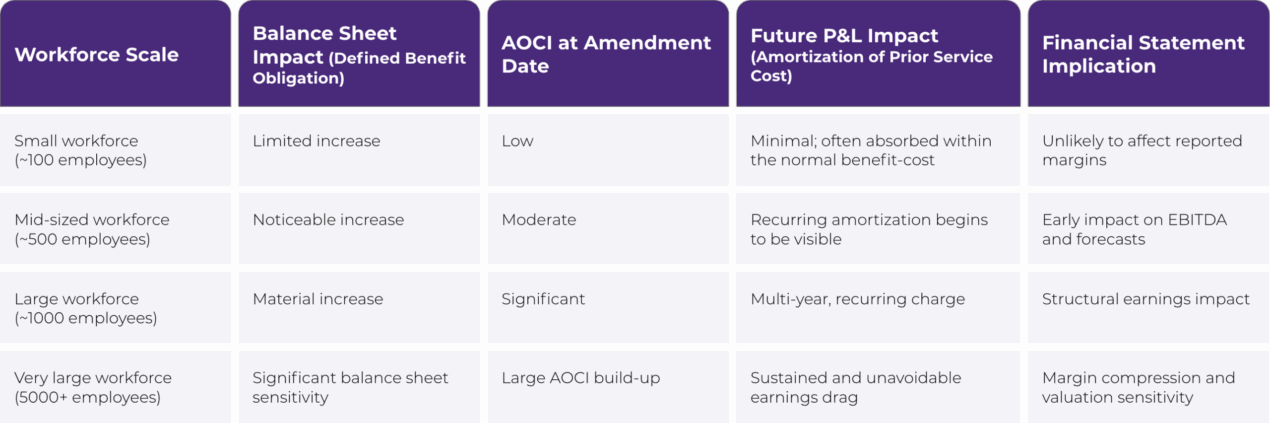
For organizations with large or long-tenured workforces, Labour Code alignment can result in a structural increase in defined benefit obligations and a persistent impact on future reported earnings, even where there is no increase in take-home pay.
Interim Reporting Considerations
(ASC 715 and ASC 270 – Interim Reporting)
Robust and transparent disclosure is critical given the immediate balance sheet impact and the deferred but unavoidable effect on future earnings arising from Labour Code–driven plan amendments. Entities should evaluate disclosing:

These disclosures are significant in the context of IPOs, M&A transactions, and lender discussions, where stakeholders focus not only on the immediate balance sheet impact but also on the predictability and sustainability of future earnings charges.
Divergence in Ind AS and IFRS from US GAAP
Unlike US GAAP, Ind AS and IFRS require prior service costs arising from plan amendments to be recognized immediately in the statement of profit or loss, resulting in an immediate impact on earnings. In contrast, under US GAAP, such costs are initially recorded in accumulated other comprehensive income and amortized to profit or loss over the employees’ remaining service period, thereby spreading the earnings impact over future periods.
Bottom-Line for CFOs, Board, and Audit Committees
For boards, audit committees, and CFOs, the key takeaway is clear: The Labour Codes do not merely change payroll mechanics; they alter the underlying economics of employee benefit plans. The balance sheet impact is immediate, disclosure expectations are elevated, and judgments relating to effective dates and the substance of compensation restructuring are likely to be closely scrutinized by auditors. Transparent disclosure of the nature of the change, the quantum of impact, and implications for future periods is particularly important in the context of IPOs, M&A transactions, and lender discussions.
It requires early financial planning, robust documentation of assumptions, and close coordination among finance, HR, and legal teams. Delayed or reactive implementation increases the risk of balance sheet surprises and audit friction.
The application of the Labour Codes also involves interpreting the legislation and related rules, which may evolve and differ across jurisdictions. Companies may therefore consider seeking appropriate legal advice when finalising compensation structures, compliance positions, and implementation approaches.