IPO Insights- November 2024

Lorem ipsum dolor sit amet, consectetur adipiscing elit. Phasellus pharetra tortor eget lacus ullamcorper, posuere fringilla justo convallis.

Newsletter

IPO Insights- November 2024

21, November 2024

The U.S. presidential election and Federal Reserve (Fed) policies significantly influence global financial markets, including India’s capital market and the Initial Public Offering (IPO) landscape.

Historically, U.S. elections introduce market volatility due to policy uncertainties, affecting investor sentiment and capital flows. For instance, the 2008 financial crisis during the U.S. election year led to a sharp decline in Indian IPOs, with only 21 offerings compared to 94 in 2007. Conversely, post-2016 election optimism saw Indian IPOs surge to 153 in 2017, raising approximately INR 67,000 crore. When Donald Trump won the 2016 US presidential election, the stock markets saw a rally, particularly in sectors like technology, finance, and energy. This positive market sentiment could have indirectly influenced investor behaviour in other markets, including India.

Similarly, in periods of geopolitical instability, such as tensions between major economies, IPOs in India could face challenges. Companies may delay their IPOs if they sense that the market is too volatile or if investors are more risk-averse during these times.

While the US presidential election and IPOs in India are not directly correlated, there are indirect connections through factors like market sentiment, economic policy, global trends, and geopolitical risks.


Fed monetary policy

In 2024, the Federal Reserve’s monetary policy has taken center stage. Following a prolonged period of maintaining the federal funds rate at 5.25% to 5.50% since July 2023, the Fed implemented a 50-basis point cut in September 2024, reducing the rate to a range of 4.75% to 5%. Subsequently, in November 2024, the Federal Open Market Committee (FOMC) further lowered the benchmark overnight borrowing rate by 25 basis points to a target range of 4.50% to 4.75%. These rate cuts are expected to have far-reaching effects beyond the U.S. economy, potentially influencing monetary policy decisions by other central banks, including the RBI.

The India’s 10-year G-sec yield, has already dropped below 6.8%, could fall further, benefiting both government borrowing and the corporate bond market. The rate cuts could have impact on certain sectors favourably like infrastructure and metals.

This easing aims to support economic growth amid cooling inflation, which has decreased from a peak of 9.1% in June 2022 to 2.4% in September 2024.

The Fed’s rate cuts are expected to enhance global liquidity, potentially increasing foreign investments in emerging markets like India. This environment is conducive to IPO activity, as companies can access capital more readily. India’s IPO market has already shown resilience, with 292 issues totaling $12.94 billion in the first ten months of 2024, leading the Asia-Pacific region.

In summary, the Companies planning IPOs should monitor these developments closely, as these developments will likely influence investor sentiment and capital availability in the Indian market.


KEY INSIGHTS

Inflows and outflows in secondary market

In the current financial year, Foreign Institutional Investors (FIIs) and Domestic Institutional Investors (DIIs) have taken divergent positions. FIIs recorded net outflows of approximately INR 2 lakh crore, while DIIs made net investments totaling INR 3.4 lakh crore. A portion of the FII sell-off has flowed into the primary market, as indicated by capital inflows of around INR 1 lakh crore since January 2024. Other attributes contributing to such sale by FII include uncertainties surrounding the US elections, high valuation as against peers, attractiveness of other emerging markets and stimulus from Chinese market. This sale from FII was fully absorbed by the DII because of the robust SIP inflows from the general public. With SIP reaching record levels each month, this trend has helped in better performance from nifty 2024, which has registered a gain of 6% from April 2024 levels despite such aggressive selling.


October month saw record outflow of cash by FII (INR 1.14 lakh crores) and combined net outflow (both FII and DII) from secondary market resulting in underperformance by the markets. However, such under performance didn’t hamper the progress of IPOs in primary market as October month registered one of the highest capital inflows of INR 33, 770 crores.

Considering that the elections are completed with a clear mandate and a dip in valuations in India as against the previous months, we expect the FII to come back to Indian market with a positive outlook.


During September and October 2024, IPO activity in India remained strong, driven primarily by the listing of Hyundai Motors, India’s largest IPO, in October. Despite a declining trend in the secondary market and significant FII outflows, the IPO market continued to outperform. Over these two months, 20 IPOs collectively raised approximately INR 48,595 crore, marking a 3.5x increase in activity compared to the same period last year. Remarkably, the funds raised in these two months nearly matched the cumulative capital raised in the first eight months of the year. A significant portion of the proceeds came from Offer for Sale (OFS) transactions, reflecting promoters offloading their stakes in companies.


Listing in Pipeline with SEBI

As of today, SEBI had received approximately 91 draft offer documents, which collectively represented a proposed issue size of around INR 131,083 crore (approximately USD 15.61 billion). This includes INR 36,116 crores from October month with an additional 25 issuers submitting draft offer documents, despite the negative sentiments in the secondary market.

Such robust pipeline coupled with outperformance of secondary market by the primary market indicates a vibrant IPO environment, positioning the upcoming months as a potentially significant period for both issuers and investors in India.


Listings on Main-Board


During September and October 2024, 20 companies successfully listed on the mainboard, raising a total of INR 48,595 crore (approximately USD 5.78 billion). The year-to-date average issue size rose from approximately INR 1,300 crore as of August 2024 to around INR 1,800 crore by October 2024.


Analysis on Historic Performance of Large IPOs in India

India’s largest initial public offerings (IPOs) have exhibited diverse performance trajectories, reflecting the complexities of market dynamics and investor sentiment. Notably, several high-profile IPOs, including Paytm, Reliance Power, and Hyundai Motors, debuted below their issue prices, indicating initial market caution. Paytm’s shares, for instance, fell 27% on listing and have since declined by approximately 64.6% from the issue price, highlighting challenges in sustaining investor confidence amid intense competition in the fintech sector. Similarly, Reliance Power’s shares have plummeted by about 84.8% from their issue price, underscoring the difficulties faced in meeting performance expectations. In contrast, Coal India stands out with a 40% listing gain and a current price approximately 76.3% above its issue price, demonstrating sustained investor confidence and the stability of companies in essential industries. Other IPOs, such as LIC and SBI Cards, while trading slightly below their issue prices, have avoided drastic declines, suggesting a more tempered but stable investor sentiment. This trend underscores that initial market enthusiasm and issue size do not guarantee long-term performance. For investors, this analysis serves as a reminder to weigh long-term fundamentals over listing-day excitement when evaluating IPO opportunities.
 

Investor Participation

The subscription trends for IPOs from April to October 2024 reveal varying levels of investor interest across categories:

Qualified Institutional Buyers (QIBs):

QIBs demonstrated strong and steady demand for IPOs throughout the period, with notable peaks in July (140.37 times) and September (138.02 times). This high level of interest from institutional investors highlights their confidence in the market’s IPO offerings, especially in these peak months. However, by October, QIB demand slightly cooled to 83.17 times, indicating a cautious approach following the significant activity in the prior months. This trend suggests that while institutional interest remains robust, there may be selective enthusiasm, with QIBs focusing on specific IPOs that align well with their investment strategies.

Non-Institutional Investors (NIIs):

NIIs showed a substantial increase in interest from April to September, with a notable spike in June (139.34 times) and again in September (139.57 times), indicating a high level of engagement in certain high-profile IPOs. This pattern suggests that NIIs are actively participating in the IPO market but are selective, responding strongly to particular offerings they deem favorable. By October, NII subscription levels slightly tapered to 113.53 times, reflecting sustained but tempered interest as the year progressed. The data implies that while NIIs are responsive to market opportunities, they may also be recalibrating their investments as the market dynamics evolve.

Retail Investors:

Retail participation, while generally lower than institutional and non-institutional segments, displayed a steady upward trend, peaking in October at 41 times (ex-Hyundai, which had a muted subscription from retail investors). This rise in October, following a strong September (39.24 times), suggests that retail investors are gradually gaining confidence in the IPO market, possibly driven by increased awareness and favorable market conditions. Retail subscriptions saw consistent growth over the months, highlighting a growing willingness among retail investors to engage in IPOs, even as they approach cautiously compared to larger investors. This trend underscores the expanding role of retail investors in the IPO landscape.

Overall Subscription:

The total subscription levels across all categories show a clear pattern of rising and falling interest in IPOs, with notable peaks in June (75.29 times), August (76.87 times), and a particularly strong high in September (87.81 times). September marked the highest overall subscription level during the period, driven by the combined enthusiasm of QIBs, NIIs, and Retail Investors, reflecting a favorable market environment for IPOs at that time. By October, the total subscription slightly decreased to 65.50 times, indicating sustained but moderated interest. This suggests that, while the IPO market remained active, investor enthusiasm slightly tapered following September’s high.

The IPO subscription trends from April to October 2024 reveal varying levels of interest across different investor categories, with QIBs and NIIs showing more selective but intense spikes, particularly in July, September, and October. Retail investors, while more cautious, demonstrated steady growth in engagement, culminating in a peak in October. The strong overall subscription level in September underscores a favorable period for IPOs, likely supported by market optimism and attractive offerings. However, the slight decline in October hints at a more measured approach as the year progresses. These trends highlight the dynamic nature of IPO participation in India, driven by selective enthusiasm among institutional and non-institutional investors and a gradually increasing role of retail investors. For issuers, this analysis underscores the importance of timing and strategic alignment with investor expectations to maximize subscription levels.

IPO Returns

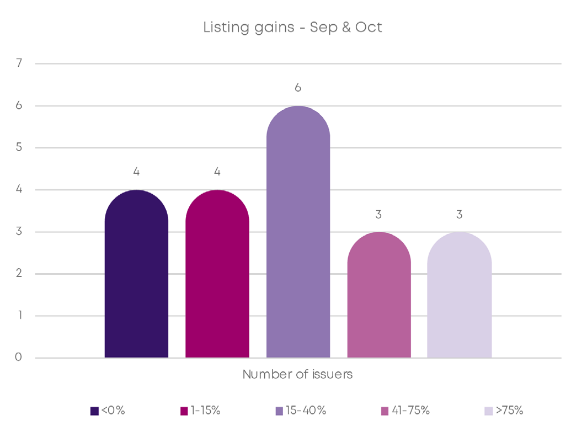
Distribution of listing gains by number of issuers
The analysis of the recent IPO landscape reveals a positive trend, characterized by a significant number of issuers experiencing moderate to high listing gains. With almost 60% of issuers achieving gains of more than 15% and an average listing gain of 33%, the environment continue to be conducive for successful IPOs in line with the previous periods.


Top 5 Issuers by listing gains

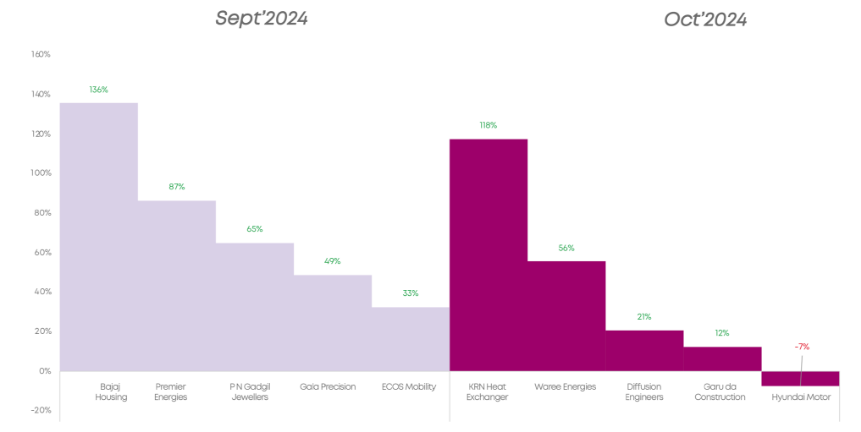
The IPO listings in September and October 2024 reveal varying levels of investor enthusiasm, with September generally outperforming October in terms of listing gains. In September, high-profile IPOs like Bajaj Housing and Premier Energies saw substantial listing gains of 136% and 87%, respectively, reflecting robust investor confidence and favorable market conditions. Other companies, such as P N Gadgil Jewellers (65%) and Gala Precision (49%), also achieved solid gains, indicating broad interest across different sectors. By contrast, October’s IPOs showed a more selective response, with only KRN Heat Exchanger matching the high gains seen in September with a 118% increase. Waaree Energies, Diffusion Engineers, and Garuda Construction recorded moderate gains of 56%, 21%, and 12%, respectively, while Hyundai Motor experienced a -7% loss on listing, suggesting a more cautious approach from investors. Overall, September’s listings highlight a particularly favorable period for IPOs, whereas October reflects a more tempered, selective enthusiasm from the market, influenced by company-specific factors and potential shifts in broader market sentiment.


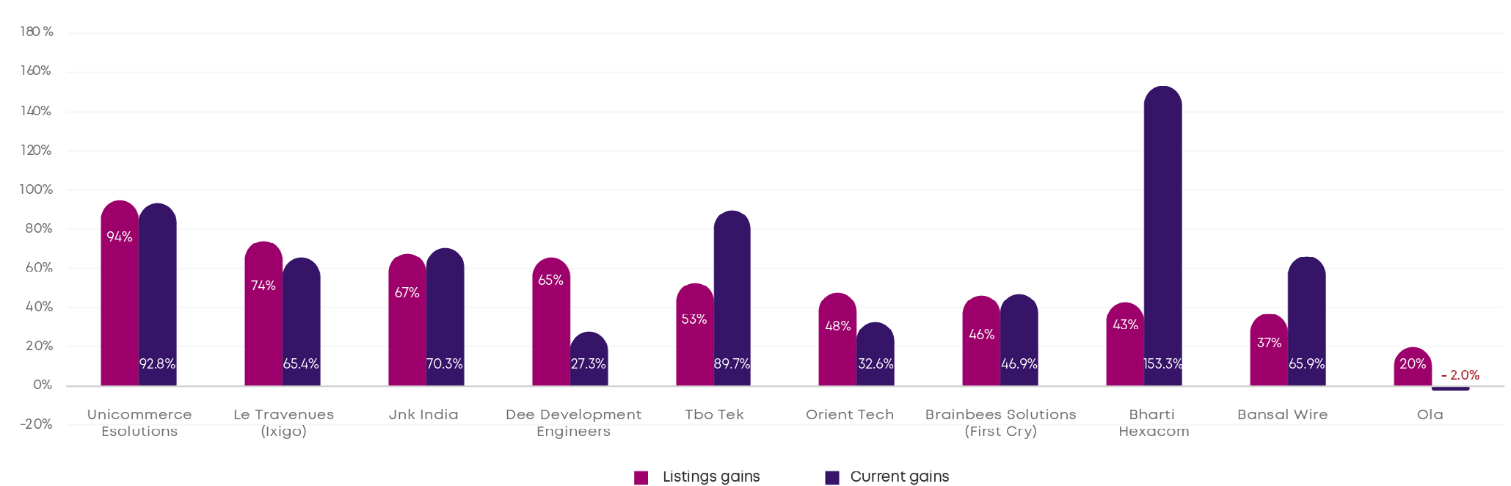
Current Performance vis-à-vis listing gains for issuers listed during April to August 2024

Shares that were listed during April to August 2024, with major listing gains, continued to outperform the boarder markets in majority of the stocks. While some companies have dipped slightly from the listing price, there is positive sentiment for the newly listed stocks beyond listing gains.

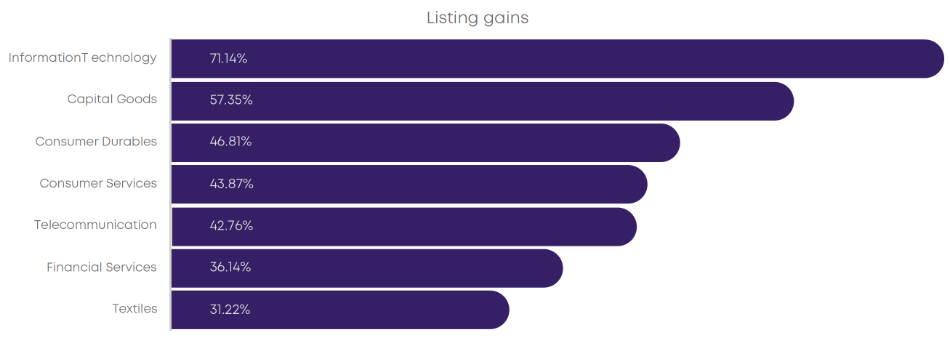
Sector contributing to major listing gains
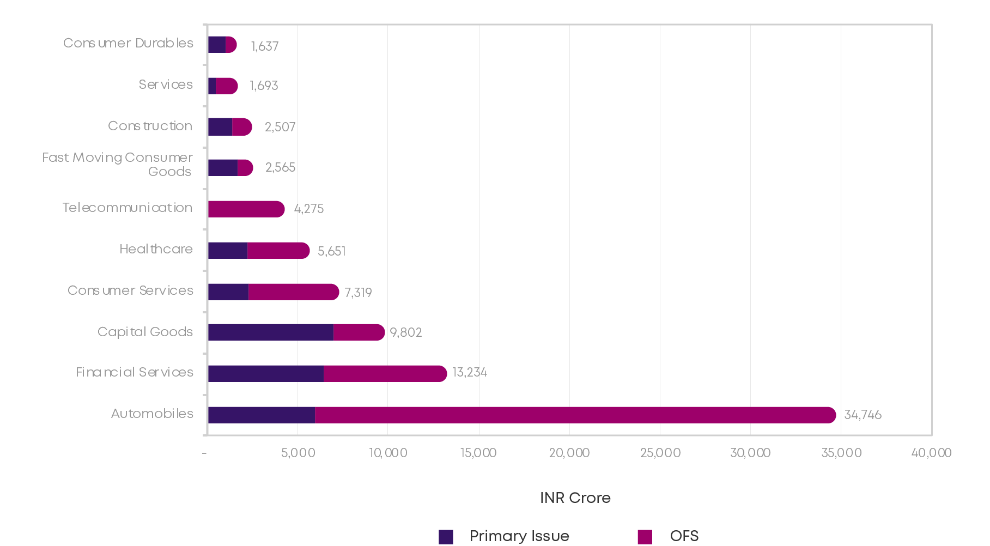
Based on our analysis of the listing gains from various industries, we observed that information technology has given the highest listing gains (2 listing during the year) as compared to other industries. Capital good industry registered a stellar growth both in terms of the number of listing with 9 in total and the listing performance considering the average return of 57% across the 9 listings. Other industries that fared well in listing include consumer durables, consumer services, telecommunication, financial services and textiles. The automobile industry, which raised INR 35,000 crores (appx) registered a meagre 6% listing gains from 4 listings.


Industry trends

The automobile, financial services, and capital goods sectors emerged as the top performers, collectively contributing to over 70% of the total capital raised during the period. A significant portion of the funds was raised through Offer for Sale (OFS) mechanisms. In the automobile sector, Hyundai Motors India Limited and Ola were the major contributors to the capitalraising activity. The financial services sector experienced strong momentum, driven by the highly anticipated listing of Bajaj Financial Services from the Bajaj Group. Other notable listings included Go Digit Insurance and Aadhar Housing Finance, representing the insurance and housing finance segments. The capital goods industry led in the number of listings, with nine companies going public during this period. This sector not only saw the highest activity but also delivered remarkable average listing gains of 57%. Significant capital was raised by Waaree Energies and Premier Energies, with the funds earmarked for expansion and further investments.

CLOSER LOOK: USE OF PROCEEDS


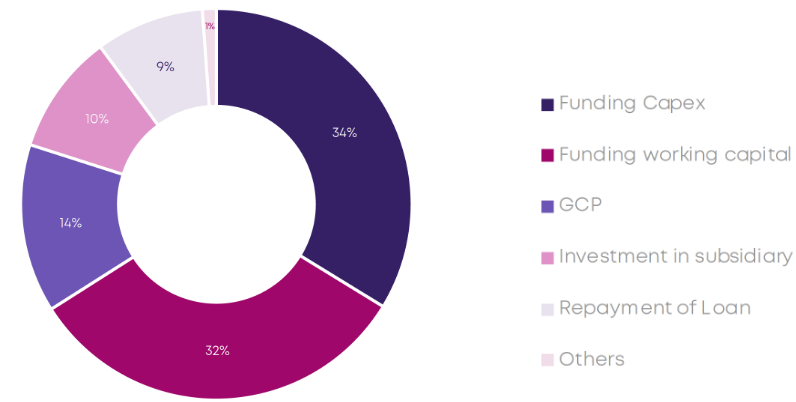
Proposed use of proceeds (Sep-Oct 2024)
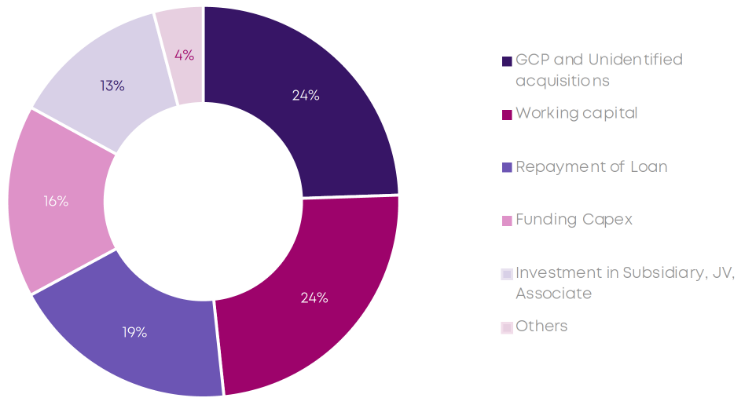
Our analysis of the offer documents filed during September and October 2024 indicates that a significant portion of the proposed allocation of the offer proceeds is earmarked for capex expansion, followed by the use for working capital requirement. These two purposes accounted for 66% of the total capital raised, while the remaining amount was used for general corporate purposes, investment in subsidiaries and repayment of loans.

Proposed use of proceeds (Apr-Oct 2024)
While the funds raised over the past two months are primarily earmarked for capital expenditure and working capital requirements, the year-to-date allocation of IPO proceeds tells a broader story. A significant portion has been directed toward general corporate purposes, unidentified acquisitions, working capital needs, and loan repayments. In contrast, approximately 30% of the proceeds have been utilized for capital expenditures and investments in subsidiaries.

KNOWLEDGE CORNER

SEBI’s New Guidelines on Voluntary Proforma Financial Disclosures: Enhancing Transparency in Public and Qualified Institutional Placements

The Securities and Exchange Board of India (SEBI) has recently approved a set of recommendations to improve the transparency and reliability of financial disclosures in public offerings, rights issues, and Qualified Institutions Placements (QIPs). SEBI’s new guidelines allow issuers greater flexibility in disclosing proforma financial statements and financial information related to recent acquisitions or divestitures. These changes are designed to give investors a clearer picture of a company’s financial health, particularly in cases where acquisitions or divestments may impact financial results. Here’s a detailed look at SEBI’s new approach to voluntary proforma financial disclosures and how it benefits investors.

Requirements before amendment

Under the SEBI (ICDR) Regulations, issuers undertaking a public or rights issue must include proforma financial statements for any “material” acquisition or disposal that occurs after the latest reported financial period but before the offer document’s filing date. These proforma statements must cover the latest completed financial year and stub period as applicable. They are prepared according to the guidance note issued by Institute of Chartered Accountants of India (ICAI) and certified by either the statutory auditor or an independent chartered accountant.

However, there are no enabling regulations for the voluntarily inclusion of the proforma financial statements for acquisition or divestment already undertaken or proposed to be undertaken from issue proceeds in case of public issue, rights issue and QIPs.

Recognizing these limitations, the Expert Committee for facilitating ease of doing business and harmonization of the provisions of ICDR and LODR Regulations recommended a set of voluntary disclosure options to SEBI, designed to give issuers the flexibility to present a more comprehensive view of their financials. Key recommendations include –

in public issues and rights issues (both fast track and otherwise), in addition to the existing requirements, the issuer should be permitted to voluntarily include proforma financial statements for such additional fiscal periods as it deems necessary, including, even if the acquisition or divestment was undertaken before the completion of the latest period(s) for which financial statements are disclosed, especially if the full year impact of the acquisition or divestment is not reflected in the latest period(s) financial statements;
the issuer should be permitted to voluntarily disclose financial statements of the subsidiaries/ businesses acquired or divested, provided such financial statements are certified by the auditor (of the business or subsidiary acquired or divested) or an independent chartered accountant, either of whom should be peer reviewed;
in QIPs, the issuer should be permitted to voluntarily include proforma financial statements, provided these are certified by the statutory auditor or an independent chartered accountant, either of whom should be peer reviewed; and
Further, it was also recommended that if the proceeds of the issue are proposed to be used for the acquisition of one more businesses or entities in a public issue, rights issue or a QIP, an issuer should also be permitted to voluntarily disclose proforma financials (on a consolidated basis) to disclose the impact of such acquisition. The proforma financial statements should be certified by the statutory auditor or an independent chartered accountant, either of whom should be peer reviewed.

Illustrating the Importance of Proforma Financials for Investors

To understand how these changes benefit investors, consider two illustrative scenarios involving companies with recent acquisitions:

Scenario 1

A company acquires another entity after the close of FY 2023 (post-March 31, 2023) and prepares a draft red herring prospectus (DRHP) including restated consolidated financials for FY 2023, FY 2022, and FY 2021. Without proforma financials for prior periods, investors may see an abrupt jump in financial metrics such as revenue when comparing FY 2022 to FY 2023, lacking context for growth continuity. With comparative proforma financials for both FY 2023 and FY 2022, investors can evaluate a normalized growth trend, gaining insights into the acquisition’s full impact on revenue and profitability.

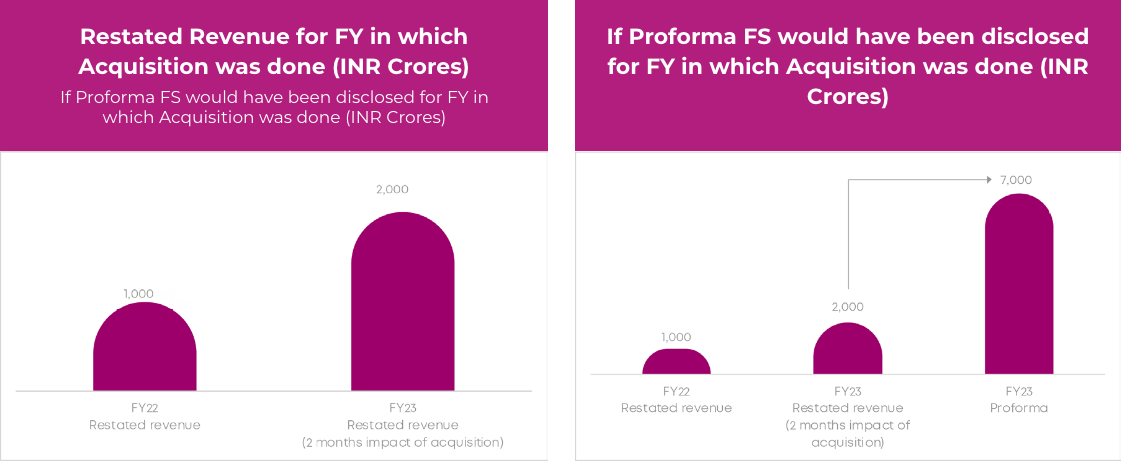
Scenario 2 – A company completes a significant acquisition in February 2023 and prepares a DRHP with consolidated financial statements for FY 2023, FY 2022, and FY 2021. Only two months of the acquired company’s financials are included for FY 2023 (February and March), which could lead investors to underestimate the acquisition’s full impact on the company’s financials. Voluntary proforma financials for the full fiscal year would allow investors to see the acquisition’s effect on an annualized basis, offering greater clarity on the acquisition’s implications for revenue, expenses, and overall financial health.


Voluntary Inclusion of Proforma FS even if Acquisition Consummated Prior to Completion of Last FY

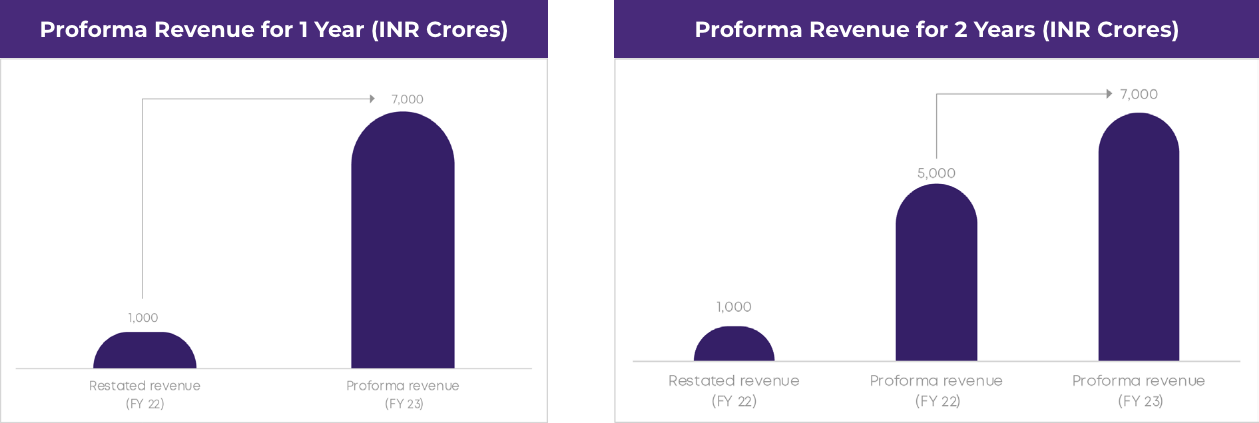
Significant Acquisition done prior to completion of FY and thus no Proforma FS disclosed in DRHP

If Proforma FS would have been disclosed for FY in which Acquisition was done (INR Crores)


If Proforma FS would have been disclosed for FY in which Acquisition was done (INR Crores)


If Proforma FS would have been disclosed for FY in which Acquisition was done (INR Crores)

By permitting issuers to voluntarily include proforma financial statements for acquisitions and divestments, SEBI aligns India’s regulatory framework with global best practices. These changes are designed to promote transparency and give investors a comprehensive view of a company’s financial position, especially in cases where strategic transactions significantly affect its financial results. The requirement for peer-reviewed certification further reinforces the credibility of these statements, ensuring that investors can rely on accurate and robust financial data.

Conclusion

SEBI’s new guidelines for voluntary proforma financial disclosures represent a significant advancement in regulatory flexibility and market transparency. By allowing issuers to provide additional financial context around acquisitions and divestments, SEBI enables investors to make more informed decisions based on a comprehensive understanding of a company’s financial trajectory. As SEBI continues to align its regulations with international standards, these updates further solidify India’s capital markets as a competitive and transparent investment destination.

Topics in this article

Related

Newsletter

FRM Regulatory Pulse- August 2026

Executive Summary The second edition of the Uniqus "Regulatory Pulse" bulletin covers key regulatory developments and supervisory themes observed across India and the Middle East over the quarter ended June 2026. Consistent with the series, this publication focuses on banking...

Newsletter

Sustainability & Climate Pulse- August 2026

In the News Global Record Climate Finance by Multilateral Development Banks Reaches USD 163 Billion in 2025 In a significant boost for global climate action, multilateral development banks (MDBs) achieved a record climate finance total of USD 163 billion in...

Early Impressions

FASB’s Proposed Accounting Standards Update

Executive Summary On June 10, 2026, the FASB issued a proposed Accounting Standards Update that would clarify the discount rate used to measure the benefit obligation under Subtopic 715-30, Compensation—Retirement Benefits—Defined Benefit Plans—Pension, for certain market-return cash balance plans. The...

Ask Uniqus
Your AI Knowledge Assistant
AI
Hi 👋 How can I help you today?

Download the pdf of this publication


This will close in 0 seconds