Background
The guidance in Topic 270 is derived from APB Opinion 28, issued in 1973. Interim reporting requirements have evolved over time as a result of the issuance of new accounting guidance, but Topic 270 has not been updated to reflect the effects of the SEC’s form and content requirements related to interim reporting that were added in 1981. In connection with FASB’s 2021 disclosure framework project, the Board received numerous stakeholder feedback indicating that Topic 270 is complex and challenging to navigate. Accordingly, the Board has introduced these amendments and updates to clarify which types of interim reporting are subject to the requirements in Topic 270.
Key Highlights of Amendment in ASU
The ASU has three primary objectives:

Form and Content of Interim Financial Statements
SEC Registrants:
SEC registrants should refer to the relevant form and content requirements for interim financial statements under SEC Regulation S-X, Rule 10-01, or Regulation S-X, Rule 8-03 when preparing interim financial statements and notes.
Non-SEC Registrants:
Non-SEC registrants may issue financial statements and notes in accordance with GAAP that are presented at the same level of aggregation as the annual financial statements and notes (which are subject to applicable annual disclosure requirements) or condensed financial statements (which have limited notes that are subject to the disclosure requirements in ASC 270).
Where condensed financial statements are prepared, an entity will need to either (1) follow Rule 10-01(a) or Rule 8-03(a) or (2) follow the reporting requirements as added by the ASU as follows:
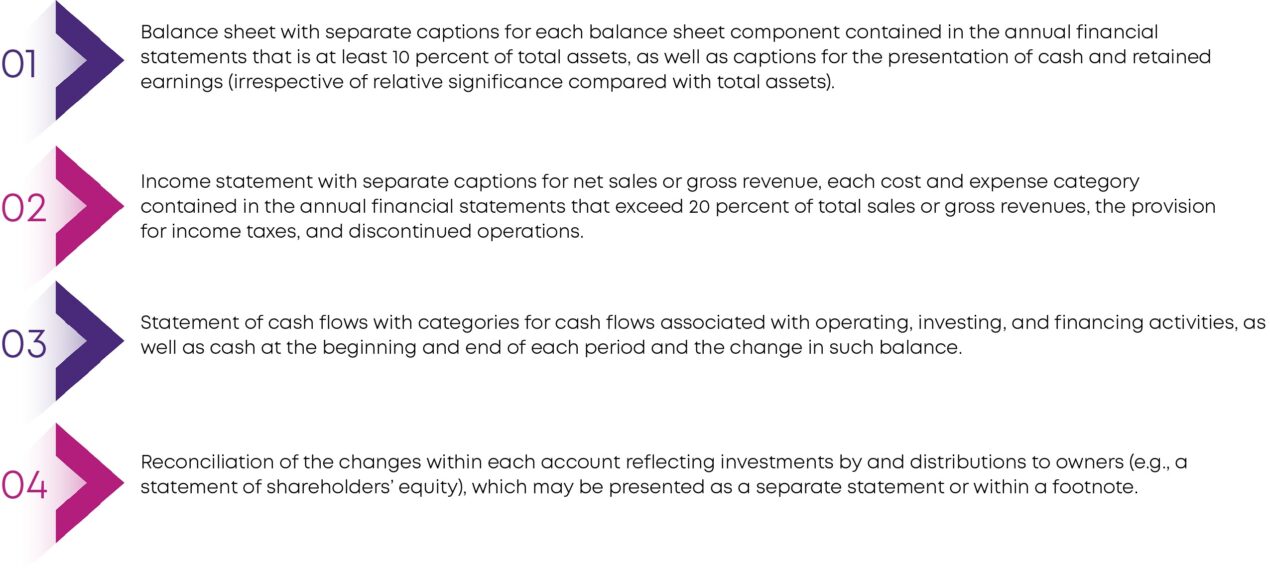
In certain situations, an entity that is not an SEC registrant could still be subject to certain form and content requirements under SEC rules and regulations (e.g., a private company whose financial statements are included in an SEC registrant’s filing under SEC Regulation S-X, Rule 3-05). In these situations, an entity should apply the SEC’s guidance on condensed statements.
Further, the ASU states that condensed statements may be provided only if the previous annual financial statements have been issued or made available for issuance.
Comprehensive List of Required Interim Disclosures
As a result of the ASU’s codification updates, Topic 270 now includes a comprehensive list of required interim disclosures, with references to the relevant Topics that cover the required disclosures for interim financial statements and notes. Examples of how the update added references to other Topics are below:
- Topic 205: Presentation of Financial Statements – Reference added by ASU in ASC 270-10-50-12, 270-10-50-13, and 270-10-50-14
- Topic 260: Earnings per Share – Referenced added by ASU in ASC 270-10-50-20
- Topic 805: Business Combinations – Reference added by ASU in ASC 270-10-50-39, 270-10-50-40, 270-10-50-41
References to other Topics are covered from ASC 270-10-50-12 through ASC 270-10-50-66.
Practical Considerations: While the new sections added provide a list of the interim disclosure requirements, an entity should refer to each referenced Topic to determine the scope of the disclosures and related requirements.
Disclosure principle
The ASU adds the disclosure principle in ASC 270-10-50-67 through 50-70, which requires entities issuing condensed statements to disclose events occurring since the end of the most recent fiscal year that have a material impact on the entity.
ASC 270-10-50-68 (added by the ASU) indicates that examples of such events may include, but are not limited to, significant changes in: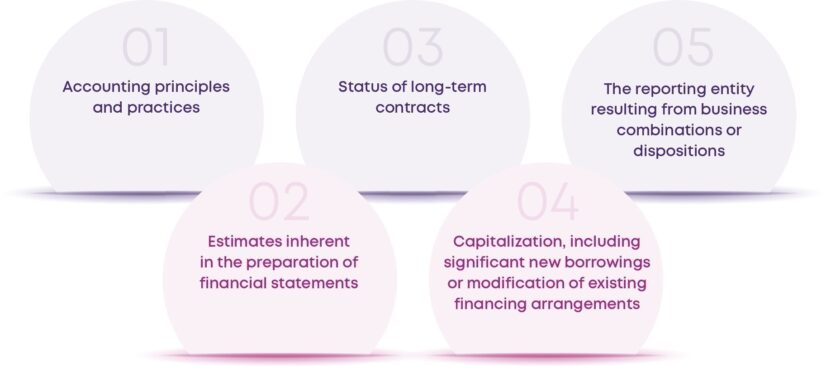
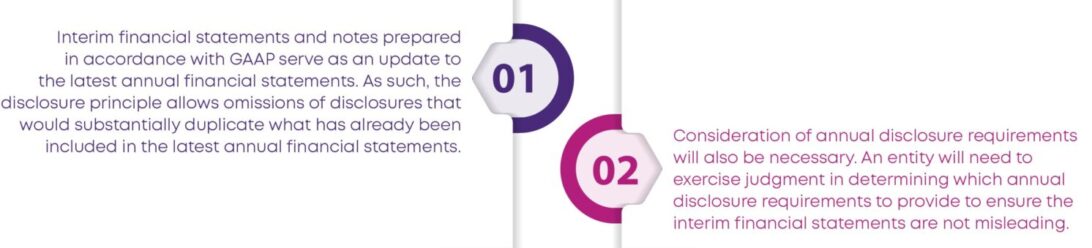
When meeting the requirements under the disclosure principle added to Topic 270, an entity should keep in mind that:
Effective Date and Transition
Applicability
The amendment to ASU applies to all entities.
Effective Date
- ASU 2025-11 is effective as follows:
- Public business entities – Interim periods in fiscal years beginning after December 15, 2027
- All other entities – Interim periods in fiscal years beginning after December 15, 2028
- Early adoption: Early adoption is permitted for all entities.
Transition Provisions
Update can be applied either (1) prospectively or (2) retrospectively to any or all prior periods presented in the financial statements
Uniqus Perspective of Amendments in ASU
We see this as…
- Clarification of various requirements in interim reporting: ASU 2025-11 introduces a clear framework for interim reporting, which should be able to address issues of difficulty in navigability and provide greater clarity for companies seeking accounting advisory services.
- Standardization of reporting: The ASU allows more clarity on reporting requirements and brings in standardization for interim reporting.
- Opportunity to enhance discipline: With clearer rules and expectations, companies can use the ASU as a catalyst to strengthen discipline in interim reporting requirements.
Companies’ Action Point
- Create an interim reporting checklist and assess the financial reporting process: Entities need to assess the requirements of the ASU and accordingly update their interim reporting checklist.
- Refer but review: Although ASU 2025-11 introduces a comprehensive list of disclosures required to be made within the interim financial statements, the list does not eliminate the requirement to perform a thorough review within other ASC topics to ensure all disclosure requirements are met.
For more information on the proposed Accounting Standard Update, see the press release on the FASB’s website.